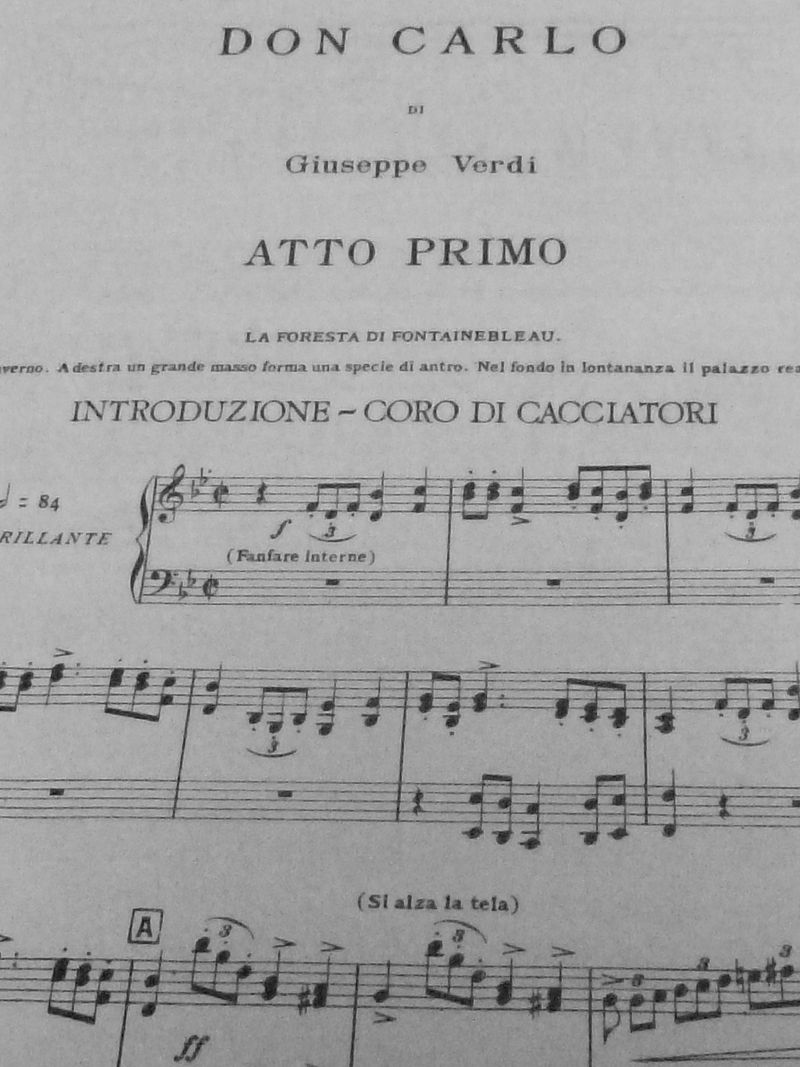
Monday February 25th, 2013 – A powerful line-up of male principal singers drew me to this performance of Verdi’s DON CARLO at The Met. The women in the cast seemed less interesting by far; having seen the production before – and feeling no need to see it again – I took a score desk and settled in.
DON CARLO was for years my favorite opera, but then the German repertory began to edge out the Italian in my heart and soul. Now ARIADNE AUF NAXOS, ELEKTRA and DIE WALKURE are in a sort of three-way tie for the top spot. But I still love DON CARLO and always go when it is performed. I’m not crazy about the Fontainebleau scene, and I never watch the Auto da Fe since the sight of people burning other people alive for the greater glory of some fiendish imagined god (or rather, to maintain the power of the men who created him and sustained the myth thru blood and force over the centuries) is revolting.
Negative reviews of Loren Maazel’s conducting and of Barbara Frittoli’s singing as Elisabetta had me thinking in advance that this might be a partial CARLO for me. Added to the prospect of two Gelb-intermissions, and the fact that I was already feeling tired when I got there, it seemed that a very long evening was loooming ahead. But I found myself drawn in by the opera itself, and I always enjoy the experience of being in the House with the score in front of me. I stayed to the end and on the whole felt it was a very good evening, particularly thanks to the superb performances of Dmitry Hvorostovsky and Ferruccio Furlanetto as Posa and Philip II respectively.
To be sure, some of Maestro Maazel’s pacing was slow. To me his conducting registered a measured sense of grandeur and dignity, and of events unfolding with a sort of epic inevitability. Often considered Verdi’s most purple opera – the colour of royalty evoked in sound – I felt Maazel’s concept worked well: there were lively passages along the way, and his Auto da Fe scene was amply majestic and well-structured. For the most part he kept his singers at the forefront; in a few places they needed all their reserves of breath to sustain the line thru the slow tempi. But, following the score, I thought the conductor had things well in hand.
Maazel experienced some boos at his solo bow; I wonder if it was pre-meditated since it seemed to be coming from one area of the Family Circle. Recently while my friend Dmitry and I were having a pre-PARSIFAL supper, I could overhear a woman in the next booth telling her companion that she was planning to boo conductor Daniele Gatti. If she did, it got lost in the cheers. Maazel’s conducting was quirky but worked well to my ears; the only potentially boo-able performance was that of Ms. Frittoli but the audience tolerated her with polite applause.
I find the Fontainebleau scene a needless introduction to the evening. Verdi sanctioned its elimination for performances in Italy following the premiere in Paris where five-act operas were de rigeur. Some people say, “Oh, it gives the opera context!” Undoubtedly. But we lived without it for years, savoring the gloriouly dark horn theme which opens the four-act version and immeditely sets us in the mood for this opera about royalty and religion. Tonight, with Ms. Frittoli sounding very wary, the scene seemed even more expendable than ever. It makes for such a long night, even under the best of circumstances.
The soprano’s perilous performance serves as a reminder that a vocal career is short enough without quickening its demise by singing roles that are too heavy. Ms. Frittoli will be remembered in New York City for her exquisite singing as Desdemona in 1999; she was also a particularly fine Mimi, and as recently as 2005 she managed an impressive Fiordiligi by manipulating the dynamics to control the effects of a widening vibrato. But singing things like the Verdi REQUIEM and Donna Anna have taken their toll on her lyric instrument. Tonight the vibrato was painfully evident even at the piano level. She managed to avert disasters, though a high B-flat in the quartet was scary and she could not sustain the floated B-natural in the final duet, on “…il sospirato ben”, one of the role’s most affecting moments. Overall it was sad to experience this voice in its current state. The news that she’ll be singing Tosca later this year in Europe does not bode well.
These performances of Elisabetta were originallly slated for Sondra Radvanovsky; when Sondra moved to BALLO instead, the Met turned to Ms. Frittoli. They should have cast about for a more appropriate alternative. When I think of the wonderful Elisabettas I have experienced – Caballe, Kabaivanska, Freni, and Radvanovsky as well as Marina Mescheriakova’s flawless Met debut in the role – Ms. Frittoli’s pales into a haze.
Anna Smirnova’s voice does not always fall pleasantly on the ear, being rather metallic. But she is a skilled singer who managed the filagree of the Veil Song very well and pulled out all the stops for an exciting “O don fatale” with brazenly sustained high notes.
Don Carlo is a bit heavy for Ramon Vargas but this very likeable tenor sang quite beautifully through most of the evening. His voice is clear and plaintive, his singing stylish and persuasive. Only near the end of the opera did a few signs of tiredness manifest themselves. His delicious singing of “Qual voce a me del ciel scende a parlar d’amore?” in the love duet was a high point of the evening.
Eric Halvarson’s Inquisitor was powerully sung and stood up convincingy against the overwhelming Philip II of Ferruccio Furlanetto. The two bassos had a field day, trading thunderbolts in their great confrontation. Basso Miklos Sebestyen was a very impressive Friar (the Ghost of Charles V), drawing a round of applause fo his sustained low F-sharp in the St. Juste scene of Act I. Jennifer Holloway was a very fine Tebaldo but Lori Guilbeau, who has a pretty sound, seemed not to be well-coordinated with the pit as she sang her offstage lines as the Celestial Voice.
The towering magnificence of Dmitry Hvorostovsky‘s Posa and Ferruccio Furlanetto‘s Philip II put the performance on a level with the greatest Verdi experiences of my opera-going years. Dima’s singing was velvety and suave, his breath-control mind-boggling, his singing affecting, elegant and passionate by turns. His high notes were finely managed and marvelously sustained.
Mr. Furlanetto’s glorious singing is a throwback to the days when great Italian voices in every category rang thru the opera houses of the world. Now nearing his fortieth year of delivering generous, glorious vocalism, the basso’s dark and brooding tones fill The Met with a special sonic thrill. His singing, so rich and deeply-felt, can thunder forth at one moment and then draw us in with hushed, anguished introspection the next. From first note to last, Furlanetto’s Philip II was simply stunning. His hauntingly tender musing on the phrase “No…she never loved me…her heart was never mine…” just before the epic climax of his great monolog moved me to tears.
There were huge eruptions of applause and cheers after both the baritone and the basso finished their big arias; but applause nowadays tends to dwindle rather quickly and the days of show-stopping aria ovations are largely a thing of the past.
There were lots of empty seats which surprised me: with this starry assembly of male singers and the season’s biggest name from the conducting roster involved, I expected a fuller house.

Dmitri Hvorostovsky

Ferruccio Furlanetto
Metropolitan Opera House
February 25, 2013
DON CARLO
Giuseppe Verdi
Don Carlo...............Ramón Vargas
Elizabeth of Valois.....Barbara Frittoli
Rodrigo.................Dmitri Hvorostovsky
Princess Eboli..........Anna Smirnova
Philip II...............Ferruccio Furlanetto
Grand Inquisitor........Eric Halfvarson
Priest Inquisitor.......Maxime de Toledo
Celestial Voice.........Lori Guilbeau
Friar...................Miklós Sebestyén
Tebaldo................ Jennifer Holloway
Count of Lerma..........Eduardo Valdes
Countess of Aremberg....Anna Dyas
Flemish Deputy..........Alexey Lavrov
Flemish Deputy..........Paul Corona
Flemish Deputy..........Eric Jordan
Flemish Deputy..........Evan Hughes
Flemish Deputy..........Joshua Benaim
Flemish Deputy......... David Crawford
Conductor...............Lorin Maazel




 Oberon's Glade