Tag: Arnold Schoenberg

  • Decoda ~ Verklärte Nacht

    Schoenberg

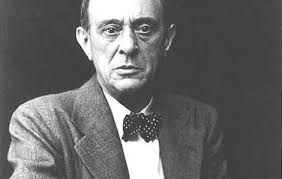
    Above: Arnold Schoenberg

    ~ Author: Oberon

    Tuesday March 11th, 2025 – A rare chance to hear Arnold Schoenberg’s Verklärte Nacht played live drew me to Weill Hall tonight where the work was on a program offered by Decoda, an ensemble of musicians who had first met while playing with Ensemble Connect.

    Songs by two pairs of husband-and-wife composers – the Schumanns and the Mahlers – opened the evening. Pianist Mika Sasaki played Robert Schumann’s “Eintritt” from Waldszenen, a melody that describes entering the forest path. Baritone Thomas Meglioranza and Ms. Sasaki then offered Herr Schumann’s Sehnsucht nach der Waldgegend“; any song with ‘sehnsucht’ (longing or desire) in the title is bound to please me.

    A sextet of string players now joined the pianist for Clara Schumann’s “Geheimes Flüstern“, in an arrangement by Clara Lyon; this brought forth soprano Lucy Fitz Gibbon, her voice light and charming.  

    Mr. Meglioranza stepped forward again for Gustav Mahler’s “Ich ging mit Lust durch einen grünen Wald” (arranged by Brad Balliett), expressively sung.

    Alma Mahler’sLicht in der Nacht” was sung by Ms. Fitz-Gibbon in an arrangement by Terry Cook (could this be the Terry Cook, a popular Met Opera basso who sang nearly 200 performances with the Company from 1983 to 2006?), accompanied by the sextet.

    During this lieder segment of the program, Ms. Fitz-Gibbon and Mr. Meglioranza did not lend an operatic feeling to their singing, but rather sounded like they were performing among friends at the Schumann’s salon.

    [Special note: anyone with an interest in Alma Mahler’s life and work should seek out the film Bride of the Wind.]

    From the concluding Alma Mahler song, the music led directly into the Schoenberg masterpiece, Verklärte Nacht; the players were Anna Elashvili and Clara Lyon (violins), James Thompson and George Meyer (violas), and Hannah Collins and Claire Bryant (cellos).

    The work was inspired by a collection of poems by Richard Dehmel published in 1896. Entitled Weib und Welt (Woman and the World), the saga speaks of a man and a woman as they walk through the moonlit woods on a frigid but clear winter evening. Guilt leads the woman to admit that, craving motherhood, she had become pregnant by another man before meeting and falling in love with her current amour. The woman stumbles miserably on in the silent darkness; but then the man tells her, “Do not let the child you carry burden your soul.” He pledges that he will love and care for the unborn child as if it were his own. They embrace, and they continue their walk on into the night, their love transfigured thru forgiveness.

    Played without break, the score mirrors the five sections of the poem: throughout, Schoenberg continuously transforms themes and motifs into an expressive musical depiction of the poem. The composer travels the road from the opening line of the poem – “Two people walk through bleak, cold woods…” to its marvelous finale: “Two people walk through exalted, shining night….”

    The playing by the Decoda artists was nothing less than sublime; as individual voices, and in their harmonizing and phrasing, the sextet summoned all the magic that the composer packed into his writing. Of special note was cellist Hannah Collins, whose rich-toned playing was both poetic and powerful.

    Despite what seemed to me a riveting performance thus far, audience distractions during the first half of the program were especially annoying, climaxing with a dropped metal water bottle at a particularly poignant moment in the Schoenberg. Although the second half the program certainly sounded interesting –  a work by four composers featuring all the evening’s artists – I decided to head out, taking the memories of the Schoenberg home with me. 

    ~ Oberon

  • Transfigured Night @ Chamber Music Society

    Arnold_Schonberg_Richard_Gerstl

    Above: portrait of Arnold Schoenberg by Richard Gerstl

    ~ Author: Oberon

    Friday March 18th, 2022 – Whenever Arnold Schoenberg’s Verklärte Nacht (“Transfigured Night”) is being performed in Manhattan, I will try to be there. This evening, it was the closing work on an imaginative program of ‘music of the night’ put together by Chamber Music Society of Lincoln Center.

    Opening the evening was Luigi Boccherini’s Quintet in C-major for Two Violins, Viola, and Two Cellos, G. 324, “La musica notturna delle strade di Madrid”  which was composed in 1780. As my friend Ben Weaver remarked after hearing it tonight: “This music is so ahead of its time…it could have been composed yesterday!” To be sure, it is very inventive work, and there’s so much packed into its 12-minute duration.

    Tonight, this Boccherini gem was performed to perfection by Yura Lee (having exchanged her more usual viola for the violin this evening), violinist Stella Chen, violist Matthew Lipman, and cellists Nicholas Cannellakis and Sinhao He. The best-known section of the work, the Minuet, caused a ripple of recognition to run thru the hall. Elsewhere, plucking and shivering motifs provide accompaniments as the melodies spin out; it ends with a regal section as Retreat is sounded and the guardsmen return to barracks.

    Franz Schubert wrote his Notturno in E-flat major for Piano, Violin, and Cello, D. 897, Op. 148, in 1828. It is sublimely beautiful, and was played tonight by three extraordinary musicians: Yura Lee (violin), Sihao He (cello), and Michael Brown (piano).

    The piano commences a slow waltz, the violin and cello harmonizing. Then roles are reversed: the strings take up a plucking rhythm as the pianist assumes the melody. From gentleness, there comes a rise of passion, with rippling keyboard figurations. The opening melody is repeated, becomes expansive, fades briefly, is revived, and then on to a quiet ending. Throughout the ten-minute work, I greatly enjoyed watching the silent communication between the three players.

    James+Austin+Smith

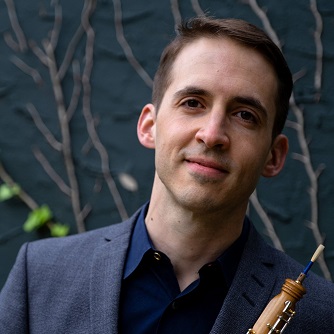
    Above: oboist James Austin Smith

    This evening brought my second hearing of Benjamin Britten’s Phantasy Quartet for Oboe, Violin, Viola, and Cello, Op. 2,  which. was written in 1932 for a competition for single-movement chamber works established in 1905 by Walter Wilson Cobbett,

    When I heard this work in 2013, James Austin Smith was the oboist; and he was back tonight, playing it so clearly and thoughtfully. He was joined by violinist Stella Chen (elegantly gowned in purple and white), violist Hsin-Yun Huang (very chic in a halter top and toreador trousers), and cellist Nicholas Cannellakis. 

    The piece commences with short, dotty cello notes, and then a march develops. The oboe takes up a songful passage. A swift and vibrant allegro is followed by a string trio before the oboist picks up where he left off, and the music marches off into the air as magically as it appeared. Mr. Smith’s delicious, multi-hued playing was – as always – a delight to hear.

    After the interval, the Society’s Executive Director, Suzanne Davidson, gave a brief speech, dedicating the concert to the heroic people of Ukraine. The crowd’s reaction was loud and clear.

    Maxresdefault

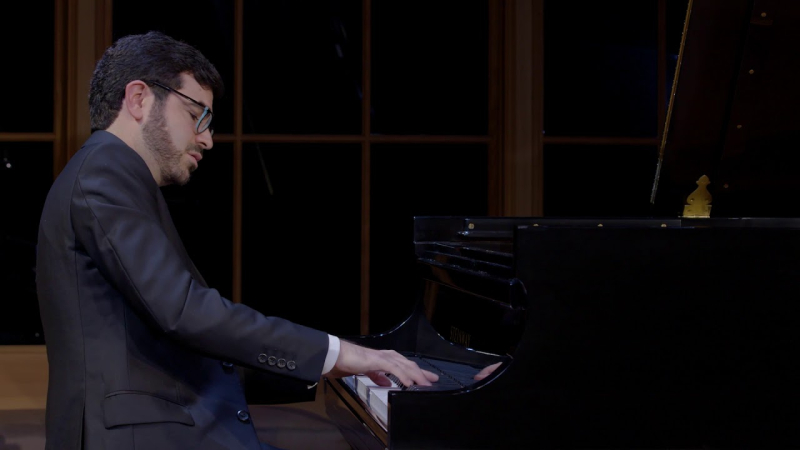
    The program continued as Michael Brown (above) took the stage alone to ravish the ear with his magical playing of two piano works by Claude DebussyLa terrasse des audiences du clair de lune” from Préludes, Book II (1913), and “Clair de lune” from Suite bergamasque (circa 1890; revised in 1905).

    In the first, Mr. Brown’s incredibly hushed pianissimo playing cast a spell of rapture and mystery over us; his control was astounding. As the prélude reached its tranquil end, Mr. Brown kept his hands poised over the keyboard momentarily and then embarked on an intoxicating rendering of the “Clair de lune”.. I found myself wishing that this poignant dream could go on and on… 

    Huang_

    Above: violist Hsin-Yun Huang

    To end this fascinating program, Arnold Schoenberg’s Verklärte Nacht (“Transfigured Night”) was magnificently played by a string sextet of the highest order: Yura Lee and Stella Chen (violins), Hsin-Yun Huang and Matthew Lipman (violas), and Nicholas.Cannellakis and Sinhao He (cellos).

    The composer drew inspiration for this work from a poem by the Austrian poet Richard Dehmel which tells of a man and woman wandering together late into the evening. The woman confesses to her lover that she is pregnant by another man. In the shadowy forest, the man consoles his beloved and, through his forgiveness, her guilt us assuaged. He assures her that he will care for the child as his own. Their love is transfigured through this night of communion they have shared, and they look to the future with hope.

    In its thirty-minute time span, Verklärte Nacht traces the lovers’ journey with incandescent harmonies and haunting melodies that sing of the redemption of forgiveness and the enduring power of love, The music traces the arc of the poem from its first line – “Two people walk through a bare, cold wood;” to its last: “Two people walk on through the high, bright night.” For a die-hard romantic like myself, few other works can compare.

    One of the most wonderful things about this work is the way Schoenberg distributes the musical treasures in his score: each of the six players has ample opportunity to display their tone and artistry as melodies are passed about and harmonies mingle on the air. As the music wends towards its finish, a great flow of lyricism rises up.

    Stella-Chen-

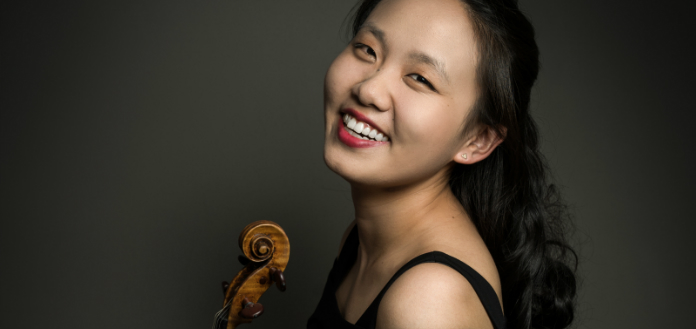
    Above: violinist Stella Chen

    This evening’s performance was so richly rewarding; the players captured every nuance of this profoundly moving score. At the end, a standing ovation was the only possible audience reaction; onstage, the artists quietly embraced one another during the bows.

    The cumulative effect of Verklärte Nacht tonight was to pull me – at least for a time – out of a deep feeling of world-weariness that has weighed on me in recent weeks, due to the lingering pandemic, the downward spiral of our great democracy, and a war started by a power-mad fiend. Indeed, it has, at times, felt like life is no longer worth living.

    To the musicians who played tonight: please know the great value of your music-making, and what it means to us. You provide a ray of light in an ever-darkening world. . 

    ~ Oberon

  • Karen Cargill ~ Song of the Wood Dove

    Snapshot - cargill

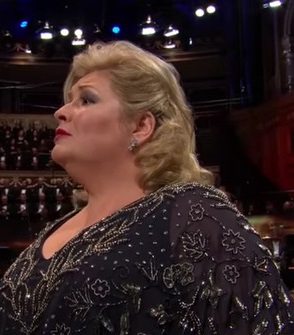
    Karen Cargill sings the Song of the Wood Dove from Arnold Schoenberg’s GURRE-LIEDER at the BBC Proms. The concert, conducted by Sir Simon Rattle, took place in August 2017.

    Watch and listen here.

  • 20th Century Masterworks @ The NY Philharmonic

    _DSC9923

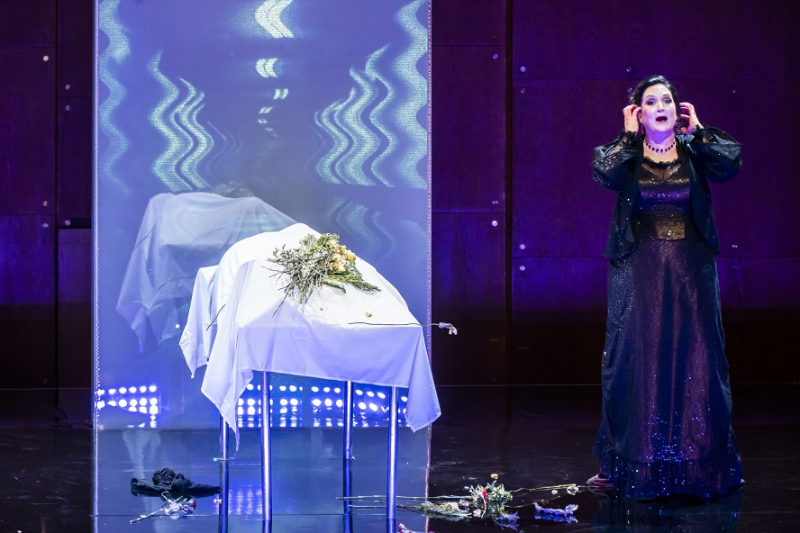
    Above: Katarina Karnéus in ERWARTUNG at The New York Philharmonic; photo by Chris Lee

    ~ Author: Oberon

    Thursday September 26th, 2019 – This long-awaited program by The New York Philharmonic paired Arnold Schoenberg’s monodrama ERWARTUNG with Béla Bartók’s expressionist opera BLUEBEARD’S CASTLE. The Philharmonic’s music director, Jaap van Zweden was on the podium, and a trio of esteemed singers took on the demanding vocal roles. The orchestra was simply splendid, from first note to last.

    In 1989, the Metropolitan Opera presented these two works on a double bill, conducted by James Levine. Jessye Norman sang both The Woman in the Schoenberg and Judith in the Bartók; Bluebeard was sung by Samuel Ramey. It was a magnificent evening musically, though the setting and direction for the Bartók left a lot to be desired. But the staging of the Schoenberg was unforgettable: just a grand piano, hundreds of white candles, and Ms. Norman. How I would love to see it again!

    The idea of presenting these two works in a semi-staged concert setting at Geffen Hall seemed intriguing on paper but was less successful in practice. The singers performed on a raised platform behind the musicians, who were seated in near darkness. The addition of silent actors – portraying medical staff and a crime-scene photographer in ERWARTUNG, and Bluebeard’s previous wives in the Bartók – neither added to nor distracted from the flow of the two works. From where we were sitting, we could not discern what was under the sheet of that autopsy table, which was revealed when they came to take The Woman away. One small screen sufficed for the projections, which were neither here nor there. The lighting effects, however, were well-integrated into the music, especially a blood-red drenching at one point.

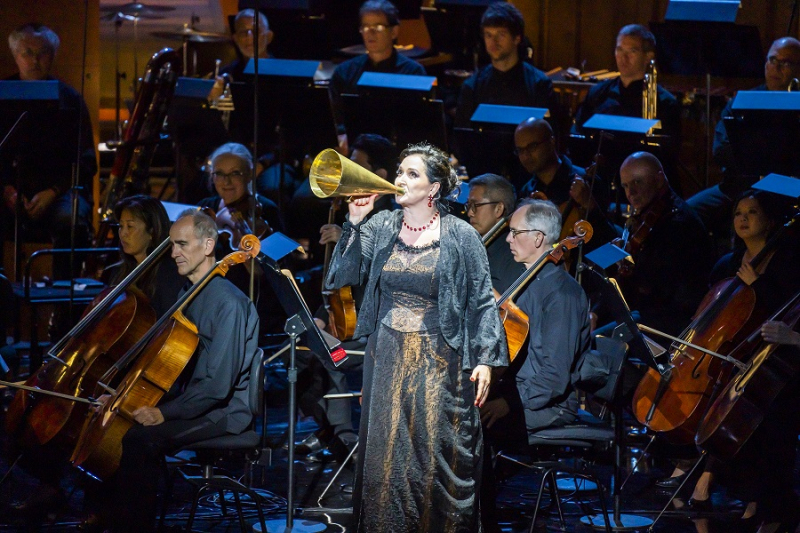
    The monodrama and the opera were linked theatrically by having Katarina Karnéus, who had just given a phenomenal performance in the Schoenberg, re-appear as the prologue to BLUEBEARD’S CASTLE. Here, Ms. Karnéus (using a megaphone) proved to be every bit as engaging as a speaker as she has been in her singing of The Woman. And while, in the end, the evening could have just as thrillingly been presented in straight-up concert form, that would have deprived us of Ms. Karnéus’s inspired acting of her role.

    The concert opened with a performance of the song Erwartung, from Schoenberg’s Vier Lieder, his opus #2, composed in 1899. This gorgeous piece of music, which I had never heard before, was originally written for voice and piano but was tonight performed in a setting for voice and harp. The Philharmonic’s harpist Nancy Allen played divinely, creating a poetic atmosphere. In a black gown shot with silver and holding a large bouquet, soprano Nina Stemme’s voice seemed beset by a wide tonal beat or fluctuation which rather undermined the strange beauty of the song. Ms. Stemme fared much better in BLUEBEARD, where she was fully warmed-up and with the voice profiting from the cushioning orchestra.

    Katarina Karnéus was the Cardiff Singer of the Year in 1995 and from there went on to a grand worldwide career. She came to The Met in 1999, debuting as Varvara in KATA KABANOVA and also appearing as Siebel, Olga in EUGEN ONEGIN, as Rossini’s Rosina, and as Cherubino. I had the pleasure of meeting her while I was working at Tower Records, and of attending a lovely recital she gave in 2001 with pianist Brian Zeger. She last sang at The Met in 2005; in the interim she has developed into a fascinating singing-actress.

    _DSC0141

    Above: Katarina Karnéus as The Woman in ERWARTUNG; photo by Chris Lee

    What a performance of ERWARTUNG Ms. Karnéus gave tonight! The voice encompasses an impressive vocal span, with a silvery sheen on the high notes and a dusky, dramatic throb in the lower range. Her wide-ranging singing is pointed and subtle in terms of word colourings, has a lovely vein of lyricism running thru it, and is possessed of striking power in the climactic moments. It’s an expressive, even bewitching, instrument. Beyond this, Ms. Karnéus is a compelling physical presence, and she captured the emotional state of The Woman with her vibrant and detailed physicality; at one point her entire body was overcome with trembling agitation. Mixed in with the madness were passages that were extraordinarily moving, as in the moment she tells her absent lover that he has “…not even the grace to let me die with you.”

    In recent years, only a handful of operatic performances have captivated me in the way Katarina Karnéus did tonight in ERWARTUNG. She is truly one of a kind.

    Here’s a sampling of the Karnéus voice:

    Katarina Karneus – Mahler ~ Ich bin der Welt abhanden gekommen

    _DSC0348

    Above: Katarina Karnéus in the spoken prologue to BLUEBEARD’S CASTLE at The New York Philharmonic; photo by Chris Lee

    After the interval, BLUEBEARD’S CASTLE commenced with a re-appearance of Ms. Karnéus in a speaking role; I must admit that I found myself wishing she was also singing Judith, for while there is no denying the power and commitment of Nina Stemme’s performance in that role, hers is a voice that has never reached me on a deeper level. That said, the soprano was in full-tilt form for the Bartók tonight and was much admired by the audience.

    In the role of Bluebeard himself, it gave me great pleasure to see onstage again the excellent baritone Johannes Martin Kränzle who, in 2014, was an ideal Beckmesser in his (to date) only Met appearances. We simply must have this man back at The Met, for he is a singing-actor (and an acting-singer) of the highest calibre. 

    _DSC0651

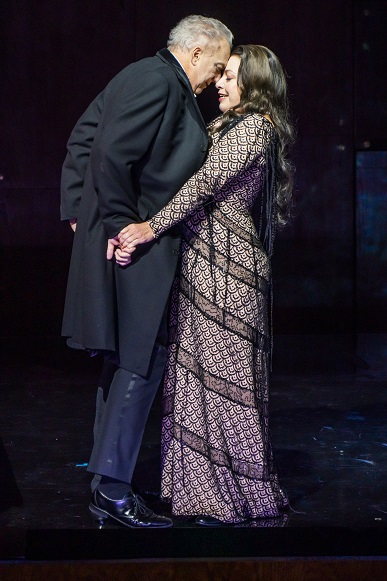
    Above: Johannes Martin Kränzle and Nina Stemme in BLUEBEARD’S CASTLE; photo by Chris Lee

    Ms. Stemme and Mr. Kränzle made the Bartók glow in all its dark radiance with their powerful vocalism and intense acting. They played beautifully off one another, seeming to feed off each others energy as well as off the astonishing sounds being produced by the artists of the Philharmonic.

    It was a performance to immerse oneself in totally, and by the time the harp and horns marvelously underscored Mr. Kränzle’s spectacular vocalism at the opening of the fourth door, I was thoroughly enthralled. Ms. Stemme’s blockbuster high-C at the opening of the fifth door was followed by simply mind-bogglingly impressivel singing from the baritone. Ever a compelling mover, Mr. Kränzle even executed a little dance, and then led his soprano is a waltz.

    Responding to Judith’s questions about the mysterious white lake, Mr. Kränzle was hauntingly moving as he replied: “…tears, Judith…tears!” And then – incredibly – he took his performance to an even higher level with his gorgeous singing of the passage where Bluebeard describes how he met his previous wives and what they mean to him: morning, noon, and evening have been personified for him by these women, and with Judith joining them, his world is complete. “Now it will be night forever!”

    _DSC1438

    Above: from BLUEBEARD’S CASTLE, photo by Chris Lee

    Throughout the evening, the playing of The New York Philharmonic was darkly dazzling, glorious, sublime. Maestro van Zweden reigned over the music with a sure sense of its enormous emotional range, from eerie piani to unfettered, magnificent fortes. The musicians played their hearts out, creating sonic textures that sent chills thru me time and again, and the numerous solo passages were given extraordinary clarity by these remarkable artists.  

    ~ Oberon