Tag: Ballet

  • Kochetkova/Cornejo SWAN LAKE @ ABT

    ABT_Swan_Lake_14_event

    Friday June 26th, 2015 – This evening my 2014-2015 officially ended with a bang when Maria Kochetkova and Herman Cornejo gave the ABT audience a SWAN LAKE to cheer about. The two dancers were recently paired in a very fine performance of BAYADERE and now, having established a lovely rapport, they must be seen in GISELLE, COPPELIA, and ROMEO & JULIET.

    ABT really needs a new SWAN LAKE, and their audiences deserve it. Though at fifteen years of age the production is not old by ballet standards (think of Balanchine’s NUTCRACKER or MIDSUMMER NIGHT’S DREAM), so much of it looks merely random and dutiful rather than dramatic and intriguing. Its main redeeming value is that any incoming pair of principals can step into the classic elements of the white/black/white scenes and feel perfectly at home; it’s the court scenes that really need freshening.

    Tonight in the opening scene we had a superbly-danced pas de trois from Sarah Lane, Skylar Brandt, and Joseph Gorak; all three had ample technique and charm, and Mr. Gorak’s beautifully pointed feet were an added delight. The national dancers in the Black Swan scene are burdened with over-costuming and funny fake moustaches; tonight, only Nicole Graniero (in Hungarian) managed to seize my opera glasses with her vivid performance. Later, as Herman Cornejo was anguishing over which unwanted princess to choose, I wanted to text him and suggest that he grab Nicole and elope to Morocco.

    James Whiteside was wonderfully alluring in the solo where he glamors every woman in the hall (and probably some of the men); yet however well this solo is performed, I always feel Rothbart doesn’t need to be humanized and that the less the character does, the more potent his force seems.

    But all these quibbles vanished in the face of the wonderful telling of the central love story from Ms. Kochetkova and Mr. Cornejo. Having sailed thru some high-flying combinations in the opening scene, it was at the lakeside that Herman’s Siegfried took on the poetic expressiveness that made his performance so compelling. Such a handsome young prince with the cheekbones, the silken mop of hair, the dark eyes filled with wonder – and later with despair. Slowly overcoming her fear of this ardent youth, Ms. Kochetkova surrendered to his tenderness in an adagio filled with haunting romantic nuance. The ballerina’s pin-pointe turns and poised balances wove a spell thru Odette’s music.

    In the Black Swan, the Kochetkova/Cornejo duo simply soared; the detailed courtship and Kochetkova/Odile’s brazen mimicking of the Odette motifs made for a vivid narrative in the adagio. Herman’s solo was a virtuoso show-stopper – igniting a volley of cheers and applause – and in her solo turn, the ballerina displayed her agility and technical command to impressive effect. Then the couple whipped the crowd into fits of rapture in the coda, where Kochetkova’s dazzling speed-of-light fouettés had real sparkle, with Herman taking up the challenge with his own barrage of pirouettes. A roar went up as they struck the final pose.

    In the last scene by the lake, the hapless lovers take final leave of one another; their joint suicide leads to the breaking of the curse and Rothbart’s destruction by the swans. The pink sunrise, with the lovers shown embracing in some afterlife, is a final miscalculation in this production. But as Kochetkova and Cornejo came forward for their bows, nothing else mattered: the audience, pleased as punch, were still screaming as I headed up the aisle.

  • The Royal Ballet: Mendelssohn & Mahler

    C7bc4191abf4460d877244cfebd694b0

    Above: Edward Watson in the Royal Ballet’s production of SONG OF THE EARTH; photo by Johan Persson

    Thursday June 25th, 2015 – The Royal Ballet are presently at Lincoln Center, and this evening’s double-bill of Sir Frederick Ashton’s THE DREAM and Sir Kenneth MacMillan’s SONG OF THE EARTH seemed particularly appealing to me, not least for the music of two of my favorite composers: Felix Mendelssohn and Gustav Mahler. The fact that Edward Watson would be appearing in the MacMillan made an appealing prospect irresistible.

    Ashton’s THE DREAM was the first ballet I ever saw live, performed by The Joffrey at New York’s City Center on October 16th, 1974; Rebecca Wright, Burton Taylor, and Russell Sultzbach had the principal roles that evening. I’ve not seen the ballet again since that performance.

    The Royal Ballet’s production of the Ashton boasts a particularly evocative and gorgeous set, and lovely costumes – notably those for the corps of ‘adult’ fairies (unlike in Balanchine’s version, there are no children to be seen in the Ashton, aside from the Changling Boy). Ashton tells the story in a more abbreviated rendering than Mr B – Ashton’s mortal couples are less-fully-fleshed-out as characters than Balanchine’s; Ashton’s Titania has a more sensuous quality and his Puck is more annoying (in a good way) than their Balanchine counterparts. Ashton sometimes has Oberon and Puck doing virtuoso passages at the same time, and they oddly seem to cancel one another out.

    The Mendelssohn score (played by the New York City Ballet orchestra – though in a different arrangement than that used for the Balanchine), sounded as charm-filled as ever, with some lovely singing from the Brooklyn Youth Chorus.

    Golding oberon

    Above: Matthew Golding as Oberon in THE DREAM; photo by Bill Cooper

    Matthew Golding’s tall, long-limbed Oberon, with beautifully up-right pirouettes, was handsomely characterized with a mixture of nobility and sexiness. Natalia Osipova was a lushly sensuous Titania, with an interesting touch of earthiness. Dancing in oddly-battered toe shoes, she had just polished off a lovely solo passage when suddenly she slipped and fell to the floor; she re-bounded at once and went on to a winning performance, beautifully meshed with Mr. Golding in their pas de deux.

    Valentino Zucchetti was a sprightly Puck; his performance was a big hit with the audience and though I prefer the Balanchine portrait of this character, Zucchetti’s dancing had plenty of verve. Jonathan Howells met the challenge of dancing Bottom on pointe. The mortal couples were finely danced, making the most of their fleeting vignettes: a special bravo to Ryoichi Hirano for his excellent Lysander. A pretty quartet of principal fairies, given their Shakespearean names, added yet another delectable element to the performance.

    17055613604_41fabbcb30

    Above: Edward Watson, Laura Morera, and Nehemiah Kish in SONG OF THE EARTH; photo from The Royal Ballet‘s website

    I had no idea what to expect from Kenneth MacMillan’s SONG OF THE EARTH. In pondering what it might be like, my first thought was that Mahler’s score is singularly unsuited to dance. But how wrong I was! I ended up being thoroughly mesmerized by the unexpected ‘rightness’ of MacMillan’s setting of the music, and by the superb dancing of the three principals.

    9848827a-c4de-491d-8c48-63368e0b21ec

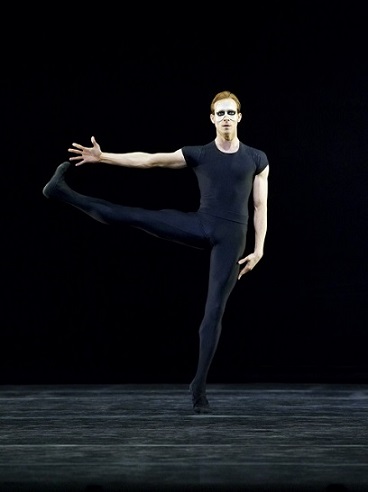
    If there’s a more distinctive danseur on the planet than Edward Watson (above), I’ve yet to find him. The lithe muscularity, the pale skin, the ginger hair, and the hypnotic eyes – clearly gleaming thru a half-masque tonight as MacMillan’s Messenger of Death – combined with a lyrically powerful technique make his performances (far too rare here in Gotham) something to cherish. The moment I saw his name listed for this evening’s performance I knew I had to be there.

    D74f4800af5876ce8dca814c00c1e26c

    A great pleasure to see Nehemiah Kish (above) again; he danced with MORPHOSES in their premiere New York season. Tall and with an easy command of space, his role in the MacMillan serves as both a compliment and a counter-poise to Edward Watson’s character: at the very end of the ballet, Mr. Kish appears masked, clearly ‘marked’ by Mr. Watson’s influence.

    13467865565_8cf990feaa

    New to me and making a magnificent impression was Laura Morera, a Spanish-born ballerina whose clarity of steps and of gesture as well as a radiant, far-searching gaze, marked her as a unique presence: despite the overwhelming allure of Mssers. Watson and Kish, I found it hard to take my eyes off Ms. Morera. She showed a deep connection to the music, and a blessed freedom from theatricality. (The rehearsal photo of Laura Morera above is from The Royal Ballet website…I simply love it…and her!)

    The Mahler score of Das Lied von der Erde calls for two vocal soloists: they alternate in singing the songs. For his ballet, MacMillan has them unobtrusively step out from the opposite sides of the  proscenium to sing; thus the focus remains on the dancers throughout. Tenor Thomas Randle seemed a bit stressed by the vocal demands cruelly placed on him by Mahler, but he managed well enough. Katherine Goeldner, who a few seasons back was an excellent Carmen on this very stage, summoned up some very expressive vocalism, making an especially haunting effect in the final passages of the work as she repeats the word “Ewig…” (‘Forever’) in gradations from piano to lingering pianissimo.

    To attempt to describe for New York dance-goers the overall look of the choreography MacMillan devised for this musically epic piece one might say it combines the stripped-down immediacy of Balanchine’s black-and-white ballets with the ritualistic aspects of Martha Graham’s mythic masterworks.

    In the abstract yet curiously meaningful passages for the corps, MacMillan has created a stylized world thru which the principals and soloists come and go with alternating sensations of urgency and angular introspection. Irony manifests itself at times, but overall the work takes itself very seriously and that in itself makes it all the more compelling.

    There were times when I wished for a bit more sense of unity of movement from the ensemble; of course Mahler’s endless thematic ebbs and flows don’t provide a real rhythmic blueprint for synchronization of steps and gestures. Nevertheless, everyone looked wonderfully handsome and attractive, individual personalities emerging even in the regimented sequences.

    To the splendid performances from Ms. Morera, Mr. Watson, and Mr. Kish were added some radiant dancing from Yuhui Choe and Lara Turk. There were others, too, who caught the questing gaze of my opera glasses but I’m not familiar enough with the Company to single them out.

    In a week that brought the news of Albert Evans’ untimely death, it was moving to be back in the theatre where I saw him dance hundreds of times. So lovely, too, to run into Wendy Whelan, who shared that stage with Albert on countless evenings. My feeling is that Albert would not want us to stop dancing…not even for a moment.

  • Beloved Albert

    6a00d8341c4e3853ef00e5523b71cf8833-800wi

    Above: Albert Evans with Wendy Whelan in Ratmansky’s RUSSIAN SEASONS, photo by John Ross

    Tuesday June 23rd, 2015 – I don’t want to be writing this.

    It seems impossible that Albert Evans has passed away. News of his death came this morning in an e-mail from a fellow balletomane; my initial reaction was that it must be some other Albert Evans because our Albert’s life force was too vibrant to have been extinguished.

    The news is still sinking in. These days, I am constantly hearing of the passing of dancers, singers, and musicians whose artistry made an impression on my life; but these are people in their 80s and 90s who have lived out their lives to the fullest. One would certainly have expected Albert to be with us for many, many more years. That’s why his passing is so tragic. It reminds us that we must never take for granted the presence of the people in our lives.

    It’s true that Albert’s passing brings back a flood of dance memories, and yet – as with all my favorite dancers – recollections of his performances have frequently sprung to mind in the days since his retirement.

    6a00d8341c4e3853ef013484aab3f8970c

    Among his most felicitous roles was Puck in Balanchine’s MIDSUMMER NIGHT’S DREAM (with Arch Higgins and Alexandra Ansanelli, above, in a Paul Kolnik photo). In a role often undertaken by dancers of smaller physical stature, Albert made his own indelible mark with his brilliant characterization and marvelous, cat-like landings. The ‘Rhinestone Cowboy’ in WESTERN SYMPHONY was another Evans gem, as were his performances in AGON, THE FOUR TEMPERAMENTS, STRAVINSKY VIOLIN CONCERTO, and EPISODES. Albert frequently appeared in new repertory too, with Dove’s RED ANGELS, Ratmansky’s RUSSIAN SEASONS and Wheeldon’s LITURGY and KLAVIER among the most memorable. And who could forget his epic Rothbart in Peter Martins’ SWAN LAKE?

    6a00d8341c4e3853ef00e552536a7d8834-800wi

    Above: Albert in Ratmansky’s RUSSIAN SEASONS with NYCB colleagues Jonathan Stafford, Antonio Carmena, Sean Suozzi, and Adam Hendrickson. Photo: John Ross

    After his 2010 farewell to dancing at New York City Ballet, Albert continued working there as a ballet master. I would still run into him sometimes in the Lincoln Center area and there was always a smile and a friendly greeting. 

    6a00d8341c4e3853ef01348366cad2970c-800wi

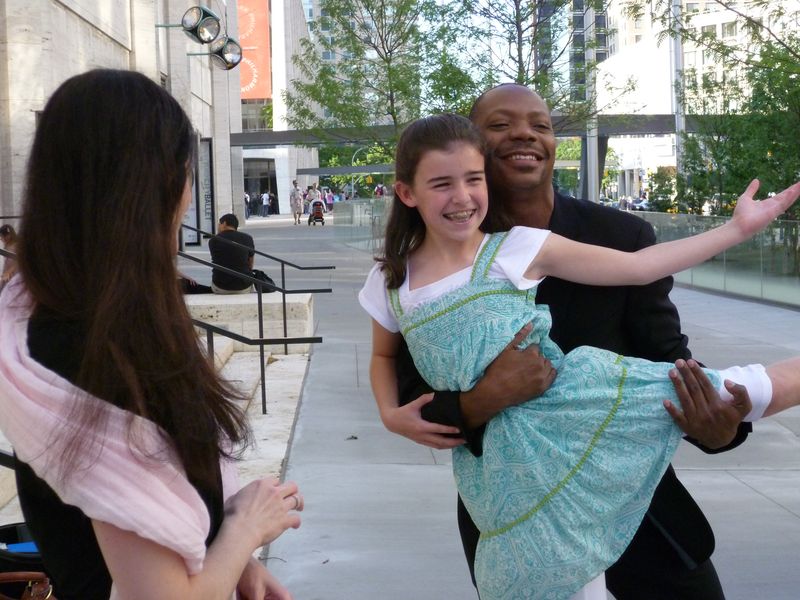
    Albert was always such a thoughtful person, always illuminating other people’s lives in a special way. After Yvonne Borree’s NYC Ballet farewell, Albert amazed a young dance student outside the stage door by sweeping her up into a pas de deux pose. It was such a happy moment, and that’s how I want to remember him.

    34127_1422702001586_4885590_n

    Above: curtain call at Albert’s NYCB farewell

  • Chamber Music Society’s Season Finale

    Banner1

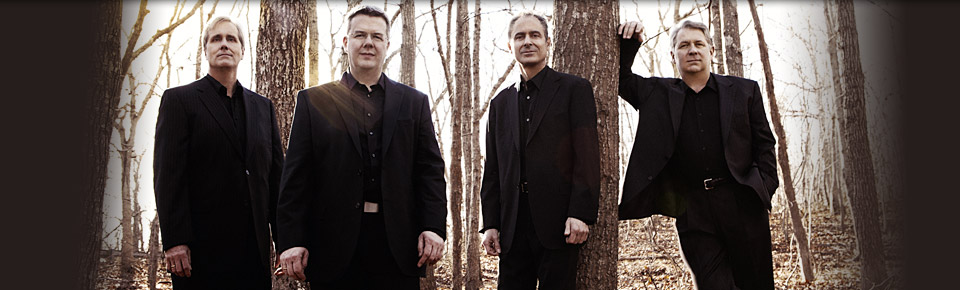
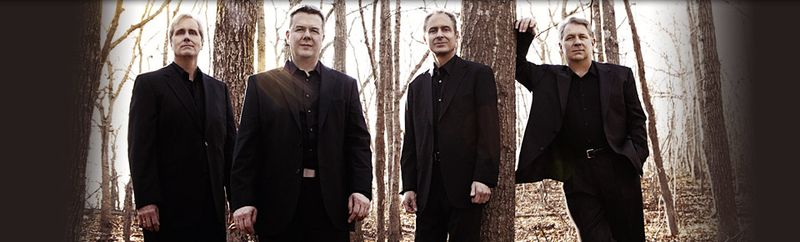
    Above: The Emerson String Quartet (Lawrence Dutton, Paul Watkins, Eugene Drucker, Philip Setzer) in a Lisa Mazzucco photo

    Tuesday May 19th, 2015 – Marking the end of their wonderful 2014-2015 season, Chamber Music Society of Lincoln Center presented the Emerson String Quartet, joined by violist Paul Neubauer and cellist Colin Carr, in a programme featuring the New York City premiere of a Lowell Liebermann work plus classics from Mozart and Tchaikovsky.

    It seems like only yesterday that I opened the CMS 2014-2015 season brochure and found myself anticipating every single one of the concerts listed; how quickly the months have flown by! But a few weeks ago, the Society announced their first Summer Season, and so now we will not have to wait until Autumn to be back at Tully Hall, hearing the great music and incredible artists who make the Society such a valuable part of our lives. 

    Tonight Alice Tully Hall was packed for this, the second performance of this programme. The Emerson String Quartet, surely one of the greatest chamber ensembles of all time, showed their mastery in works of contrasting styles; their marvelously integrated sound has a richness all its own: there are times you’d swear you’re listening to larger orchestra.

    Lowell Liebermann’s String Quartet No. 5 is one of the finest new works I have heard in recent years; not only is it superbly crafted, but it also draws a deep emotional response – something you can’t honestly say about a lot of newer music. Mr. Liebermann, who was seated directly behind us, wrote this brief note for the Playbill: “…I have no doubt that my mindset composing the piece and its resultant overriding elegiac tone was at least partly influenced by any number of depressing/terrifying events of the kind with which we are bombarded daily, in what seems more and more like a world gone mad.”  That sentence encapsulates to perfection my own feelings as I turn to the news each day and think “Can these things really be happening? Can people really have become so vain, shallow, and heartless? Has humanity lost its soul?” And so we turn to great music, both for consolation and also – sometimes – to weep with us. And that’s exactly what this quartet does.

    The music wells up from a deep cello phrase to eerie murmurings and a mournful viola theme. There’s a muted lullabye and a lamenting theme passed from viola to violin 2. Poignant textures draw us deeper and deeper into the music, and then it starts to scurry. A dance for viola is taken up by the violin; agitation builds. A full-scale canon develops, then more swirling dance music. A buzz, a violin duo, and then calm is restored with a yearning theme. A simply gorgeous violin solo is passed to violin 2 and then to the viola, which sings of anguish. A plucked passage from violin and viola takes us to a violin solo of pristine sadness before the music starts to echo its beginnings, fading in a ghostly glimmer. A profound silence filled the hall as the musicians finished: this evocative and thought-provoking piece had clearly made a deep impression. The composer was called to the stage, as bravos resounded. Both the music and the playing of it left me spell-bound.

    I kind of wished there’d been an intermission at that point, the better to remain in reverie; but Mozart’s Quintet in E-flat major K 614 brought the esteemed violist Paul Neubauer to the stage with the Emerson for music that was an antidote to the Liebermann and, almost against my will, I was drawn out of my pensive state into a sunnier place.

    Though written in Mozart’s last year, this Quintet is optimistic in tone and quite jolly in its dance motifs. Its elegant andante, prancing minuet, and jaunty finale were all played with spirit and grace, with much lovely ‘communicating’ between the players.

    For the evening’s concluding performance of Tchaikovsky’s Souvenir de Florence, Philip Setzer took the 1st violin stand with Mr. Neubauer and cellist Colin Carr adding their rich voices to the Emerson’s choir. The sound of this ensemble was really phenomenal, of symphonic resonance.

    The Souvenir is a pleasure from first note to last, but just as Tchaikovsky’s adagios in Swan Lake and Sleeping Beauty strike us most deeply in the heart, it’s the second movement of Souvenir that speaks directly to the receptive spirit. It reminded me so much of the composer’s Serenade for Strings which Balanchine transformed into his remarkable and eternal ballet masterpiece Serenade. Tonight’s performance of this Adagio cantabile was so richly played and so moving: music as consolation.     

    The Repertory:

    The Participating Artists:

  • Chamber Music Society’s Season Finale

    Banner1

    Above: The Emerson String Quartet (Lawrence Dutton, Paul Watkins, Eugene Drucker, Philip Setzer) in a Lisa Mazzucco photo

    Tuesday May 19th, 2015 – Marking the end of their wonderful 2014-2015 season, Chamber Music Society of Lincoln Center presented the Emerson String Quartet, joined by violist Paul Neubauer and cellist Colin Carr, in a programme featuring the New York City premiere of a Lowell Liebermann work plus classics from Mozart and Tchaikovsky.

    It seems like only yesterday that I opened the CMS 2014-2015 season brochure and found myself anticipating every single one of the concerts listed; how quickly the months have flown by! But a few weeks ago, the Society announced their first Summer Season, and so now we will not have to wait until Autumn to be back at Tully Hall, hearing the great music and incredible artists who make the Society such a valuable part of our lives. 

    Tonight Alice Tully Hall was packed for this, the second performance of this programme. The Emerson String Quartet, surely one of the greatest chamber ensembles of all time, showed their mastery in works of contrasting styles; their marvelously integrated sound has a richness all its own: there are times you’d swear you’re listening to larger orchestra.

    Lowell Liebermann’s String Quartet No. 5 is one of the finest new works I have heard in recent years; not only is it superbly crafted, but it also draws a deep emotional response – something you can’t honestly say about a lot of newer music. Mr. Liebermann, who was seated directly behind us, wrote this brief note for the Playbill: “…I have no doubt that my mindset composing the piece and its resultant overriding elegiac tone was at least partly influenced by any number of depressing/terrifying events of the kind with which we are bombarded daily, in what seems more and more like a world gone mad.”  That sentence encapsulates to perfection my own feelings as I turn to the news each day and think “Can these things really be happening? Can people really have become so vain, shallow, and heartless? Has humanity lost its soul?” And so we turn to great music, both for consolation and also – sometimes – to weep with us. And that’s exactly what this quartet does.

    The music wells up from a deep cello phrase to eerie murmurings and a mournful viola theme. There’s a muted lullabye and a lamenting theme passed from viola to violin 2. Poignant textures draw us deeper and deeper into the music, and then it starts to scurry. A dance for viola is taken up by the violin; agitation builds. A full-scale canon develops, then more swirling dance music. A buzz, a violin duo, and then calm is restored with a yearning theme. A simply gorgeous violin solo is passed to violin 2 and then to the viola, which sings of anguish. A plucked passage from violin and viola takes us to a violin solo of pristine sadness before the music starts to echo its beginnings, fading in a ghostly glimmer. A profound silence filled the hall as the musicians finished: this evocative and thought-provoking piece had clearly made a deep impression. The composer was called to the stage, as bravos resounded. Both the music and the playing of it left me spell-bound.

    I kind of wished there’d been an intermission at that point, the better to remain in reverie; but Mozart’s Quintet in E-flat major K 614 brought the esteemed violist Paul Neubauer to the stage with the Emerson for music that was an antidote to the Liebermann and, almost against my will, I was drawn out of my pensive state into a sunnier place.

    Though written in Mozart’s last year, this Quintet is optimistic in tone and quite jolly in its dance motifs. Its elegant andante, prancing minuet, and jaunty finale were all played with spirit and grace, with much lovely ‘communicating’ between the players.

    For the evening’s concluding performance of Tchaikovsky’s Souvenir de Florence, Philip Setzer took the 1st violin stand with Mr. Neubauer and cellist Colin Carr adding their rich voices to the Emerson’s choir. The sound of this ensemble was really phenomenal, of symphonic resonance.

    The Souvenir is a pleasure from first note to last, but just as Tchaikovsky’s adagios in Swan Lake and Sleeping Beauty strike us most deeply in the heart, it’s the second movement of Souvenir that speaks directly to the receptive spirit. It reminded me so much of the composer’s Serenade for Strings which Balanchine transformed into his remarkable and eternal ballet masterpiece Serenade. Tonight’s performance of this Adagio cantabile was so richly played and so moving: music as consolation.     

    The Repertory:

    The Participating Artists:

  • Huang/Schwizgebel @ The Morgan Library

    Huangschwizgebel

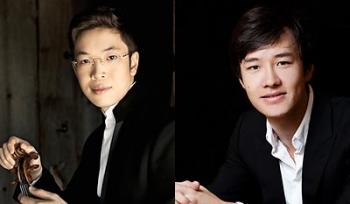
    Wednesday April 22nd, 2015 – Violinist Paul Huang and pianist Louis Schwizgebel (above) in a noontime recital at the Morgan Library, presented by Young Concert Artists in collaboration with the Morgan Library and Museum.

    Earlier this year I heard Paul Huang playing in a Young Concert Artists Composers Series concert at Merkin Hall. His artistic maturity seemed remarkable in one so young. Shortly after that concert, it was announced that Paul was one of five recipients of an Avery Fisher Career Grant.

    Swiss-Chinese pianist Louis Schwizgebel won the Geneva International Music Competition at the age of seventeen, and two years later, he won the Young Concert Artists International Auditions in New York. In 2012 he was awarded the Arthur Rubenstein Prize in Piano at the Juilliard School, and in 2013 he was announced as a BBC New Generation Artist.

    Franz Schubert’s Rondo brilliant in B Minor, D. 895 (Op. 70) opened the programme, with both the musicians looking dapper in black suits with red silk handkerchiefs in their breast pockets. Gilder Lehrman Hall at The Morgan is a wonderful venue for chamber music, with its comfortable, steeply-raked seating and its fine acoustic which gives the music real immediacy. Displaying ‘Olde World’ warmth of tone and depth of sensitivity, the Huang/Schwizgebel duo gave an exhilarating performance of this demanding Schubert showpiece.

    Thematically rich, with an upward-leaping signature motif, the Rondo (composed 1826) showed the two young musicians in a fine rapport, mining both the dramatic and the virtuosic passages with flair. Shifts of key and pacing were astutely mastered, and Mr. Huang’s technical command was impressive. Incidentally, the manuscript score of this work is housed at The Morgan.

    Arvo Pärt’s Fratres is well-known to Gotham’s ballet lovers since it was used by Christopher Wheeldon for his 2003 ballet LITURGY at New York City Ballet. After a twitchy, nervous passage for solo violin, the piano makes an emphatic entrance. Thereafter we are taken on a musical/spiritual journey that veers from urgency to pensiveness, rises to a passionate cry to heaven, and develops into a soulful hymn. A repeated, rising theme for the violin seems to depict souls ascending to heaven before the work reaches its ethereal finish. Mssrs. Huang and Schwizgebel gave an engrossing performance of this piece which is surely among Pärt’s finest and most memorable compositions.

    Cesar Franck’s Sonata for Violin and Piano in A Major is so poignantly familiar; right from the start we are drawn into its melodic soundscape. Louis Schwizgebel’s playing of the first solo piano passage radiated romantic tenderness, and the piano introduction to the second movement was superbly played. Paul Huang brought intense beauty to each theme that Franck so generously gives to the violin; the clarity and expressiveness of his playing was something uplifting to experience.

    Responding to very warm applause from the large audience, Paul and Louis offered a heartfelt rendition of Robert Schumann’s Träumerei as an encore, thoughtfully dedicating it to Susan Wadsworth, the director of Young Concert Artists, and to everyone involved in the organization. The recital celebrated a beautiful Spring day in high style; I felt so fortunate to have been there.

  • New Chamber Ballet: Four Works

    L1550484

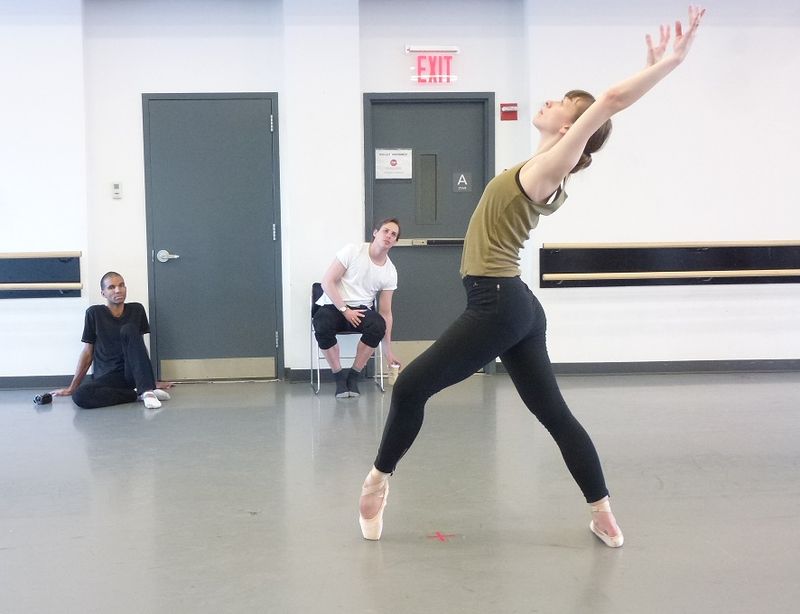
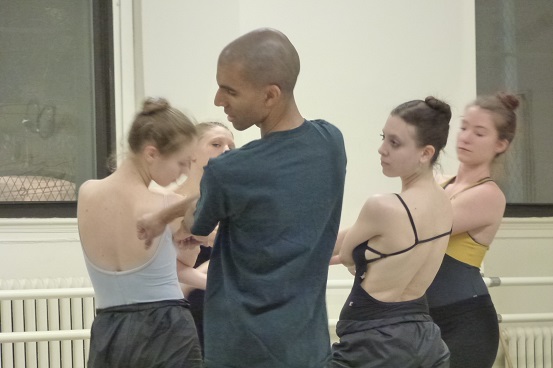
    Above: Elizabeth Brown of New Chamber Ballet rehearsing the solo Moments, observed by choreographers Miro Magloire and Constantine Baecher

    Saturday April 18th, 2015 – “Ballet is Woman,” said George Balanchine; and Miro Magloire‘s New Chamber Ballet seems to be living proof of it. Miro’s obvious delight and skill in choreographing for female dancers has resulted in a series of works which honor the ballerina tradition whilst at the same time pushing boundaries, especially in the realm same-sex partnering. Tonight, the customary New Chamber Ballet formula of women dancing in an up-close-and-personal setting to live music brought us works by both Miro and NCB‘s resident choreographer Constantine Baecher, including two world premieres.

    Now celebrating their tenth anniversary, New Chamber Ballet have always presented an ensemble of finely-trained ballerinas with vivid, individualized personalities. The current quartet maintains the high standard: these are women who are comfortable with having their audience literally within reach, able to dance with confidence and poise in an intimate setting. Their dancing is enhanced by the accomplished musicality of violinist Doori Na and pianist Melody Fader who are always ready, willing, and able to tackle whatever music Miro hands them – and that’s saying a great deal.

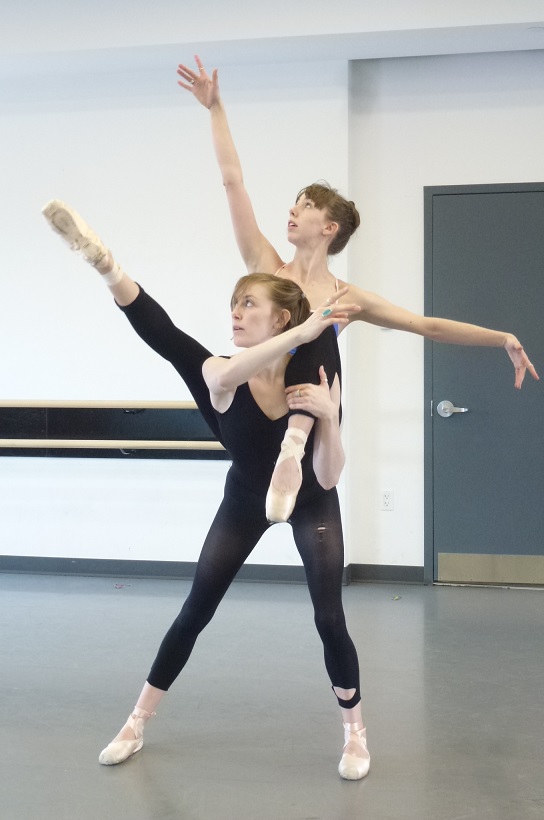
    Entangled, a quartet for on- and off-pointe dancers, is performed to Paganini’s Caprices expertly played by Doori Na. The girls, in Sarah Thea’s minty-green sheer costumes with a harem feeling, are paired off: two on pointe (Sarah Atkins and Traci Finch) and two in slippers (Elizabeth Brown and Amber Neff). 

    L1550289

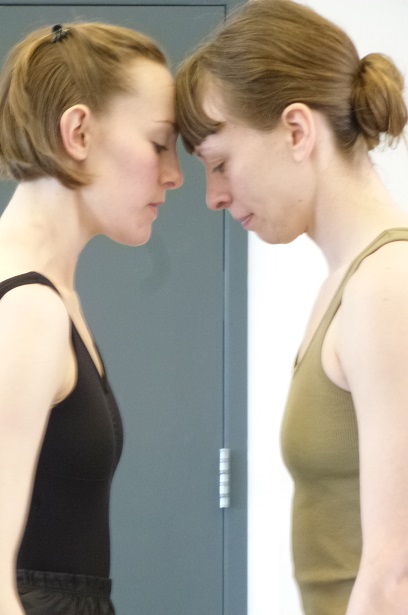
    The ballet opens with Amber and Elizabeth face to face (rehearsal image, above); they rush away from one another and then meet again – repeatedly – in an approach-avoidance sequence. Their dance becomes spastic; they struggle on the floor and there are shakes and shapes. Doori, the violinist, is meanwhile making fast and furious with the demanding Paganini score. The pointe couple appear: Sarah and Traci in stylized balletic poses with stretched arabesques and sculptural port de bras. The couples alternate; the soft-slipper girls have a shuffling little jig. As the adagio begins, the pointe pair lean into one another before they are left alone to a high violin shimmer. Innovative floor choreography follows. We half expect a faster final movement, but instead the ballet ends quietly.  

    Elizabeth Brown, a founding member of New Chamber Ballet, has been thru a serious injury episode and has come back in phenomenal physical condition and more expressive than ever. A unique dancer, Elizabeth performed Miro’s solo Moments to Salvatore Sciarrino’s Caprices 5,2, and 6. Doori Na plays the annoying (in a good way) and demanding score with touches of wit. The opening section is all about line and control, and Elizabeth here reveled in these beautiful, slow-to-still poses. The choreography becomes more animated, gestural, and space-filling, with a spirited circle of piqué turns. New Chamber Ballet audiences tend to be rather reserved, but lusty cheers went up after Moments.

    L1550245

    Above: Traci Finch and Amber Neff rehearsing Miro Magloire’s newest ballet, La Mandragore

    La Mandragore (The Mandrake) is a new duet by Miro set to Tristan Murail’s solo piano work of the same title. Melody Fader at the keyboard showed a particular affinity for this music which begins misterioso, becomes turbulent, then sinks back into eerie calm. Dancers Traci Finch and Amber Neff meet Miro’s complex partnering demands head-on; they are fearless, strong and supple as they wrap around one another, performing lifts and mutually supportive feats in an unusual mixture of power and intimacy. Miro pushes the two dancers to extremes and they respond with compelling assurance and grace.  

    The world premiere of NCB resident choreographer Constantine Baecher’s Two Tauri and A Tiger marked yet another success for Constantine, who has created several works for New Chamber Ballet over the years. Two Tauri opens with Elizabeth Brown rushing on to a stimulating Mozart theme played by Melody Fader; Elizabeth’s solo is questing and energetic. Traci Finch enters next, followed by Sarah Atkins, each dancing a restless and animated solo. The movement has a playful, windswept feeling with an aspect of childlike joy, as when Elizabeth and Traci join hands and spin mirthfully about. 

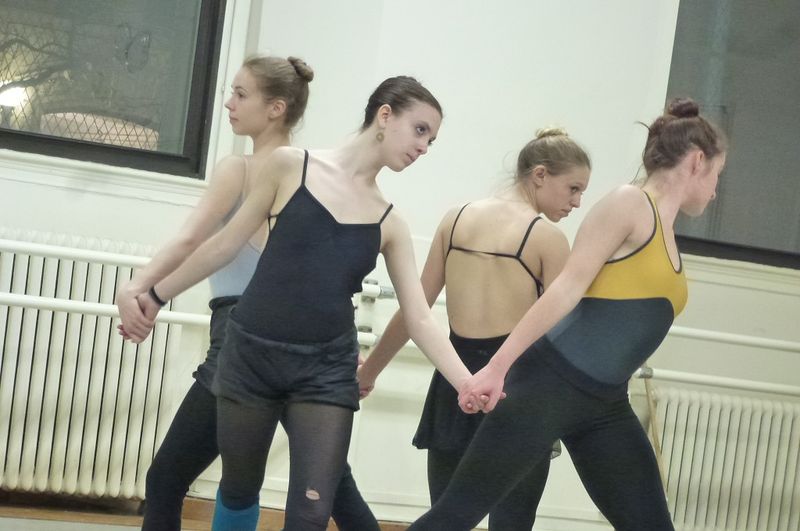
    The music pauses and we hear the dancers breathing; they re-group in silence, have a walkabout, and a bit more spinning. As Melody intones a more staid Mozart theme, the ballet becomes pensive. The girls circle around, holding hands and relying on counter-balance. This passage recalls Balanchine’s fondness for similar linkings, and also evokes Matisse’s La Danse. As the music animates, the dancers rush about and a pair will playfully drag the third as in a children’s game. This recedes into a more temperate passage with some stretching motifs. Overall, Two Tauri seems like a romping, good-natured piece; yet I feel there might be some underlying shadows, too. I’ll need to see it again to get a deeper sense if it. One thing for sure: the three dancers seemed to be genuinely having a good time dancing it.

    So nice to see Candice Thompson, Amy Brandt, Emery LeCrone, and Lauren Toole among the audience tonight.

    New Chamber Ballet will conclude their 10th anniversary season with performances on June 12th and 13th, 2015. Further details will be forthcoming.

  • Miro Magloire for CBC

    L1540856

    Above: dancers from Columbia Ballet Collaborative rehearsing a new Miro Magloire ballet; the girls are Vanessa van Deusen, Shoshana Rosenfield, Alyssa Hubbard, and Morgan Caglianone

    Sunday March 29th, 2015 – This evening I stopped in at Barnard College where Miro Magloire, artistic director of New Chamber Ballet, is creating a new work for Columbia Ballet Collaborative‘s upcoming performances – a matinee and an evening show at The Miller Theater, Columbia University on Saturday April 18th, 2015.

    L1540721

    Above: violinist Pala Garcia, Miro Magloire

    The music Miro has selected is “tanz.tanz” for solo violin by composer Reiko Fueting, who is a professor at Manhattan School of Music; it will be played live by violinist Pala Garcia.

    L1540947

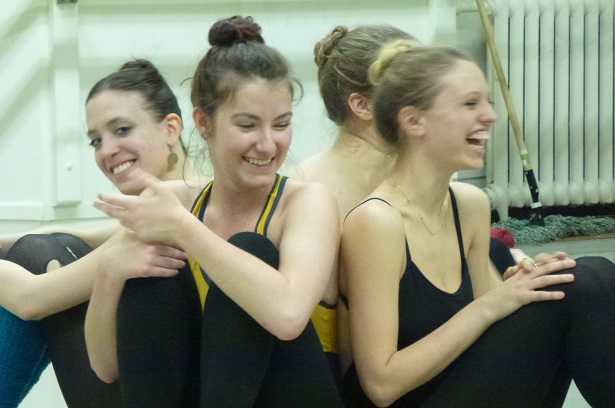
    A nice, relaxed atmosphere in the studio this evening; the dancers were experimenting with a seated back-to-back formation from which Miro wanted them to rise…

    L1540804

    …this produced some mirth from the girls, but eventually they figured out how to make it work. 

    L1540883

    There was also an attempt to cover their neighbor’s mouth or eyes by feeling: more levity. But again it soon was absorbed into the dance.

    L1540861

    Miro later had them draw into a Matisse-like circular formation, moving faster and faster.

    L1540730

    There are fleeting partnered passages (Morgan and Alyssa, above)…

    L1540931

    …and reflective moments where the girls sit, each in her own dreamy world (Vanessa, above).

    L1540880

    As the rehearsal was drawing to a close, Shoshana Rosenfield (above) breezed thru a beautiful solo passage, full of swift, lyrical turns.

    For the Spring 2015 season, Columbia Ballet Collaborative welcomes new ballets by five choreographers: Charles Askegard, former dancer with American Ballet Theatre and New York City Ballet and co-founder of Ballet Next; Roya Carreras, graduate of UC Irvine’s Claire Trevor School of the Arts and dancer with Danielle Russo Dance Company (NYC); Serena Mackool, senior at the School of General Studies and former dancer with Tulsa Ballet, Ballet San Antonio, and Proyectos en Movimiento; Miro Magloire, founder and artistic director of New Chamber Ballet; and Katya Vasilaky, Postdoctoral Earth Institute Research Fellow at Columbia University and former dancer with San Francisco Ballet. CBC is also proud to present selections from George Balanchine’s Who Cares?.

    Tickets will be $10 with a Columbia University ID, $15 with a non-Columbia University student ID, and $22 for general admission. They are available for purchase via these links: 

    3pm Show

    8pm Show

  • Graham @ The Joyce 2015 – Part II

    30828_433083144185_6944679_n

    Above: Blakeley White-McGuire and Tadej Brdnik; these two phenomenal dancers were making their ‘farewell’ appearances as members of the Graham company tonight.

    Sunday February 22nd, 2015 – For me it was a bittersweet evening at the Martha Graham Dance Company‘s final performance of their 2015 Joyce season following the news earlier this week that tonight would mark the ‘farewell’ Graham performances of Blakeley White-McGuire and Tadej Brdnik, two of the great Graham interpreters of our time and two people I greatly love and admire both as dancers and personalities. 

    Tadej danced in the very first performance of a Graham work that I ever saw: Appalachian Spring at Jacob’s Pillow some 20 years ago. That afternoon his Bride was the inimitable Miki Orihara. Combining the physique of a champion athlete with an appealingly boyish face, Tadej’s boundless energy and commitment have made him a Graham icon; he also has a devilish sense of humor, and I’ve seen him at the end of a long rehearsal keeping his fellow-dancers merry with one-liners and dead-pan expressions. In these final performances as a Company member, he has again shown the power and presence that have made him an emblematic Graham dancer throughout his career.

    Of Blakeley White-McGuire, one can say she has indomitable technical prowess and a rare gift for communicating emotion. But beyond that there’s an undefinable element in her dancing which only a handful of dancers in my experience have possessed: a spiritual connection with the music and the movement that makes her performances not just important, but essential. Blakeley is twice-blessed by Terpsichore, and it is we – the audience – who reap the benefits of her beauty and generosity of spirit. 

    Like Wendy Whelan, who recently retired from New York City Ballet (and who was in the audience tonight!), both Blakeley and Tadej have indicated that they aren’t retiring, but simply turning a page in the chronicle of their dancing careers.

    Blakeley and Tadej walked into the Graham studios for the first time on the same day some two decades ago. Although in the original scheme of things they were not scheduled to dance Errand Into The Maze together this season, it seems they were destined by the gods to do so.

    _MG_7823

    Their performance was thrilling, commencing with Blakeley’s opening solo (photo above by Brigid Pierce) in which she danced with a palpitating mixture of fear and resolve, delineating the character’s destiny in a vivid marriage of technique and temperament. Tadej, as the monstrous Minotaur, stalks her like a vicious predator, his incredible thigh musculature giving him grounded strength of purpose. Their pas de deux, so fraught with struggle and sexuality, shows Graham’s gift for devising miracles of leverage, counter-balance, and entwining in her partnering motifs. Blakeley and Tadej’s joint triumph was vastly cheered by the packed house, and their Graham colleagues joined them onstage for the celebration. 

    For all the excitement generated by Blakeley and Tadej, the evening was an enriching one overall, commencing with two Graham works in which two of my beloved Muses appeared: Deep Song opened the program in a vivid performance by Carrie Ellmore-Tallitsch, and Miki Orihara gave a luminous rendering of an excerpt from Primitive Mysteries, presiding over a corps of young women in blue.

    _MG_7545

    Above: Carrie Ellmore-Tallitsch in Deep Song; photo by Brigid Pierce

    Deep Song is a solo work by Martha Graham, set to Music by Henry Cowell. It was premiered in 1937 as one of the choreographer’s responses to the horrors of war (the Spanish civil war in this case). In a black and white gown, Carrie Ellmore-Tallitsch is first seen seated on a white bench. The choreography develops with seeming inevitability as she struggles with her  inner torment, sinking to the ground. She later lifts the bench, seeming to use it as a shield or hiding place. Finally the bench takes on a coffin-like aspect as she lowers it over herself. Carrie, a dancer I have always held in highest esteem, danced as superbly as I expected. The audience seemed to agree: she won a prolonged ovation which made me want to smile and weep at the same time.

    6a00d8341c4e3853ef01a511cbecd5970c-800wi

    Miki Orihara (rehearsal image, above) appeared like a shimmering angel all in white to perform the ‘Hymn to the Blessed Virgin’ from Graham’s 1931 ballet Primitive Mysteries. This is the Graham work I am most curious about, and tonight’s tantalizing excerpt makes me curiouser and curiouser. Escorted by a group of attendants in deep blue gowns (members and apprentices of Graham II), Miki radiates feminine mystique with her poetic gestures, moving with an almost ghostly lightness of tread. To Louis Horst’s atmospheric melody for flute and piano, the women perform antique rituals in this finely-structured dancework. The ensemble’s signature poses and port de bras make a particularly strong effect as Miki walks forward between facing rows of acolytes who sink down or raise their arms to heaven as she passes by. Miki sustains a powerful pose in demi-plié as the women circle about her. All to soon, their cortège passes onward but the resonance of their dancing lingers. Miki, always so movingly inspired and inspiring, sets a lovely example for the young dancers surrounding her: not only of how to move, but how to be.

    In the Graham Company’s on-going project of asking now-generation choreographers to create short danceworks inspired by Martha’s legendary solo Lamentation, Michelle Dorrance and Liz Gerring have now devised new pieces – Lamentation Variations – for the Graham dancers. Bulareyaung Pargalava’s Variation, a classic by now, was also on offer tonight.

    007_ChristopherJones_013

    Above: the Graham men in Michelle Dorrance’s Lamentation Variation; left to right are Abdiel Jacobsen, Ben Schultz, Lloyd Knight, Lloyd Mayor, Tadej Brdnik. Photo by Christopher Jones.

    Ms. Dorrance, a tap-dancing paragon, did not ask the Graham dancers to tap. But the music she used relied on tap rhythmics with a jazzy over-lay. The men formed a kind of central knot, while a quintet of women were seen in walkabouts…which one or two of the men sometimes strayed into. Though abstract, an underlying aspect of sadness and solitude prevailed throughout this work.
    001_MG_2624

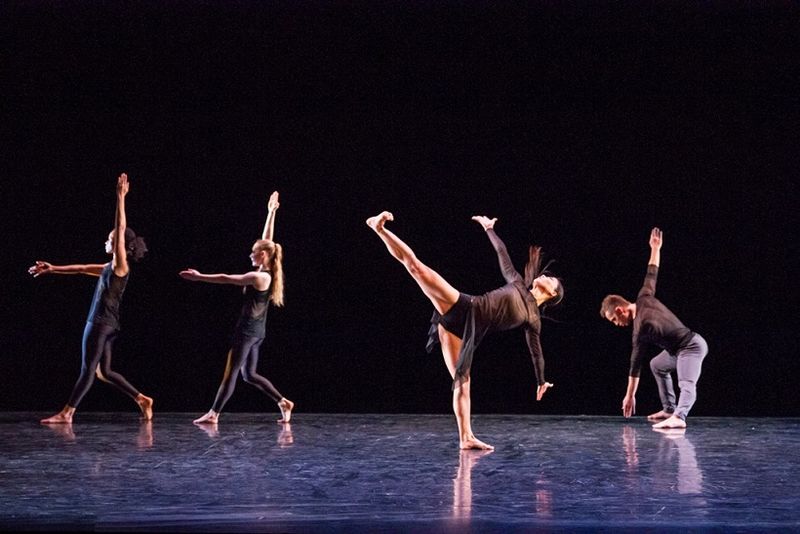
    Liz Gerring’s Lamentation Variation is a quartet – performed by Natasha M Diamond-Walker, Charlotte Landreau, Ying Xin, and the indefatigable Tadej Brdnik (photo, Brigid Pierce) – which is set to a score for electronics and piano. The movement is rather stylized, and choreographer and dancers make excellent use of the space.

    150212_M_Graham_B_Pagarlava_003

    Above: from Bulareyaung Pargalava’s Lamentation Vartiation; photo © 2015 Yi-Chun Wu.

    Pargalava’s Variation opens to the sound of Martha Graham’s voice speaking about the solo that inspired all these variations. Soon a haunting melody from Mahler’s ‘Songs of the Wayfarer’ is heard. In flesh-coloured tights, the delicate XiaoChuan Xie and her three demi-god partners – Ben Schultz, Lloyd Knight, and Lloyd Mayor – move with a sense of flowing lyricism through intricate partnerings in which Chuan alternately sinks down and is lifted on high. The dancers and the dance certainly wove a hypnotic spell tonight.
    002_MG_7971

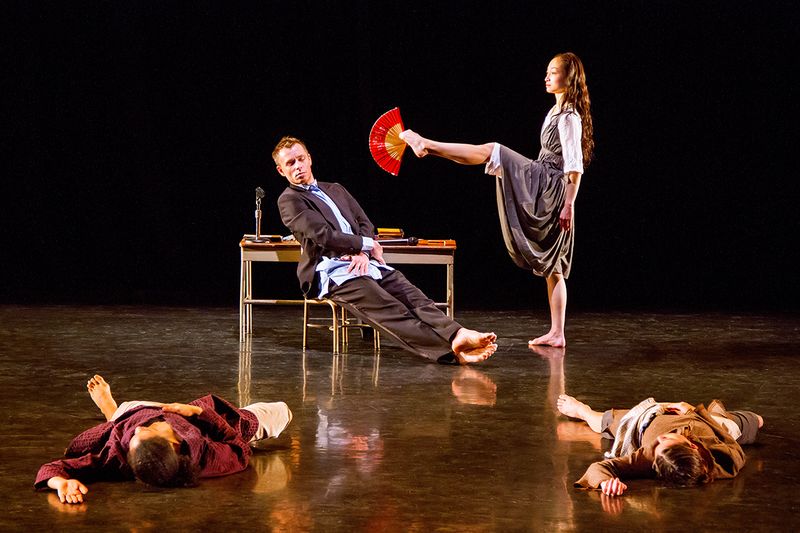
    Above: Tadej Brdnik and XiaoChuan Xie in Annie-B Parson’s The Snow Falls in the Winter; photo by Brigid Pierce.

    I saw Annie-B Parson’s The Snow Falls in the Winter a few seasons ago when OtherShore performed it. It’s simply not my cup of tea. For me one of the great joys of watching dance is: the dancers are silent. Once they begin to speak, a whole element of mystery falls away. Ms. Parson’s work is more like a play with a bit of dancing thrown in. The Graham dancers of course flung themselves into the piece with their customary zest, and Carrie Ellmore-Tallitsch and Natasha Diamond-Walker in particular proved themselves adept actresses. But while many in the audience applauded lustily and commented enthusiastically on this very ‘different’ work, I found it pretty tedious.

    006_MG_8799

    Above: from Andonis Foniadakis’ Echo, Lloyd Mayor, PeiJu Chien-Pott, and Lloyd Knight; photo by Brigid Pierce

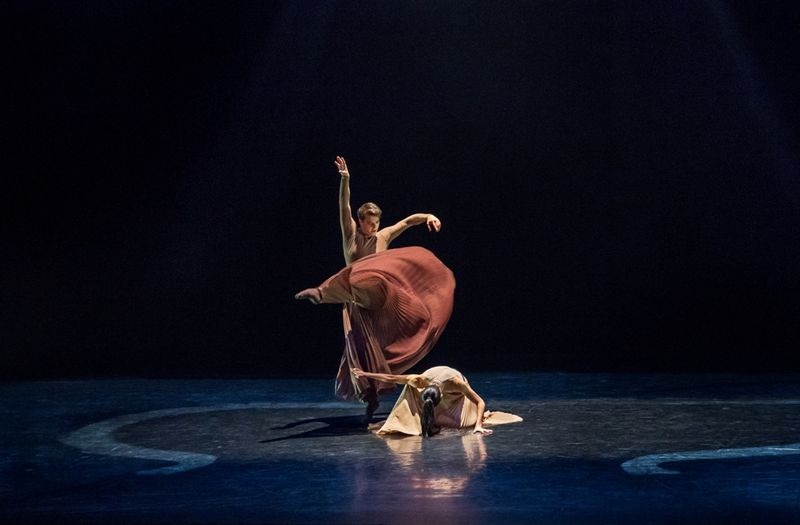
    The evening then soared to its conclusion with Andonis Foniadakis’ myth-inspired masterwork, Echo. It’s more a mood piece than a literal re-telling of the ancient tale of Narcissus and Echo, and as such it flows gorgeously upon Julien Tauride’s atmospheric score. The Graham Company’s beautiful pair of Lloyds – Mayor and Knight – create the illusion of Narcissus and his refection in deeply-enmeshed duets, their movement enhanced by their long sheer skirts (costumes by Anastasios Sofroniou) as caught in shadowy swirls by Clifton Taylor’s lighting design. PeiJu Chein-Pott is simply gorgeous as Echo, her dancing radiant and her creation of the character’s unspoken love and frustration literally becoming poetry in motion. In a supporting ensemble (as if such dancers can ever be thought of as merely ‘supporting’!) Tadej Brdnik, Ben Schultz, Abdiel Jacobsen, Natasha Diamond-Walker, XiaoChuan Xie, Charlotte Landreau, and Lauren Newman all wove into the marvelous mythic tapestry that Mr. Foniadakis has created.
    002_MG_8527

    Above: from Andonis Foniadakis’ Echo, Lloyd Mayor and PeiJu Chien-Pott; photo by Brigid Pierce

    So nice to see many dancer-friends among the crowd: Wendy Whelan, Mariya Dashkina Maddux, Jere Hunt, Justin Lynch, Jonathan Breton, and Alexandre Balmain; and of course my delightful companion of the evening, Roberto Villanueva. Special thanks to Janet Eilber, the dance world’s most gracious hostess, and to publicist Janet Stapleton for sending me the production photos with perfect timing. 
    11018652_10152754243055749_7393396627905223554_n

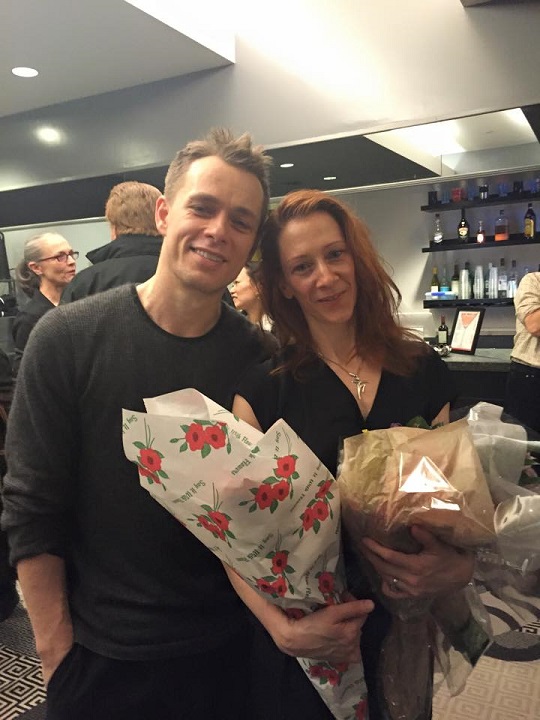
    Afterglow: Tadej Brdnik and Blakeley White-McGuire basking in the affectionate admiration of friends and fans after the performance. Photo courtesy of Karen Brounstein.

  • Ax/Robertson @ The New York Philharmonic

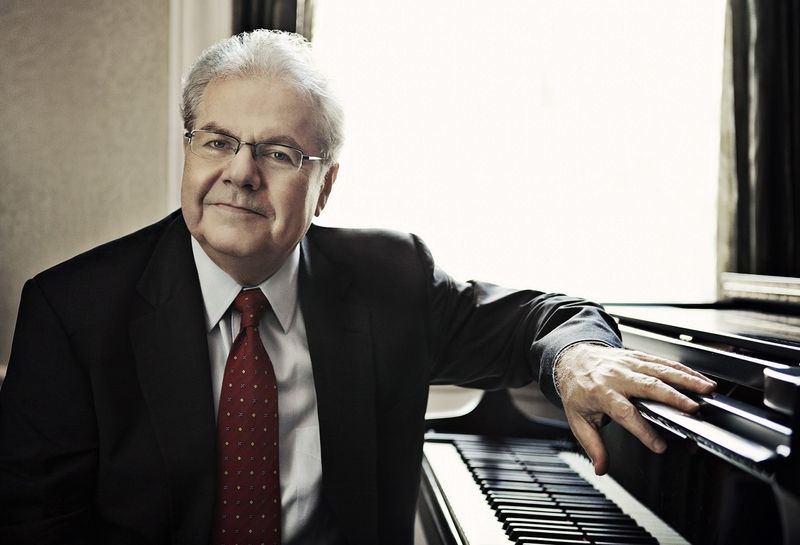
    Emanuel Ax

    Above: Emanuel Ax

    Thursday January 29th, 2015 – The esteemed pianist Emanuel Ax, enormously popular with New York Philharmonic audiences, was warmly cheered tonight after his performance of the Chopin piano concerto #2. David Robertson was on the podium for a programme that proved highly enjoyable and that allowed several of the individual players of the orchestra to shine.

    5377c09f319dd.preview-620

    Above: David Robertson

    As a brief and savorable prelude, the Vocalise of Sergei Rachmaninoff was rendered in full romantic bloom by Mr. Robertson and the orchestra. Originally a wordless composition for soprano, the Vocalise was written in 1915; the composer went on to orchestrate the work which is perhaps his best-known melody, whether performed in the arrangement for soprano and orchestra or for orchestra alone. So many of Rachmaninoff’s best-loved works are in a minor key, giving the music a mood of melancholy and gentle regret. The orchestra played it with distinction; the melodic familiarity of the piece has the poignant effect of encountering an old friend one has not seen for many years.

    Mr. Ax then appeared for the Piano Concerto No. 2 of Frédéric Chopin. In the summer of 1829, the 19-year-old Chopin, recovering from the breaking of an unhappy romantic attachment, sketched out the F-minor concerto and when he returned to Warsaw for the winter season, he performed this new concerto at the National Theatre the following March. The concerto gained Chopin the public exposure and audience acclaim that his numerous private salon performances could not have achieved.

    As the years passed, musicologists began to denigrate the Chopin concertos as being inferior to much of his writing for solo piano. Tonight’s superb performance made an emphatic stand in the concerto’s favor: it’s simply a beautiful piece of music.

    A contemporary account from the concerto’s premiere in 1830 records: “How beautifully (Chopin) plays. What fluency! What evenness!” And the same could be said of Mr. Ax’s performance tonight. In a refined partnership with Maestro Robertson, the pianist let the music flow with grace and charm, allowing us to savour the thematic generosity of Chopin in an illuminating performance. The unfortunate ringing of a phone just as the concerto’s first movement ended prompted a witty exchange between pianist and conductor. But order was immediately restored as Mr. Ax commenced the Larghetto, a movement full of lyricism in which the pianist’s glowing tone captivated the audience. With flourishing agility, the pianist then took wing in the final Allegro vivace. Near the end, trumpet calls herald the concerto’s final rippling cadences; it all ends with Mr. Ax striking a single low note as the orchestra takes the final chord. The audience’s warm expressions of admiration drew Mr. Ax to offer us a Chopin encore, summoning up visions of the Jerome Robbins ballet DANCES AT A GATHERING.

    The Firebird (Suite/1919) – Igor Stravinsky arranged three suites from the full score of The Firebird, in 1911, 1919 and 1945. It is the second of these which is most frequently played today, containing as it does approximately half the music of the complete score. This suite follows the narrative of the original ballet scenario, so familiar to admirers of the Balanchine/Chagall incarnation often seen across the Plaza at New York City Ballet. The atmospheric score – Stravinsky at his most colorful  and melodious – casts a spell of enchantment. It includes themes from two Russian folk songs: one a lyrical melody danced by the captive princesses, and the second the regal anthem which closes the ballet.

    Maestro Robertson and the Philharmonic players reveled in this extraordinary music, with oboist Sherry Skylar particularly impressive in her plaintive theme. The conductor drew forth some ravishing, shimmering piani as well as the lulling tenderness of the Berceuse; and the nightmarish Infernal Dance of  Kastcheï’s ghoulish slaves was given the full, brilliant treatment.

    The Miraculous Mandarin (Suite) is drawn from Bela Bartók’s pantomime-ballet of the same title. The original theatrical setting of the piece (written 1918-1919) was considered too vulgar in its portrayal of lurid sex, violence, and the macabre. After its 1929 premiere at Cologne, it was banned after a single performance. But Bartók, perhaps foreseeing that the ballet would not survive as a stage work, had already arranged the Suite, which we heard tonight in a thoroughly engrossing performance.

    Opening with a big, noisy clatter of sound, the score employs a wide range of instrumentation to ear-tingling effect: piano, flute, harp, xylophone, and celeste all play a part in this sonically intriguing piece. Ms. Skylar’s oboe artistry and Anthony McGill’s remarkable clarinet playing were especially clear and colourful. And a broad, dancing passage with drums near the end served as a reminder of the Suite’s balletic beginnings.

    I at first wondered how the Stravinsky and Bartok would play back-to-back, but the cumulative effect was indeed rewarding: both works have a similarity of texture at certain points, and there’s even some over-lapping of effects – trombone glissandi and frequent interjections of solo winds – which made second half of tonight’s concert every bit as satisfying as the first half.