Tag: Bayreuth Festival

  • Boulez Conducts TRISTAN & ISOLDE

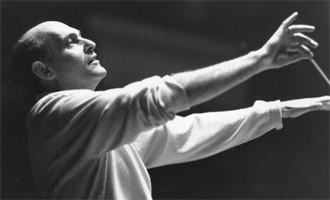
    Pierre-boulez

    Above: Pierre Boulez

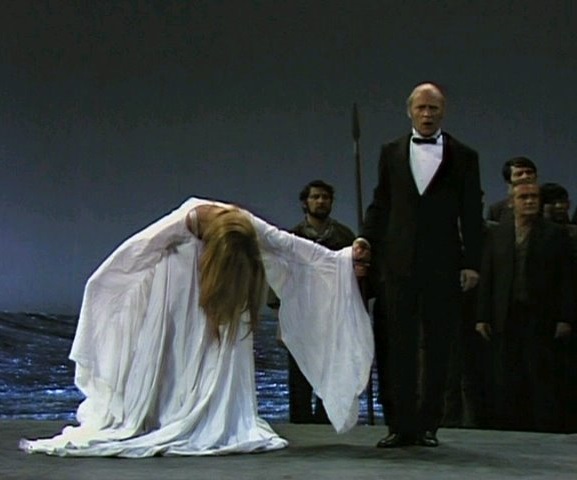
    In April of 1967, the Bayreuth Festival’s Wieland Wagner production of TRISTAN UND ISOLDE was brought to Osaka, Japan, for three performances, featuring a stellar cast: Wolfgang Windgassen (Tristan), Birgit Nilsson (Isolde), Hertha Töpper (Brangäne), Frans Andersson (Kurvenal),  Hans Hotter (King Marke), Sebastian Feiersinger (Melot), Georg Paskuda (Young Sailor/Shepherd), and Gerd Nienstedt (Steersman).

    These performances marked the only time Pierre Boulez conducted this Wagner masterpiece.

    Watch and listen here.

    For me, this recording captures, perhaps more truly than any other, the way Birgit Nilsson sounded live in the performances of hers that I heard at The Met.

  • Sinopoli: PARSIFAL @ Bayreuth ~ 1998

    Sotin elming

    Above: Hans Sotin as Gurnemanz, Poul Elming as Parsifal

    Wagner’s PARSIFAL from the 1998 Bayreuth Festival, conducted by Giuseppe Sinopoli.

    Watch and listen here.

    Cast:

    Amfortas – Falk Struckmann
    Titurel – Matthias Hölle
    Gurnemanz – Hans Sotin
    Parsifal – Poul Elming
    Klingsor – Ekkehard Wlaschiha
    Kundry – Linda Watson
    Grail Knights: Richard Brunner, Sándor Sólyom-Nagy
    Squires: Sarah Fryer, Jane Turner, Helmut Pampuch, Peter Maus
    Alto solo: Andrea Bönig 

    Flower Maidens: Claudia Barainsky, Joyce Guyer, Simone Schröder, Katerina Beranova, Dorothee Jansen, Laura Nykänen

  • PARSIFAL @ Bayreuth ~ 1981

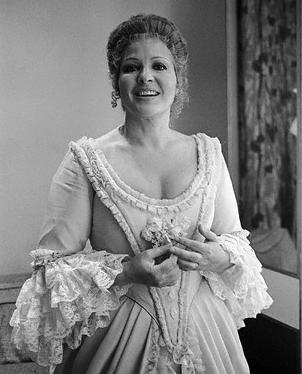
    Snapshot kundry randova

    Above: Eva Randová as Kundry

    Horst Stein conducts Wagner’s PARSIFAL at the Bayreuth Festival 1981. Watch and listen here.

    Cast:

    Amfortas: Bernd Weikl ~ Titurel: Matti Salminen ~ Gurnemanz: Hans Sotin ~ Parsifal: Siegfried Jerusalem ~ Klingsor: Leif Roar ~ Kundry: Eva Randová ~ 1st Knight of the Grail: Toni Krämer ~ 2nd Knight of the Grail: Heinz Klaus Ecker ~ 1st Squire: Marga Schiml ~ 2nd Squire: Hanna Schwarz ~ 3rd Squire: Helmut Pampuch ~ 4th Squire: Martin Egel ~ Flower Maidens: Norma Sharp, Carol Richardson, Hanna Schwarz, Mari-Anne Häggender, Marga Schiml, and Margit Neubauer ~ Alto Solo: Hanna Schwarz

  • DIE WALKURE @ Bayreuth ~ 2016

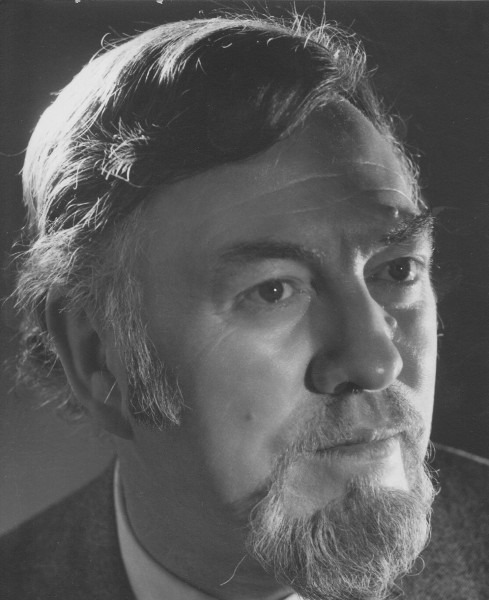
    Lundgren

    Above: bass-baritone John Lundgren

    Wagner’s DIE WALKURE from the 2016 Bayreuth Festival, conducted by Marek Janowski with the following cast:

    Siegmund – Christopher Ventris
    Hunding – Georg Zeppenfeld
    Wotan – John Lundgren
    Sieglinde – Heidi Melton
    Brünnhilde – Catherine Foster
    Fricka – Sarah Connolly
    Gerhilde – Caroline Wenborne
    Ortlinde – Dara Hobbs
    Waltraute – Stephanie Houtzeel
    Schwertleite – Nadine Weissmann
    Helmwige – Christiane Kohl
    Siegrune – Mareike Morr
    Grimgerde – Wiebke Lehmkuhl
    Rossweisse – Alexandra Petersamer

    Watch and listen here.

  • Janis Martin as Kundry

    Janis Martin

    The American soprano Janis Martin was my first Kundry; she was also my first Sieglinde and Marie in WOZZECK. She was a featured singer at the Bayreuth Festival from 1968 to 1989 where she appeared in nine different roles: Magdalene, Fricka, Eva, the Second Norn, Gutrune, Kundry, Freia, Sieglinde, and Brünnhilde. She returned in for the 1995 and 1997 festivals, again as Kundry.

    Janis Martin sang nearly 150 performances at the Metropolitan Opera, commencing in 1962 as Flora Bervoix in TRAVIATA. As a young opera-lover, I heard her many times on the Texaco broadcasts. She eventually progressed to “medium-sized” roles: Siebel, Nicklausse, Lola in CAVALLERIA RUSTICANA. Hearing her in these roles (in which she excelled), one would not have anticipated how her career would develop.

    Ms. Martin left The Met in 1965 to build a career abroad, moving into soprano territory. She returned to The Met from 1974 thru 1977, when I saw her as Kundry, Marie in WOZZECK, and Sieglinde. Following another hiatus, she was back at Lincoln Center from 1988-1992, singing the Witch in HANSEL & GRETEL, the Dyer’s Wife in FRAU OHNE SCHATTEN, Senta, the Foreign Princess in RUSALKA, and two performances of Tosca.

    Here is Ms. Martin as Kundry in a scene from the 1973 Bayreuth production of PARSIFAL; Jean Cox sings the title-role, with Eugen Jochum conducting:

    Janis Martin – Ich sah das kind ~ PARSIFAL – with Jean Cox – Bayreuth 1973

    ~ Oberon

  • Franz Mazura Has Passed Away

    Mazura

    The great Austrian singing-actor Franz Mazura has passed away at the age of 96. Mazura made his operatic debut at Kassel in 1949, and went on to appear at numerous German theaters in a wide variety of roles. His career eventually took him to the great stages of Paris, Vienna, Bayreuth, and New York City.

    Mazura was a stalwart at the Bayreuth Festival for fifteen summers, beginning in 1971. His most frequent Wagnerian roles were Alberich in the RING Cycle and Klingsor in PARSIFAL, but he also sang the Wanderer and Gurnemanz at the Wagner shrine.

    Franz Mazura as Gurnemanz – Bayreuth 1973

    Cap189

    At Bayreuth, he appeared in 1976 as Gunther in the controversial Pierre Chéreau centennial production of the RING Cycle: photo above, with Dame Gwyneth Jones as Brunnhilde.

    In 1979, Mazura sang Doctor Schön and Jack the Ripper in the premiere of the completed version of Alban Berg’s LULU at the Paris Opéra, conducted by Pierre Boulez.

    After making his Metropolitan Opera debut in 1980 in the Berg double-role, Franz Mazura went on to appear on The Met stage 175 times. In 1989, he was a magnificent Alberich in the RING Cycle, my first experience of seeing the Cycle in the span of a week. Earlier, in 1987, he had stepped in as Wotan in WALKURE, a performance my friend Paul Reid attended; Paul described Mazura as “…a cantankerous god.”

    Franz Mazura’s final Met appearance was as Schigolch in LULU in 2002.

    Here is a sampling of his extraordinary portrayal of Klingsor:

    PARSIFAL – scene from Act II – Leonie Rysanek & Franz Mazura – Met bcast 1985(1)

    Among the many roles Franz Mazura sang in his long career was the Spirit Messenger in DIE FRAU OHNE SCHATTEN:

    Helga Dernesch & Franz Mazura – FRAU OHNE SCHATTEN ~ opening scene – C Perick cond – Met 1989

    He displayed his versatility in such roles as La Roche in CAPRICCO, Pizarro in FIDELIO, Scarpia in TOSCA, the Doctor in WOZZECK, Creon in OEDIPUS REX, and the Speaker in ZAUBERFLOETE. His final operatic appearance was at Berlin as Schwarz in MEISTERSINGER on April 21st, 2019…the eve of his 95th birthday.

    Franz Mazura appears in the film of Pierre Chéreau‘s 2013 production of ELEKTRA from the Aix-en-Provence Festival; he makes a touching effect as the Tutor of Orest.

    ~ Oberon

  • New Bayreuth

    Scanned Section 4-1

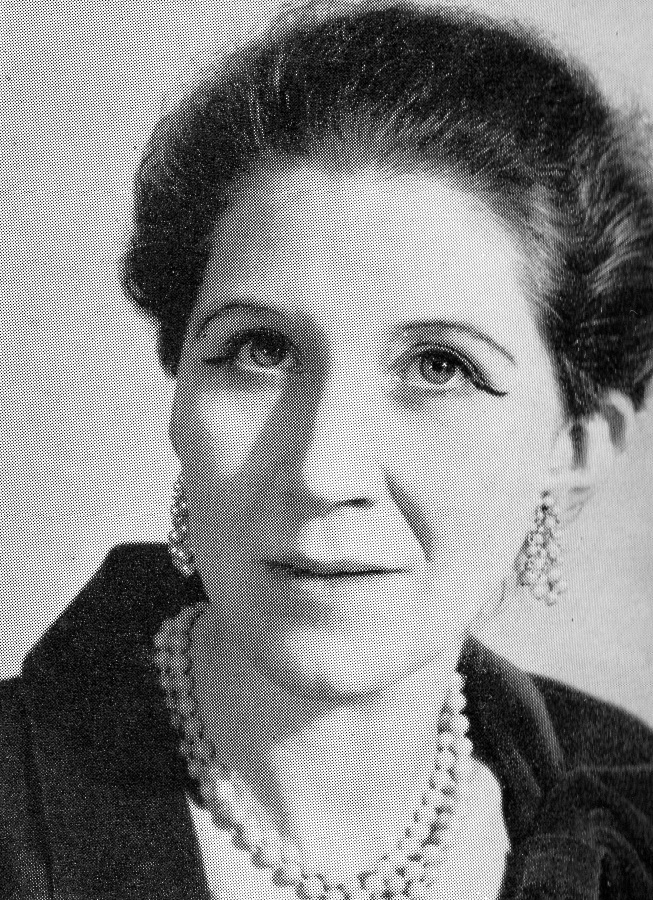
    Penelope Turing (above) was an Englishwoman who attended the second post-war Bayreuth Festival in 1952, returning to the Green Hill for many seasons thereafter. She continued to attend performances thru the Summer of 2009, and she passed away in 2010.

    Turing’s book, New Bayreuth, was first published in 1969. It is full of detailed writing about both the scenic and the musical aspects of the productions she saw there over her first seventeen years of attending the Festival, commencing – in 1952 – with DAS RHEINGOLD, in Wieland Wagner’s ground-breaking production which had premiered the Summer before.

    Turing’s writing about the voices and characterizations of the eminent singers who appeared in those first post-war festivals is fascinating to read.  

    Her descriptions are so evocative. Of curtain-rise for the Wieland Wagner PARSIFAL, which had been introduced in 1951, Turing writes: “According to the score, the scene is a glade in a solemn, shady forest in the domain of the Grail. In what we saw, however, there was no forest definable, nor even a tree. We felt the forest rather than saw it: a legendary forest that was of no time and no place, and one, moreover, over which mystery and sorrow and pain seemed to have brooded long.”

    After reading that, on page 6, I was hooked on Turing’s book, and have been barely able to put it down. Turing’s writing is free of ‘intellectual’ blather, theories, and nit-picking. She writes about what she saw and what she heard, and how she felt about it all. 

    Md30327760771

    The book contains many black-and-white photos from those years: of the iconic productions, and of the fabled singers who appeared in them; of the Festspielhaus, and of the town of Bayreuth. These produce a feeling of nostalgia for a place I’ve – unfortunately – never been.

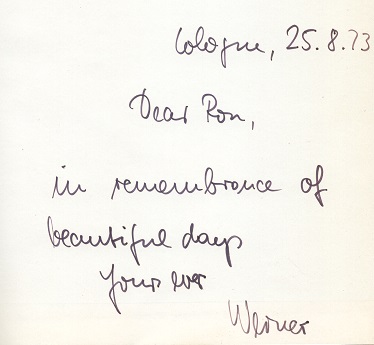
    But there’s another reason I’m so captivated by the book. As I so often do, I bought New Bayreuth in a used, hardcover edition via Alibris. Used books invariably have a life of their own, and, opening it for the first time, I found this inscription:

    Scanned Section 2-1

    Who were Ron and Werner? Were they lovers? Had they gone to Bayreuth together, or did they perhaps meet one another there? Are they still alive? My guess would be: probably not.

    But now their book has come down to me, and it is intriguing in so many ways.

    ~ Oberon

  • At Home With Wagner VI

    Richard-wagner-1351529175-view-0

    Wagnerian afternoons in the Summer: from the Bayreuth Festival 1961 comes the prologue and first act of GOTTERDAMMERUNG featuring Birgit Nilsson at her most marvelous. Conducted by Rudolf Kempe, the performance generates tremendous excitement, most notably in the thrilling build-up to the Dawn Duet. Nilsson unleashes her patented lightning-bolt top notes, and hearing her on this form reminds me of my first encounters with her live at The Met where in 1966 she sang a series of Turandots that were simply electrifying.

    Elisabeth Schärtel

    The performance is very fine all around, opening with a thoroughly absorbing Norn Scene which begins with the richly expressive singing of contralto Elisabeth Schärtel (above) followed soon after by the equally impressive Grace Hoffman. It’s rather surprising to find Regine Crespin singing the Third Norn. She had made a huge success at Bayreuth in 1958 as Kundry, and had repeated that role at the next two festivals. In 1961 she was invited back to the Green Hill for Sieglinde, and thus she was able to take on the Norn as part of her summer engagement. She sings beautifully, with her distinctive timbre, though there is a trace of tension in her highest notes.

    317372_340994792689362_1142580761_n

    Above: Birgit Nilsson; we used to refer to her as “The Great White Goddess” or simply “The Big B”. The thrilling accuracy and power of her singing here, as well as her ability to create a character thru vocal means, is breath-taking.

    Hans Hopf is a fine match for Nilsson in the Dawn Duet; he is less persuasive later on when his singing seems a bit casual. Wilma Schmidt (Gutrune) and the always-excellent Thomas Stewart (Gunther) make vocally strong Gibichungs, and the great Wagnerian basso Gottlob Frick is a dark-toned Hagen with vivid sense of duplicity and menace. Rudolf Kempe again shows why he must be rated very high among the all-time great Wagner conductors: his sense of grandeur and ideal pacing set him in the highest echelon.

    ~~~~~~~~~~~~~~~~~~~~~~~~~~~~~~~~~~~~~~~~~~~~~~~~~~~~~~~~~~~~~~~~~~~~~~~~~~~~~~~~~~~~~~~~~~~ 

    Gerhard Stolze

    Gerhard Stolze (above) is the Loge in a RHEINGOLD from the Bayreuth Festival 1964; I have a special love for Mr. Stolze in this role as he was my first Loge – at The Met on February 22, 1968, a broadcast performance conducted by Herbert von Karajan and my first experience of a RING opera live. Here at Bayreuth, as later at The Met, Stolze brings a wonderfully debauched, almost greasy vocal quality to the vain, spoiled demi-god. The voice is large and effortlessly penetrating, but he can also be tremendously subtle: after screaming “Durch raub!’ (‘By theft!”) when Wotan asks Loge how the Rhinegold might be acquired, Stoltze goes all lyrical as he says: “What a thief stole may be stolen from the thief…” this is but one of Stotze’s countless brilliant passages in the course of his portrayal. At Nibelheim and later, as Loge taunts the captured Alberich, Stolze is simply superb.

    Two other singers who appeared in my Met/Karajan RHEINGOLD are also heard in this Bayreuth performance: Theo Adam has a big, burly voice and sings imposingly if not always with a lot of tonal allure. His Wotan builds steadily throughout the opera to an imposing rendering of Wotan’s greeting to Valhalla and the entire final scene. Zoltán Kelemen is a splendid Alberich; his handsome baritone sound sometimes shines thru in what is essentially a dramatic character role. Power and calculation mark his traversal of the first scene; later, in Nibelheim, Kelemen is wonderfully subtle. Having been tricked by Loge and kidnapped, he’s truly fabulous as he summons his slaves to bring the treasure up as ransom for his freedom. Later, having lost everything, his crushing sense of vulnerability gives way to a violent hurling of the curse at Wotan.

    Z Keleman

    Above: Zoltán Kelemen as Alberich

    Grace Hoffman is a capital Fricka, bringing verbal urgency and vocal attractiveness to her every line, most expressive as she draws Wotan back to her after Erda’s intervention. Jutta Meyfarth, a very interesting Sieglinde on the 1963 Bayreuth WALKURE conducted by Rudolf Kempe, is too stentorian and overpowering as Freia, a role which – for all its desperation – needs lyricism to really convince. Hans Hopf, ever a stalwart heldentenor, probably should not have tried Froh at this point in his career: he sounds too mature. Marcel Cordes is a muscular-sounding Donner; there is an enormous thunderclap to punctuate Donner’s “Heda! Hedo!”

    The estimable contralto Marga Höffgen brings a real sense of mystery to Erda’s warning. Gottlob Frick is a vocally impressive Fasolt, his scene of despair at giving up Freia is genuinely awesome. Peter Roth-Ehrang (Fafner) and Erich Klaus (Mime) are names quite unknown to me; the basso is a bit blustery but has the right feeling of loutishness. Herr Klaus is a first-class Mime, with his doleful singing in the Nibelheim scene giving way to a fine mix of dreamy dementia and raw power as he tells Loga and Wotan of his dwarvish despair. Barbara Holt as Woglinde plucks some high notes out of the air; Elisabeth Schwarzenberg and the excellent Sieglinde Wagner as her sister Rhinemaidens.
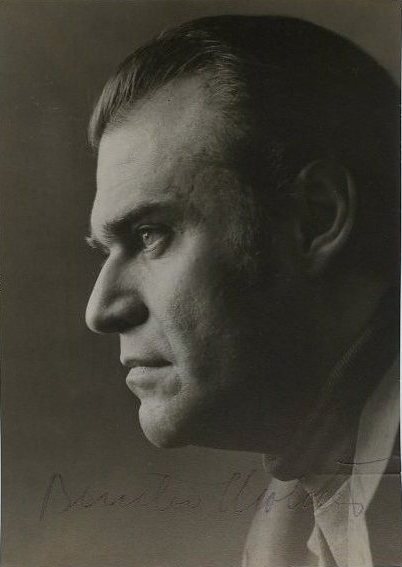
    Klobucar

    Berislav Klobucar (above), who conducted 21 Wagner performances at The Met in 1968 (including taking over WALKURE from Herbert von Karajan when the latter withdrew from his half-finished RING Cycle for The Met) opens this RHEINGOLD with a turbulent prelude. Klobucar has an excellent feel for the span of the opera, for the intimacy of the conversational scenes, and for the sheer splendour of the opera’s finale.

    ~~~~~~~~~~~~~~~~~~~~~~~~~~~~~~~~~~~~~~~~~~~~~~~~~~~~~~~~~~~~~~~~~~~~~~~~~~~~~~~~~~~~~~~~~~~
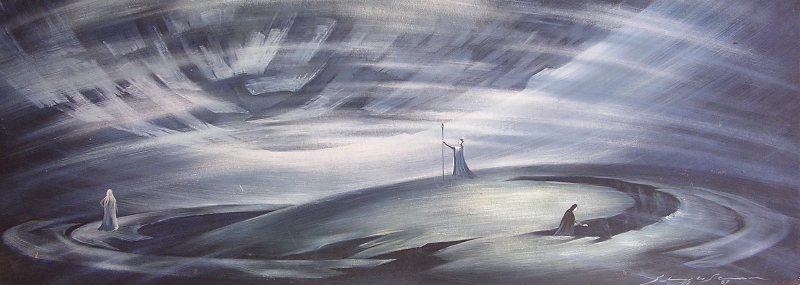
    1967-rheingold-salzburg-easter-festival-karajan-1967

    Above: a Günther Schneider-Siemssen design for the Herbert von Karajan Salzburg Festival production of the RING Cycle, 1967.

    Thinking of my Karajan/RHEINGOLD introduction to the RING at The Met in 1968 caused me to next take up the conductor-director’s complete WALKURE and GOTTERDAMMERUNG from the 1967 Salzburg Festival where his production of the Cycle originated. Of course, he only ended up conducting RHEINGOLD and WALKURE at The Met though the two remaining operas were staged there in his absence, with the productions credited to him. The settings remained in use at The Met thru 1981, and then the Otto Schenk production commenced in 1986.

    I must admit to never having listened to Karajan’s commercial RING Cycle (maybe a few random scenes but never any of the complete operas); it’s simply one of those inexplicable sins of omission which all opera lovers must eventually confess to. Maybe someday I will get around to it, though I’m so taken up with all these live RING recordings that Opera Depot keep tempting us with.

    At any rate, I must say I don’t much care for Karajan’s first act of WALKURE, at least not as it was performed at Salzburg in 1967. It feels to me terribly slow and overly polite. Gundula Janowitz and Jon Vickers seem much of the time to be vocally walking on eggshells: they whisper and croon gently to one another and the lifeblood seems to drain out of the music. Martti Talvela is his usual excellent self as Hunding; once he has gone to bed, Vickers commences a properly reflective sword monologue (the first orchestral interjection of the Sword motif ends on a cracked note). The tenor is stunning in his prolonged cries of “Wälse! Wälse!”, and then comes Janowitz’s ” Der Männer Sippe” which is verbally alert but there’s a slight tension in her upper notes and a feeling of being a bit over-parted. They sing very successfully thru the familiar “Winterstürme” and “Du bust der Lenz” all filled with attractive vocalism but Karajan maintains a rather stately pacing thru to end end of the act: there’s no impetus, no sense of being overwhelmed by sexual desire. Actually I found it all somewhat boring, and my mind tended to wander.

    A complete volte face for Act II, one of the finest renderings of this long and powerful act that I have ever encountered. Karajan launches the prelude, weaving together the various motifs, and Thomas Stewart unfurls Wotan’s opening lines commandingly. Regine Crespin’s sings a spirited “Ho-Jo-To-Ho!” and then Fricka arrives on the scene…
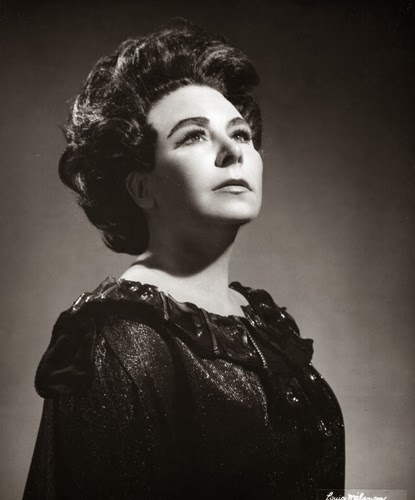
    16 Ludwig Fricka Walkure Melancon 1967

    …in the marvelous person of Christa Ludwig (Louis Melançon photo, above). When people ask me, “Who was the greatest singer you ever heard?” I invariably reply “Christa Ludwig” even though on a given day the memory of some other voice might seem to rival her. But in everything I have heard from her, both live and on recordings, Ludwig seems to have the ideal combination of a highly personal timbre, natural and effortless technical command, a remarkably even range, phenomenal abilities as a word-colorist, and overwhelming warmth and beauty of sound. Her Fricka here is magnificent in every way, and so supremely Christa

    6a00d8341c4e3853ef01901e20b373970b-800wi

    The scene between Fricka and Wotan is so impressive, yet incredibly Thomas Stewart (above, with Karajan) goes on to surpass himself with one of the most thrilling and spine-tingling renderings of Wotan’s monolog that I have ever experienced. Stewart vocally displays every nuance of the god’s emotional state as he confides in his daughter, first in his long ‘historical’ narrative which grumbles and whispers its way into our consciousness. Crespin is an ideal listener, her beauteously sung queries lead her father to divulge more and more. Soon Stewart is pouring out both his vanity and despair; the temperature is at the boiling point when he reaches “Das ende! Das ende!”, overcome by tears of anguish. Instructing Brunnhilde to honor Fricka’s cause and defend Hunding in the impending fight, Stewart crushes Crespin’s protests with a furiously yelled “Siegmund falle!” (“Siegmund must die! That is the Valkyrie’s task!”) and he storms away. I had to stop at this point; Stewart’s performance had both moved and shaken me and I wanted to pause and reflect.

    As beautifully as Crespin and Vickers sing the ‘Todesverkundigung’ (Annunciation of Death), the scene does not quite generate the mysterious atmosphere that I want to experience here. Thomas Stewart’s snarling “Geh!” as he send Hunding to his fate is a fabulous exclamation mark to end the act.

    Act III opens and there is some very erractic singing from the Valkyries in terms of pitch and verbal clarity. Crespin’s top betrays a sense of effort in her scene with Sieglinde, and Janowitz’s voice doesn’t really bloom in Sieglinde’s ecstatic cry ” O hehrstes Wunder!”  Thomas Stewart hurls bold vocal thunderbolts about as he lets his anger pour out on Brunnhilde and her sisters.

    And then at last the stage is cleared for the great father-daughter final scene. Crespin is at her very best here, singing mid-range for the most part and with some really exquisite, expressive piano passages. Only near the end, when the music takes her higher, does the tendency to flatness on the upper notes seem  to intrude. Stewart is impressive throughout. Karajan takes the scene a bit on the slow side, but it works quite well.

    It should be noted that the voice of the prompter sometimes is heard on this recording, especially in Act I.

    ~~~~~~~~~~~~~~~~~~~~~~~~~~~~~~~~~~~~~~~~~~~~~~~~~~~~~~~~~~~~~~~~~~~~~~~~~~~~~~~~~~~~~~~~~~~
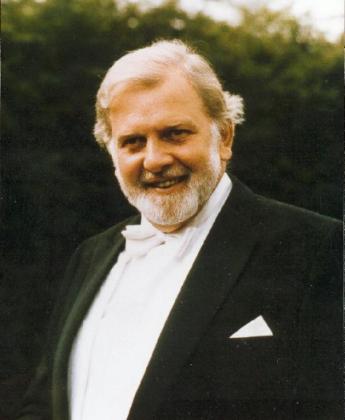
    Ridderbusch

    Above: Karl Ridderbusch, who sang Hagen in the 1967 Salzburg Festival RING Cycle.

    Herbert von Karajan’s GOTERDAMMERUNG, from the Salzburg Festival 1970, starts off with a very fine Norn Scene. Lili Chookasian – after a few warm-up measures – and Caterina Ligendza are authetically Wagnerian as the first and third sisters, with the resplendent Christa Ludwig luxuriously cast as the 2nd Norn. Her superb vocalism is marked by a great lieder-singer’s colourings of the text.

    Helga Dernesch and Jess Thomas give a sturdily-sung rendition of the Dawn duet. Though Dernesch’s highest notes seem somewhat tense, she does sustain a solid high-C at the duet’s conclusion. Karl Ridderbusch is a potent Hagen, able to bring out a softer grain to the tone when he wants to. His sound is somewhat baritonal, but he still hits the lowest notes with authority. Thomas Stewart is an outstanding Gunther, a role that often loses face as the opera progresses. Gundula Janowitz  is not my idea of a good Gutune: she sound mature and a bit tired.

    Christa Ludwig’s Waltraute is a performance of the highest calibre; her superb musicality wedded to her acute attentiveness to the words make this scene the highlight of the performance. Dernesch is good here also, but both she and Jess Thomas seem to flag a bit in vocal energy in the rape scene.

    Act II opens with another of my favorite RING scenes: Alberich (Zoltán Kelemen) appears to his son Hagen (Karl Ridderbusch). Kelemen, so musical in the 1964 Klobucar RHEINGOLD reviewed above, here resorts to sprechstimme and all manner of vocal ‘effects’: I wonder if this is what Karajan wanted, or is this simply what the baritone came up with. Ridderbush sings much of Hagen’s music here in an appropriately dreamy half-voice. A bit later he turns on the power with his “Hoi ho!”, summoning the vassals; the men’s chorus lung it lustily in response. Despite the continued feeling of effort behind Helga Dernesch’s high notes, she hits them and holds them fair and square. Jess Thomas sounds a bit tired as Siegfried; though he manages everything without any slip-ups, the voice just seems rather weary. Gundula Janowitz’s Gutrune is much better in Act II than earlier in Act I, and Thomas Stewart’s Gunther transforms what is sometimes viewed as a ‘secondary’ role into a major vocal force in this performance.

    I had high hopes for the opening scene of Act III: the Rhinemaidens – Liselotte Rebmann, Edda Moser, and Anna Reynolds are all fine singers. Yet they don’t quite achieve a pleasing blend. Jess Thomas sounds brassy and one keeps thinking he might have a vocal collapse, but he stays the course. It is left to Dernesch to be the performance’s saving grace and she nearly accomplishes it: the sense of vocal strain is successfully masked for the most part and she hits and sustains the high notes successfully though it’s clear she is happier singing lower down; she did in fact become a highly successful dramatic mezzo in time. Dernesch gives the Immolation Scene a tragic dimension, and then Karajan sweeps thru the long orchestral postlude with a sense of epic grandeur.

    Overall, Karajan’s GOTTERDAMMERUNG is impressive to hear. Were Helga Dernesch and Jess Thomas thoroughly at ease vocally the overall performance would have been quite spectacular. As it is, it’s Christa Ludwig, Thomas Stewart, and Karl Ridderbusch who make this a memorable Twilight of the Gods.

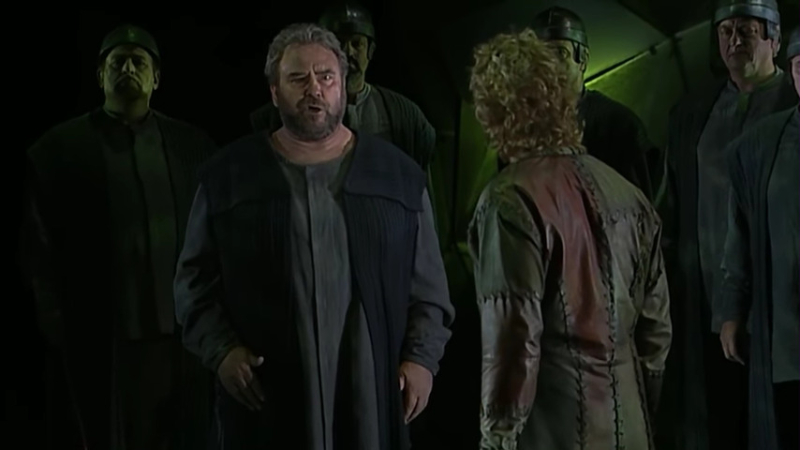
  • Irene Dalis as Kundry

    Dalis-719053

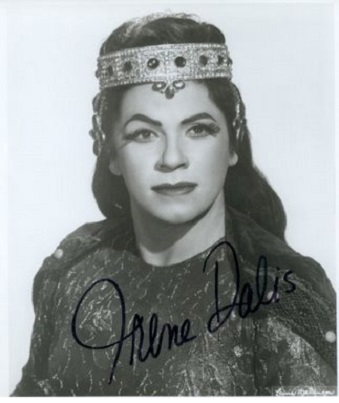
    Irene Dalis, a particular favorite of mine in my formative first decade of opera-going, made only one commercially-released recording during her distinguished career – and even this derived from a live performance: PARSIFAL from the 1962 Bayreuth Festival. She seems never to have found her way into a recording studio (though there is supposedly a set of CARMEN highlights recorded by her in German…which I can’t seem to locate); some of her Met broadcasts have now been issued on the Sony label.

    The Philips-label release of the Bayreuth ’62 PARSIFAL is a highly-regarded recording; the ‘Bayreuth Sound’ has been well-captured and the performance under Hans Knappertsbusch is overall very impressive. However, I’ve never felt that this particular performance of Kundry was representative of Irene Dalis’s finest work. So I was happy to receive from Dmitry a copy of Act II from the following year’s (1963) Bayreuth Festival which is now available at Opera Depot.

    To my ears, Irene seems far more herself vocally in this ’63 Kundry than she did the previous Summer. She sings a great deal of the role piano, beautifully supported by Knappertsbusch. This gives her interpretation a mysterious sense of intimacy; after the kiss (marvelously underscored by Kna and the orchestra) the tide begins to turn against Kundry. Irene’s colorful voicing of the character’s desperation and – later – fury makes for an exciting dramatic build-up in the final minutes of the Act. Traces of tension in some of her upper notes are evident, but her intense focus on Kundry’s psychological conflict propels the singer thru any thorny moments with success. Throughout, Knappertsbusch’s pacing is spot-on: ever forward-moving but not shirking either the sensual or spiritual aspects of the music. Wolfgang Windgassen is on fine form here, bringing firm lyricism and then steely power to the music of Parsifal’s emotional evolution. Gustav Neidlinger, Solti’s Alberich in the famous London/Decca RING, is a commandingly malevolent Klingsor.

  • At Home With Wagner

     Richard_wagner2

    Thanks to my friend Dmitry, I’ve added some exciting Wagner performances to my CD collection over the past few weeks: parts of two historic RING Cycles, a 1976 Met broadcast of LOHENGRIN conducted by James Levine (I was there!), and a surprisingly thrilling Act I of WALKURE from Hamburg 2008, conducted by Simone Young.

    Keilberth

    Chronologically the earliest of these acquisitions – the WALKURE, third Act of SIEGFRIED, and GOTTERDAMMERUNG – come (in surprisingly good sound) from the 1953 Bayreuth Festival. These are conducted by Josef Keilberth (above) who shared the RING podium duties with Clemens Krauss at the ’53 festival. The Krauss Cycle has been isssued commercially and is considered legendary; Keilberth’s 1955 Cycle is also available (from Testament) but this ’53 Keilberth seems a real rarity, at least here in the USA (I’ve seen import copies selling for $300+, while Dmitry and I found it at Opera Depot for considerably less).

    Dmitry gave me the GOTTERDAMMERUNG first and it’s a tremendous performance; this prompted me to ask for more and I’m really pleased with what I’m hearing. Keilberth is grand but never ponderous; his Twilight of the Gods unfurls like a magnificent sonic banner. The maestro has a powerhouse cast to work with.

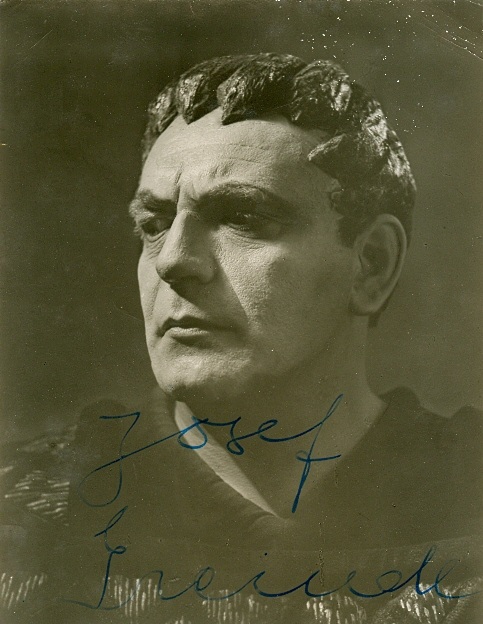
    Martha-Modl

    I’ve never ‘gotten’ Martha Modl (above) until very recently, but she’s teriffic here as Brunnhilde. Her voice production reminds me somewhat of Irene Dalis’s. Modl’s flaming intensity and the colour and vitality of her singing are something to hear. Wolfgang Windgassen meets the huge demands of Siegfried with tireless power and is a good match for the soprano in terms of vocal generosity. A splendid Hagen from the Josef Greindl bristles with black-hearted malevolence, and in the most thrilling rendering of the role of Gunther that I’ve ever experienced, Hermann Uhde is overwhelming. With her rather odd tmbre, Natalie Hinsch-Grondahl nevertheless makes a mark as Gutrune. Ira Malaniuk’s superb singing as Waltraute makes me wish her long scene was even longer, and the mezzo is also a distinguished Second Norn in the prologue where she is joined by Maria von Ilosvay and then-soprano Regina Resnik.

    6186

    Back-tracking, I then took up the WALKURE from the same 1953 Keilberth RING and was again impressed by the immediacy of the sound. Herr Greindl (above) is again in cavernous voice, this time as Hunding. Regina Resnik and Ramon Vinay are the strong-voiced Walsung twins, though neither attain the heights that others have in this passionate music. The tenor’s baritonal sound  is sturdy but not particularly poetic and at one point the prompter gets involved, feeding him lines word for word. Miss Resnik gets lost at one point and her highest notes show a very slight sense of discomfort; her decision to switch to mezzo was a brilliant move and sustained her career for many years. In spite of these minor misgivings, Resnik and Vinay keep the temperature of the drama high, and Keilberth steers us thru the first act with true surety of hand.

    Hotter

    Hans Hotter (above) opens the second act grandly, and this performance shows why his Wotan was considered a revelation. Both in terms of godlike vocal heft and wonderfully nuanced shaping of the text, Hotter’s monolog is a masterpiece. Martha Modl flashes thru a spirited Ho-Jo-To-Ho though surprisingly later in the act, after the annunciation of death, she seems to tire a bit as she assures Siegmund she’ll protect him in the coming battle. Ira Malaniuk is a particularly fine Fricka; she doesn’t wheedle or whine but deals from the strength of her rightness. She is vocally so pleasing to experience, the registers even and the timbre filled with feminine dignity. Resnik and Vinay are effective here as the desperate lovers, seeking escape…waching over his sleeping sister-bride, Vinay finds the tenderness of the character. Resnik lets out a blood-curdling scream when Hunding strikes Siegmund dead. Hotter’s contemptuously whispered dismissal of Hunding followed by his towering rage as he sets out to punish Brunnhilde end the act with a veritable bang.

    In the Ride of the Valkyries, the sopranos swoop upward at will, not always in unison. Resnik handles the great scene of Sieglinde’s blessing of Brunnhilde quite exctingly; Hotter storms in and rages at his daughters who finally flee in terror. And then, starting with Brunnhilde’s ‘War es so schmalich’ the performance becomes something else altogether.

    Modl finds the magic that made her GOTTERDAMMERUNG so spell-binding, and Hotter is simply magnificent. The sound quality is pretty remarkable and the two singers give a performance that ranks wth my greatest experiences in 50+ years of listening to opera. Modl begins Brunnhilde’s self-defense with colours of deep despair, slowly gaining self-confidence. When she courageously tells her father that Sieglinde now keeps the sword Nothung, Hotter thunderoulsy reminds her “The sword that I shattered!!” Hotter outlines the punishment Brunnhilde will face; her pleading with him not to humiliate her is in vain. But Modl’s last desperate and gloriously sung passage finally wins the day; Hotter opens the floodgates and hs entire final scene is both vocally thrilling and wrenchingly expressive of a father’s longing and grief. Adjectives become superfluous on hearing this kind of vocalism.

    The third act of SIEGFRIED from this cycle is very exciting, commencing with Hotter’s majestic summons of Erda. As the act proceeds, it seems the great bass-baritone’s voice was recorded in a rather odd, somewhat echo-chamber acoustic. It doesn’t deter from his performance in the least, but it’s not quite as pleasing to listen to as the WALKURE. Maria von Ilosvay is a firm-toned and not overly weighty Erda; like her colleague Ira Malaniuk, Ilosvay seems largely to have been forgotten these days, which is a shame, It’s a wonderful voice. Windgassen arrives for his confrontation with his grandfather in fine vocal fettle; the two long-standing colleagues play up the dark humour of their banter at first, but after Siegfried puts Wotan in his place by breaking the spear, the once-powerful god slinks away in shame. Windgassen manages to hold his own against the fresh-voiced Modl, awakening as Brunnhilde and singing with remarkable intensity: despite her successful but less-than-blooming forays to the high-Cs, Modl’s voice is both maternal and seductive, with an unsettlling sexual sorcery in her timbre that makes it utterly distinctive.

    Overall this Keilberth cycle is fascinating in so many ways and seems to have caught the singers mostly at their peaks. I suppose I’ll want to eventually have the RHEINGOLD also. 

    ~~~~~~~~~~~~~~~~~~~~~~~~~~~~~~~~~~~~~~~~~~~~~~~~~~~~~~~~~~~~~~~~~~~~~~~~~~~~~~~~~~~~~~~~~~~

    Solti-conducting3

    From London’s Royal Opera House comes a RING Cycle conducted by Sir Georg Solti (above), from which the WALKURE (in very good sound) makes a strong impression, notably in the radiant singing of Dame Gwyneth Jones as Sieglinde. Apart from Ernst Kozub as Siegmund, the principals are all from the Royal Opera “home team”. Mr. Kozub is bright-voiced and steady, and Dame Gwyneth – just coming into fame – is already showing signs of the great Wagnerienne she was to become. Michael Langdon’s powerful Hunding anchors the first act, excitingly led by Solti.

    Amy Shuard is a bit uneven as Brunnhilde though overall she makes a positive impression; a bit of flatness here and there – most notable in the early pages of the Todesverkundigung – is offset by her bright Battle Cry and her moving singing of the opera’s final scene. Josephine Veasey starts off as a rather ladylike Fricka, but she soon works herself into a fine fettle of self-righteous indignation and casts off vivid dramatic sparks, her vocalism fervent and secure.   

    347

    It is especially gratifying to hear David Ward (above) as Wotan. I still vividly recall hearing him as The Dutchman on a Met broadcast in 1965 opposite Leonie Rysanek. I love his Wotan here for its humanity. Ward is more a lyrical than a thunderous singer, and his bass-oriented sound give him a solid springboard thru the music. His monolog is intense and personal, with a miraculous reflective piano on “Das ende!” while his choked whisper of “Geh!” as he dispenses with Hunding at the close of Act II is breath-taking. Ms. Shuard is at her best as she joins Mr. Ward for the opera’s final scene: their exchanges have an intimate feel, dynamically subtle and with deep undercurrents of heartache. Pleading to be spared dishonor, Ms. Shuard’s feminine urgency spurs the bass-baritone on to a wonderful outpouring in “Leb wohl, du kunhes, herrliches Kind!”. Later, Mr. Ward’s great tenderness as he quietly kisses Brunnhilde’s godhood away is so moving. Sir Georg, on the podium, cuts a majestic path thru this glorious score.

    ~~~~~~~~~~~~~~~~~~~~~~~~~~~~~~~~~~~~~~~~~~~~~~~~~~~~~~~~~~~~~~~~~~~~~~~~~~~~~~~~~~~~~~~~~~~

    The 1976 series of LOHENGRINs at The Met marked Maestro Levine’s first experiences of conducting this opera in the House; he moulds the great arcs of music, from the ethereal to the thunderous, with grandeur; and his violins underline the great confrontation between Elsa and Ortrud with furiously driven playing.

    Pl

    Pilar Lorengar (above) was a rapt, visionary Elsa, and her silvery and utterly feminine sound projected clearly into the great hall, cresting the ensembles radiantly. Rene Kollo in his debut role as Lohengrin (he sang only one other role at The Met: Bacchus in ARIADNE AUF NAXOS) sounded splendid in the House (yes, I was there!) though the recording shows some chinks in the vocal armor which the unforgiving mikes pick up. Still, it’s an impressive rendering of the music, especially his poetic ‘In fernam land’. Mignon Dunn sings with thrilling passion as Ortrud, meeting all the demands of what is essentially a dramatc soprano role. In the house, Mignon was made a tremendous impact with her acting, especially her raging discomfort at having to carry Elsa’s train during the bridal procession. Unable to contain her bitter fury, she breaks free and lashes out at her virginal rival in a confrontation that brought the performance to the boiling point. Donald McIntyre’s powerful Telramund and Allan Monk’s sturdy Herald make strong impressions, and Bonaldo Giaiotti (a great favorite of mine, presently celebrating his 80th birthday) is a splendid-sounding King Henry.

    Metropolitan Opera House
    December 4, 1976 Matinee Broadcast

    LOHENGRIN
    Wagner

    Lohengrin...............Rene Kollo
    Elsa....................Pilar Lorengar
    Ortrud..................Mignon Dunn
    Telramund...............Donald McIntyre
    King Heinrich...........Bonaldo Giaiotti
    Herald..................Allan Monk
    Gottfried...............Rex James
    Noble...................Robert Goodloe
    Noble...................Andrea Velis
    Noble...................Philip Booth
    Noble...................Charles Anthony

    Conductor...............James Levine

    ~~~~~~~~~~~~~~~~~~~~~~~~~~~~~~~~~~~~~~~~~~~~~~~~~~~~~~~~~~~~~~~~~~~~~~~~~~~~~~~~~~~~~~~~~~~

    Young

    The single act of the Hamburg WALKURE literally knocked me for a loop on first hearing; I’d never given Simone Young (above) much thought as a conductor, but from now on I’ll need to. She makes this thrice-familiar music sound incredibly fresh and alive. Her trio of singers, while perhaps unlikely to go into the history books alongside such names as Lehmann, Melchior, Rysanek or Vickers, are superbly tuned into both the music and the words. Following Young’s lead, they seem to give a feeling of music that is newly-discovered. Yvonne Naef’s Fricka and Waltraute at The Met in 2009 RING Cycles (the last performances of he “Levine” RING) were especially memorable in my view. There was some talk of her possibly taking on the Brunnhildes at one point, but she was probably wise to resist (exciting as the prospect would have been). Here she is a vivid Sieglinde, her middle voice and parlando so persuasive – the role lies right in her comfort range – and her top rings out excitingly. The sound of Stuart Skelton’s voice may not be intrinsically beautiful, but he is a strong and verbally alert singer, bringing some imaginative colours to his music. His cries of “Walse! Walse!” are steady and sustained, and he shows a sense ofSiegmund’s poetic side, long-buried in the hardships the Volsung has faced in his life. Mikhail Petrenko is a more lyrical Hunding than we usually hear; he sings well and fits finely into Young’s vision of the act. There are many felicitous passages in the conductor’s scheme of things, with a particular ‘lift’ of the tempo after Sieglinde concludes “Der manner sippe” that really took my breath away.

    After a lapse of ten days, I played this WALKURE Act I again just to be sure it was as good as I thought it was. It’s even better on second hearing, with some really fine playing from the individual instrumentalists. The singers and conductor make this very familiar music feel startlingly vivid. What more could we ask?