Tag: Bella Hristova

  • String Resonance @ Chamber Music Society

    Bella 2

    Above: Bella Hristova

    ~ Author: Oberon

    Sunday April 21st, 2024 – A quintet of exceptional string players gathered this evening at Alice Tully Hall where Chamber Music Society of Lincoln Center was presenting works by Beethoven, Françaix, Bridge, and Mendelssohn.

    Beethoven’s Trio in E-flat major, Op 3, was superbly played by Bella Hristova (violin), Timothy Ridout (viola), and Sihao He (cello). In this early work, the composer gives us six movements instead of the usual four. Each movement seemed a bit drawn out, and – beautiful as the music is – various motifs recur until their originality wears thin.

    String

    Above: Bella Hristova, Sinhao He, and Timothy Ridout at the end of the Beethoven

    The opening Allegro con brio has a witty start; along the way, pauses will charmingly crop up. The violin part is quite florid, and Ms. Hristova played it vividly, The music veers from agitated to lyrical until – In a mood swing –  Mr. He’s cello suddenly digs in dramatically. The music fades, then rebounds with some lively bowing from all. After another lull, we move on to a brisk finale.

    The Andante has gentle start, with violin trills set over a graceful dance rhythm. Lovely subtleties emerge from the ideal blend of the three voices, and how lovely to observe the communication between the musicians. The movement ends with a brief plucked motif.

    The opening bars of the first Minuet have a hesitant quality; then a sense of irony develops. Sweet melodies entwine, laced with touches of humor. Mr. Ridout’s velvety viola opens the Adagio in a gently swaying mode. Mr. Hristova brings perfect clarity to a solo violin passage, then joins in the swaying feeling  as viola and cello take up the melodic line. The roles of melodist and accompanist shift graciously. A cadenza from Ms. Hristova is heard. Violin and viola echo one another, then the viola and cello commune. Near the end, a strange droning sound emerges.

    The second Minuet, marked Moderato, is light and lively at first, then the sound grow denser. A high, fanciful violin passage again shows off the Hristova magic. The Finale/Allegro begins with bright, virtuosic passages before sailing thru a variety of moods and rhythms. After some false endings, the final cadence is reached.

    String 2

    Above: Chad Hoopes, Sinhao He, and Matt Lipman playing the Françaix

    Nothing could have provided a more vibrant contrast to the Beethoven than Jean Françaix’s Trio for violin, viola, and cello, which was composed in 1933. Chad Hoopes (violin), Matthew Lipman (viola) and Mr. He (cello) took the stage for this delightful fifteen-minute piece which is alive with contrasts and gleaming tone colours. The opening Allegretto vivo is sprightly, with a jazzy feel; the Scherzo is a fast, waltzy dance.

    In the Andante, the individual timbres of the three players can be delightfully savored. Mr. Hoopes opens the movement with a sweet/sad violin theme; then Mr. He’s cello sets a slow rhythm before taking up the melody with his deep-violet sound. The theme then passes to Mr. Lipman’s distinctive viola. The zestful final Rondo is rapid and rhythmical, with the violin sailing to airy heights before the mood turns whimsical with the viola interjecting some cunning trills. Then, out of the blue, the music turns into a march. The three musicians seemed to be having so much fun with this refreshing piece.

    String 3

    Above: violists Timothy Ridout and Matthew Lipman after the Bridge

    Following the interval, I experienced Frank Bridge’s Lament for two violas for the first time. Composed in 1912, this eight-minute work is a real treasure for folks like me who love the viola sound. The two dapper young players, Timothy Ridout and Matthew Lipman, immediately drew us into the mood of the music. Mr. Lipman starts with a sorrowful theme, richly intoned. Mr. Ridout joins, playing poignantly in a higher range. In passages of close harmony, the music gets more passionate. A dialogue emerges: Matt in a lyrical mode as Tim plucks a rhythm: then they switch roles. In a passage of double-stops, we sense the aural illusion of a quartet. They two then play in unison, and Tim then sustains a long tone over Matt’s gentle plucking beat. The final chord fades. There was a big audience reaction to this rarely-heard work, and the players were enthusiastically applauded.

    Mendelssohn

    At last we come to Mendelssohn (above), who composed his Quintet #2, Op. 87, in 1845. The composer’s Piano Trio #1 is the piece that turned me on to chamber music…and his MIDSUMMER NIGHT’S DREAM is the perfect ballet score.

    In this evening’s Quintet performance, Mr. Hoopes was 1st violin, and Ms. Hristova 2nd, while Mr. Lipman was 1st viola and Mr. Ridout 2nd; anchoring the work with his opulent cello tones was Mr. He. The lively start of the Allegro vivace heralded a thrilling performance, the rich blend these players achieved had the effect of an orchestra playing. Tremolos spring up, adding to the vivacious atmosphere. A big theme sounds, Mr. Hoopes’ violin shines in high-lying passages…it’s all very grand. Suddenly things soften, only to surge up again to a glorious finish.

    The Andante scherzando has a sly start, later developing into a courtly waltz with cello pizzicati setting the pace. Minor-key harmonies emerge, and Mr. Ridout plays descending tremolos, opening an exchange of melodies between Mr. Lipman and Mr. Hoopes. The movement flows on to a wispy conclusion.

    A somber – almost tragic – atmosphere pervades the Adagio e lento, with achingly beautiful harmonies evolving over the tones of the cello rising step by step. A proud rhythm is taken up, almost like a noble Spanish dance, and the music grows more lyrical, with a reassuring violin solo. The doleful atmosphere returns, with Mr. Hoopes, and then Mr. Lipman, taking the melodic lead. Mr. Hoopes has a cadenza, and then shines in a high passage over shimmering tremolos. Passion rises to a sense of grandeur, with the violin soaring over all. The music calms to a wisftul end. 

    The final Allegro molto vivace is a bustling affair, with each player having a chance to shine. The violas, and then the violins, harmonize. After a lull, there is a final dash, further lifting the audience’s spirits and igniting a standing ovation wherein the players were recalled for a second bow while shouts of bravo! rang thru the hall.

    (Performance photos from the Chamber Music Society’s Facebook page)

    ~ Oberon
  • Christmas Eve 2023 @ Carnegie Hall

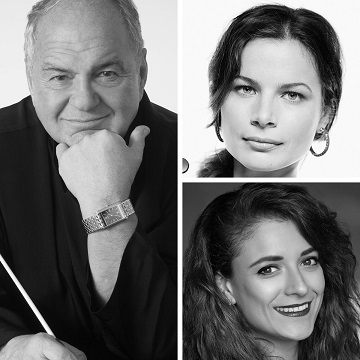
    Laredo hristova Milena Pajaro-van de Stadt

    Above: Jaime Laredo, Bella Hristova, and Milena Pajaro-van de Stadt 

    ~ Author: Oberon

    Sunday December 24th, 2023 – The New York String Orchestra’s Christmas Eve concert at Carnegie Hall this year was an all-Mozart program which featured soloists Bella Hristova (violin) and violist Milena Pajaro–van de Stadt (viola) with Jaime Laredo on the podium. I invited my long-time friend Rob Scott to join me; Rob was one of the very first people I met on moving to NYC twenty-five years ago. Later, he became Lisette Oropesa’s first manager, helping her to launch her brilliant career.

    I learned the overture to The Marriage of Figaro long before I heard the complete opera: we played a transcription of it in my high-school band (we also played the prelude to Lohengrin Act III!). Tonight, the young players of the New York String Orchestra gave a lively and immaculately-played rendering of the Figaro, immediately setting the mood of the evening.  There were many young children among the audience tonight, and this brisk music seemed to draw them in.

    A wonderful sense of attentive silence was sustained in the hall throughout the playing of the Sinfonia concertante in E-flat Major, K. 364, which I was – incredibly enough – hearing “live” for the first time. Dating from 1779, this is simply a great piece of music. The two soloists chose striking gowns that brought a glamorous touch to the evening: Ms Hristova in an elegant, one-shoulder forest green frock, and Ms. Pajaro–van de Stadt in shimmering gold and silver.

    In the Sinfonia‘s opening Allegro maestoso, duetting motifs for two horns are picked up by two oboes, with the orchestra’s basses sound velvety. Now the soloists join, their timbres ideally matched as they exchange phrases; displaying their fluent techniques; the two seem to converse whilst gracious horn harmonies are heard. In Mozart’s day, cadenzas were usually improvised by the performers, but in the Sinfonia Concertante’s first and second movements, the composer specifically wrote out the cadenzas. And what magical cadenzas they are, played tonight with great finesse and charm.

    The ensuing Andante takes on a feeling of mournful lyricism, with Ms. Hristova’s beautifully sustained tone singing a lament that is then taken up by the duskier colours of Ms. Pajaro–van de Stadt’s viola. A sense of exquisite sadness slowly gives way to tender harmonies  A rich tutti passage leads to the cadenza of the entwining solo voices, underscored by sustained horn tones. Bella’s enchanting trills take us to a sublimely poignant finish.

    Maestro Laredo let the hushed atmosphere linger by keeping his arms poised before delving into the concluding Presto wherein the horns and oboes are again welcome, with the basses sounding so appealing to my ear. In a spirit of friendly competition, Mlles. Hristova and Pajaro–van de Stadt regaled us with their virtuosity, clearly savoring every phrase that Mozart offered them. A roar of applause rang out as the final note hung on the air, and our gracious soloists embraced one another. For this precious half-hour, the woes of the world had been forgotten.

    The familiar Symphony No. 35, “Haffner“, made for a perfect end to the evening; despite the fact that some of the children in the crowd became a bit restive, the power of Mozart’s spirit prevailed. The young musicians handled all of the music’s demands with assurance, and I especially loved hearing the timpani lending an air of nobility to the concluding Presto

    ~ Oberon

  • Arensky & Brahms @ Chamber Music Society

    Bella2

    Above: violinist Bella Hristova, photographed by Lisa-Marie Mazzucco

    Author: Oberon

    Tuesday March 28th, 2023 – Works by Anton Arensky and Johannes Brahms were on the bill at Chamber Music Society of Lincoln Center this evening as violinist Bella Hristova, cellist Dmitri Atapine, and pianists Wu Qian and Wu Han teamed up for some magical music-making.

    The concert commenced with Arensky’s Six Children’s Pieces for Piano, Four Hands, Op. 34, composed in 1894. These charming miniatures found our two pianists side by side at the Steinway, with Wu Han presiding over the upper octaves and Wu Qian the lower.

    To give the pieces their English titles, we start with Fairy Tale which begins in the minor key, has a folkish feeling, and then becomes quite dramatic. Wu Han plays a series of decorative trills as the music ranges from hesitant to animated. Then, Wu Qian plays the familiar two-note birdcall that signals the delightful Cuckoo bird is nearby. This is a sprightly little piece with a subtle finish. The mood changes for Tears, which has the feel of a lament, with a deep bass line supporting a hymn-like melody. The ending is very quiet.

    Rippling motifs underscore the lovely Waltz, which gets quite bouncy. A passing reverie turns expansive before fading away, as if the dance was continuing in another room. Cradle Song appropriately has a slow, rocking feeling; the melody is that of a gentle lullaby. The concluding Fugue on a Russian Theme is tuneful and jovial. The music turns grand, and the two pianists have a grand time playing it.

    Dmitri-atapine

    Listening to Bella Hristova and Dmitri Atapine (above), joined by Wu Qian, play the Arensky Trio No. 1 in D -minor for Piano, Violin, and Cello, Op. 32, makes one wonder why we don’t hear more of this composer’s gorgeous music. He wrote copiously for solo piano, and numerous chamber works as well. And why cannot we hear more of his large orchestral works – which include two symphonies – or his choral pieces?  He also wrote three operas, which must be wonderful to experience.

    At any rate, we must be thankful for any opportunity to hear the music of this pupil of Tchaikovsky, especially when it as a luminously played as this evening. The introductory theme of the opening Allegro moderato, first played by Ms. Hristova and then taken up by Mr. Atapine, is hauntingly beautiful. These virtuosos bring such richness of timbre to everything they play, and this trio – a veritable font of melody – affords them so many opportunities.

    It is restless, passionate music, interrupted by a Springlike interlude in which Wu Qian spins lovely swirling passages from the Steinway. Now a sense of drama takes hold; the opening theme recurs, played – if it’s possible to imagine – even more thrillingly. There is a coda full of lyrical grace before the movement ends quietly.

    The ensuing Scherzo opens with an odd, stuttering quality. There are crisp plucking and jaunty melodies to be savoured, whilst at the keyboard Wu Qian offers cascades of notes decorated with lively trills. Now a swaying feeling takes over, and the music gets grand. After a brief hesitation, the stuttering resumes and the Scherzo comes to its whimsical finish.

    The evocative Elegia is the heart of the trio: Mr. Atapine opens with a pensive theme, then the string voices entwine as Wi Qian introduces poetic phrases from the keyboard. The music seems to evoke the memory of a lost love as the gently rocking strings sound over the quiet rapture evoked by the pianist. Ms. Hristova in her high range, the pianist pulsing quietly, and Mr. Atapine plucking ever so gently give the music an ethereal quality. Ms. Hristova takes up an autumnal melody as Mr. Atapine’s deep resonance sounds and the music fades away on a sustained chord.

    A reverential silence filled the hall, and then the agitated drama of the final Allegro non troppo sprang up. Things cool off, melodic phrases are exchanged, but then restlessness builds and the music becomes impassioned. From a sudden silence, Wu Qian’s shimmering notes are heard as the strings sing softly. The music ascends, and becomes reflective with the poignant violin and the soulful cello sounding. Then, out of the blue, a bustling rush to the finish line springs up. 

    The music of Johannes Brahms took the limelight after the interval: our two pianists returned for selections from the composer’s Hungarian Dances for Piano, Four Hands; Wu Qian was now playing the upper range and Wu Han the lower. These delightful pieces were written between 1868 and 1880, and they are chock full of rhythmic and melodic variety, spiced with a dose of paprika. The two women seemed to be having a blast playing them, much to the audience’s delight.

    Bringing the evening to its close, Wu Han, Ms. Hristova, and Mr. Atapine illuminated the Brahms Trio in C-major Op. 87, with sumptuous playing.

    In the opening Allegro, a unison theme for violin and cello develops int something big ad thrilling. When cal finally settles in, a sense of yearning is felt. The textures created by the three players are rich indeed, each displaying alluring tone that meshes into a persuasive whole. Epic grandeur develops as we relish Wu Han’s superbly polished playing, which takes the movement to a royal finish.

    Unison strings again herald the Andante con moto: a theme with five variations. The music takes on a gypsy air, reflecting Brahms’ interest in Hungarian music, which began in his youth. Here the blend achieved by our three artists was nothing short of remarkable, continually drawing me in to the music, which reaches a touching, quiet ending.

    In the brisk Scherzo, I sensed a Mendelssohnian enchantment. Lush melodies sprang up, and there’s a songful outpouring before a feeling of Puck lurking about returned at the music’s sudden stop.

    From its opening agitato, the concluding Allegro giocoso brings an abundance of delicious melodic and rhythmical treats, and the Mendelssohn mood continued to be felt. The musicians were warmly cheered as they took their bows, and I simply must mention Ms. Hristova’s bejeweled shoes, which added an extra sparkle to an already brilliant evening.

    ~ Oberon

  • Bella Hristova @ Merkin Hall

    Hristova

    Above: violinist Bella Hristova

    ~ Author: Oberon

    Tuesday March 26, 2019 – A thoroughly impressive and enjoyable evening at Merkin Hall, as Young Concert Artists presented violinist Bella Hristova in a recital that mixed the familiar with the rare. A striking Bulgarian-born beauty, Ms. Hristova had a perfect colleague in pianist Anna Polonsky; together, the two women evoked a shouting, standing ovation at the end of their program. 

    Glamorously gowned in black, Ms. Hristova seemed to have stepped off the fashion runway and onto the Merkin stage. The abundant richness of her tone – which maintains its allure throughout the dynamic range and even at speed-of-light tempos – is matched to a mastery of technique and a depth of emotion that makes her a paragon among violinists of the day. 

    Mlles. Hristova and Polonsky opened their imaginative program with Olivier Messiaen’s Theme and Variations, a work which deserves wider exposure. Composed in 1932 – nearly a decade before the composer’s monumental Quartet for the End of Time – the opening Thème has a dreamlike quality, with a sustained violin line and a marvelous role for the piano. The ensuing five variations bring a buildup of speed, tension, and drama which climax with the fourth – marked Vif et passionné – before calm descends in the final Tres modéré, with its sustained ending. At the Steinway, Ms. Polonsky brought a wonderful forward impetus as the first four variations progressed, whilst Ms. Hristova dispatched the swift passages and some lively trills with élan. The Vif et passionné movement found the violinist playing on high over accents from the keyboard: the music reaches a grand passion indeed. The return to a more peaceful mood was finely evoked by the two musicians. Insistent applause drew them back for a bow, the pianist’s red shoes an added delight to the evening’s visual aspects.

    In a violin ‘test piece’ sans pareil, Ms. Hristova dazzled the crowd with Ellen Taafe Zwilich’s Fantasy for solo violin. And a test piece it literally is, having been written by Ms. Zwilich as a compulsory work for the Indianapolis Violin Competition. From a passionate start, Ms. Hristova soars on high; later the music percolates, and there’s a touch of the blues. Stretches of coloratura were effortlessly dispatched, some of them extremely fast…and delicate. The music rises to a shining softness, then morphs into an agitato that develops into a rocking sway. Simmering down, Ms. Hristova plays high and sublime before the Fantasy‘s brilliant ending. The audience went wild for this exciting piece, again summoning Ms. Hristova back to bask in a wave of affection. I was hoping that the composer might be among us, so we could express our admiration. 

    There followed a thrilling rendering of the beloved Partita no. 2 in D-minor, BWV 1004, by J S Bach. Ms. Hristova was not only in total command of every aspect of this music, she brought a distinctive glow to it that made it seem ever fresh and vital. The thoughtful melody of the Allemande showed her radiant tone, pristine articulation, lovely phrasing and dynamics. What more could we ask? In the lively dance of the Courante, Ms. Hristova’s flowing musicality carried us along. The melancholy Sarabande was beautifully played, with exquisite touches, and in the Gigue, the reams of fiorature – played very fast – had true clarity, further enhanced by dynamic nuance. An astonishing display of virtuosity…a real treat!

    In the famous Chaconne which concludes the Partita, Ms. Hristova’s passionate playing – and her inspired control as she shaped her vision of this masterpiece – made me wish it could go on and on. The audience, having been held under her spell throughout, gave the violinist a fervent ovation, so eminently deserved.

    Annapiano

    Above: pianist Anna Polonsky

    Arnold Schönberg’s Phantasy for violin and piano, Op. 47, is a remarkable piece which I’d never heard before. After a jagged start, quiet settles briefly over a misterioso passage for the piano; this peace is broken by slashes from Ms. Hristova’s violin, and her isolated notes, plucked from the air. Music of near violence alternates with moments of gentle, somewhat eerie lyricism.

    With Ms. Polonsky playing twinkling notes in the upper end of the keybord, Ms. Hristova joins on the heights. After a whimsical passage, there’s sudden drama, followed by some sneaky music which then turns quite perky. Again, the lyric and the spiky take turns, becoming intense. A pulsating violin note creates a buzz. The Phantasy ends suddenly. 

    Olde World richness of musicality and grace marked evening’s final offering: Johannes Brahms’ Sonata no. 3 in D-minor, Op. 108. Of this familiar piece, I need only say that both violinist and pianist played with overwhelming tenderness and compelling beauty of sound. The hall felt like a haven for those of us seeking solace in a darkening world; for such moments of hope and contentment – however fleeting – I feel a deep gratitude.

    As the two artists beamingly acknowledged the wildly enthusiastic applause of the standing audience, there was no question that an encore was in demand. With sublimely poised lyricism, the players offered a Bach Largo that felt like a benediction, eliciting murmurs of admiration as the music came to an end.

    ~ Oberon

  • Christmas Eve @ Carnegie Hall

    CH1464970_Medium_res_comp

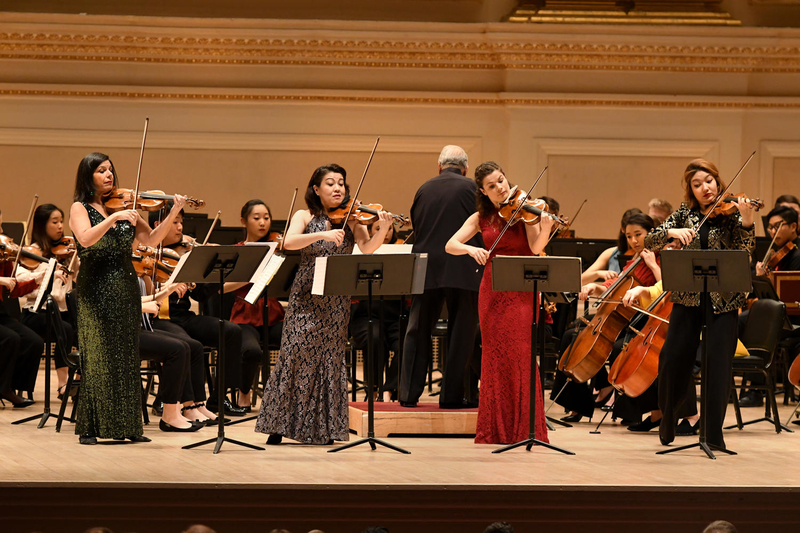
    Above, violinists for Vivaldi: Pamela Frank, Kyoko Takezawa, Bella Hristova, and Jinjoo Cho; photo by Pete Cecchia

    ~ Author: Ben Weaver

    Monday December 24th, 2018 – Christmas Eve at Carnegie Hall was a nearly sold-out performance by the New York String Orchestra, a program organized by the Mannes School of Music each year: its 50th incarnation this year was marked by mayor Bill De Blasio declaring it the New York String Orchestra Day in NYC. Under the baton of Jaime Laredo, the 64-member orchestra, made up of young musicians from around the world (ages 16-23) presented an ambitious program of Mendelssohn, Vivaldi and Beethoven.

    Mendelssohn’s popular Hebrides Overture is one of his most famous compositions: the moody, dark opening from the low strings, evoking the churning waves of the ocean, is an instantly recognizable tune. There are several of those in the work, heard by all in numerous commercials and movies over the years. The young musicians, following Maestro Laredo’s relaxed tempo, created an evocative, almost creepy, aural landscape.

    Vivaldi’s thrilling Concerto for Four Violins from his famed collection of 12 concertos entitled L’estro armonico, was so admired by J.S. Bach that he transcribed it for four harpsichords. Requiring a quartet of star soloists to pull it off, the New York String Orchestra delivered four with unimpeachable credentials: Jinjoo Cho, Pamela Frank, Bella Hristova, and Kyoto Takezawa. The soloists both compete and complement one another throughout the work. Dazzling displays of virtuosity and unpredictable rhythms of the first movement give way to a yearning slow moments, where the four soloists play by turn in unison and in solo passages, then the fiery finale brings down the curtain. Certainly the four soloists leave nothing to be desired and the orchestra provided thrilling support.

    CH1464968_Medium_res_comp

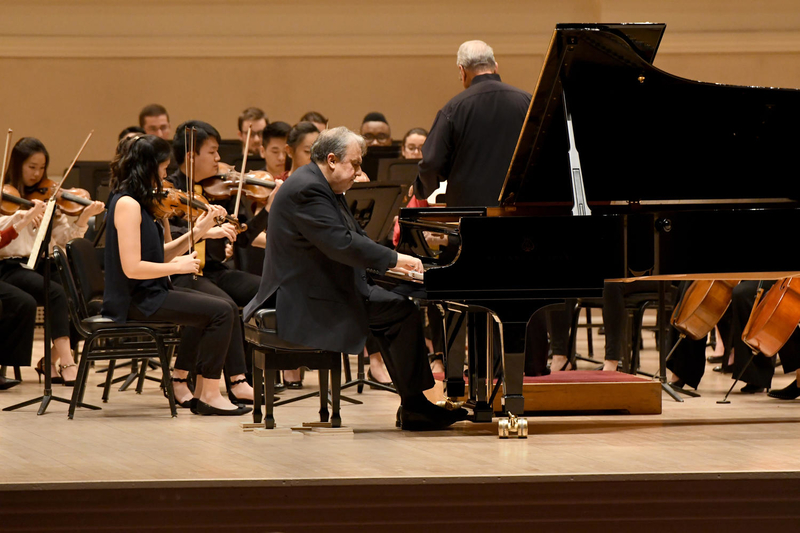
    Without stopping for an intermission (a welcome move), the piano was immediately set up for Beethoven’s great Piano Concerto #4 with Yefim Bronfman (above, photo by Pete Cecchia) at the piano. Mr. Bronfman has long been one of our favorite artists on this blog: he a musician of singular musical sensitivity and imagination. His gentle solo introduction of the concerto before the orchestra picks up the melody was like meeting an old friend. Beethoven’s melodies come in waves. Bronfman handles the running scales effortlessly. Maestro Laredo’s expansive tempo was especially rewarding in the Andante con moto movement where Bronfman’s soulful playing could move anyone to tears. Here, too, the young musicians provided wonderful support.

    Performance photos by Pete Cecchia, courtesy of Carnegie Hall.

    ~ Ben Weaver