Tag: Ben Weaver

  • Bach’s Matthäus-Passion @ The NY Philharmonic

    Bach

    Author: Ben Weaver

    Saturday March 25th, 2023 – J.S. Bach’s Matthäus-Passion, composed around 1724-27 (and revised through 1742), is arguably Bach’s greatest composition. Personally, I’d place it in the top ten greatest works of Western music. The NY Philharmonic performs it infrequently; the last time was in 2008 under the baton of Kurt Masur. Running at roughly 2:45 hours, the Matthäus-Passion is a work filled with passion and drama…more drama than most church music. Anyone mocking Verdi’s Requiem as being more opera than mass perhaps should take a closer look Bach’s greatest work. Verdi was following in Bach’s mighty footsteps. I was very glad to see it on the program this year, finally! I quite literally got chills as the work started and the chorus (Musica Sacra) sang the opening words: “Kommt, ihr Töchter, helft mir klagen.” Alas, the thrills did not last; I was sadly disappointed with tonight’s performance.

    Tenor Nicholas Phan sang the very difficult part of the Evangelist, who narrates the story of Jesus’ arrest, the debate over what his fate should be, his execution, and its immediate aftermath (the Passion ends before the resurrection.) Much of the drama of the work flows through the Evangelist’s words. Mr. Phan managed the difficult music very admirably, but the part can be a trap dramatically: there are many proclamations like “And Jesus said unto him.” How does one make each one sound fresh? I don’t have a clear answer. I suppose if it was easy, anyone would be able to do it. 

    Bass-baritone Davóne Tines’ Jesus (Mr. Tines was the only person on stage wearing a costume: a white, sleeveless robe) possesses a large voice; but it’s a voice with a guttural quality, which seldom opens or blooms.

    Mezzo-soprano Tamara Mumford, a favorite at the Metropolitan Opera across the Plaza, sang nicely. “Buß und Reu” in Part I was vocally steady and clear. But in Part II, Maestro Jaap van Zweden robbed Ms. Mumford and concertmaster Frank Huang of an opportunity to give their all in “Erbarme dich”, perhaps  the Passion’s most famous aria; certainly its most emotional and devastating piece. Written for solo voice, solo violin, and orchestra, this breathtaking music has the ability to stop time. Alas, Maestro van Zweden took it at a preposterous Allegro tempo; he absolutely wrecked it by turning it into a cabaletta. If your tempo is faster than John Eliot Gardiner’s, Nikolaus Harnoncourt’s, Trevor Pinnock’s, and Gustav Leonhard’s – you may consider looking at the score again.

    Amanda forsythe

    Soprano Amanda Forsythe (above), making her Philharmonic subscription concert debut with these performances, was sublime. Her ability to float pianissimi high notes was indeed spine-tingling. The aria “Aus Liebe will mein Heiland sterben,” which also includes a flute solo by Robert Langevin, was the highlight of the evening. 

    The Philharmonic’s Principal Associate Concertmaster, Sheryl Staples, had a chance to shine in “Gebt mir meinen Jesum wieder,” with a difficult solo. Unfortunately, bass Philippe Sly, making his Philharmonic debut with these performances, had pitch difficulties which offset Ms. Staples fine playing. Tenor Paul Appleby was superb all evening, the high tessitura of the aria “Geduld” presenting no difficulties for him.

    The Choral group Musica Sacra was in excellent form all evening, from the Chorales to dramatic exchanges representing specific characters. The Brooklyn Youth Chorus sang the opening and closing choruses of Part I, but did not return for Part II. Can’t say if that was intentional or if something kept them from returning.

    I do hope the Matthäus-Passion returns to the Philharmonic again soon – under a more caring conductor.

    ~ Ben Weaver

  • Stutzmann/Weilerstein/NY Philharmonic

    Stutzmann

    Author: Ben Weaver

    Thursday February 23rd, 2023 – For many years,  Nathalie Stutzmann (photo above) has been a highly accomplished singer, with numerous operatic and lieder recordings under her belt, and many awards, too. In recent years she has begun to spend more time on the conductor’s podium. I am always skeptical of performers transitioning to conducting because these are all highly specialized crafts. There have, certainly, been many extremely successful switch-overs, but mostly coming from the instrumentalist sides (people like Vladimir Ashkenazy and Christoph Eschenbach come to mind). It’s rare for singers to make the jump, and while someone like Plácido Domingo has conducted many operas over decades, he has never become more than passable in the pit. Which brings me back to Nathalie Stutzmann, who made her New York Philharmonic debut with these concerts, conducting a varied program of Wagner, Prokofiev, and Dvořák. Based on what I heard, Maestro Stutzmann is a phenomenal musician and she would have been a far more interesting new Artistic Director for the Philharmonic than the flashy but vapid Gustavo Dudamel.

    The concert opened with a superb overture to Wagner’s Tannhäuser – an opera Stutzmann will conduct at the Bayreuth Festival this summer. The mournful strings that open the work were lovingly molded as the drama built, the Philharmonic’s wonderful string section matching Stutzmann’s passion at every step. The rock solid wall of horns, trombones, and tuba was heavenly. Appearance of Venus had a magical, light sound that – perhaps for the first time for me – sounded like a Mendelssohn fairy got lost in Wagnerland. The explosive, thrilling climax of the work brought down the house. I suspect Maestro Stutzmann’s Tannhäuser in Bayreuth will be very special indeed.

    Weilerstein jpg

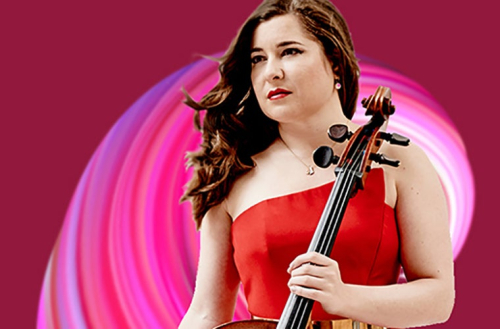
    Above: Alisa Weilerstein

    One of my favorite musicians, cellist Alisa Weilerstein (in a glorious red pantsuit) played Prokofiev’s Sinfonia concertante, Op. 125. Composed for (and with the help of) a very young Mstislav Rostropovich, this is a supremely difficult piece, which posed no difficulties for Weilerstein. The playful opening – like a ticking clock – is echt Prokofiev, and the cello enters almost immediately. Weilerstein’s gorgeous, mellow, glowing tone is always a balm to the ear. Even the crazed, breathless opening of the second movement sounded like the most romantic love song. Weilerstein’s passion and commitment never wavered; even when not playing, she gently swayed to the music. Prokofiev’s kaleidoscopic music – sweepingly romantic one moment, mockingly blowzy the next – can be tricky to navigate, but Weilerstein and Stutzmann had a deep connection and made everything whole. Stutzmann’s history of singing for conductors no doubt make her deeply sensitive to her soloists. She was careful to let Weilerstein room to breathe and to never let the orchestra overpower the cello. I hope Weilerstein and Stutzmann enjoyed working together because they make wonderful, deeply sympathetic music together; may their partnership continue and grow.

    Antonin Dvořák’s Symphony No. 9 in E-minor, Op. 95 (subtitled hastily by the composer “From the New World” as he handed the score off to be copied for the world premiere performance by the NY Philharmonic in 1893) is easily one of the most standard works in the classical repertoire: a warhorse as popular as Beethoven’s  5th and Tchaikovsky’s Nutcracker. It’s easy to get jaded and cynical, and roll our eyes when another performance is on the program. These works can be played by any orchestra with their eyes closed, and the audience will dutifully applaud. But sometimes you hear a performance that makes you sit up and rethink your cynicism, and reevaluate why these works are warhorses in the first place. It’s not pure chance that some of these compositions have been played more than others, and will continue to be played.

    This evening’s performance of Dvořák’s 9th was such a performance: Maestro Stutzmann led a revelatory, fresh, thrilling interpretation of a work we’ve all heard countless times. She struck a perfect balance between embracing the familiarity of the melodies while not lingering on them for their own sake. Harking back to Mendelssohn’s fairies dropping in on Wagner’s Tannhäuser, many moments of Dvořák symphony sounded like his beloved Slavonic Dances of decades earlier, effortlessly swirling and swaying. The second movement was perhaps the most wonderful music making of the evening from all involved. It’s chamber music-like orchestration, with small sections of the orchestra handing off music to one another, was wondrously coordinated. I was reminded of that famous speech Salieri delivers in Peter Shaffer’s “Amadeus” about Mozart’s Serenade for Thirteen Wind Instruments: “A single note, hanging there, unwavering. Until a clarinet took it over, sweetened it into a phrase of such delight!” That’s what the entire Largo felt like tonight: every note being sweetened into phrases of delight. The opening notes of the final movement have never sounded more like the theme from “Jaws” (wouldn’t be even a little bit surprised if that’s where John Williams got the idea considering how many of his ideas were directly lifted from existing works). The swirling rhythms and melodies have seldom sounded this fresh and exhilarating.

    The ovation that greeted the performance was huge, people leaving the theater were buzzing about the debuting conductor. I hope we see and hear much more of Maestro Stutzmann at David Geffen Hall.

    ~ Ben Weaver

  • Yuja Wang ~ Rachmaninoff @ Carnegie Hall

    Yuja wang

    Above: pianist Yuja Wang

    Author: Ben Weaver

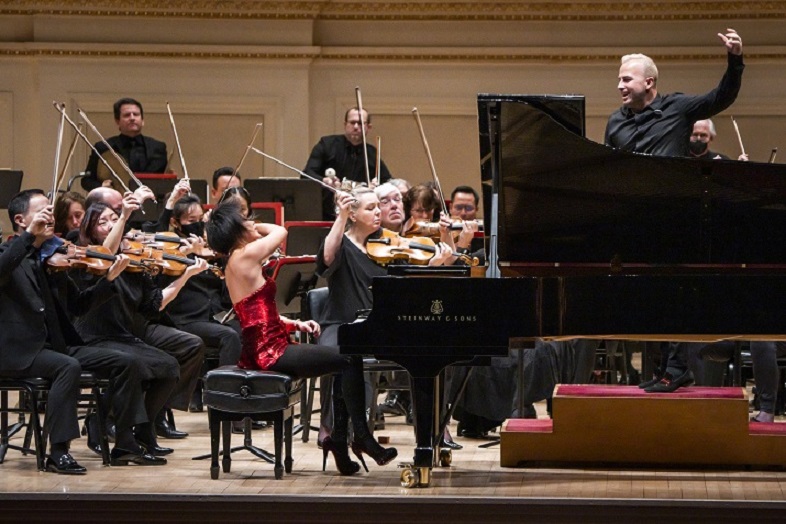
    Saturday January 28th, 2023 – Sergei Rachmaninoff’s four piano concertos are among the most challenging works in any pianist’s repertoire. Today, at Carnegie Hall, pianist Yuja Wang raised the bar for her colleagues by playing all four – plus Rhapsody on a Theme of Paganini – in one afternoon, accompanied by the Philadelphia Orchestra under the baton of Yannick Nézet-Séguin. These kinds of Olympic feats are rare; I’ve heard of the complete Beethoven Symphonies being conducted in a single day and Brahms’ two Piano Concertos in one concert, but I’m unaware of a single soloist taking on 5 concertos in one afternoon. Overall, the concert lasted nearly 5 hours, with two intermissions. Carnegie Hall was completely sold out, and, as a testimony to the artists and to the music, no one seems to have left early.

    One unscheduled extended pause was caused by a member of an audience collapsing and, apparently, dying just as the second movement of the 2nd Concerto ended. The man was revived in the hallway before the performance resumed. Maestro Nézet-Séguin informed us before performance of the 3rd Concerto that the gentleman was out of surgery and was expected to make a full recovery. That’s how long the concert lasted: a man died, was brought back to life, and was out of surgery at the 2/3 point of the afternoon!

    The marathon started with Rachmaninoff’s most enduring work and one of the most beloved works in the classical repertoire: the Piano Concerto No. 2 in C minor, Op. 18, composed in 1900-01 after an extended composers’ block Rachmaninoff suffered because of the disastrous premiere of his Symphony No. 1. After seeing a psychiatrist in France – which included hypnosis – Rachmaninoff composed this magnificent, melodic work which decades later would have pop-songs written to its tunes. (Eric Carmen’s “All By Myself” being perhaps the most successful chart-topper.) Ms. Wang’s strong, incisive solo introduction was a preview of the muscled playing that dominated the entire afternoon. She easily produced massive sounds from the Steinway, rising above Rachmaninoff’s dense orchestrations. Even on recordings, the piano sometimes gets lost in the famous melody at the beginning of Second Concerto’s Moderato movement. Not with Wang, who summoned torrents of sound that cut through the orchestra.

    Rachmaninoff was quite fond of the clarinet and wrote a number of magnificent music for it in his works, including in the Adagio sostenuto of this concerto. (The clarinet’s dark hues are also prominently featured in the contemporaneous Symphony No. 2). Clarinetist Ricardo Morales’ playing was invaluable here. I did feel the tempi in the first two movements were perhaps a bit too languorous; momentum seemed to be lost. But (after the performance resumed following the incident with the ill audience member), the closing Allegro scherzando was an exhilarating conclusion.

    Rachmaninoff’s Piano Concerto No. 1 in F-sharp minor, Op. 1 (composed 1890-91 and revised extensively in 1917) and Piano Concerto No. 4 in G minor, Op. 40 (composed in the US in 1924-26, and premiered by the composer with Leopold Stokowski and the Philadelphia Orchestra) are his least known concertos. Perhaps their melodies are not as hummable as the other works, but they are filled with melodies nonetheless, and wonderful writing for the piano. Ms. Wang met every obstacle with ease and bravura. Concerto No. 1, composed when Rachmaninoff was only 17, has all the trademarks that would define his style as he matured, including expansive, romantic melodies and dark orchestrations. And though Rachmaninoff always maintained that he was a romantic composer through-and-through (and was criticized for it by the modernists), his Concerto No. 4 sometimes echoes – intentionally or not – Ravel’s Piano Concerto and Gershwin’s Rhapsody in Blue (which Rachmaninoff heard at its 1924 world premiere performance.) So while he never became a modernist, Rachmaninoff was certainly influenced by the sounds of his contemporaries. I’ve heard Ms. Wang play a magnificent Ravel Piano Concerto live, and I was getting flashes of some of those moments as she played the Fourth here.

    The Rhapsody on a Theme of Paganini, Op. 43, composed in 1934 and premiered by the composer with Stokowski again conducting the Philadelphia Orchestra, is one of Rachmaninoff’s most brilliant works. Using the same Paganini Caprice that inspired numerous others to compose variations (Schumann, Brahms (two separate works), Liszt, Lutosławski, Schnittke), Rachmaninoff’s compact work never flags. It is a magnificent, tenacious bulldozer of invention. The original tune is shaped, reshaped, stretched in every imaginable way, and yet each variations is a beautiful thing of its own. The most famous of these, the immortal 18th Variation, is the original melody played upside down. The joy maestro Nézet-Séguin took in conducting of this section was clear: he seemed to be floating off the podium. Ms. Wang – needless to say conquered every technical challenge – but also the poetry, the beauty of her playing was unmatched.

    The concert ended with the Mount Everest of the concerto repertoire, the towering Piano Concerto No. 3 in D minor, Op. 30. Composed in 1909, while Rachmaninoff still lived in Russia, he intended it to be his calling card in the West, as he was embarking on his first American tour. And so the concerto was premiered in New York with the New York Symphony Orchestra, conducted by Walter Damrosch. (Six weeks later Raxhmaninoff played it again in New York, this time with the New York Philharmonic- the two orchestras later merged into one – under the baton of Gustav Mahler. There are stories that Mahler was not entirely happy with the collaboration.)

    I don’t know if this concerto actually drove David Helfgott to madness, but it is certainly enough to scare anyone into an asylum, and for Ms. Wang, playing it after roughly 4 hours of performing, was a brave decision. Fortunately for us her hands seem to be made of steel. This was not an example of someone crawling across the finish line: Ms. Wang crossed it at full speed. I noticed her hanging her hands down between playing, seemingly resting/stretching. But her playing did not show any sign of fatigue. Every note was crystal clear, and she – and Maestro Nézet-Séguin – did not shy away from the grandness and romanticism of Rachmaninoff’s music. And there is no better orchestra to play Rachmaninoff than his own favorite Philadelphians. They have this in their blood.

    One thing Yuja Wang is known for – outside of her extraordinary pianism – is outfits (she wore 5, one new ensemble for each work), but another is encores. She is very generous with encores: as long as the public wants more, she is happy to provide. I joked to a friend that really this concert was just a performance of the Second Concerto followed by encores of the rest of Rachmaninoff’s concertos. In the end – after such a grueling afternoon – she gave just one encore, an achingly beautiful “Dance of the Blessed Spirits” from Gluck’s Orfeo ed Euridice, transcribed by Giovanni Sgambati.

    There is so much to admire in Yuja Wang’s artistry. Some people seem to be distracted by her showmanship and outfits. I’m struck by her genuine love of performing live and love for her audience. It’s why she’s so happy to keep playing encores as long as her audience is on their feet. Another great pianist I recently saw live at Carnegie, after an extraordinary concert, offered an encore of just literally a few notes (something by Schoenberg.) Really, it was a joke, but it was also rude. Ms. Wang’s joy at being on stage is infectious. We’ve read about Liszt and Paganini’s shenanigans. Why can’t a contemporary artist do more than roll out, play, and leave? Brava, Ms. Wang, for treating this music as a living, breathing being and engaging with your audience with such generosity.

    ~ Ben Weaver

    Here’s a gallery of performance images by photographer Chris Lee documenting this unique evening:

    CH11298876

    CH11304127

    CH11304129

    CH11304132

    CH11304130

    CH11298873

    CH11298875

    Above: Maestro and soloist at the close of the evening; performance photos by Chris Lee, courtesy of Carnegie Hall

  • Ben Weaver @ The “New” Geffen Hall

    Geffen hall

    ~ Author: Ben Weaver

    Saturday November 19th, 2022 – It is wonderful to be back at David Geffen Hall to hear the New York Philharmonic. I love the new space, which is far more attractive than the previous relic of 1960s hideousness. Bringing the stage forward to make room for seating  behind the orchestra – something practically every European concert hall has been doing for decades – shrinks the auditorium and creates an intimate space. I thought I’d be distracted by the people behind the orchestra, but the design of the stage – with its horizontal lines and wood trims – creates a nice frame for the eye to focus, so my gaze was always on the players, rarely above them. (Except when someone turned on their phone flashlight to find something they dropped…that’s when one wishes one had a cannon to shoot the audience member right into the sun.) But otherwise, the hall is gorgeous.

    And the sound is spectacular. For decades NY Philharmonic audiences had to listen to music land with a thud and the glorious sound of this orchestra never bloomed. No more. This was the reason these renovations were essential and long overdue. We can finally hear this great orchestra in all its sonic glory! Tonight’s concert gave us a wide range of musical styles to appreciate the varied nuances of the new acoustic.

    The announced program for this concert was supposed to begin with Jean Sibelius’ glorious tone poem Oceanides. Alas, it was replaced with an Igor Stravinsky piece I’ve always found to be rather a waste of time: Symphonies of Wind Instruments. Composed in 1920 and revised in 1945-47, it is a shapeless, senseless series of tedious honking. Occasionally echoes of Le Sacre du printemps do not save it. Its premiere was not a success (“hisses and laughter”) and with good reason. Fortunately it only lasts 10 minutes. One can’t fault the wonderful Philharmonic wind section here because they played wonderfully and it is good to hear them play in isolation. I wish more music was programmed generally to showcase specific sections of the orchestra.

    Béla Bartók’s Concerto for Two Pianos, Percussion, and Orchestra, composed in 1937 as a sonata for two pianos and transformed into its current concerto form in 1940, is a virtuosic tour-de-force. One can easily see that the work was conceived as a sonata for two pianos because the orchestral contribution is rather spare throughout. The two pianists dominate, but the percussionists get a fair workout as well. The caustic, rhythmic Bartók is on full display here, the pianists and percussionists taking turns trading blows. The first and second movements are particularly aggressive, though the second movement in a more creepy way. The strings are struck with bows, adding to the percussive nature of the piece. Pianists Daniil Trifonov and his former teacher Sergei Babayan were spectacular. Playing – and occasionally swaying – in perfect sync, their ability to bring beauty and lyricism into Bartók’s most caustic music was magical. The three Philharmonic percussionists – Christopher Lamb, Daniel Druckman  and Markus Rhoten – were in perfect sync with the two star pianists. The lighter and almost humorous final movement was a lively conclusion to this difficult work. Conductor Hannu Lintu coordinated everyone spectacularly.

    Hannu lintu

    Finland – home of Maestro Lintu (above) – dominated the second half of the program. Kaija Saariaho’s Ciel d’hiver – lifted from her larger 2003 composition Orion – was a gorgeous sensory experience. Saariaho has a highly unique sound palette, her ability to create otherworldly sounds are extraordinary. There’s a timelessness and weightlessness to her music; it’s as if it has always been there, like primordial space – it is all around us. The transparency of the sound can now be appreciated in the new acoustics.

    Jean Sibelius’ Symphony No. 7 – composed in 1924 – finally allowed us to hear the Philharmonic in its combined glory, and to appreciate the acoustics of the new Hall. If Saariajo’s music is like a frozen lake, Sibelius is a surging river and ocean of sound. His ability to make you feel the cold wind of a Finnish winter has always been a distinct feature of his extraordinary music. A relatively brief single-movement work, the Seventh realized Sibelius’ desire to pare down his music to the barest essentials. (Sadly he seems to have pared himself down to nothing just two years later. Only two major works followed the Seventh, and then Sibelius stopped composing – though he lived another 30 years!)

    The symphony is made of 11 interconnected sections, some highly lyrical (recalling the more Romantic Sibelius of yore), and some far more abstract. The symphony’s final note, held by the strings, raising in volume and intensity – by turns sinister and unfinished – always reminds me of the harrowing Interlude in Berg’s Wozzeck, after Wozzeck has murdered Marie. A sustained note full of terror and hysteria. How can a single note contain so much emotion? And yet it can. Here Sibelius, like Berg before – although more subtle than Berg – shows us how.

    Hannu Lintu has this music in his bones and brought out the most extraordinary performance from the Philharmonic. The climaxes were shattering, and because of the clear acoustic in the new Hall, they were shattering in volume and clarity, as well as emotion. The music simply glowed.

    ~ Ben Weaver

  • Orchestra of St. Luke’s: All-Mendelssohn Program

    Benjamin Grosvenor

    Above: pianist Benjamin Grosvenor

    Author: Ben Weaver

    Thursday November 17th, 2022 – The Orchestra of St. Luke’s and conductor Harry Bicket continued their multi-season traversal of the works of Felix Mendelssohn on Thursday evening at Carnegie Hall.

    British pianist Benjamin Grosvenor was the soloist in Mendelssohn’s Piano Concerto No. 1 in G-minor, Op. 25, composed in 1831. The 22-year-old composer’s Piano Concerto is not a standard piece in the concerto repertoire and that’s rather inexplicable. It’s a well-crafted work, with wonderful melodies, wide range of moods, and plenty for a soloist to dig into. A stormy opening from the orchestra and a quick, dramatic entry for the soloist set the tone for a wild ride. Grosvenor is an accomplished pianist and his dazzling playing was never lacking in beauty and excitement. The concerto is written without a pause between movements, effortlessly flowing from the tumultuous first to the lyrical second movement. One thing that stands out is the lack of sentimentality from Mendelssohn: he is earnest without cheap effects, and Grosvenor reflected that wonderfully. An especially lovely passage in the Andante movement passes the melody from the piano to lower strings, and here Grosvenor and the string players of the orchestra were spellbinding. A seamless transition into a quirky final movement was nicely handled, and Grosvenor continued his dazzling playing. Perhaps only a bit of humor was lacking in the whole proceeding, but I’ll place the blame for his on Maestro Bicket because this also marred an otherwise wonderful performance of Mendelssohn’s most famous work, incidental music to A Midsummer Night’s Dream.

    Mendelssohn composed the famous Concert Overture when he was 18 years old and it became a staple of the concert repertoire quickly: a magnificent work filled with whimsy, drama, and endlessly hummable tunes, it conquered the world. 15 years later Mendelssohn was commissioned to write additional music for Shakespeare’s play and – remarkably – the now mature composer managed to time-travel to his youth and compose a score as magical as the Overture had been. After a shimmering playing of the Overture, Bicket and the Orchestra of St. Luke’s launched into the Scherzo – a lively wind section driven ode to fairies (excellent playing by the flutes especially).

    Hiding among the players all along was actor David Hyde Pierce, appearing seemingly from nowhere as Puck: which is, obviously, the best way for Puck to appear. Hyde Pierce’s performance of selected sections of the text were delightful: by turns dramatic (Titania shocked to discover her husband’s tricks), a wryly delightful Puck, and gravely pompous Oberon, the real ass of the play. The veteran actor and comedian of TV, film, and stage, moved effortlessly from one mood to the next, sometimes without taking a breath. A marvelous performance! I have always enjoyed Mendelssohn’s music for these melodramas in the work, and so many recordings omit them, alas. So it was a pleasure to hear this music, especially as sensitively played as it was. 

    Soprano Elena Villalón and mezzo-soprano Cecelia Hall were most excellent Fairies, one wishes Mendelssohn had written more music for the singers. Members of the The Choir of the Trinity Wall Street were also excellent in their music; I especially appreciated their very clear diction.

    The Orchestra of St. Luke’s played extremely well all night. The only difficulties came in the beautiful Notturno. Featuring extensive writing for the horns, perhaps the players got tired. The only thing missing in the whole – as I mentioned above – was a sense of humor in the proceedings. The dramatic and lyrical passages were magnificent, but a somewhat lighter touch would have been welcome. Since this afflicted both the Piano Concerto and A Midsummer Night’s Dream, I’ll place this squarely on the shoulders of Maestro Bicket. Maybe he was just having one of those days; let’s blame it on a spell.

    ~ Ben Weaver

  • Orchestra of St. Luke’s: All-Mendelssohn Program

    Benjamin Grosvenor

    Above: pianist Benjamin Grosvenor

    Author: Ben Weaver

    Thursday November 17th, 2022 – The Orchestra of St. Luke’s and conductor Harry Bicket continued their multi-season traversal of the works of Felix Mendelssohn on Thursday evening at Carnegie Hall.

    British pianist Benjamin Grosvenor was the soloist in Mendelssohn’s Piano Concerto No. 1 in G-minor, Op. 25, composed in 1831. The 22-year-old composer’s Piano Concerto is not a standard piece in the concerto repertoire and that’s rather inexplicable. It’s a well-crafted work, with wonderful melodies, wide range of moods, and plenty for a soloist to dig into. A stormy opening from the orchestra and a quick, dramatic entry for the soloist set the tone for a wild ride. Grosvenor is an accomplished pianist and his dazzling playing was never lacking in beauty and excitement. The concerto is written without a pause between movements, effortlessly flowing from the tumultuous first to the lyrical second movement. One thing that stands out is the lack of sentimentality from Mendelssohn: he is earnest without cheap effects, and Grosvenor reflected that wonderfully. An especially lovely passage in the Andante movement passes the melody from the piano to lower strings, and here Grosvenor and the string players of the orchestra were spellbinding. A seamless transition into a quirky final movement was nicely handled, and Grosvenor continued his dazzling playing. Perhaps only a bit of humor was lacking in the whole proceeding, but I’ll place the blame for his on Maestro Bicket because this also marred an otherwise wonderful performance of Mendelssohn’s most famous work, incidental music to A Midsummer Night’s Dream.

    Mendelssohn composed the famous Concert Overture when he was 18 years old and it became a staple of the concert repertoire quickly: a magnificent work filled with whimsy, drama, and endlessly hummable tunes, it conquered the world. 15 years later Mendelssohn was commissioned to write additional music for Shakespeare’s play and – remarkably – the now mature composer managed to time-travel to his youth and compose a score as magical as the Overture had been. After a shimmering playing of the Overture, Bicket and the Orchestra of St. Luke’s launched into the Scherzo – a lively wind section driven ode to fairies (excellent playing by the flutes especially).

    Hiding among the players all along was actor David Hyde Pierce, appearing seemingly from nowhere as Puck: which is, obviously, the best way for Puck to appear. Hyde Pierce’s performance of selected sections of the text were delightful: by turns dramatic (Titania shocked to discover her husband’s tricks), a wryly delightful Puck, and gravely pompous Oberon, the real ass of the play. The veteran actor and comedian of TV, film, and stage, moved effortlessly from one mood to the next, sometimes without taking a breath. A marvelous performance! I have always enjoyed Mendelssohn’s music for these melodramas in the work, and so many recordings omit them, alas. So it was a pleasure to hear this music, especially as sensitively played as it was. 

    Soprano Elena Villalón and mezzo-soprano Cecelia Hall were most excellent Fairies, one wishes Mendelssohn had written more music for the singers. Members of the The Choir of the Trinity Wall Street were also excellent in their music; I especially appreciated their very clear diction.

    The Orchestra of St. Luke’s played extremely well all night. The only difficulties came in the beautiful Notturno. Featuring extensive writing for the horns, perhaps the players got tired. The only thing missing in the whole – as I mentioned above – was a sense of humor in the proceedings. The dramatic and lyrical passages were magnificent, but a somewhat lighter touch would have been welcome. Since this afflicted both the Piano Concerto and A Midsummer Night’s Dream, I’ll place this squarely on the shoulders of Maestro Bicket. Maybe he was just having one of those days; let’s blame it on a spell.

    ~ Ben Weaver

  • NYO-USA at Carnegie Hall

    Aw

    Above: cellist Alisa Weilerstein

    Author: Ben Weaver

    Friday July 29th, 2022 – Elgar’s Cello Concerto and Mahler’ Fifth Symphony made up the very ambitious program by the National Youth Orchestra of the United States of America at Carnegie Hall. The young American musicians – aged 16 to 19 – are embarking on a world tour with these works and will perform at the Concertgebouw in Amsterdam, as well as in Berlin, Ravello, and Lucerne in the upcoming weeks. Leading the orchestra in all these concerts is the British conductor Daniel Harding, with American cellist Alisa Weilerstein the soloist in the Elgar.

    Elgar’s Cello Concerto, composed in 1919, was mildly popular before Jacqueline du Pré gave it immortality with Sir John Barbirolli in the 1960s. There are few mainstream works as identified with one performer as Elgar’s concerto is with du Pré. For any cellist to take on this work must be intimidating. Alisa Weilerstein is a cellist who needs not fear anything from comparison. A consummate artist of genuine depth, gravitas, and beauty, Ms. Weilerstein’s performance glowed with humanity and grace. From the first passionate notes of the work – no orchestral introduction here – Elgar’s  writing for the cello is intricate and deeply emotional. Even the Scherzo has little frivolity. Ms. Weilerstein’s warm and powerful playing, the rich sound of her cello effortlessly filling the hall, was a true joy. Elgar’s ability to compose for a large orchestra, yet keep the orchestration translucent so it never buries the solo instrument, is perhaps rather unique among cello concertos. And Maestro Harding also kept the young players of the orchestra at bay, letting loose when necessary, but allowing Ms. Weilerstein to always be heard. Everything in this performance was perfectly balanced. An all-around marvelous performance of a very special work.

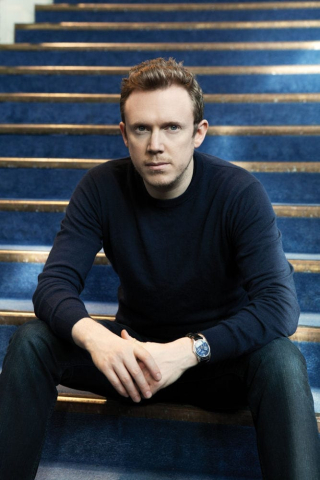
    Harding

    With Mahler’s Fifth Symphony things got a bit more complicated. Maestro Harding (above) is an excellent Mahlerian, having began his career as an assistant first to Simon Rattle in Birmingham and then to Claudio Abbado in Berlin. And his decision to include such a difficult work for a young orchestra was certainly brave, but it did not pay off on this evening. There’s no need to mention any specific mistakes made by specific musicians – I’ve heard the same mistakes made by professional and very experienced musicians of the New York Philharmonic. And there were many wonderful moments too: the horns were warm and fruity, the concertmaster’s solo was lovely, the percussion section was on peak form (I especially enjoyed the grin on the face of one of the percussionists every time he played something loud – his enthusiasm and joy were wonderful, charming, and infectious.) But the totality of the work just did not come together. There were wonderful moments scattered throughout. Perhaps it was Maestro Harding who failed to bring it all together. Perhaps the orchestra’s future performances, as they face more audiences and play the work more, will come together. But, with its faults, I’m glad these young musicians played Mahler. They are the future members of our great American orchestras.

    ~ Ben Weaver

  • Chen/Honeck @ The NY Philharmonic

    Schulhoff

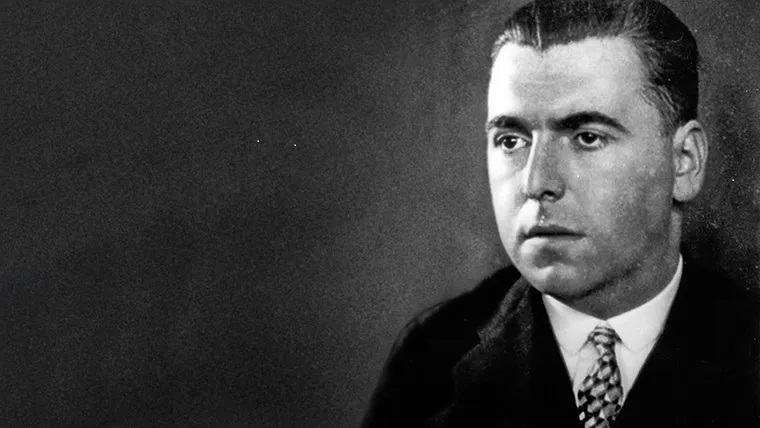
    Above: composer Erwin Schulhoff

    ~ Author: Ben Weaver

    Thursday February 24th, 2022 – Conductor Manfred Honeck returned to the New York Philharmonic with a thrilling concert of old chestnuts and a fresh take on an unfamiliar classic. Maestro Honeck and composer Tomáš Ille have created some marvelous orchestral arrangements of familiar pieces like a suite of Richard Strauss’ Elektra, Dvořák’s Rusalka, among others. In 2021 they premiered what may be their most successful collaboration yet: an orchestral arrangement of Erwin Schulhoff’s Five Pieces for String Quartet, composed in 1923 (and dedicated to Darius Milhaud).

    Shulhoff’s marvelous composition, a collection of dances (including a valse, a tango, and a tarantella), is a lively and inventive piece. Honeck and Ille created a highly imaginative suite, filled with a wide range of colors, with a touch of jazz (a style of music Schulhoff loved). Each movement – featuring a great deal of fun percussive instruments (including a marimba, a vibraphone, woodblock, tambourines, tom-toms, and castanets) – burst at the seams with excitement. A playful Alla Serenata gives way to a blousy Czeca. A soulful and passionate Tango milonga (with a lovely solo played by concertmaster Sheryl Staples) is followed by a head-spinning Tarantella, all played magnificently by the orchestra. Special kudos to the percussion section who juggled their instruments with aplomb.  And more kudos to Honeck and Ille for giving this wonderful pieces new life.

    Schulhoff is not as known as he should be. He was born Ervín Šulhov (Erwin Schulhoff being the Germanized version of the name) in 1894 in Bohemia. When he was 6 years old, Antonín Dvořák told his family to prepare their child for a musical career. Schulhoff was friends with people like Alban Berg. Schulhoff was arrested by the Nazis in 1941 and died in the Wülzberg Concentration Camp in Bavaria on August 18, 1942.

    Ray chen

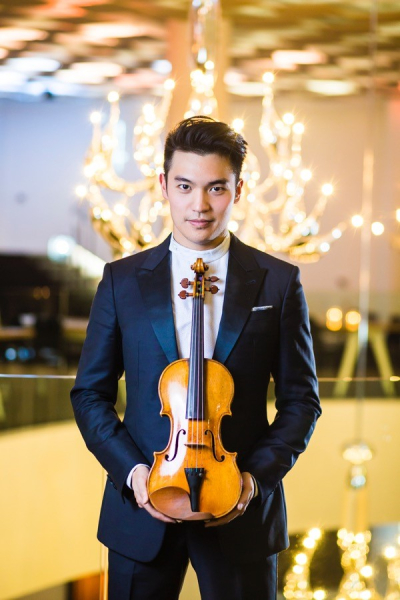
    Above: violinist Ray Chen

    Felix Mendelssohn’s famous E minor Violin Concerto, composed in 1844, is one of the standard violin concertos in the repertoire. Young violinist Ray Chen was making his Philharmonic debut this season and there’s alway ssome risk playing a work as familiar as this because everyone has heard it numerous times and no doubt has some favorites already in mind. Chen was dazzling. His playing is gorgeous and secure, with beautifully honeyed tones from the violin, and a very passionate and committed interpretation. He received wonderful support from Maestro Honeck, who supported the soloist at every turn. The audience greeted Chen enthusiastically. As an encore, he played dazzling variations on Waltzing Matilda, the unofficial anthem of Australia, the country of Chen’s birth. 

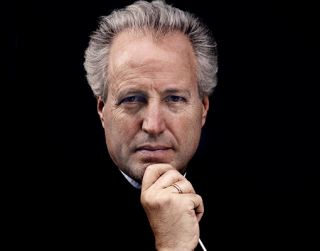
    Manfred_Honeck Felix_Broede

    Above: Maestro Manfred Honeck, in a Felix Broede portrait

    Antonín Dvořák’s cheerful Symphony No. 8 (composed in 1889), is one of his most enduring works. I’ve always called it Dvořák’s “Pastoral” symphony. Filled with sunshine and joy, melodies you feel like you’ve known your entire life (including a magical Waltz of the third movement), it came as a big contrast from the dark and stormy Symphony No. 7. Maestro Honeck clearly loves his work (he conducted it without a score), etching every moment and phrase with relish. The orchestra (including another wonderful solo from Sheryl Staples) was on peak form once again. A rousing ovation was well-deserved.

    ~ Ben Weaver

  • Schultz/Rouvali @ The NY Philharmonic

    Composer

    Above: composer Žibouklė Martinaitytė, photo by Romas Jurgaitis

    Author: Ben Weaver

    Saturday February 19th, 2022 – As we all anxiously await the reopening of David Geffen Hall (née Philharmonic Hall, then re-christened Avery Fisher Hall) at Lincoln Center in Autumn 2022 (two years ahead of schedule!), the orchestra returned to the Rose Theater at Jazz at Lincoln Center for a concert featuring Richard Strauss, Tchaikovsky and a US Premiere of a recent work by Žibouklė Martinaitytė.

    Born in St. Petersburg (then Leningrad), USSR, but raised in Lithuania and now based in NYC, Ms. Martinaitytė’s gripping 2019 work Saudade received its US Premiere in these NY Philharmonic performances. The word “saudade” is Portuguese and has no direct English equivalent, but it comes close with “longing,” (or as Madonna described it when covering Césaria Evora’s great ballad “Saudade” during her Madame X Tour: “yearning.”) To be honest, I’m not entirely certain what Ms. Martinaitytė is longing for in her Saudade, which is rather dark and ominous. But that’s not important when the music is this hypnotic. Much of the composition is played at a steady, slow pace, with strings providing the canvas on which the rest of the orchestra makes its contributions. There is something of Arvo Pärt here, though more varied in orchestration. Martinaitytė’s orchestra is huge, with numerous brass and percussion instruments (including, three trombones, tubular bells, and vibraphone), but unlike the lazy “throw in the kitchen sink ” noise of a composer like Christopher Rouse (who Albert Gilbert subjected us to for several seasons), Ms. Martinaitytė’s use of every instrument on stage is always economical and perfectly woven into the tapestry of sound, not just smashing a gong to cover up inadequate musical transitions – something numerous contemporary composers do with abandon. As she slowly builds Sodade to its climaxes and retreats, the work most reminded me of the freezing winds of Sibelius and crashing waves of John Luther Adams. Although unlike John Luther Adams (not to be confused with John Adams), Ms. Martinaitytė believes in brevity. She tells the whole story in about 15 minutes of Saudade. This is a beautiful and gripping piece. Maestro Santtu-Matias Rouvali, currently artistic director of the Philharmonia Orchestra in London, shaped it superbly, and the orchestra seemed to enjoy its challenges. They applauded Ms. Martinaitytė warmly when she came up on stage for a bow: the crowd seemed truly impressed.

    The work Saudade has been recorded by the Lithuanian State Symphony Orchestra conducted by Giedrė Šlekytė, and is available on the Ondine label. It is highly recommended.

    Richard Strauss’ Brentano-Lieder, Op. 68, were composed in 1918 following a lengthy break from lieder composition, and on the heels of completing ROSENKAVALIER, both versions of ARIADNE AUF NAXOS, and DIE FRAU OHNE SCHATTEN. This is relevant because you can hear all three of these operas in these Brentano songs, and that is perhaps the reason they are infrequently performed as a set: the style of composition is so different from song to song that it’s difficult to find as singer who can cover the full spectrum of Straussian styles in less than 25 minutes. Over the years, some of these songs have been performed at the Philharmonic, by Beverly Sills, Kathleen Battle, Barbara Bonney, and Deborah Voigt, but they did not sing the same songs.

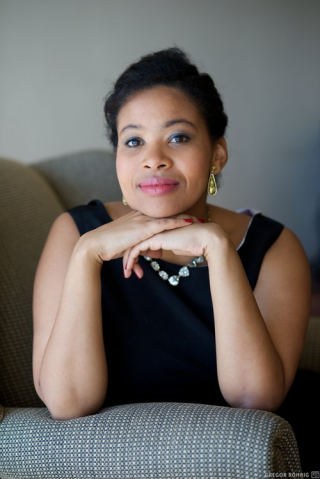
    Golda

    Above: Golda Schultz, photo by Gregor Röhrig

    Fortunately the orchestra found an interpreter who managed to not only survive the challenge, but do so with flying colors. Young South African soprano Golda Schultz, who now resides in Bavaria, made a stunning Philharmonic debut with these performances. She has a silky, beautiful voice, even throughout the range, from a secure bottom (which she wisely does not force) to a ringing and full top. “Säus’le, liebe Myrtle!” and “Amor” could be outtakes from Zerbinetta, the more thoughtful in the former and coquettish in the latter, and Ms. Schutlz managed the runs and playful coloratura with aplomb. The lyrical yearning of “An die Nacht” could be Sophie’s wedding night jitters, and wildly passionate “Als mir din Lied erklang” a desperate outburst of the Composer. Ms. Schultz already sings Sophie and I think she’d make a marvelous Composer too. (Originated by Lotte Lehmann, it’s not really supposed to be sung by mezzo-sopranos.) And finally DIE FRAU OHNE SCHATTEN comes blaring in with an Empress-inspired “Ich wolf ein Sträußlein binden” – lyrical and passionate, with some light coloratura, Ms. Schultz never pushed her voice, but showed a simple pleasure of passion and signing. The final song of the cycle, “Lied Der Frauen,” is something the Dyer’s Wife could have sung. Perhaps here Ms. Schultz was reaching the limits of her current vocal comfort, but she did not become desperate and Maestro Rouvali did not allow the orchestra (massive, echt-Strauss sound) to cover her. If the Dyer’s Wife – a vocally brutal role – would be beyond Ms. Schultz’ natural capabilities, I think the Empress is a role she should seriously consider taking on. Ms. Schultz is an exciting young singer and was greeted appreciably by the audience. (…which did applaud after each song…but what can you do?)

    Rouvali

    Santtu-Matias Rouvali (above, photo by Chris Lee) concluded the concert with Tchaikovsky’s familiar Symphony No. 5. It is a long favorite of the public, even though after the premiere Tchaikovsky – in his typical manner – declared it his worst composition and that the public only pretended to like it. Perhaps Maestro Rouvali took the slow parts a bit too slow, they began dragging from the opening pages of the score. But anything above Adagio took on a playful pep and interesting rhythms. The Valse was perhaps the most successful of the movements, a warm and well judged pacing, lovingly shaped by the orchestra. The finale, too, was thrilling. This is music the orchestra has played many times and they seem to relish it once again.

    Since NY Philharmonic music director Jaap van Zweden is leaving the Philharmonic, people are speculating that every conductor who steps on the podium is auditioning for the post. This is certainly true of Maestro Rouvali. New York could certainly do much worse. I’d argue it has.  Worth noting currently Rouvali is principal conductor of the Philharmonia Orchestra, chief conductor of the Gothenburg Symphony, and chief conductor and artistic director of the Tampere Philharmonic Orchestra.

    Another interesting note on the state of the current Covid-19 pandemic and wearing of masks. One thing that has historically been difficult not to notice is how noisy NYC audiences frequently are. Many nights – and not only in the cold season – it sounds like a consumption ward with someone hacking up a lung every moment of a concert. This was not the case at this concert. One thing the CDC has noted is that, no doubt due to wearing of masks, very few people have gotten sick with the common cold. I don’t think I heard a single cough at this concert. I think perhaps we should make the wearing of masks mandatory at all times going forward.

    ~ Ben Weaver

  • The Beethoven Symphonies on Record

    Beethoven-

    My friend Ben Weaver has devoted a great deal of time over the years listening to the music of Ludwig van Beethoven. Here he writes about recordings of the nine symphonies that have particularly captured his interest:

    “With the 250th anniversary since Ludwig van Beethoven’s birth celebrations curtailed by a worldwide pandemic, what’s a Beethoven lover to do but try to make the best of semi-voluntary home imprisonment by turning to recordings of Beethoven. I have previously taken a stroll through recordings of Wagner’s Tristan und Isolde; why not go back to some of my favorite recordings of Beethoven’s Nine. THE Nine that started the count and turned the world of music on its head. (Mahler and Bruckner both feared the number 9 and that they would not be able to out-do Beethoven and compose a symphony beyond that number – and both turned out to be correct: Bruckner never finished his Ninth and Mahler only completed one movement of his Tenth.) I will only go through some of the finest sets of the complete Symphonies – this is not intended to be a study of every recorded cycle and I’m only looking at complete sets of the Symphonies. (I will honorably mention some stand-alone recordings at the end.)

    So where does one begin a traversal of Beethoven’s recorded Symphonies? Naturally, with Herbert von Karajan – the Dean of recorded sound who left behind 4 complete studio sets: one from the 1950s with the Philharmonia Orchestra of London on EMI and three with the Berlin Philharmonic, one for each subsequent decade. (There are also at least two complete sets recorded by Japanese radio during Karajan’s concert tours with the Berliners.) 

    Karajan’s Philharmonia set (in mono) is unjustly neglected: produced by Walter Legge it captures the great vintage Philharmonia (arguably a better orchestra in the 1950s than even the Berliners were) in all its warm virtuosic glory and the young(er) Karajan, still not the domineering force he would become later, in a more playful mood than he would be in his Berlin recordings. This is especially noticeable in the “non-heroic” symphonies: One and Two sizzle with excitement and Seven, which Wagner called “the apotheosis of dance,” zooms out of the speakers and around the room. Of course the fact that it’s in mono will deter many listeners. The current issue of the EMI (now Warner) set includes two versions of the Ninth Symphony, one in mono and one in Legge’s experimental stereo (Legge preferred mono); the stereo version has never been available before.

    Of Karajan’s three Berlin sets – recorded 1961-62, 1975-76, and finally 1982-84 – interpretively there was not a great change in Karajan’s approach over the years. Since the London days he would become a more “serious” musician, maybe wiser, with what one would call a Germanic (he was actually Austrian) sense of humor. And for all his stürm und drang, Beethoven was certainly a man of humor. Karajan’s firmer grasp of the music and structure grew, and he now had complete control over his Berlin Philharmonic, wrestled from Wilhelm Furtwängler’s cold, dead hands and remade in his own image. The teutonic sound of Karajan’s Berliners would become firmer over the years, its granite-like wall of sound could level buildings, its virtuosity would be second-to-none. (The roster of principals over the years has given birth to more star soloists than perhaps any other band, including the likes of flautist Sir James Galway who played for Karajan from 1969 to 1975 and clarinetist Sabine Meyer’s very unhappy stint as the Orchestra’s first female principal in 1982. The orchestra voted her out after her “trial period” over Karajan’s objections, angering the maestro who insisted the male-dominated orchestra objected to Meyer’s gender, not musicianship; the incident caused a serious rift in their relationship and saw Karajan perform with the Vienna Philharmonic more in his final years. Berlin’s star soloists today include flautist Emanuel Pahud, oboist Albrecht Meyer, and clarinetist/model Andreas Ottensamer. But I digress…)

    So what sets all that Karajan Beethoven apart from one another? The 1961-62 set is one of the most famous classical recordings ever made; it has never been out of the catalog and has been reissued a bazillion times. (There is a new 2020 remastering being issued on SACD in Japan only and it does sound spectacular.) But there is a separatist group of listeners, which includes myself, that consider the 1970s cycle to be superior. There’s something a little rough in the 1960s set; maybe it’s Karajan still fighting the ghost of Furtwängler, or the orchestra still resisting Karajan’s attempts to possess them, but for me the cycle doesn’t register as extraordinary and the Ninth is a disappointment: the over-large and poorly recorded choir is an aural mess and sounds like they were singing in an empty subway station. By the late 1970s recording techniques had been improved and Karajan’s takeover of the orchestra was complete: they were now an extension of himself, with no ensemble lapses, no hesitations. And the recorded sound is gorgeous: warm, from the softest to the loudest moments. Listen to the Storm of the Pastoral Symphony: it’s all encompassing in sound and terror, as if we are hearing God’s flood for Noah. But then the romantic sweep of the Shepherd’s Call is overwhelming too in its depth of feeling and beauty of sound.

    Claudio Abbado took the reins of the Berlin Philharmonic after Karajan’s death and though Abbado recorded the Symphonies with the Vienna Philharmonic in the 1980s, he took another stab with his new orchestra in the 1990s. The results were electrifying. Paring down Berliners’ big and saturated sound favored by Karajan and echoed by many others over the years, Abbado brought Beethoven down from Mount Olympus and gave the symphonies a fresh, more Classical sound, reducing the number of players and exploiting Berliners’ newfound energy without gratuitous rushing. Deutsche Grammophon released Abbado’s recordings in two different versions: first came a cycle recorded at the Philharmonie in 1999-2000 and then a cycle recorded in concert in Rome in 2001. (Except the Ninth, which exists only from its Philharmonie performance, but re-edited in 2001 from original recordings according to Abbado’s new wishes.) DG says the Rome cycle is intended to replace the earlier Berlin one. Many argue that the Rome performances are the real jewels: I don’t know if I personally hear a huge difference in Abbado’s take or the orchestra’s performances, but I’m glad to have both. (To add to the confusion, the Rome cycle was also issued on DVD, but with a different Berlin recording of the Ninth, this one with bass Eike Wilm Schulte replacing Quasthoff, who remains the bass on the audio-only recording.) 


    With Abbado’s many years of experience with these works and having had time to cleanse the orchestra of Karajan’s late-career excesses, everything sizzles. The Fifth reminds us why the first movement has had the world ta-ta-ta-taming for centuries and the rest reminds us why this is an extraordinary, world-changing work and is more than just 4 chords. The Eroica is exceptional in its nobility and the Fourth makes you wonder why it’s not as famous as the two Symphonies bracketing it. The Pastoral is a gorgeous, gentle giant and the Seventh an exuberant dance. A superb quartet of soloists in the Ninth (Mattila, Urmana, Moser and Quasthoff) dominate the grand finale.

    Perhaps no orchestra has recorded Beethoven’s symphonies more frequently than the Vienna Philharmonic over the years. Leonard Bernstein’s Vienna cycle from the late 1970s not only leaves his 1960s New York recordings in the dust, but it leaves almost everyone else in the dust too. The playing is stupendous and Bernstein finds threads and sounds that nobody else has unearthed. The is nothing gratuitous about the interpretations, no odd Bernsteinisms, nothing willful. Bernstein doesn’t pull the music in any perverse direction, like his New York Fifth’s preposterous tempos: and yet he and the orchestra create sounds and discover ideas that nobody has before or since. Inspired by Lenny’s fertile imagination the Viennese play like gods. From beginning to end it feels like you hearing these works for the first time. No matter what others have done with these works or will do, these lovingly shaped performances will always belong near the top of recommendations. 

    The late 1980s/early 1990s brought two exceptional sets: Nikolaus Harnoncourt’s and John Eliot Gardiner’s. Harnoncourt – with the Chamber Orchestra of Europe – brought his decades of period instruments experience to a modern instruments orchestra (except natural horns) and the results were electrifying, except a disappointing, shapeless Ninth. The rest of the cycle – a surprisingly big boned Eroica, cheerful Pastoral, delirious Seventh – can stand proudly along with the best. The blaring, natural horns, over smooth modern strings, is an inspired and attention-grabbing touch.

    John Eliot Gardiner’s cycle with the newly created Orchestre Révolutionnaire et Romantique (an expanded English Baroque Soloists, specifically created to perform music of the Romantics) was not the first period instruments cycle of the Symphonies. Roger Norrington and Christopher Hogwood, among others, preceded him. But nothing could have prepared the world for the barnstorming, hair-raising Gardiner set. For reasons unclear to me the earlier period instrument sets can often sound anemic and unsteady. For years people seem to have accepted that as the nature of period instruments. Sir John turned all that on its head: the Orchestre Révolutionnaire et Romantique comes at you like a category 5 hurricane. Suddenly the terror, confusion and wonder people felt at hearing Beethoven in his own time started to make sense. Yes the tempos are fast, but never feel rushed. Gardiner makes it all feel completely organic: from the opening chords of the First Symphony – no longer just a fluffy Mozart tribute, but a foreshadowing of something never heard before – all the way to the awe-inspiring choral conclusion of the Ninth, no one has done more to show the truly revolutionary Beethoven than John Eliot Gardiner. The Eroica is truly worthy of Napoleon and the Fifth is like a bat out of hell. The Pastoral transitions perfectly from sunshine to a storm of epic proportions, and Seven and Eight are dizzying. The Ninth is a crowning glory of the set: you can see how and why this work, above all else, changed the course of music. The extraordinary Monteverdi Choir levels all competition in its path and four exceptional soloists (Luba Orgonasova, Anne Sofie von Otter, Anthony Rolfe Johnson and Gilles Cachemaille) cover themselves in glory. This is essential listening.


    With the celebrations in full swing, everybody and their mother is issuing a new Beethoven Symphonies cycle. What is there left to say that hasn’t been said yet? Well, turns out a good conductor can still send a tingle up your leg.


    Among the highlights of the new cycles are Philippe Jordan’s exhilarating recordings with the Vienna Symphony Orchestra (an orchestra that lives in the shadow of the Vienna Philharmonic and unjustly so.) Jordan’s tight rhythms and mostly quick tempos – along with the orchestra’s virtuosity and beautiful sound – create numerous thrilling moments: the early symphonies are full of exuberance. With the Eroica Jordan manages to create something remarkable: a balance that melds the unmistakable early, Mozartian, youthful Beethoven with the forward-looking revolutionary. The Pastoral, a symphony that can be tedious in the wrong hands, is truly one of the most perfect performances of this work I’ve ever heard. There’s not a note or feeling out of place. These are carefully thought out and prepared performances, well recorded by Vienna Symphony’s home label.


    THE TOP CHOICES:


    Herbert von Karajan – Philharmonia Orchestra – EMI – Elisabeth Schwarzkopf, Marga Höffgen, Ernst Haefliger, Otto Edelmann


    Herbert von Karajan – Berlin Philharmonic – DG – Anna Tomowa-Sintow, Agnes Baltsa, Peter Schreier, José van Dam.


    Leonard Bernstein – Vienna Philharmonic – DG – Dame Gwyneth Jones, Hanna Schwarz, René Kollo, Kurt Moll.


    Claudio Abbado – Berlin Philharmonic – DG – Karita Mattila, Violeta Urmana, Thomas Moser, Thomas Quasthoff.


    Nikolaus Harnoncourt – Chamber Orchestra of Europe – Teldec – Charlotte Margiono, Birgit Remmert, Rudolf Schasching, Robert Holl.


    Sir John Eliot Gardiner – Orchestre Révolutionnaire et Romantique – Archiv – Luba Orgonasova, Anne Sofie von Otter, Anthony Rolfe Johnson, Gilles Cachemaille.


    Philippe Jordan – Vienna Symphony Orchestra – VS – Anja Kampe, Daniela Sindram, Burkhard Fritz, René Pape


    HONORABLE MENTIONS:


    André Cluytens’ 1959 Berlin Philharmonic cycle (in stereo for EMI) predates Karajan’s and has Furtwängler’s orchestra at his disposal. These are very noble readings from the old school. With Gré Brouwenstijn, Kerstin Meyer, Nicolai Gedda, Frederick Guthrie.


    Another terrific old-school set with a vintage Vienna Philharmonic can be heard under Hans Schmidt-Isserstedt on Decca in the late 1960s. And his quartet of soloists is an unbeatable all-star: Joan Sutherland, Marilyn Horne, James King, Martti Talvela.


    A glowing Staatskapelle Berlin can be heard under Daniel Barenboim from 1999 for Teldec. With Soile Isokoski, Rosemarie Lang, Robert Gambill, René Pape.


    A warm, ravishing Gewandhausorchester Leipzig plays for Herbert Blomstedt’s in a terrific set from Accentus Music. This recording shows off Blomstedt’s wonderful Beethoven to better effect than his Staatskapelle Dresden set from 40 years earlier. With Simona Šaturová, Mihoko Fujimura, Christian Elsner, Christian Gerhaher.


    Early music specialist Jan Willem de Vriend’s often surprising period instruments approach with modern instruments galvanizes the Netherlands Symphony Orchestra for Challenge Records. With Annemarie Kremer, Wilke te Brummelstroete, Geert Smits, Marcel Reijans.


    Paavo Järvi and the Deutsche Kammerphilharmonie Bremen set the music world buzzing with their fleet-footed, exciting cycle on RCA. With Christiane Oelze, Petra Lang, Klaus Florian Vogt, Matthias Goerne.


    Sir Simon Rattle’s exciting Berlin Philharmonic set – after he took over from Abbado, also having recorded a mediocre cycle in Vienna earlier – is great, old-school fun, released by Berlin’s own in-house label. With Annette Dasch, Eva Vogel, Christian Elsner, Dimitry Ivashchenko.


    Sir Bernard Haitink’s autumnal London Symphony Orchestra recordings from 2005-06 on the LSO Live label are old-fashioned, yet full of surprising touches and warmth. With Twyla Robinson, Karen Cargill, John Mac Master, Gerald Finley.


    Kent Nagano’s big, Romantic set with the Orchestre Symphonique de Montréal features beautiful, warm playing. With Erin Wall, Mihoko Fujimura, Simon O’Neill, Mikhail Petrenko. (Also includes excerpts from “Egmont” sung by Adrianne Pieczonka.)


    Period instrument specialist Jos van Immerseel presents a warm, sunny cycle with the Anima Eterna ensemble. With Anna-Kristiina Kaapola, Marianne Beate Kielland, Markus Schäfer, Thomas Bauer.


    George Szell’s vintage recordings on Sony with the Cleveland Orchestra are brilliant and brash. With Adele Addison, Jane Hobson, Richard Lewis, Donald Bell.


    Ádám Fischer’s recent strange, idiosyncratic set with the Danish Chamber Orchestra is full of surprises – some of which you may enjoy, some not so much – is worth exploring. With Sara Switlicki, male alto Morten Grove Frandsen, Ilker Arcayürek, Lars Møller.


    Japanese composer and conductor Joe Hisaishi’s new recording with a Japanese youth orchestra, Future Orchestra Classics, bring an exuberance only young people who have never played these works before can bring. A too-resonant acoustic takes getting used to, but the performances are fresh and engrossing. On the Exton label. With Yoko Yasui, Makiko Yamashita, Kei Fukui, Koji Yamashita.


    RECOMMENDED INDIVIDUAL SYMPHONIES:


    Ferenc Fricsay’s stereo recordings with the Berlin Philharmonic from the 1950s and 60’s is among the glories of the gramophone. Tight, thrilling, driven, insightful. A must own for any collector. Symphonies Nos. 3, 5, 7 and 9 (with Irmgard Seefried, Maureen Forrester, Ernst Haefliger, Dietrich Fischer-Dieskau) on DG.


    Carlos Kleiber’s legendary recordings of Symphonies Nos. 5 & 7 with the Vienna Philharmonic on DG are among the most beloved of all recordings. But also don’t miss his exhilarating live performances of Symphonies Nos. 4, 6 and 7 with the Bayerisches Staatsorchester on the Orfeo label.


    István Kertész died too young and left behind exciting recordings of Symphonies Nos. 2 and 4, plus some Overtures with the Bamberg Symphony Orchestra. (Plus a stunning Piano Concerto No. 3 with Conrad Hanson.)


    Sir John Eliot Gardiner, in addition to his complete cycle, more recently recorded Symphonies Nos. 2 & 8 (live at Cadogan Hall) and Nos. 5 & 7 (live at Carnegie Hall) with the Orchestre Révolutionnaire et Romantique and these are, if anything, even more exhilarating than his original recordings. On his own Soli Deo Gloria label.


    Kurt Masur’s NY Philharmonic recordings of Symphony No. 5 and the complete “Egmont” from the 1990s (with soprano Sylvia McNair and narrator Will Quadflieg) are first rate.


    Seiji Ozawa 1970 Symphony No. 5 (with Chicago Symphony Orchestra) and 1976 Symphony No. 3 (with San Francisco Symphony) are wonderfully old fashioned and exciting.


    Enfant terrible Teodor Currentzis – a modern agent of chaos – twists a lot of music into unrecognizable shapes. But sometimes the result are electrifying, even if they would send the composer spinning in his grave. Currentzis’ recent Symphony No. 5 for Sony with his Russian-based MusicAeterna orchestra is one of those performances. You may like it. Or you may want to throw your stereo out the window.


    Masaaki Suzuki, having completed his Bach Cantatas project, turns his gaze to Beethoven with an exciting Symphony No. 9 on period instruments. On Bis with Ann-Helen Moen, Marianne Beate Kielland, Allan Clayton, Neal Davies.


    Wilhelm Furtwängler recorded the Ninth Symphony a number of times. Famously in Bayreuth (twice) and in Lucerne just three months before his death in 1954 with the Philharmonia Orchestra (many consider this to be his best version.) But I don’t think anything quite comes close to the infamous March 1942 performance in Berlin recorded for German radio. (A few minutes of the finale were also filmed.) Consider the time and the place, consider who is in the audience and what is happening in the world. This performance – all fire, brimstone, rage bordering on hysteria and the most wrenching slow movement of this Symphony ever recorded – will put you through the wringer. Nobody will walk away unscathed. If you are not shell-shocked when it’s over, you are not human. With Tilla Briem, Elisabeth Höngen, Peter Anders, Rudolf Waltzke.


    ~ Ben Weaver