
The great Canadian contralto Maureen Forrester sings Gustav Mahler’s Kindertotenlieder, which she recorded with the Boston Symphony Orchestra under Charles Munch’s baton in 1958.
Listen here.
The great Canadian contralto Maureen Forrester sings Gustav Mahler’s Kindertotenlieder, which she recorded with the Boston Symphony Orchestra under Charles Munch’s baton in 1958.
Listen here.

Above: Maestro Andris Nelsons; photo by Fadi Kheir
Author: Ben Weaver
Tuesday April 25th, 2023 – The Boston Symphony Orchestra, under the baton of their music director Andris Nelsons, returned to Carnegie Hall last week. The concert of April 25th, 2023 was a marvelous evening of music by Mozart, Adès, and Sibelius, featuring two outstanding soloist artists.
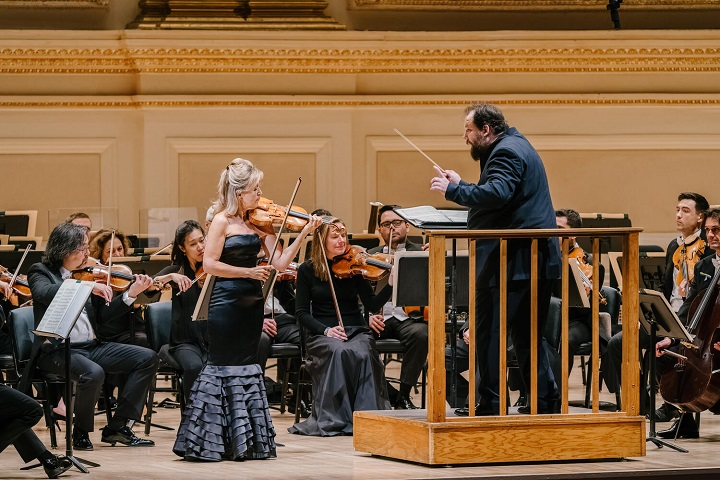
The great Anne-Sophie Mutter (above, photo by Fadi Kheir) performed two works: Mozart’s Violin Concerto No. 1 in B-flat major, KV 207 and the New York premiere of Thomas Adès’ Air (Homage to Sibelius) for Violin and Orchestra.
Mozart’s violin concertos have been part of Mutter’s repertoire for her entire career; it’s music she has played and internalized, and performances she has perfected, through the years. The magical performance on Tuesday night of the 1st Concerto, composed in 1773, was essentially perfect. Mutter’s golden, rich, steady tone never wavered; the soulfulness of her playing made the audience lean in. Mozart’s virtuosic writing gave Mutter no difficulties; she dispatched every run, double stop, and trill with absolute ease.
The new composition by Adès, Air (Homage to Sibelius), is a very different work from Mozart. Composed for Ms. Mutter in 2022, it’s a single-movement, semi-minimalist work (running about 13 mins) that lets the soloist stay in the upper reaches of the instrument for almost its entire run time. While the soloist played a canon – Ms. Mutter’s perfect control and steadiness were wondrous to hear – the orchestra shifted the landscape through orchestration and rhythms. Maestro Nelsons shepherded the forces around Ms. Mutter beautifully, the BSO letting the music ebb and flow. While Mr. Adès explicitly says Air is an homage to Sibelius, I heard more Arvo Pärt and John Adams than Sibelius.
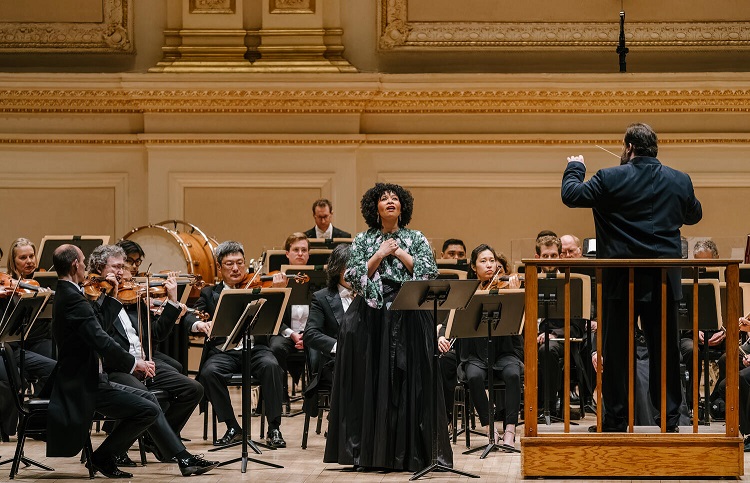
Above: soprano Golda Schultz sings Sibelius; photo by Fad Kheir
Two works by Sibelius book-ended the evening’s program. The vocal tone poem Luonnotar, Op. 70, is one of Sibelius’ most mystical and magical works. With text taken from the first “song” of the Finnish epic national poem Kalevala (a work that inspired several other major works from Sibelius), it tells the story of the (non-religious) Creation. The huge leaps and range of the vocal writing makes Luonnotar one of the most demanding works for a soprano, and South African soprano Golda Schultz was mesmerizing. Her rich voice is even throughout the range, even in the uppermost reaches it remains creamy and ravishing. Her breath control ensured she never ran out of air for Sibelius’ long and achingly beautiful melodies. Maestro Nelsons was sensitive to never let the orchestra drown out the singer. This is a work I wish would be performed more often.

Above: Maestro Nelsons and the BSO; photo by Fadi Kheir
The concert ended with an expansive performance of Sibelius’ Symphony No. 5 in E-flat major, Op. 82. Sibelius’ sound-world is really like no other. I don’t think there is another composer who composed music of such surging coldness and brilliant light. You can feel the winds sweeping across the snow and the icy water glistening in the Sun. The episodic nature of Sibelius’ writing, in the hands of lesser conductors, can be difficult to stitch together. Maestro Nelsons managed it beautifully, and the Boston Symphony – which has a long history of playing Sibelius – responded to every nuance. The orchestra’s marvelous brass section deserves special recognition here because the very exposed writing for the horns in the first and third movements was played perfectly by the ensemble. The final movement, one of Sibelius’ most famous compositions, with the majestic tolling of the horns and sweeping melody from the strings, is one of those rare truly breathtaking glories of music. It’s interesting that this overwhelming section – supposedly inspired by a flock of swans he watched passing overhead – is only played in all its Romantic glory once. When it is repeated in the second half of the movement, it changes to a darker, almost sinister tone. And the work ends with 4 chords and 2 unisons – broken by pauses. A stark and startling conclusion.
The Boston Symphony is second to none playing Sibelius; years ago Sir Colin Davis – one of the great exponents of the Finnish bard’s music – played and recorded his works with the BSO extensively. Andris Nelsons doesn’t miss a beat.
Performance photos by Fadi Kheir, courtesy of Carnegie Hall
~ Ben Weaver

The great Canadian contralto Maureen Forrester sings Gustav Mahler’s Kindertotenlieder, which she recorded with the Boston Symphony Orchestra under Charles Munch’s baton in 1958.
Listen here.

Wednesday October 21st, 2015 – Conductor Andris Nelsons (above) leading a powerful concert performance of Richard Strauss’s ELEKTRA given by the Boston Symphony Orchestra at Carnegie Hall. The evening was a great personal triumph for soprano Christine Goerke, who gave a vocally and physically super-charged rendering of one of opera’s most demanding roles.
Strauss calls for a massive orchestra for this, his most demented work; the Boston players were sprawled across the entire space of the Carnegie stage, with the chorus at the end singing from an upper tier of the hall. The musicians played their hearts out and, under Nelsons’ authoritative baton, they delivered the music with tremendous flair in all its glistening glory. There were also superbly refined stretches, notably in the Klytaemnestra scene where the maestro and musicians painted a neurotic sound setting for an amazingly nuanced performance of the role by Jane Henschel.
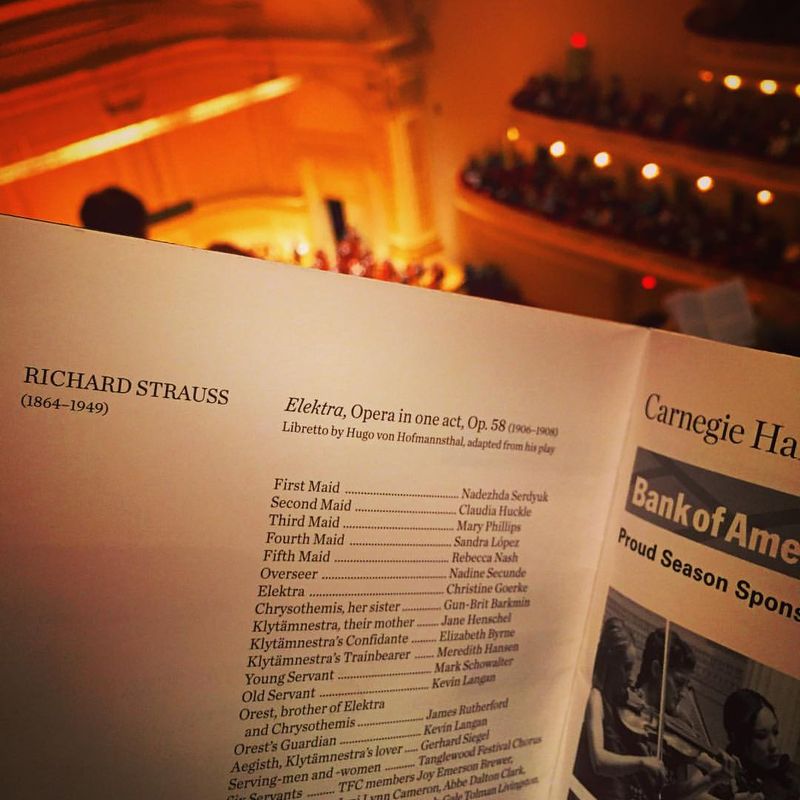
The large cast included some names to reckon with in the smaller roles: Nadine Secunde (Overseer), Elizabeth Byrne (Confidante), the Met’s Mark Schowalter (Young Servant) and stalwart basso Kevin Langan (Old Servant/Orestes’ Guardian).
In the opening scene, the psychopathic maids were a raucous lot; as they carried on their vile gossip session about Elektra – the royal princess reduced to the status of a caged animal in her own home – Ms. Goerke, in a striking blood-red gown, strode among the violins in a state of fevered anxiousness. At last the maids hauled off the fifth of their number to be beaten for defending Elektra, and Ms. Goerke took center stage.
She began the great monolog with sounds of deep, guttural anguish. As in her recent Met Turandot, Goerke’s voice narrowed as she ventured higher and some of the upper notes were covered by the orchestra. This necessitated an adjustment for those of us inured to the likes of Nilsson, Behrens, and Dame Gwyneth Jones in this music. Yet Goerke knew what she was doing and she went about the music on her own terms; by the scene with Klytaemnestra, the Goerke voice was firing on all cylinders and she delivered a performance on a par with her career-defining portrayal of the Dyer’s Wife at The Met in 2013.
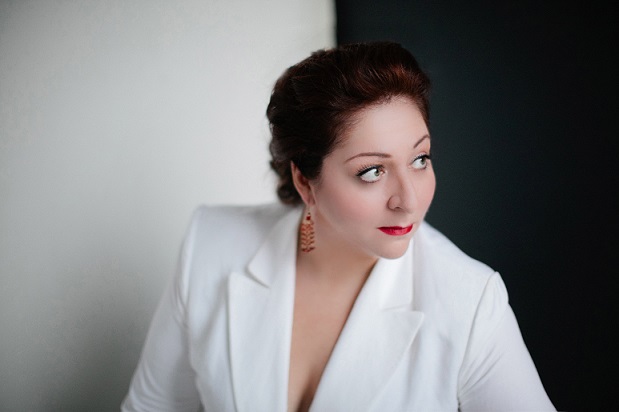
Above: Christine Goerke
The soprano’s portrayal of Elektra was so committed and intense: she entered into the physicality of the role as if in a staged performance, interacting brilliantly with her colleagues and even including a frantic, manic dance at the end. Vocally she sailed forth undaunted by the orchestra’s volume and hurling out the character’s dramatic punch lines (“Triff noch einmal!”) with force. Summoning up a colossal effort for the last sprint, Goerke packed a final punch with her ecstatic “Schweig, und tanze!” before collapsing into her chair. The ensuing ovation for the intrepid soprano was epic, and very much well-deserved.
As the hapless Chrysothemis, Gun-Brit Barkmin made a far better impression than she had as Salome in this same hall in 2014. Slender of frame and of voice, she nevertheless finds a way of projecting over the orchestra and her shining top notes made me think she might be a good SIEGFRIED Brunnhilde. Errant pitch was sometimes evident, but overall Ms. Barkmin did well and was a good foil for Ms. Goerke.

Jane Henschel (above), though the top of her voice must now be handled with care, gave such a illuminatingly subtle and detailed performance as the demented Klytaemnestra – playing off the words and using a kozmic array of vocal colours – that a few random strained notes were only of passing worry. She and Goerke made their encounter crackle with verbal vibrancy: the most dramatically engrossing passage of the evening.
James Rutherford was a sturdy-voiced but not especially imaginative Orestes. The great Recognition Scene was not persuasively staged, though Goerke’s singing after the revelation was wonderful….and deeply felt; and here the orchestra playing was sublime. Gerhard Siegel was a capital Aegisth, vividly neurotic and strongly sung: his final “Weh mir!”, voiced onstage, was a lightning bolt rather than a last gasp.
 Oberon's Glade