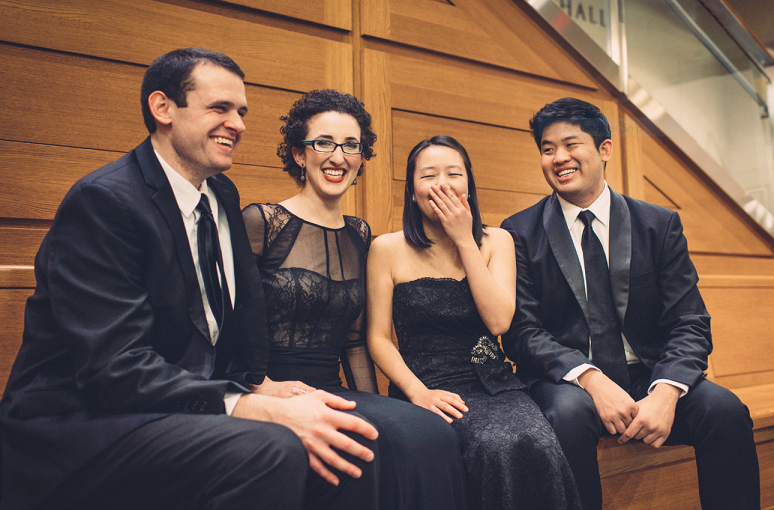
Above: the players of the Verona Quartet; photo credit ~ Joseph Ong/Brittany Florenz
Author: Scoresby
Friday June 16th, 2017 – On a hot sticky night, I went to the penultimate set of events for the Chelsea Music Festival. Hosted in St. Paul’s German Lutheran Church was a lecture by the neuroscientist Dr. Michael Shadlen and a performance by the Verona Quartet. For those who do not know, the Chelsea Music Festival is much more than the name would suggest. Rather than just a few concerts, it brings it together all of the different senses by having food, art, lectures, music and other events focused on one theme hosted in different venues in Chelsea in a whirlwind of eight days. For each of these various disciplines, the festival has a residency – thus no night is the same, and it is a true intellectually stimulating week.
Unfortunately, due to illness, I only ended up attending the second to last evening. This year’s theme focuses on keeping time. Dr. Shadlen’s lecture was about how humans perceive and anticipate time. His accessible talk first discussed the idea that time grounds the mind. It seems to Dr. Shadlen, time and anticipation help breed consciousness.
More interestingly, he then gave different demonstrations of sight experiments in chimps. Dr. Shadlen was able to show anticipation thru graphs (and audio) of the various neurons of a chimp reacting. Right before each anticipated event would happen, you could see a crescendo of neural activity until the event took place. The longer it was from the expected time, the more activity. As he put it, this is where “the neuroscience of cognition and aesthetics meet.” Because the brain is constantly anticipating and timing, music stimulates this part of the brain – constantly being thrown off by the various changes in what is anticipated. The implications of his lecture set up a classical performance perfectly.
While all of the other performances during the week are curated by the festival, here the Verona Quartet (this year’s Ensemble-in-Residence) was playing a program of their own choosing. The opener of the program was Ravel String Quartet in F Major. This young Quartet sounded fantastic throughout the Ravel, the lower strings delivering a beautiful blend of dark colors. The Quartet took a rather tight structural approach, keeping the tension high through the entire first movement. In their hands the piece seemed unstable and nervous, constantly bursting with energy through each phrase. This led to a dramatic outbursts that felt restrained almost right away and I couldn’t help but smile after the lecture about anticipation. The purplish lighting on stage and humid venue made the air seem to be saturated with energy.
During the pizzicato-ridden second movement, the players made a full use of Ravel’s sound effects. One of my favorite sections was the muted trio during the movement. The Quartet took on a much warmer tone, contrasting the more aggressive tone from earlier. I only wish they had slowed the trio section down a little more; it still felt as structured and nervous as the opening movement. They did a great job of building dynamic range transitioning back into the scherzo. During the third and fourth movements, the group seemed to change sound to thicker, rougher textures. While technically precise, instead of the smooth edges that some groups produce in this piece, the Veronas had a tense edgy sound. It would be great to hear this group play Janacek.
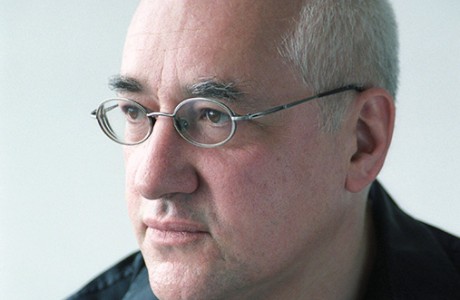
The other part of the first half was a world premiere by the Composer-in-Residence (and well-known composer) Sebastian Currier (above). His music had been played all week during the festival, and this commission was the capstone event of sorts. The new piece is part of a project of creating six etudes and six lullabies for six different string quartets, this set of two being the second entry of the project. In keeping with the festival theme, the piece is titled Etude: Interactions and Lullaby: Pulsing.
Through the etude, the quartet plays a theme that seems to keep developing. It is a fast-paced piece that reminded me some of John Adams’s writing, though more tonally adventurous and colorful. As each player’s theme gets offset and displaced, the chords gradually became more dissonant. The music is skittering and spider-like, and the Verona Quartet played it with verve, managing to capture all of the intricate accents. Because of the driving sections in this piece, there is very little silence. At times it sounded like Mr. Currier was making use of a Shepard Tone as everything falls out of sync. Finally, the difficult etude opened up into a muted chorale of sorts that brings the piece to a close, really the restlessness finally settling.
The lullaby to me felt like a ship that was rocking back and forth, with chords that slowly crescendo and decrescendo, each played by the whole quartet. This contrasted the etude well. As the piece evolves and moves forward, melodies start to emerge as instruments drop out of these larger chords to take on their own sound. Here Mr. Currier is employing a microtonal language so that each chord has completely different texture, timbre, and feeling. The piece builds to a beautiful E-flat chord that ends the piece, sounding much lighter than all the material preceding it. These pieces are great miniatures in the quartet repertoire, and I look forward to hearing the other five sets.
The lengthy program concluded with the very difficult Beethoven String Quartet in C-sharp minor, Op. 131. This seven-movement piece, played with no breaks, is a great way to conclude a program about measuring time. The first movement opens with an extended fugue, played here with attention and clarity. Similar to in the Ravel, the Quartet seemed be intent on the structure of the piece, infusing it with energy. While it was effective, it felt at times that some of the more delicate sections of this movement were overlooked. Nonetheless, they brought out the counter-melodies clearly. During the second movement, the group had a more folksy sound. They did best in the energetic rhythmic sections. While well-played, the third and fourth movements seemed to lack the structure that they had brought elsewhere. The music here seemed more about the individual movement rather than moving the piece forward.
Luckily, in the penultimate movement they seemed to regain their focus creating a beautifully sorrowful adagio; particularly lovely were the downward runs near the end of the movement. Throughout, they seemed to use a sweeping dynamic range that paved the way into the dramatic finale. During the last movement, the Quartet did a good job of bringing out the intense counterpoint while still managing to sound lyrical. Watching a quartet coordinate this is always a treat, and here the players seemed to be able to navigate the intricate voicing and virtuosity well, leading to an exciting conclusion. I look forward to hearing this young quartet in the future and seeing how their sound develops, they are certainly formidable performers.
While an overwhelming evening in many ways I am so glad that the Chelsea Music Festival provides such a diverse and vibrant set of events. It really is a quintessential New York celebration of culture and I look forward to attending again next year.
~ Scoresby
 Oberon's Glade