Tag: Chicago Symphony

  • Mälkki/Skride @ NY Phil

    ~ Author: Scoresby

    Thursday January 11 2018 – Last night at the New York Philharmonic was an evening that I had been looking forward to for a long time. It was conducted by Susanna Mälkki and featured violinist Baiba Skride. I had never heard Ms. Mälkki conduct the New York Philharmonic before, but had heard her during her days as music director of Ensemble intercontemporain, her debut at the Chicago Symphony a few years ago, and most recently conducting L’Amour de Loin. She is one of those conductors that I don’t necessarily agree with stylistically, but she always has an interesting and unique interpretation that is worth hearing.

    The performance began with Baiba Skride performing the Tchaikovsky Violin Concerto in D major, Op. 35, which while a warhorse is also one of the most difficult concerti in the violin repertoire. Immediately from the orchestral introduction it was clear that Ms. Mälkki had prepared the orchestra well – all of the textures were transparent and grand. Ms. Skride for her part had a warm interpretation but that didn’t indulge in large romantic gestures. Instead, she played the piece as one might play Brahms. Each of the tuttis were more memorable though as I don’t think I’ve heard an orchestral accompaniment as vibrant or full of life for a piece like this. Ms. Mälkki followed Ms. Skride’s lead in taking out extravagant gestures usually found in the concerto. In the second tutti, the orchestra felt light, brisk, with the trumpets sounding grand above the violins. Ms. Mälkki produced an almost frantic tempo in the lead up to the cadenza. Ms. Skride was at her best in the fast skittering parts of the first movement, but seemed to have trouble with some of the technical sections of the piece.
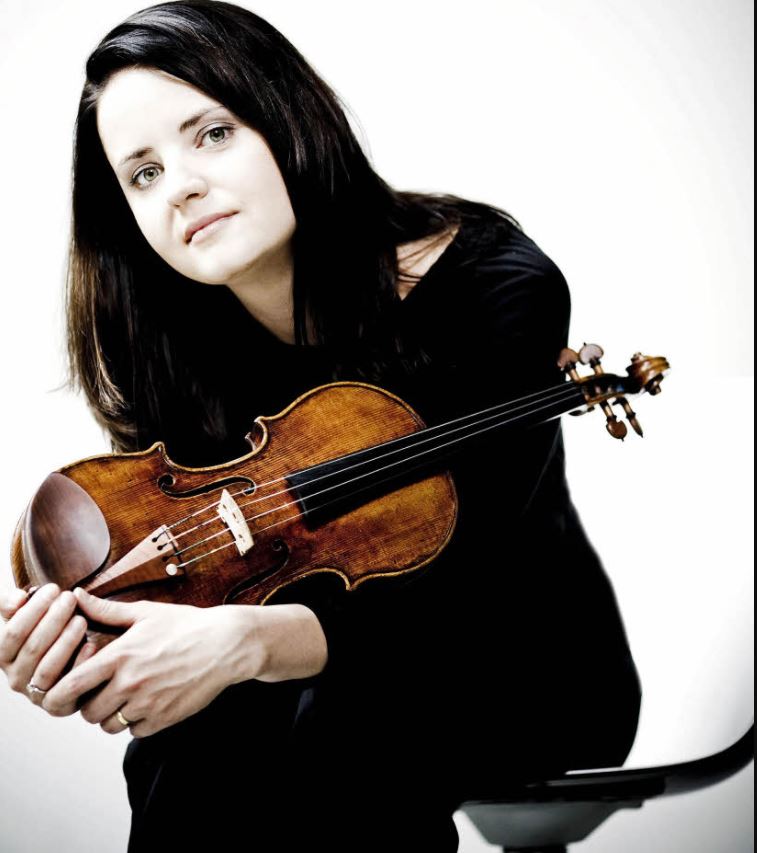
    Capture

    Above: Violinist Baiba Skride; Photo Credit: Marco Borggreve

    The second movement was the best of the concerto, in part because there was more direct interplay between Ms. Skride and the orchestra. Principal clarinet Anthony McGill’s duet with Ms. Skride was crafted beautifully; each note sounding like velvet. Ms. Skride took the third movement at a blistering pace and seemed more in her element here. She got a folksy, scraggily sound out of the violin that made the music feel more dance like.

    After intermission Ms. Mälkki led the orchestra in the NY Premiere of an older piece of Esa-Pekka Salonen’s called Helix. While not the most exciting work by Salonen, this is an enjoyable overture-style piece that builds in momentum and dynamics until the very end. It begins with low gongs beating with high flutes coming in way above them. This extreme tonal range gives an almost primordial sound that one would hear in Ives. As with all Salonen pieces, this one relies on dance-like motifs mixed with a lot of orchestral coloring – thus it made sense to pair with the Debussy that would come later. Most impressive was that as the pieces gains momentum and becomes denser, Ms. Mälkki managed to create absolute clarity with the orchestra. Every instrument could be heard near the end, evening with banging percussion and wild dancing from all the instruments. Ms. Mälkki’s style of conducting reflects this precision: it is punctilious and clear; every beat is perfectly straight.

    Capture

    Above: Conductor Susanna Mälkki; Photo by: Simon Fowler

    The final piece on the program was Debussy’s La Mer. Ms. Mälkki had an unusual interpretation that I found to be thrilling and dull at the same time. On one hand, particularly in the first and last movements, I have never heard the piece played with so attention to orchestral coloring. The winds and the brasses sparkled, the strings gushed at times, and there were thrashes, yet also beautifully delicate moments. Through all three movements every part of the orchestral was ringing with sound and clear. There wasn’t a note out of place. That said, Ms. Mälkki seemed to eschew all sense of ambiguity and impressionism in her interpretation using the same precision as in the Salonen. This worked well in the second movement which has a lot of counterpoint and fast runs, but it made the mystery of the music disappear in the others. I can imagine that anyone that enjoys a more sensual Debussy would be bored by this interpretation, but it is hard to argue with the interpretation as a whole when the orchestra has that much color. Ms. Mälkki obviously has the respect of the orchestra; the players were playing the best I’ve heard them in the past few years and were giving it their all.  I look forward to hearing Ms. Mälkki’s return.

    ~ Scoresby

  • Bartok & Bruckner @ The NY Philharmonic

    Medium_071220_bronfman

    Above: Yefim Bronfman

    Friday October 24th, 2014 – After experiencing Yefim Bronfman’s magnificent renderings of all the Beethoven piano concertos (and the triple concerto!) in a series of New York Philharmonic concerts last season, my friend Dmitry and I were keen to hear the pianist live again. Tonight, Mr. Bronfman’s playing of the Bartok 3rd marked the first of two concerts we’ll be attending this season which feature the pianist, the second being his performance of the Brahms 2nd concerto with the Chicago Symphony under Riccardo Muti at Carnegie Hall on January 31st, 2015.

    Bela Bartok, who had fled Europe for America in 1940 to escape the rise of National Socialism, composed his third piano concerto as a birthday gift for his pianist-wife Ditta Pasztory-Bartok, working on it during the summer of 1945 at Saranac Lake, New York. Already in the final stages of lukemia, the composer returned to New York City where he died on September 26th, 1945, leaving the concerto unfinished. The task of orchestrating the final 17-measures, drawing from Bartók’s notes, eventually fell to the composer’s friend Tibor Serly.

    Tonight’s performance found Mr. Bronfman at his finest, his fleetness of technique to the fore as his hands rippled up and down the keyboard, summoning forth one Bartokian marvel after another. He and Maestro Alan Gilbert formed a very simpatico union over this music, and the orchestra were at their best also: their many colourful eddies of sound swirling around the solo piano line. Mr. Bronfman’s dynamic range, his delightful dexterity, and his wonderfully genial personality combined to make this a truly enjoyable half-hour of music-making. The pianist, basking in enthusiastic applause at the end, bowed graciously to his fellow musicians, celebrating their mutual admiration.

    Following the intermission, a genuinely thrilling experience for me: hearing the Bruckner 8th live for the first time. Everyone who follows my blog knows that, after decades of devoting myself to opera and dance, I’m now exploring the symphonic and chamber repertories; works that are thrice-familiar to most  classical music lovers are new discoveries for me. Of course, having worked at Tower Records for almost a decade before they closed up shop, I did hear a lot of symphonic music day in and day out, some of it subconsciously absorbed; but there was no opportunity to stop and savor anything. So despite the familiarity of many thematic passages in the Bruckner tonight, it was all fresh and fantastic to me.

    At a time when performances of Wagner’s music here in New York seem increasingly rare (The Met has only MEISTERSINGER to offer us this season, following on their ‘No Wagner’ season of 2013-2014) tonight’s Bruckner, with its Wagnerian sonorities, was a welcome treat.

    Bruckner’s 8th opens murmuringly, but soon the composer begins to expand into marvelous arches of sound. The huge orchestra, resonating in the dense textures of intermingling voices of strings and winds, maintained clarity under Alan Gilbert’s steady baton. The 8th’s opening movement has been described as “simply shattering, destroying every attempt at criticism.” And Bruckner himself referred to the passage where the brass ring out the main theme repeatedly as “the announcement of Death…” This is followed by a surprising silence and the gentle, faltering heartbeat of the timpani.

    In the scherzo, a big familiar theme dances forth; and then its in the adagio where I finally lost my heart to this symphony. This incredibe movement, marked in the score as  “Solemn and slow, but not dragging”, opens up great vistas of panoramic sonic-painting. The harps are evocative indeed, and the massive waves of sound wash over us, suddenly to evaporate in a delicate waltz-like theme. The horns then blaze forth majestically; the overall sensation is life-encompassing.

    Throughout this cinematic symphony, the ear and the soul are equally gratified. In the culminating fourth movement Bruckner’s architecture evokes a great cathedral wherein the listener is alternately overwhelmed by epic grandeur or sinks into a state of reverent contemplation.

    In the end, this performance of this massive symphony – surely Wagnerian in its looming grandeur but also at times making me think of Tchaikovsky – gave so much pure satisfaction. I found myself wishing that Bruckner had written operas: what a thrill it would be to hear huge, dramatic voices soaring over his glorious orchestral soundscapes.