
~ Author: Oberon
Thursday April 25th, 2019 – The American Ballet Theatre Studio Company has three evenings at The Joyce this week; I went on the second night for a program in which a pair of well-beloved pas de deux book-ended four new (or very recent) works.
Tarantella, George Balanchine’s Neapolitan duet set to music by Louis Moreau Gottschalk, opened the evening. When the dancers made their entrance, my first thought was that they were too tall for this ballet. They executed all the steps and went thru the motions well enough, but their dancing didn’t sparkle, and the feeling of imminent sex was missing. Perhaps it’s been toned down for the MeToo crowd.
Neon by Claudia Schreier, having its New York premiere, is set to music by Marc Mellits. The dancers, wearing black belted in teal, look sleek and dashing. At curtain rise, two men stand in a pool of light, one behind the other, their arms in sweeping arcs seeming to depict the hands of a clock. Then the dance erupts to the propulsive Mellits music. The sometimes complex partnering motifs Ms. Schreier demands of her dancers are smoothly executed; this is a choreographer who likes to set challenges for her dancers, then rehearse them astutely so they end up looking well-polished.
Neon’s first movement ends with all eight dancers in a circle, taking up the rotating arm gestures of the work’s opening moments. A series of departures clears the stage for a men’s trio in which the women eventually join. Sub-groups come and go, enhanced by excellent lighting. The ballet’s third section opens with a striking overheard lift, the couple commencing a luminous pas de deux, wherein Ms. Schreier’s choice of music pays off handsomely. The concluding movement, alive with musical agitation, displays the choreographer’s trademark surety of structure into which a sense of contemporary poetry has been woven.
As with every Schreier work I have seen to date, Neon ended with the audience whooping up a storm. The choreographers should have been given a bow after their respective ballets tonight, so we could properly show our appreciation.
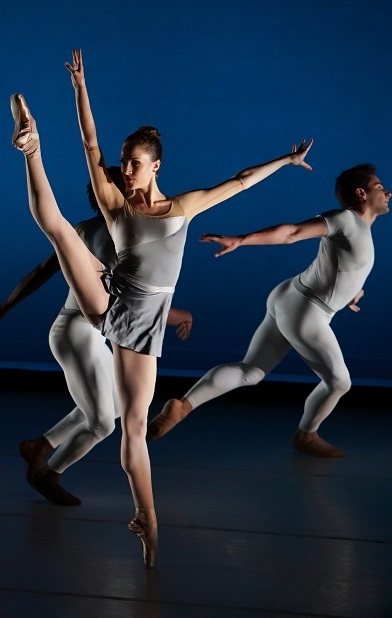
Overture by Ethan Stiefel is a ballet that mixes – in perfect measure – gorgeousness with wit. In choosing Beethoven’s Egmont overture, Mr. Stiefel is already halfway down the road to success. And a success it was, in every respect: from the stunning opening tableau with the dancers classically arranged in silhouette, Overture is a pleasure to watch…and to hear.
The dancers are prettily costumed in traditional ballet style, but soon we notice contemporary touches – each man has one bare arm. The dancing also mixes old with new: a Romantic atmosphere has been established, and the choreography abounds in classic vocabulary and time-honored partnering themes; but modern modes crop up – a shoulder-shrugging motif and some quirky port de bras keep the ballet vivid. The dancers excelled here, taking their cues from the Beethoven score and bringing touches of tongue-in-cheek charm to their dancing. Overture is a winner on all counts.
Returning to my seat after the intermission, I found the curtain already up. Soon a lone dancer ambled onto the stage and began chatting us up. The performance of Pliant by Stefanie Batten Bland, he told us, had already started…and we were to be part of it. Dancers moved up and down the aisles, supposedly ‘interviewing’ audience members. Since they did not have hand mikes, the rest of us were not privy to these conversations, so we sat there twiddling our thumbs.
Finally the dancers hauled themselves up onto the stage and, to nondescript music, they struck poses and did a bit of dancing (nothing strenuous). While this was going on, I was thinking that I could have been home doing my ironing, whilst one of my fellow writers seated nearby fell deeply asleep. Pliant is exactly the kind of clever, now-for-something-different “ballet” that has dampened my enthusiasm for dance in recent years.
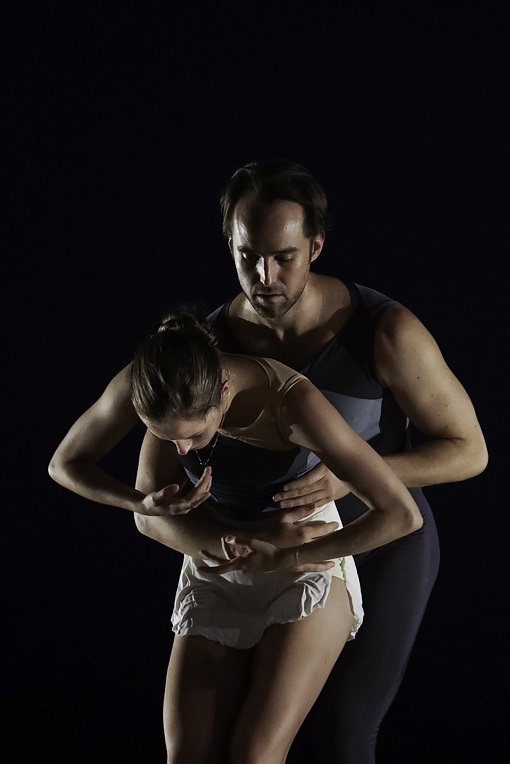
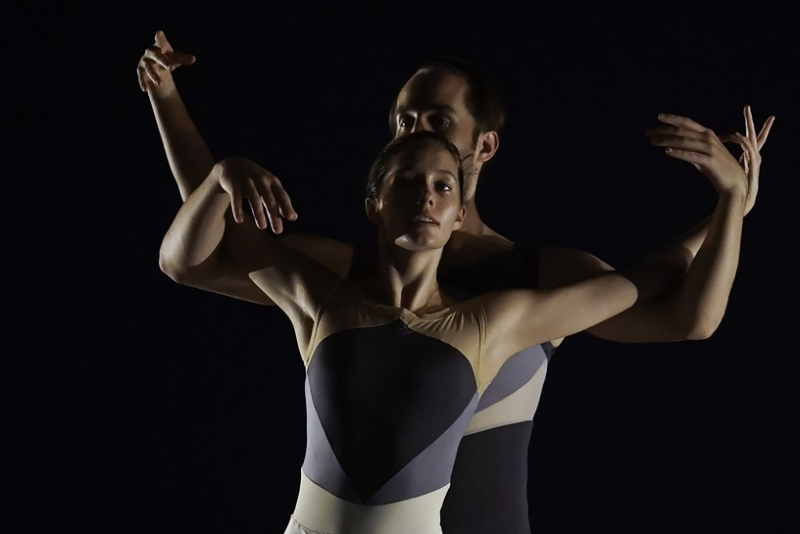
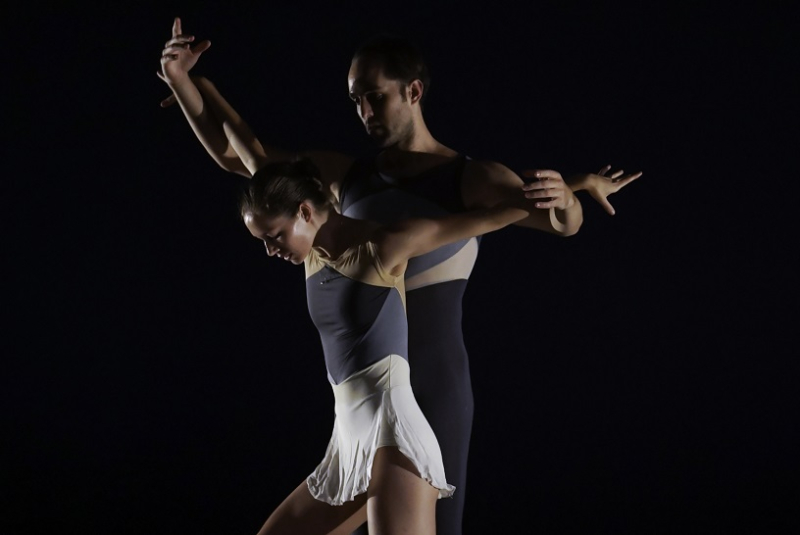
Gemma Bond’s Interchangeable Text was a perfect restorative. Some people think Philip Glass has been done to death in the dance world; I disagree, and I’m glad Gemma shares my feeling that it’s ideal music for dancing. Her ballet, impeccably danced by four couples, had the benefit of atmospheric lighting.
Interchangeable Text opens with a male dancer alone in a pool of light; the music comes from the “romantic” Glass catalog. Soon it begins to pulse, and the dance takes off. Ms. Bond shows off her gift for making classic ballet combinations look fresh. Through ever-shifting patterns, the eight dancers are fully-engaged, the music being their springboard. A chain of pas de deux commences, each couple in turn having their chance to shine. The ballet ends as it began, with the man isolated in the glowing circle.
The Don Quixote ‘Wedding Suite’ brought the evening to an end; danced with fine technique, lively spirit, and a dash of allure à l‘Espagnole by Chloe Misseldine and Joseph Markey, this gave the hardcore classical ballet fans in the audience something to cheer about. The two ‘bridesmaid’ solos were woven in, and though they were not named in this evening’s cast list, I believe the dancers were Leah Baylin and Kanon Kimura, who were dancing these solos on the other two nights.
The ABT Studio Company has always been a place to spot stars of the future: it’s where I first saw David Hallberg dancing! Tonight, one dancer who often caught my eye was Melvin Lawovi, a native of Toulouse. It did not surprise me to read that Mr. Lawovi is the recipient of The David Hallberg Scholarship.
~ Oberon













 Oberon's Glade