Tag: Choreography

  • Martha Graham: Myth & Transformation I

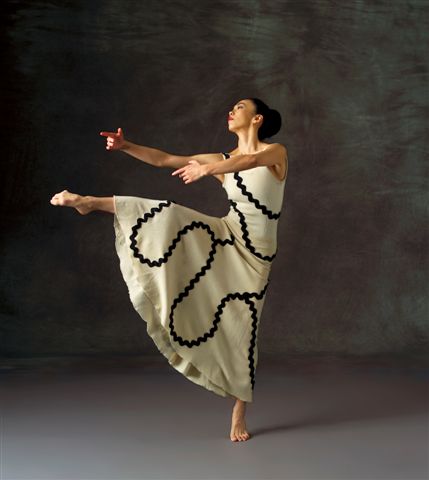
     ErrandMikiSideLegFnl

    Above: Miki Orihara in the original costume for Graham’s ERRAND INTO THE MAZE; photo by John Deane.

    Saturday evening February 22, 2013 – The Martha Graham Dance Company are at The Joyce thru March 3rd with three programmes centering on themes of myth and transformation, as well as a special gala. Details of the performances and ticket information here.

    Tonight’s bill consisted of three Graham masterworks, each with an iconic principal female role – and each of those roles performed by one of the Graham goddesses of the 21st century: Blakeley White-McGuire as Medea in CAVE OF THE HEART, Miki Orihara as Ariadne in ERRAND, and Katherine Crockett as Jocasta in NIGHT JOURNEY. The musical scores are by three of the 20th century’s leading composers: Samuel Barber, Gian Carlo Menotti, and William Schuman.

    In Martha Graham’s CAVE OF THE HEART, the choreographer distills the story of Medea, her betrayal by Jason, and her subsequent destruction of Jason’s young bride into a powerfully compact dancework. As Medea, Blakeley White-McGuire, a brilliant red-haired sorceress, gave a compelling performance – whether moving about the space with restless passion or laying in utter stillness waiting to play out her revenge, Blakeley is a riveting presence. Her marvelously spastic solo as the piece moves towards its inevitable denouement was something to behold. Tadej Brdnik’s boyish handsomeness underscored Jason’s ambitious heartlessness, and his striking musculature propelled him boldly thru the athletics of the choreography and the demands of the partnering. Xiaochuan Xie was a vision of loveliness as the Princess, her dancing spacious and light-filled, blissfully unaware of her impending doom. Powerful presence and physical suppleness marked the performance of Natasha Diamond-Walker as the Chorus, majestic in her black and red striped gown.

    The collaboration between Martha Graham and sculptor/designer Isamu Noguchi created the look we associate with these Graham ballets. In both CAVE OF THE HEART and NIGHT JOURNEY, Noguchi’s set pieces evoke a feeling of familiarity – of being in a space we have been in before. But the damage to the Company’s sets and costumes caused by Storm Sandy left the decor for ERRAND INTO THE MAZE beyond repair. The sets will be re-created in time, but for the current season an alternative solution for presenting this important Graham work was needed. Choreographer Luca Veggetti, working with Miki Orihara, devised a stripped-down version of the piece, now referred to as ERRAND. Martha Graham’s original choreography remains intact, but the work is presented on a bare stage, reaching to the exposed brick wall at the rear of the space. Miki, as the heroine, wears a long plain white skirt with a ‘nude’ leotard white Ben Schultz as the Minotaur wears only his tattoos and white briefs. The effect is absolutely stunning.

    Graham’s choreography feels utterfly fresh, and Miki’s vulnerable qualities have never seemed so touching as here, menaced by the ominous man-bull of Ben’s splendid physique. The illusions of near-nudity gave the piece a timeless, mythic quality. Miki was ravishing, the poetic expressiveness of her body illuminating the smallest nuances of gesture and movement. Ben stalked about the set like a gladiator awaiting his chances in the arena; even standing still, he posed a threat. At the end, having conquered the monstrous symbol of her fear, Miki’s stance of quiet victory and her feeling of wonderment were poignantly expressed.

    During the intermission I caught bits of several conversations among the crowd; people seemed to be saying that this new look at ERRAND had lifted the piece out of a somewhat dated context they’d experienced in CAVE OF THE HEART. Much as I admire Noguchi’s work – and if you haven’t been to the Noguchi museum in Queens you owe it to yourself – and the Graham-designed costumes, I have to say that Mr. Veggetti’s take on ERRAND is a revelation. I’ve often wondered how Balanchine’s ORPHEUS, for which Noguchi designed both sets and costumes, would look as an unadorned black-and-white ballet. In presenting this ERRAND, the Graham Company took a chance – and in my view it paid off handsomely.

    In its full Noguchi-Graham decor, NIGHT JOURNEY is theatrically satisfying, yet I did find myself thinking it would hold up very well in a bare-stage-and-leotard configuration. The choreography, especially for the female ensemble (led by the beauteous and triumphant Mariya Dashkina Maddux) is striking in any event. And it did cross my mind how forceful the athletic movements of the blind seer Tiresias – a marvelous role for Abdiel Cedric Jacobsen – would seem if he was to be divested of his bulky garments. But, we’re getting ahead of ourselves here: NIGHT JOURNEY is perfect as it stands, and Katherine Crockett is beyond perfect in the role of the devastated Jocasta who strangles herself on discovering she has been married to her own son, the man who killed her first husband. (“The killer of the King is a King.”) Ms. Crockett, a luminous gift to the world of dance, is thrilling to behold – as much for her beauty and intensity as for her exalting extension and the evocative flow of her arms and hands. Ben Schultz polished off his demanding, two-ballet evening with a majestically tragic portrayal of the ill-fated Oedipus, the dancer’s godlike physique taking on an assailable aspect as his world collapsed.

    And how does the Graham repertory strike a young person today who has never experienced any of it, except for tidbits on YouTube? My twenty-something dancer-friend Alejandro was quite taken with the evening, with a special affinity for ERRAND. I’ll be seeing the other two programmes of the current season, each with a “Graham virgin” as my companion. It will be interesting to see what they think.

  • NYCB Tchaikovsky Festival 2013 #6

    422

    Saturday evening January 26, 2013 – This evening’s performance at New York City Ballet was filled with wonderful dancing (and playing from the pit) and went a long way to compensate for the previous evening’s late-seating debacle.

    The programme was the same as the night before, but what a difference! Tonight we were able to fullly enjoy the delicate mysteries of BAISER DE LA FEE, led by Andrews Sill. I have a special fondness for this ballet since it was the first work I ever saw at NYCB lo! these many decades ago. My ‘premiere’ cast featured Patricia McBride and Helgi Tomasson and it is pleasing to report that Megan Fairchild and Andrew Veyette made just as fine an effect in the ballet as ther illustrious predecessors. Megan and Andrew caught the quality of rhapsodic youthfulness right from the start, abetted by the very nice dancing of the corps ensemble. Andrew’s solo had a dreamy feeling, but it’s one of those restless dreams (we’ve all had them) where you are seeking something that seems to elude you; his dancing was so expressive, making me want to see him as Jerome Robbins’ Dreamer in OPUS 19. Megan’s solo, set to the birdlike song of the flutes, was fetchingly spun off by the ballerina. The couple then brought a lovely feeling of quiet ecstacy to the magical backing-away which brings this Balanchine jewel to a close. Erica Pereira and Mary Elizabeth Sell led the corps to charming effect.

    Tiler Peck and Joaquin de Luz then went to town, pulling out all the stops for an exciting Tchaikovsky Pas de Deux in which Tiler scintillated with her magical pirouettes whilst also capturing the warm lyricism of the adagio. Joaquin fills the stage and the theatre with his generous dancing and genial smile; if there’s a dancer with a bigger heart than Joaquin de Luz I haven’t met him. The two dancers swept thru the bravura fireworks of the coda to the audience’s delight, and if the fish dives took on a risky quality tonight, that’s part of the fun. They swept off as the curtain fell, igniting a full-house ovation which made them smile all the more as they stepped out to take their bows.

    Now being in a really good mood, I even decided to give BAL DE COUTURE another try and strangely enough I liked a lot of it tonight, or maybe I should say that I saw where it might – with a few alterations – become something to enjoy. The music’s wonderful for one thing, but my first change would be getting rid of the women’s bizarre, fanciful costumes. And since the costumes are the whole point of the piece my other ‘fixes’ wouldn’t matter. It’s nice to see all that star-power onstage even though – as a friend pointed out – turning principals into a corps tends to make them anonymous.  Despite its drawbacks, I found I could sit thru it, and could again – if the need ever arises. 

    In the concluding DIAMONDS, Maria Kowroski and Tyler Angle were elegant, and they seemed to filter the melodies of the score directly into their dancing. Maria’s magical way of sculpting her long limbs into the regal poses of the adagio was finely echoed in Tyler’s handsome and ardent partnering. There’s a lovely simpatico quality between these two dancers and it was shining brightly tonight. The demi-solistes and corps filled the stage with Mr. B’s grand patterns in the finale; the audience loved it.     

    Andrews Sill conducted the first two ballets tonight, then passed the baton to Daniel Capps for the rest of the evening. The NYCB musicians played the entire programme very appealingly and they well-deserved the audience’s warm cheers as they took a spot-lit collective bow at the end. The players were recently chided in the press for playing too many wrong notes. Yes, musicians – even the finest ones – do sometimes hit wrong notes, especially the wind players. Anyone who has ever played a musical instrument knows that the best intentions and plenty of rehearsal can still be undone by fatigue or plain old bad luck. It’s nothing to write home about since it tends to happen randomly, even among the excellent players of at the NY Phil or the Metropolitan Opera (where the orchestra is considered one of the best ‘pit bands’ in the world). For myself, having played piano, guitar and French horn, I always have a sympathetic ear and am grateful when things go as well as they do on a given night. The NYCB musicians work hard and it’s nice when the audience acknowledges their nightly contributions to the success of the ballet.

    Heading home on the A train, I met the three people who’d been sitting behind
    me at the performance. Students at Columbia, they drew out a season brochure and began asking me questions about what they should see next. “Who was that woman with the long legs in the last ballet?” the girl asked. “She was awesome!” I could only agree. 

    DIVERTIMENTO FROM ‘LE BAISER DE LA FÉE’: M. Fairchild, Veyette, Pereira, Sell

    TCHAIKOVSKY PAS DE DEUX: T. Peck, De Luz

    BAL DE COUTURE: Lowery, Reichlen, Krohn, Scheller, Hyltin, A. Stafford, T. Peck, M. Fairchild, Bouder, Taylor, J. Angle, la Cour, Danchig-Waring), Veyette, R. Fairchild, Ramasar, Finlay, De Luz, Carmena, Marcovici

    DIAMONDS from JEWELS: Kowroski, T. Angle

  • NYCB Tchaikovsky Festival 2013 #4

    Tchaikovsky 3

    Tuesday January 22, 2013 – Where better to be on January 22nd than in the house that Philip Johnson built for George Balanchine? Today we celebrate the great choreographer’s birthday and New York City Ballet saluted their founding father with a beautiful evening of Balanchine ballets set to the music of Tchaikovsky.

    Conductor Gerry Cornelius and the NYCB musicians mined all the melodic gold to be found in these three marvel-filled Tchaikovsky scores. Six principal ballerinas appeared (including our newest two) along with four of the Company’s most impressive and unique cavaliers; two handsome boys from the corps de ballet assumed major roles, and two girls who should be soloists led the ensemble passages in SWAN LAKE.

    No one who was there will ever forget the performance of Peter Martins’ SWAN LAKE in 2006 in which Sara Mearns – then a young unknown from the corps de balletstepped into the role of Odette/Odile and took her first leap to stardom. Tonight she re-created her Odette in the Balanchine setting and danced radiantly and with a quiet intensity that was enhanced by the nobly responsive presence of Jared Angle as her cavalier. Both the partnering and the poetry of this pairing made the familiar ballet seem fresh and ever-resonant. Megan LeCrone leading the Pas de Neuf has her own brand of magic – a truly intriguing dancer – while Lauren King, always a pleasure to watch, seemed particularly ravishing tonight as she embraced the full-bodied lyricism of the Valse Bluette. Scanning the ranks of the black-clad corps de ballet, faces and forms both familiar and new to me continually seized my imagination.

    Megan Fairchild’s plush technique finds a perfect expression in ALLEGRO BRILLANTE; she begins in a rather serious mode but as the ballet sweeps onward her smile illuminates the stage just as her silky-smooth pirouettes illuminate the music. Amar Ramasar’s space-filling dance, his deft partnering and sheer magnetism all add up to a top-notch performance in this ballet. The ensemble of King, Laracey, LeCrone, Gretchen Smith, Laurent, Peiffer, Tworzyanski and Andrew Scordato (stepping in unannounced) added nicely to this charming classic-style ballet all underscored by Elaine Chelton’s playing from the pit.

    Rebecca Krohn appeared in the haunted ballroom of TCHAIKOVSKY SUITE #3 to dance the Elegie, which has over the years become one of my great favorites among all of Balanchine’s works. Bare-footed and beauteous, Rebecca seemed so Farrellesque to me tonight. Zachary Catazaro, his pale and handsome face recalling the great matinee-idols of the silver screen era, made a wonderful impression as the lonely lover who momentarily finds his ideal. As Rebecca wafted her gorgeous gown and hair thru the music, Zachary was an ardent dream-cavalier; yet when the moment of their parting came his downcast expression of resignation was so moving: his fingers brushed the spot on his face where her hand had caressed him – did her perfume linger there? – and then he looked at his hands which had held his beloved and which were now empty. A frisson swept thru me at that moment.

    In the Valse Melanconique, Abi Stafford looked so angel-like and lovely with her hair down and clad in diaphanous white; as she swept about the ballroom amidst the bevy of beautiful corps ballerinas, Abi constantly kept us aware of the pulsing nuances of the waltz tempo. Justin Peck was excellent in the cavalier role here. And it’s always a real pleasure to see Faye Arthurs onstage.

    Beauty and brilliance combine in Ana Sophia Scheller’s superb dancing of the Scherzo; she brings a touch of prima ballerina elegance to everything she does and she puts her own gracious signature on every ballet in which she appears. Viva Ana!! Antonio Carmena’s vivid leaps and the handsome polish of his dancing matched up so well with the remarkable Scheller as they flew about the space in high style.

    Costume note: could we get rid of the blouse-like Pagliaccio tops for the men in this ballet’s first three movements?

    Ashley Bouder whipped up a delicious frosting for this evening’s Balanchine birthday cake with her brilliant dancing in Theme and Variations. In total contrast to her wonderfully lyrical performance of SERENADE‘s Russian Girl last week, here was Bouder in full ballerina tutu-and-tiara mode and dancing with regal aplomb. Andrew Veyette’s dynamic series of stupefying air turns won the crowd’s cheers, and his partnering was strong and sincere. The demi-solistes Mlles. Hankes, Sell, Muller and Pollack were finely shown-off by their handsome cavaliers: Devin Alberda (welcome back), Cameron Dieck, Daniel Applebaum and David Prottas. 

    In recent seasons they’ve taken away the lyre and re-branded the Company
    (like cattle?), changed the name on the theater’s facade, carved aisles
    in the seating where Balanchine/Johnson wanted none, arranged an
    alienating ticket-pricing scheme, scattered the faithful of the 4th Ring
    Society, put butt-ugly furniture on the wonderful wide-open space of
    the Promenade – where they have also (currently) piled up a useless
    tower of mediocre MoMA PS-1-type artwork – and all for what? But it
    doesn’t matter in the end because all that really matters is the dancers
    and the dance, the music and the movement. And in those essential
    elements, the Company stays strong.

    There was no Balanchine Birthday Vodka Toast this year but I’d rather be intoxicated by the dancers than by any beverage that might be served up. Happy Birthday Mr. B !!

    SWAN LAKE: Mearns, J. Angle, LeCrone, King, Dieck

    ALLEGRO BRILLANTE: M. Fairchild, Ramasar

    TCHAIKOVSKY SUITE NO. 3: ELEGIE: Krohn, Catazaro; WALTZ: A. Stafford, J. Peck; SCHERZO: Scheller, Carmena; THEME & VARIATIONS: Bouder, Veyette

  • My Only 2012 NYCB NUTRACKER

    George-balanchines-the-nutcracker1

    Sunday December 23, 2012 matinee – Due to the rise in ticket prices at New York City Ballet, I’ve had to adopt strict budgeting rules: for the first time since moving to NYC, I found myself forced to skip NUTCRACKER season altogether. I’d been in the habit of going as many as eight times each year, seeing debuts and covering interesting casting combinations for my blog with genuine enthusiasm. I came to really love and admire the entire Balanchine NUTCRACKER experience, always finding fresh details in the thrice-familiar production.

    But this year, with prices really out of my reach and with the Tchaikovsky Festival looming ahead (I want to go every single night!), I was forced to forego NUTCRACKER; I’ve looked at the casting each week, wishing I could be there but simply unable to deal with the monetary situation.  Fortunately, my friend Monica very kindly offered me a ticket to today’s matinee.

    The cast this afternoon included some debuts, and there wasn’t a principal dancer to be seen onstage. But the soloist and corps de ballet did the Company proud, stepping into the leading roles with confidence and charm. Clothilde Otranto led a lively performance, and special kudos to concertmaster Kurt Nikkanen for his ravishing playing of the Interlude, replete with shimmeringly subtle trills in the highest register.

    LovetteLauren

    Lauren Lovette’s debut as the Sugar Plum Fairy was a major point of appeal in the casting today. This young ballerina has been doing excellent work in the corps, and she always makes a beautiful impression when she’s cast in a prominent role; her debut recently in Christopher Wheeldon’s POLYPHONIA was a real eye-opener, for she held the stage in mesmerizing fashion in her mysterious solo, danced to one of Ligeti’s most trance-like works. Her Sugar Plum today was lyrical and light in the opening solo, and showed the confident radiance of a seasoned star-ballerina in the pas de deux where her cavalier, the story-book-prince Chase Finlay, showed off his ballerina with  élan. Together they sailed smoothly thru the duet’s many difficulties: difficulties that have been known to undo the most seasoned dancers. Lauren and Chase drew the audience in with their youth and poise, winning a particularly warm reception.

    30240_1409846800214_5470712_n

    I met Mary Elizabeth Sell shortly after she joined the Company in 2006, and have kept an eye on her ever since. She and I share a birthday; I took the above picture of her one day a couple years ago when I ran into her on a rehearsal break. Always a dancer to draw the eye in any ballet because of her vivid presence and perfect smile (she was one of the few dancers to make an impact in the leaden OCEAN’S KINGDOM), her performances stand out in a way that have always made me think she could do well in major roles. This Winter the opportunity came her way – she had debuted yesterday as Dewdrop – and, just as I suspected she would, she seized the opportunity and gave a really exciting performance. Her Dewdrop was on the grand scale, able to make her own musical statement in the role by playing ever so subtly with the timing: holding an arabesque one moment, then swirling forward in a flurry of pirouettes. Her jeté was effortlessly brilliant, her extension regally unfurled, her attitude turns silky, her fouettés gracefully swift and sure. To all of this she added her dark eyes and gracious smile. Her performance had amplitude and (rare commodity:) glamour; in short, she put me in mind very much of one of my all-time-favorite Dewdrops, Colleen Neary. There’s no better compliment, in my book.

    Other notable newcomers were Cameron Dieck (handsomely squiring the marvelous Gwyneth Muller in Spanish), Claire Kretzschmar (leggy and cool as Arabian), and Joseph Gordon (bouncing high in Chinese). Sara Adams was pretty, precise and perfectly pleasing as Marzipan; Anthony Huxley – he of the fabulous feet – a stellar Candy Cane (I was hoping he’d jump thru his hoop on his exit in the finale, as he did when he first danced the role); Andrew Scordato an amusing Mother Ginger; Lauren King and Ashley Laracey led the Waltz of the Flowers with distinction…two of my favorite ballerinas.

    In Act I, Sean Suozzi replaced David Prottas as Drosselmeyer; the change was unannounced. Sean was superb, as we could expect from one of the Company’s most intriguing personalities; he even gave the grandmother a startlingly emphatic kiss. Amanda Hankes and Christian Tworzyanski were the appealing Stahlbaums, Kristen Segin and the very pretty Claire von Enck danced charmingly as Harlequin and Columbine, and Giovanni Villabos neatly executed the Soldier Doll’s solo.

    It’s kind of amazing that there are now dancers in the Company I cannot
    identify onstage; things seem to be changing more rapidly that ever in
    terms of the roster. During 2012 some of my favorite dancers left the
    Company unexpectedly; others are currently injured (an ongoing problem).
    The total complement of dancers stands at 85, the smallest number in my
    years of attending,; apprentices and (sometimes) senior SAB students
    seem to be filling the ranks in the big ensembles.

    SUGARPLUM: *Lovette; CAVALIER: Finlay; DEWDROP: Sell; HERR DROSSELMEIER: Suozzi; MARZIPAN: Adams; HOT CHOCOLATE: Muller, *Dieck; COFFEE: *Kretzschmar; TEA: *Gordon; CANDY CANE: Huxley; MOTHER GINGER: Scordato; FLOWERS: King, Laracey; DOLLS: Von Enck, Segin; SOLDIER: Villalobos, MOUSE KING: J. Peck; DR & FRAU STAHLBAUM: Hankes, Tworzyanski

    The house seemed nearly full, and so nice to run into some of the Company’s most ardent supporters during intermission.

    Thanks so much, Monica!

  • Escape to Stravinsky

    Igor s

    Wednesday September 26th, 2012 – When we’re feeling down, music, dance, art and nature become sources of solace and ways of leaving our troubles behind, at least for a span of time. Tonight an all-Stravinsky programme at New York City Ballet served as a surprising means of escape. While the ballets are all thrice-familiar Balanchine-Stravinsky masterpieces, the dancing as well as the unusual sensation of freshness being found in the scores drew me out of myself for a while.

    There were several cast changes this evening, with dancers scheduled for one ballet shifting to a different one to replace injured colleagues. It all turned out well in the end, though I was sorry not to see Abi Stafford dancing.

    The ballets look sleek and vital, and Kurt Nikkanen’s playing of the STRAVINSKY VIOLIN CONCERTO is always a pleasing experience. Curtain up, and there is Janie Taylor with the four boys. She does all the steps and port de bras that every woman who has ever danced this role have done, but her personal mystique is so intriguing you feel you’ve never seen the ballet before. Then each of the other three principals make their entree, and we’re off. I loved Sebastien Marcovici’s large-scale movement and his steady partnering. Robert Fairchild moves with incredible vitality; he and Janie are a great match-up in their pas de deux. Rebecca Krohn has one of her most congenial roles here; she was superb and she put me in mind of some of my earliest experiences with the leotard ballets, when the great ballerinas who knew Balanchine personally danced these roles. So good to see Faye Arthurs in a brief featured role, and the corps de ballet were looking spiffy with several appeasing faces and forms among their number.

    I’ll always remember my first encounter with MONUMENTUM/MOVEMENTS; it was at a Sunday matinee in the 1980s. I was going to a 4:00 PM Kathleen Battle recital at Alice Tully but I took a standing room spot for the NYCB matinee and just watched the opening ballet. Helene Alexopoulos danced the leading role; I adored her, and I was so fascinated by the way the dancers broke ranks and re-arranged themselves between movements.

    Tonight, the magnificent Maria Kowroski took the stage with her two cavaliers – Ask LaCour and Sebastien Marcovici – and it was a really impressive performance. Maria sculpted her long limbs gloriously into improbable shapes, ideally punctuating her phrasing on the music. The men gave her perfect support, and the audience gave the three a warm reception as they stepped out to bow. The Gesualdo score in particular stood out with burnished radiance in an evening of fine playing from the pit; Daniel Capps was the conductor here. 

    Although Autumn is approaching, it felt like Spring as Megan Fairchild and Chase Finlay took the stage for DUO CONCERTANT. This partnership, so thoroughly captivating in LIEBESLIEDER last season, gave this Balanchine classic a youthful glow. Chase is becoming – or maybe we should say ‘has become’ – quite the dashing cavalier, and when Megan ignited a manège of swift pirouettes, all seemed right with the world. Their joint allegro dancing was perfect, and in the slower and more tender passages of the ballet, the two dancers had just the right feeling of intimacy. Arturo Delmoni and Susan Walters were the musical duo. 

    Is there a more iconic image in all the Balanchine canon that the curtain-rise diagonal that opens SYMPHONY IN THREE MOVEMENTS?  But we only have seconds to savour it before Daniel Ulbricht comes sailing onstage and bursts into a series of fantastical leaps. Tiler Peck joins him in this rousing passage of tucked-up bounces. (And it’s time yet again to commend Tiler’s vast range and her contagious joy of dance). Savannah Lowery and Adrian Danchig-Waring danced vividly as is their wont, and the pas de deux with its oddly appealng melody was very well-danced by the delectable Sterling Hyltin and Amar Ramasar. Amar received a screaming bursts of applause at his curtain calls, and he deserved every bit of it.

    That opening diagonal and the ‘melting’ of it at the end of the ballet’s first movement showed us some of our current corps beauties. A very strong group of demi-solistes kept the opera glasses darting madly whenever they were onstage: mesdamoiselles Brown, King, Laracey, Pazcoguin and Smith and their cavaliers Alberda, Dieck, Laurent, Peiffer (long time, no see) and Schumacher.

    The house was far from full though there was considerable enthusiasm all evening. But it is so sad to see the 4th Ring gallery empty and gaping forlorn: that is the place where I and (I am sure) thousands of others first experienced the Balanchine/Stravinsky ballets. And if new generations are to be lured in, these seats at realistic prices are the place to do it.

    STRAVINSKY VIOLIN CONCERTO: Taylor [replacing Hyltin], R. Fairchild, Krohn, Marcovici [replacing Ramasar]

    MONUMENTUM PRO GESUALDO: Kowroski, la Cour
    pause
    MOVEMENTS FOR PIANO & ORCHESTRA: Kowroski, Marcovici
    pause
    DUO CONCERTANT: M. Fairchild, Finlay

    SYMPHONY IN THREE MOVEMENTS: Hyltin [replacing A. Stafford], T. Peck, Lowery, Ramasar [replacing J. Angle], Ulbricht, Danchig-Waring

  • Alison Cook Beatty for Ballet Next

    AlisonBalletNext_4454

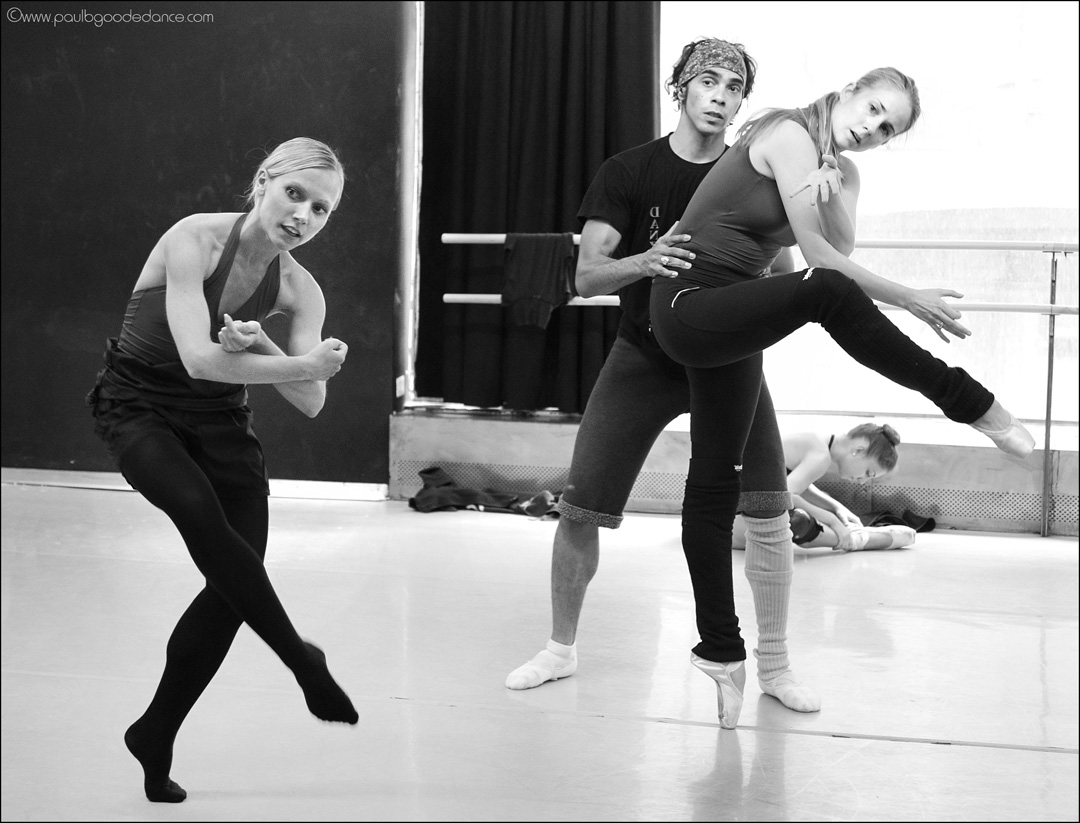
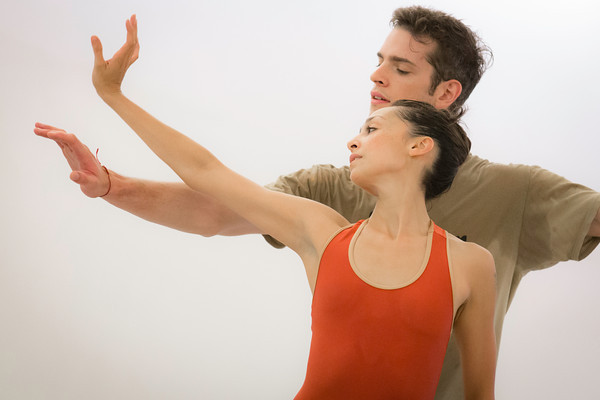
    Friday August 17, 2012 – Alison Cook Beatty (with Michele Wiles and Jason Reilly in the above photo by Paul B Goode) is choreographing a new work for Ballet Next; entitled TINTINNABULI, the ballet is set to Arvo Pärt’s Tabula Rasa. Today I stopped in at the DANY studios to have a look at this new creation, which will have its premiere during Ballet Next‘s upcoming season at The Joyce.

    The dancers were having a breather when I arrived but after a few minutes they gathered their energies (they’d already been rehearsing for 2 hours) and ran thru the new ballet’s completed first section and the nearly-finished second part. 

    TINTINNABULI begins with the women on a diagonal (watch a rehearsal sample here) which evolves into a solo for Michele Wiles – stylized, mystical movement but highly emotive in expression. Her solo is observed by Jason Reilly – principal dancer from Stuttgart Ballet, guesting with Ballet Next this season – a charismatic dancer and excellent partner. As their pas de deux commences, there’s a nice chemistry between Jason and Michele Wiles, even though for the longest time they don’t actually touch. But when they do, it’s luminous. Jason has a dynamic solo passage of his own.

    AlisonBalletNext_4391

    Alison Cook Beatty, Michele Wiles and Jason Reilly in a Paul B Goode photo, above.

    The quartet of soloists form chains with joined hands; they crouch is a circle. Their linked, ritualistic movements evoke images of Matisse and Balanchine as they move along the diagonal. The girls of the ensemble – Lily Balogh, Lily Di Piazza, Kristie Latham, Tiffany Mangulabnan and Erin Arbuckle – each bring a distinctive element to the work while functioning as a unit.

    Michele and Jason resume their duet, really gorgeously set on the music, and they give it a strong emotional context even though it’s just a rehearsal. A brief flurry of virtuosity follows.

    Alison went on from the finished passages, exploring possible phrases as the ballet moves to a conclusion. I’ll have to go back one of these days and find out how she resolves things.

    AlisonBalletNext_4501

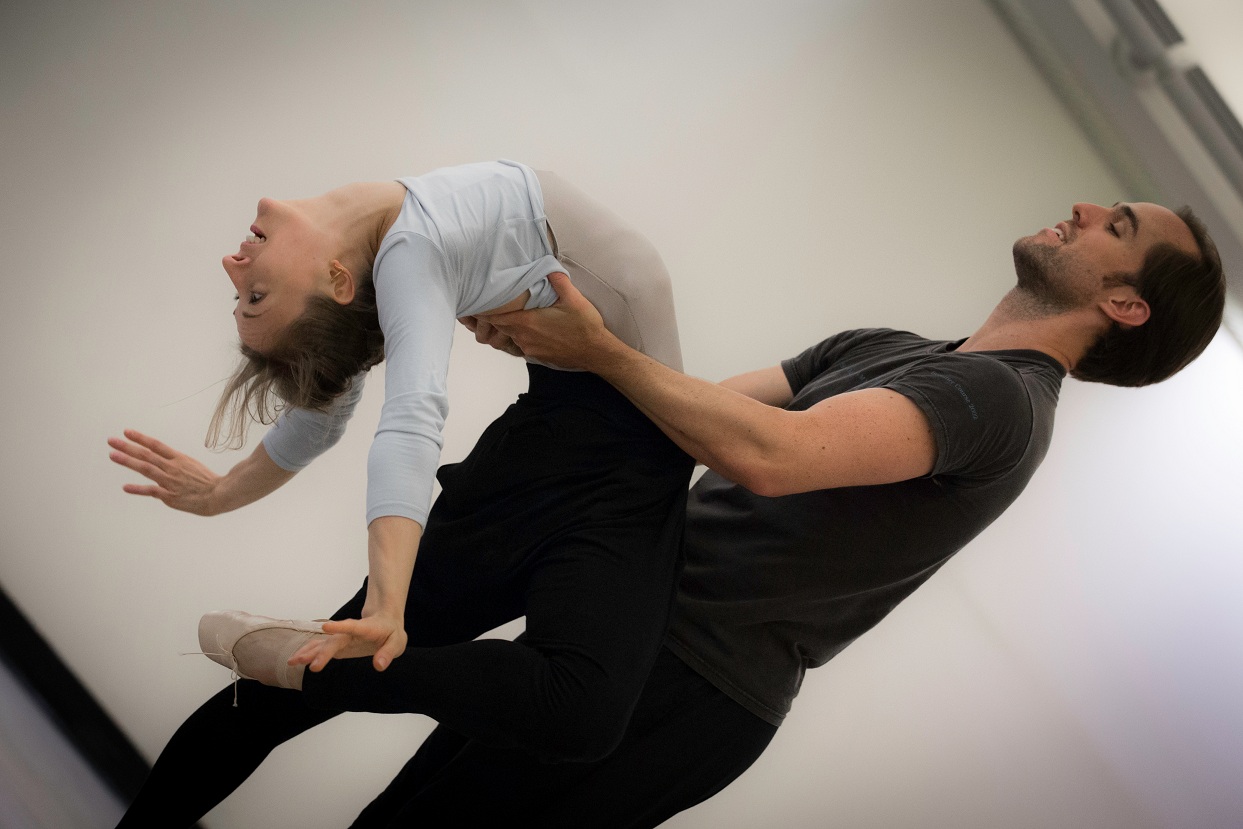
    Charles Askegard is a wonderful presence in the studio, supportive of the young choreographer and offering meaningful suggestions without intruding on the process. At one point, a lift was being pondered and Charles suddenly swept Alison overhead with the signature effortlessness of a prince among cavaliers.

    Really nice atmosphere in the studio, and I look forward to seeing Alison’s ballet costumed and lit at The Joyce. My special thanks to Paul Goode for his evocative rehearsal images.

    You can catch Ballet Next at the 92nd Street Y in the Fridays at Noon series: Friday October 19th at 12:00 noon. It’s free!

  • tomgolddance: Off to Spain!

    0H0C7208-25-M

    Likolani Brown and Russell Janzen rehearsing The Man I Love for tomgolddance; photo by Brian Krontz.

    tomgolddance are heading to Spain to perform at the Guggenheim Museum in Bilbao on August 1st. Photographer Brian Krontz and I stopped by at the City Center Studio to take a look at the dances Tom’s taking across the Atlantic. When we arrived, they’d just finished running thru Tom’s Faure Fantasy which will open the programme in Bilbao. Brian found his corner from which to shoot and the White Swan pas de deux commenced.

    A

    Above: Simone Messmer in the White Swan pas de deux

    Earlier this year, I was at an ABT SWAN LAKE in which Simone Messmer appeared in the Spanish dance at the court festivities. I found myself constantly drawn to her, even when she was simply standing on the sidelines, observing. I kept thinking: What a Swan Queen she would be! Today, that thought became a reality as Simone danced Odette, with New York City Ballet‘s Jared Angle as her prince.

    0h0c6069-3a

    In their practice clothes and making mini-corrections along the way, Simone and Jared (aboove) created a distinctive impression in this familiar pas de deux. Simone’s lyricism, coloured by a restless energy pulsing beneath the surface, finds a perfect compliment in Jared’s noble bearing and poetic expression: he’s ardent without being fussy or melodramatic. Such an intriguing experience to watch this partnership; now if we could just find a way to have them dance the whole ballet together.

    0H0C6827-14-M

    Amanda Hankes in SHANTI.

    SHANTI is Tom Gold’s colourful ensemble ballet set to an exotic-sounding John Zorn score; it will close the programme in Bilbao. Tom gives all the dancers in this piece ample chance to shine, with high-energy combinations for Devin Alberda and Russell Janzen and some sinuous moves for Amanda Hankes and Likolani Brown; Amanda also has a nice and zesty fouette combination. Abi Stafford, Simone Messmer and Jared Angle weave in and out of the ensemble in skillfully-managed partnering passages while Tom gives himself some virtuosic feats to pull off.

    0h0c6730-12a

    Tom Gold

    0h0c6676-11a

    Russell Janzen and Devin Alberda

    0H0C7169-24-M

    Whenever I’m watching New York City Ballet I always find myself thinking that the dancers in the corps de ballet could step into principal roles with ease. We had a glimpse of that today as Likolani Brown and Russell Janzen (above) danced The Man I Love from Balanchine’s WHO CARES? 

    0H0C7326-28-M

    Likolani is a beautiful dancer, someone I love to keep an eye on in the corps and who always makes the most of her demi-soliste roles; she has a warm, Springtime quality and she’s a sophisticated mover. Russell, one of the tallest men in the NYCB family, has the partnering well in hand. Together they brought a young-love feeling to this classic Balanchine duet.

    0H0C7161-23-M

    Abi Stafford and Jared Angle (above) in the Act II pas de deux from Balanchine’s MIDSUMMER NIGHT’S DREAM, one of the choreographer’s most ravishing creations. Bringing to mind their intoxicating partnership in Emeralds, Abi and Jared have the clarity of technique and the gentle combination of courtliness and romance to give this duet its special perfume: there’s really nothing else quite like it in the Balanchine canon.

    All photos by Brian Krontz; an additional gallery of images from this rehearsal will be found here.

    The Bilbao audience are in for a treat with this programme; and tomgolddance have another exciting tour stop on their itinerary: in October, the will dance in Cuba!

  • Ballet Next: Choreographic Exhibition

    BalletNext_9288

    Above: Michele Wiles and Kristi Boone in Mauro Bigonzetti’s LA FOLLIA, photo by Paul B Goode. Click on the image to enlarge.

    Wednesday April 25, 2012 – “You’ll be close enough to see us sweat and breathe,” said ballerina Michele Wiles in a brief film shown at the start of this evening’s presentation by Ballet Next. She was right, and there’s nothing more beautiful – for me at least – than watching dancers dance, especially at close range. Some dance-goers want to see an effortless sheen of ‘artistry’ which masks the physicality of the dance; myself, I love to see the body working, the minute flickerings of facial expression as the dancer ‘edits’ herself, the sense of stretch as the muscles respond, and the mechanics of delivering a triple pirouette. In a large theatrical setting, you’re at a remove from all of this. Tonight at Manhattan Movement and Arts Center, the dancers exposed themselves to our keenest scrutiny. They looked superb.

    Michele Wiles and Charles Askegard created Ballet Next as a continuation of their top-flight dance careers after they ‘retired’ from ABT and New York City Ballet respectively. They certainly don’t look like any retirees I know; their vitality and their eagerness to share their excitement about Ballet Next with an ever-broadening audience are infectious. Michele and Charles have set forth to bring us classic and new choreography danced by ballet’s greatest talents to live music. So far they’ve been succeeding admirably.

    Tonight’s programme delivered four works, each created especially for Ballet Next. The Company’s music director Elad Kabilio and his troupe of gallant young musicians delivered inspired playing of works by Stravinsky, Shostakovich, Satie and Vivaldi. Setting their musical barre very high gives Ballet Next an added lustre in my view; the better music you use, the better your choreography and dancing will look. It’s that simple. 

    And so we started with Stravinsky, violinist Hajnal Karman Pivnick and pianist Ben Laude treating us to shimmering suite of music from Baiser de la Fee. I have a special love for this music since Balanchine’s gorgeous setting of the score was the first work I ever saw danced by New York City Ballet (by Patricia McBride and Helgi Tomasson, no less…)

    Charles Askegard entitles his duet to this music simply DIVERTIMENTO. Danced with teriffic flair by Charles and NYCB‘s Georgina Pazcoguin, his choreography is witty and wonderful with some very inventive partnering motifs threading thru the music. Physically demanding, the dance evoked genuine enthusiasm from the packed house. Ms Pazcoguin, always a dancer to lure the opera glasses when she’s on the big stage, is a fascinating technician and personality to experience in this more intimate setting. Charles, one of the ballet world’s most valuable partners, doesn’t give himself any easy breaks in his own choreography. DIVERTIMENTO is a pure pleasure in every regard.

    By way of contrast, Brian Reeder’s summer-shadowy PICNIC proved to be a small jewel of a narrative ballet. Drawing inspiration from the film PICNIC AT HANGING ROCK, the choreographer turns to Shostakovich’s Cello Sonata in D Minor with its alternating currents of pensive and slightly ominous feeling, and shows us three schoolgirls in white frocks setting out on that fatal picnic from which two of them never returned. Michele Wiles, Kristi Boone and Misty Copeland comprised a stellar trio, each (like the girls in the film) with her own unique little quirks. Kissing, chaste but inquisitive, delicately projects the Sapphic undercurrents found in the film. Meanwhile, Charles Askegard, perhaps drawing on his incredible portrayal of the death figure in Robbins’ IN MEMORY OF…seems silently to draw Misty and Kristi into his thrall, leaving Michele to awaken, alone and mystified. Cellist Elad Kabilio and pianist Ben Laude supported the dancers with a poetic rendering of the Shostakovitch.

    Following an intermission during which we were up-dated as to the success of the evening’s live- streaming (people tuning in worldwide), Margo Sappington spoke briefly about her creation of ENTWINED for Ballet Next. I’ve seen this ballet evolve from a single, sensuous duet thru the addition of a pas de trois and a solo (for Michele Wiles); Margo revealed she has one more idea up her sleeve, a duet for two women; then ENTWINED will be complete. Or, she might even go on from there.

    What she has crafted to date is an atmospheric piece set to Satie Gnossiennes (played by Ben Laude) which opens with a pas de trois danced by Charles Askegard, Georgina Pazcoguin and Ana Sophia Scheller. The choreography here flows thru a misty setting, as in a dream. Images of sleep and wakefulness drift by. The solo for Michele Wiles (beautifully danced, of course) evolves seamlessly from the pas de trois and this in turn floats into the pas de deux danced by Misty Copeland and Charles Askegard. By turns sculptural and steamy, this duet borders on the erotic, temptingly lush in its signature choreographic entwining of two bodies. Misty looked gorgeous.

    (My only tiny complaint about the evening was that we didn’t get to see more of Ana Sophia Scheller; a ballerina in my super-top echelon of favorites, she danced gloriously in ENTWINED…and we did have the delightful experience of watching her warm up before the performance. Major beauty.)

    Mauro Bigonzetti’s LA FOLLIA is a grand finale for a Ballet Next presentation. I’ve seen this duet now four times and it’s just incredible. The two women – Michele Wiles and ABT‘s fantastic Kristi Boone – nailed the complex in-sync steps and launched their complex solos with real bravado. This is dancing that’s taxing to the max, and the girls gave it a splendid energy. Meanwhile the excellent quartet of musicians (violinist Francesca Anderegg joining Ms. Pivnick and Mssers. Kabilio and Laude) played the dazzling Vivaldi theme and variations for all it was worth. This brought the evening to a truly exciting close.

    So glad I ran into my young dancer-friend Alejandro Herrera whose easy, outgoing personality helped me overcome my innate shyness for once. Chatting with Chuck Askegard,  Amanda Hankes, Rebecca Krohn, Adam Hendrickson, Sterling Hyltin, Gina Pazcoguin and Kristi Boone was a pleasure, while MMAC‘s Erin Fogarty let a couple of cats out of the bag for what is sure to be a grand night of Dancing Against Cancer at MMAC on May 7th (Matt Murphy will photograph that dress rehearsal for me). 

    As for Ballet Next, the future looks bright indeed with a season scheduled for The Joyce this Autumn and plans for growth and development running apace. Michele and Charles are not only great artists but great people who have a real passion for ballet and who have the connections in the dance world to make Ballet Next a truly dynamic force. I look forward to following their every step.

  • Stravinsky & Desyatnikov @ New York City Ballet

    February 23, 2012 – New York City Ballet has been my home away from home since I moved to New York City in 1998. In fact, NYCB was a major factor in my desire to move here in the first place. This season has seen the effects of changes in ticket pricing and seating availability, along with the marginalizing of the 4th Ring Society and the way long-time friends and supporters of the Company feel they have been treated by the powers that be. The official stance seems to be that the changes are working and that everything’s hunky-dory, but the gaping emptiness of the 4th Ring (ten people sitting up there tonight) is a sad commentary on the real situation.

    Increases in ticket prices are a necessary evil from time to time, but it’s the way it was done and the lack of sync between the website and the box office in terms of availability and pricing that is off-putting to say the least. The level of dancing is very high and the lure of Balanchine is as strong as ever, but the sheer joy of attending often and feeling you are part of a happy family of ballet-goers is greatly diminished these days. In this Winter season where I’d ear-marked 14 performances on my calendar, I ended up only going six times.

    At any rate, when the curtain rose on STRAVINSKY VIOLIN CONCERTO tonight and Janie Taylor was standing there with four handsome boys, I forgot my misgivings. On the podium, George Manahan brought out individual voices in the orchestra – as we might expect a seasoned opera conductor to do – and violinist Lydia Hong conveyed the angular beauty of the concerto in an overall very pleasing performance.

    Janie and her partner Ask LaCour gave an especially fine rendering of their duet; in the course of it I noticed things in the choreography that I’d somehow never picked up on before. The allure of the two dancers, and the Taylor mystique, seemed in a way to create a narrative where there isn’t one. I really enjoyed watching them.

    Maria Kowroski and Amar Ramasar are developing into a powerful and vastly appealing partnership. Their pas de deux was marvelous in its sense of nuanced dramatic detail and in the dancers’ technical strength and clarity which both underscored the complex choreography and made it seem inevitable.

    The corps danced beautifully, and it is wonderful to see Faye Arthurs onstage again after a hiatus. It was a performance of this classic work that re-affirmed its iconic standing in the Balanchine pantheon.

    Ratmansky’s RUSSIAN SEASONS is an unique ballet in many ways; drawing on aspects of Russian peasant life, the choreographer presents characters who are anonymous yet differentiated by finely detailed aspects of gesture and movement. The music, with it’s prominent violin (Arturo Delmoni) and soulful singing (Irina Rindzuner) all came back to me from the moment of Manahan’s downbeat. The score, and the rich colours of the dancers’ costumes, weaves a particular spell. I was very glad to see this piece again after a few seasons’ absence from the repertoire.

    The Playbill now denotes role debuts at NYCB, and only Georgina Pazcoguin had previously appeared in her role as the Woman in Red. Abi Stafford danced in the premiere of RUSSIAN SEASONS but has now switched to the role originally created by Jenifer Ringer. Beyond that, the cast drew together some of the Company’s most attractive personalities.

    Amanda Hankes, Marika Anderson and Lauren Lovette were each lovely and distinctive to watch, while the presence of Taylor Stanley, David Prottas, Andrew Veyette, Adrian Danchig-Waring and Christian Tworzyanski showed off the strengths of the Company’s male contingent.

    Abi Stafford’s performance had a nice sense of freshness to compliment her clarity of movement. As the central couple, Rebecca Krohn and Robert Fairchild used their personal magnetism to full advantage. Rebecca’s dancing was serene – and poignant in the passage where she seems to have been abandoned. Rob Fairchild seized the opportunity to make yet another ballet ‘sing’ to his charismatic approach. His dancing was technically impressive and dramatically vivid.

    In a glorious performance, Georgina Pazcoguin’s Woman in Red was suffused with her highly individual beauty and intensity; as she swirled with a restless spirit through the many swift pirouettes and space-filling combinations of this demanding role, Gina seemed like a woman possessed. Truly breath-taking at every moment.

    STRAVINSKY VIOLIN CONCERTO: Taylor, la Cour, Kowroski, Ramasar

    RUSSIAN SEASONS: Pazcoguin, *Krohn, *A. Stafford, *Lovette, *Hankes, *Anderson, *R. Fairchild, *Prottas, *Stanley, *Tworzyanski, *Danchig-Waring, *Veyette 

  • TWO BALANCHINE MASTERWORKS

    Maria

    Above: Maria Kowroski photographed by Matt Furman. Maria danced AGON this evening at New York City Ballet, winning a spectacular ovation after her pas de deux with Amar Ramasar.

    Saturday February 18, 2012 evening – I’ve been going to New York City Ballet less and less these days. The dancers and the ballets still excite and entice me but the way things are being run there is a real turn-off. I’ve had to pick and choose my programmes carefully, and I have missed some debuts that I’d love to have seen but simply couldn’t afford to attend. Meanwhile the presence of two recent disasters on the programming meant there were whole weeks when there was no cause to go.

    Tonight was my only chance to see AGON and Tchaikovsky SUITE #3 this season; it was unfortunate that the other work on the programme was INTERPLAY, one of my least-favorite ballets. Compounding the tedium of the Robbins work, we had to sit thru an ‘introduction’ to Morton Gould’s third-rate music before the ballet started. To say that it was well-danced is an under-statement but in a way the better it’s danced the sorrier I feel for the dancers strapped with this juvenile, gee-whiz drivel.

    INTERPLAY put me in a pissy mood. But the moment the curtain rose on the four men – Adrian Danchig-Waring, Amar Ramasar, Craig Hall and Sean Suozzi – at the start of AGON, the stars fell into perfect alignment and all seemed right with the world. This euphoric feeling continued through the evening’s concluding Tchaikovsky SUITE #3 as well. On the podium Clotilde Otranto (Stravinsky) and guest conductor Daniel Capps (Tchaikovsky) illuminated the music of these two geniuses, properly eradicating the insipidity of the opening Gould. 

    In AGON Maria Kowroski had one of those nights that great ballerinas sometimes have when their technique and artistry transcend the music and the steps and transport the audience to an exalted state. Magnificently partnered by Amar Ramasar, Maria was on fire from her first entrance. Moving through the sculptural poses of the pas de deux, her sensational legs and line were molded by the magnetic Amar into improbable designs that only a genius like Balanchine could have conceived. As the duet progressed the two dancers went beyond the physical into some cosmic otherworld. They slumped into their final pose and were engulfed in a tidal wave of applause and cheers; they had to step forward and bow three times and even then the audience were reluctant to let the ballet proceed. At the end of AGON, Maria and Amar were called out for an extra bow as the crowd went wild. So wonderful to hear this kind of enthusiasm. And they deserved every bit of it.

    But it was that kind of AGON…right from the start, actually. Sean Suozzi’s dynamic solo set the ballet on its marvelous trajectory; my hat is ever off to Sean for the edgy brilliance and unstinting personal commitment of his dancing. He was spectacular tonight. Amanda Hankes and Ashley Laracey remind us of how rich in ballerina treasures our corps de ballet is.  

    In a striking tour de force role debut, Megan LeCrone yet again served notice that she is one of New York City Ballet‘s most fascinating dancers. Her strength and clarity of movement underscore her distinctive look, giving her performances a compelling quality; I always feel an extra twinge of anticipation when I see her name on the casting list. Tonight she was especially impressive. Her two charismatic cavaliers were Adrian Danchig-Waring and Craig Hall; they danced their duet vividly, like young gods cavorting on Olympus. We are so lucky to have them. 

    AGON always seems like a big ballet but really there are only a dozen dancers involved; tonight’s quartet of supporting ballerinas was particularly attractive: Marika Anderson, Dana Jacobson, Gretchen Smith, and Lydia Wellington. These girls appeared again in various capacities in the concluding Tchaikovsky SUITE #3 where – in fact – the entire corps shone with individual and collective dazzle. 

    In the haunted ballroom, the pale dreamer (Ask LaCour) conjures up a luminous vision of feminine perfection (Sara Mearns). Backed by a sextette of long-haired beauties, the couple dance a hypnotic, dreamlike duet of pursuit and evasion. Sara Mearns was radiantly voluptuous and Ask LaCour questingly poetic as they moved to the heart-stopping theme of the Elegie; Ask can only fleetingly hold onto his ideal as she eludes him time and again. At the end, Sara sweeps into an iconically deep backbend as a farewell gesture before vanishing altogether from this vision of romantic rapture, leaving Ask alone in his reverie. The moment stabs me in the heart every time.

    Janie Taylor has only to step onto the stage to make my heart race; her captivating allure and mystery enslaved me yet again in the Valse Melancolique where her sylphlike figure and glorious hair were set afloat on Balanchine’s ethereal waltz. Jared Angle, ever the ideal cavalier, treated his ballerina like the treasure she is. This brief film, which I have watched a hundred times and will watch hundreds more, captures a bit of Janie Taylor’s unique magic.

    In an evening of ballerina splendors, Ana Sophia Scheller once again made me long for her Nikiya, Giselle and Aurora as she swirled thru the restless pirouettes and fouettes of the Scherzo. In a floaty, gauzy gown the Argentine beauty sailed on the music with a glamorous air: simply intoxicating. Antonio Carmena was her high-leaping cavalier; it is always a great pleasure to see Antonio onstage. Among the corps, Callie Bachman was particularly luscious. 

    After all this, something truly grand was needed to cap the evening and as the lights went up on Theme and Variations, the youthful royal couple Megan Fairchild and Joaquin de Luz stood ready. They danced superbly: who needs champagne when you have Megan and Joaquin to get you high?! Megan’s elegant pirouettes and her Aurora-like charm seemed absolutely perfect this evening while Joaquin gave a performance remarkable both in its execution and in his handsome, princely appearance. Such a pleasure to watch this celebrated partnership tonight.

    Outstanding THEME demi-solistes this evening: Gwyneth Muller, Amanda Hankes, Lauren King and Brittany Pollack – each a ballerina of unique qualities. Their cavaliers were Andrew Scordato, Christian Tworzyanski, Devin Alberda and Austin Laurent; Austin has been looking especially good ths season. The full bevy of corps beauties and handsome young danseurs filled the stage for the finale, moving in Mr. B’s gloriously structured patterns to bring the evening to a fantastic finish.    

    My special thanks to photographer Matt Furman for allowing me to use his portrait of Maria Kowroski.