Tag: Chris Lee

  • Ensemble Connect ~ Up Close

    CH11514851

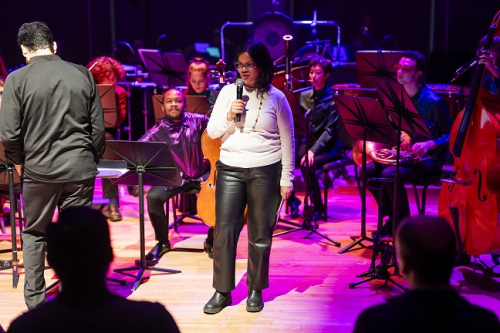
    Above, composer/curator Gabriela Ortiz welcomes the crowd; photo by Chris Lee

    ~ Author: Oberon

    Monday January 27th, 2025 – Ensemble Connect is a joint program of Carnegie Hall, The Juilliard School, and the Weill Music Institute in partnership with the New York City Department of Education. In tonight’s Up Close presentation, curated by composer Gabriela Ortiz, the young artists of the Ensemble performed at the Hall’s Resnick Education Wing, an intimate venue which I’d never been aware of until Carnegie’s Meg Boyle gently twisted my arm into giving it a try.

    CH11514901

    Above: Chelsea Wang and Ryan Dresen playing Ortiz; photo by Chris Lee

    The evening opened with the New York premiere by of Pigmentum by Ms. Ortiz, a four-movement work presented in collaboration with visual artist Martirene Alcántara that was performed by Ryan Dresen (horn) and Chelsea Wang (piano) whilst a film by Ms. Alcántara was shown on a hanging screen.

    Each of the work’s four movements is named for a shade of blue, the first being Indigo. This music veered from dreamy to jazzy; some of the piano’s tones had been ‘prepared’, giving a quirky, off-kilter sound. Mr. Dresen’s playing has beauty and power throughout the range, and passages played with a mute were intriguing. Chime-like piano notes introduce Lapislazuli, with horn calls leading to a duet in the instruments’ lower ranges. The music gets wild, and a sudden ending takes us by surprise. The rippling delicacy of Ms. Wang’s playing in Cobalto is joined by the dusky sound of the horn. The music gets grand, then pensive. In the concluding Ultramar, Mr. Dresen’s horn rambles and stutters. There is a false ending, and then the enigmatic sound of toneless air being blown thru the horn. 
    CH11514949

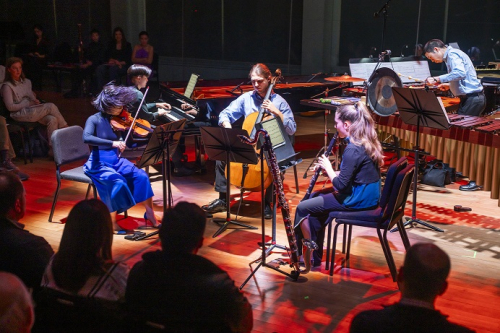
    Mexico’s Carlos Carlos Sánchez-Gutiérrez presented Luciérnagas (photo above Chris Lee) for which three alumni of the Ensemble – Yasmina Spiegelberg (clarinet), Joanne Kang (piano), and Mari Lee (violin) – joined percussionist de luxe Oliver Xu and cellist Frankie Carr, who introduced the piece. A chord introduces the insectuous music of a swarm of fireflies, whilst the cello vibrates. The clarinet trills, the sneaky piano intones, cello and clarinet sound in unison. The xylophone heralds an explosion causing the violin to go crazy. A rhythmic passage turns spacey, thunder rolls, the bass clarinet rumbles deeply whilst awesome percussion motifs sound. An intriguing marimba solo is interrupted by an urgent one-note motif from the violin, and then the xylophone goes off like a fire alarm; the insistent piano sounds urgently. Silence falls. This seemed like a perfect place to end, but no…we go on, savouring some rhapsodic playing from Ms. Kang at the piano. But then the music turns dark and scary; a cymbal crash leads to a total wipe-out. Somehow, thru all of this, it was the cellist who seemed the central figure, both thru his noble playing and his poetic face.

    For “La Hamaca” from La Hamaca (NY Premiere) by the Venezuelan composer Ricardo Lorenz, the players were Chelsea Wang (piano), alumna Mari Lee, and cellist Thapelo Masita. The music opens softly with the piano joined by the violin; the cellist enters with a pinging motif before taking up a gorgeous theme wherein Mr. Masita’s tone was matched by the sweetness of the violin and magical sounds from the piano. The music turns passionate, then staccati introduce new themes, with rich playing from the cello. The staccati resume before Ms. Lee’s violin sings on high; dense harmonies emerge before an agitato outburst. A bouncy rhythm springs up…fabulous playing from the trio as the music wafts to heaven and then fades away.

    CH11514870

    Above, in a Chris Lee photo: Joanne Kang and Oliver Xu playing the Cuban composer Ileana Perez Velazquez’s Light echoes, having its New York premiere this evening. This piece gave us a virtuoso percussion display from Oliver Xu, who moved amidst his array of instruments with assured grace, as if in a choreographed solo. No less marvelous was Ms. Kang, who was back at the piano to make more magic. Bass drum rolls, bongo beats, and gong tones set off a jazzy piano theme. The swaying rhythm gets big as Mr. Xu moves swiftly from xylophone to ancient hanging bells to every type of drum. Ms. Kang  commences a keyboard interlude, laced with various percussive comments. Suddenly, there’s a kind of cabaletta, fast and florid, before things quieten and the mysterious gong sounds; a rhythmic coda ensues. Brilliant playing from start to finish!

    CH11514918

    The Costa Rican composer Alejandro Cardona’s Axolotl (a US premiere) brought three wind players to prominence: Ms. Spiegelberg (clarinet), Anjali Shinde (flute), and Joseph Jordan (oboe) with Joanne Kang at the piano, Mr. Carr with his cello, and the lovely violinist Isabelle Ai Durrenberger (photo above by Chris Lee).  

    CH11514915

    Above: Joseph Jordan and Anjali Shinde, photo by Chris Lee

    The piece develops gradually clarinet and oboe are heard in sync, and the piano music is jazzy. Stillness, and then a haunting flute passage is heard over delicately sustained string tones creating a wonderful air of mystery. The clarinet gets jazzy as a sexy beat rises; more jazz from the violin, whilst the cello is strummed like a guitar. Wailing clarinet and oboe slowly sputter out, and a thoughtful flute solo ensues, with piano and cello commenting. Bass clarinet and flute converse over the deep cello and piano; these voices then make an incredible fade-away.
    CH11514944

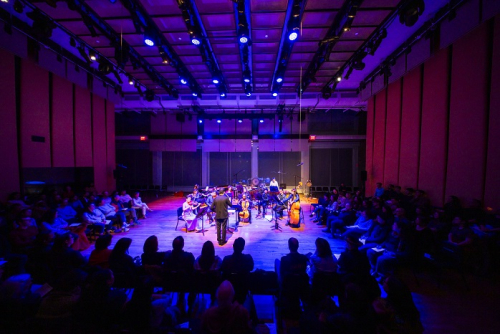
    The concert ended with the world premiere of Gritos de fuego, patrias de papel by the Colombian composer Carolina Noguera (above, photo by Chris Lee). This work brought together the largest ensemble of the evening, with Leonardo Pineda conducting. Joining Mlles. Shinde, Spiegelberg, Wang, Ai Durrenberger, and Mssrs. Jordan, Dresen, Xu, and Masita were flautist Catherine Boyack, bassoonist Marty Tung, violist Ramon Carrero-Martinez, and bass-player Marguerite Cox.

    CH11514858

    Photo: the ensemble playing the Noguera, photo by Chris Lee

    From an explosive start, announced by three massive strikes of the bass drum, eerie strings emerge; the flutes blow air as more thunder claps, wailing winds, and rumbling piano depict the storm, which gives way to the amazingly subtle and sustained violin supported by cello tremelos. A long flute trill sounds as the oboe blows air and a quiet sense of ecstasy settles overall. The piano and eerie shimmers from the violin bring on a repetitive 4-note rising motif from the violin. From a perpetual quietude, raindrop piano notes accompany a sweet and serene solo from Ms. Ai Durrenberger’s violin. The bassoon chimes in, the viola plays a repeated phrase. Big chords are repeated, and then the music vanishes into thin air as a sensationally sustained cello tone from Mr. Masita fades to silence.

    CH11514920

    Above: the composers take a bow; photo by Chris Lee

    Audience members lingered to greet the artists and the composers; except for congratulating Mr. Masita, I was too shy to speak to anyone. But I did have a chance to meet and thank photographer Chris Lee, whose remarkable gift for capturing the essence of Carnegie Hall concerts I have been lucky enough to share on my blog these past few years.
    CH11514895

    Above, the finale: this, and all the performance photos, are by Chris Lee, courtesy of Carnegie Hall

    ~ Oberon

  • Concertgebouw: Schoenberg & Mahler

    Untitled

    Performance photo by Chris Lee

    ~ Author: Ben Weaver

    Saturday November 23rd, 2024 – The Royal Concertgebouw Orchestra gave two sold-out concerts at Carnegie Hall last week under the baton of its chief conductor designate Klaus Mäkelä. The second concert on Saturday, November 23rd featured beloved works by Arnold Schoenberg and Gustav Mahler.

    Between the two concerts, this evening’s playing of Schoenberg’s Verklärte Nacht, Op. 4 was the strongest performance of the orchestral works the Concertgebouw presented this week. Originally composed for string sextet in 1899, Schoenberg made an arrangement for a string orchestra and it’s become one of his most beloved and most frequently performed works. The string section of the Concertgebouw was on absolute peak form with its lush yet concentrated sound. Schoenberg’s score is by turns dark, ominous, romantic, and shimmering, and the orchestra reflected each emotion and turn with beautiful clarity. Maestro Mäkelä conducted it without a score, so it appears to be a work that is close to his heart. Maybe that’s why he managed to keep the tension throughout the entire composition. 

    When it comes to playing Mahler, I think the Concertgebouw’s only rival is the New York Philharmonic. These symphonies are close to their hearts and they perform them frequently. The Symphony No. 1 in D major received its Dutch premiere in 1903 under Mahler himself. This evening’s performance under the orchestra’s young incoming chief conductor was somewhat mixed.

    The first movement was something of a mess that echoed the very unfortunate performance of Rachmaninoff’s Symphony No. 2 the previous evening: while Maestro Mäkelä can build to a climax, he was unable to connect any of the climaxes together, the tension and structure of the music disintegrating every few minutes. So it was here, unfortunately. Low voltage would be one way to describe it, a flicker of color quickly draining into something dull and gray.

    Fortunately things improved as the performance continued, and Mäkelä managed to keep the symphony moving. The second movement is filled with sections of chamber music, interrupted by full orchestral blasts. There was some wonderful playing from individual sections of the Concertgebouw, the winds in particular covering themselves in glory.

    The Funeral March was the best part of the performance. The double bass solo (principal Dominic Seldis) was appropriately weary and somber. The mocking tune that interrupts it was nicely paced and delightfully almost jazzy. The Finale was largely well handled, but lacked enough frenzy to be truly satisfying until the very last moments.

    With Maestro Mäkelä taking over two of the world’s top orchestras – the Concertgebouw and the Chicago Symphony Orchestra – these performances left me concerned if he is the right person for these jobs at this time. But time will soon tell if the confidence he has inspired in others pays off.

    ~ Ben Weaver

  • Concertgebouw: Schoenberg & Mahler

    Untitled

    Performance photo by Chris Lee

    ~ Author: Ben Weaver

    Saturday November 23rd, 2024 – The Royal Concertgebouw Orchestra gave two sold-out concerts at Carnegie Hall last week under the baton of its chief conductor designate Klaus Mäkelä. The second concert on Saturday, November 23rd featured beloved works by Arnold Schoenberg and Gustav Mahler.

    Between the two concerts, this evening’s playing of Schoenberg’s Verklärte Nacht, Op. 4 was the strongest performance of the orchestral works the Concertgebouw presented this week. Originally composed for string sextet in 1899, Schoenberg made an arrangement for a string orchestra and it’s become one of his most beloved and most frequently performed works. The string section of the Concertgebouw was on absolute peak form with its lush yet concentrated sound. Schoenberg’s score is by turns dark, ominous, romantic, and shimmering, and the orchestra reflected each emotion and turn with beautiful clarity. Maestro Mäkelä conducted it without a score, so it appears to be a work that is close to his heart. Maybe that’s why he managed to keep the tension throughout the entire composition. 

    When it comes to playing Mahler, I think the Concertgebouw’s only rival is the New York Philharmonic. These symphonies are close to their hearts and they perform them frequently. The Symphony No. 1 in D major received its Dutch premiere in 1903 under Mahler himself. This evening’s performance under the orchestra’s young incoming chief conductor was somewhat mixed.

    The first movement was something of a mess that echoed the very unfortunate performance of Rachmaninoff’s Symphony No. 2 the previous evening: while Maestro Mäkelä can build to a climax, he was unable to connect any of the climaxes together, the tension and structure of the music disintegrating every few minutes. So it was here, unfortunately. Low voltage would be one way to describe it, a flicker of color quickly draining into something dull and gray.

    Fortunately things improved as the performance continued, and Mäkelä managed to keep the symphony moving. The second movement is filled with sections of chamber music, interrupted by full orchestral blasts. There was some wonderful playing from individual sections of the Concertgebouw, the winds in particular covering themselves in glory.

    The Funeral March was the best part of the performance. The double bass solo (principal Dominic Seldis) was appropriately weary and somber. The mocking tune that interrupts it was nicely paced and delightfully almost jazzy. The Finale was largely well handled, but lacked enough frenzy to be truly satisfying until the very last moments.

    With Maestro Mäkelä taking over two of the world’s top orchestras – the Concertgebouw and the Chicago Symphony Orchestra – these performances left me concerned if he is the right person for these jobs at this time. But time will soon tell if the confidence he has inspired in others pays off.

    ~ Ben Weaver

  • An Evening of Trios @ Carnegie Hall

    Trio 1

    Performance photo by Chris Lee, courtesy of Carnegie Hall

    ~ Author: Oberon

    Tuesday October 24th, 2023 – Three beloved luminaries of the classical music world joined forces on the Carnegie Hall stage tonight, playing trios by Haydn, Ravel, and Mendelssohn. Pianist Jean-Yves Thibaudet, violinist Lisa Batiashvili, and cellist Gautier Capuçon took the stage to a warm welcome from the crowd.

    I’m sure the two gentlemen will forgive me if I mention my particular affection for Ms. Batiashvili; I became familiar with her artistry thru her appearances with the New York Philharmonic during Alan Gilbert’s tenure. Violinist and maestro formed a particularly cordial musical relationship; their rapport was as lovely to watch as to hear. Tonight, it was wonderful to see Lisa on the Carnegie Hall stage, looking elegant in a black trouser number with black stilettos.

    The opening Allegro moderato of the Haydn E-major Trio commences with a plucked motif, which will recur at times as the movement goes forward. In the cantabile passages, the sweetness of Ms. Batashvili’s tone was finely meshed with the mellow lyricism of the Capuçon cello, whilst M. Thibaudet at the Steinway produces silvery cascades of notes.

    The Allegretto opens with a rather somber unison passages, and then M. Thibaudet begins a long piano solo, with appealing commenting phrases from the violin and cello. Some vivid flourishes near the movement’s end carry us on to the final cadence.

    The trio’s final Allegro has a gently bustling feeling, with the players bringing lovely subtleties to the music. A darkish, minor-key interlude develops into a tempest, and the movement then takes a da capo before reaching a coda with retards and pauses etched in. Beautiful blends of timbres, and a sense of camaraderie among the artists that was lovely to observe.

    The players rose for a bow, and then immediately sat down to play Maurice Ravel’s Piano Trio.

    M. Thibaudet’s delicate piano introduction to the opening Modéré creates a sense of mystery. The strings join, and the music develops a gentle sway. Cello and violin exchange brief melodic sentences, and the music grows passionate. Then Ms. Batiashvili spins out exquisite phrases in the violin’s highest range; following an agitato interruption. The music turns dreamy.

    Ravel titles the second movement Pantoum, which refers to a Malaysian form of poetry.  It is sprightly and dancelike, with the strings conversing. There are some stormy bits, and then an acceleration. M. Thibaudet opens the third movement, Passacaille, with a low, simple theme. M. Capuçon joins, with a hauntingly deep, rather mournful melody, and Ms. Batiashvili brings her magic to a ravishing solo. Passion waxes and wanes, with the music becoming dense and darkish; things quieten for a sustained cello solo, richly played. The piano brings the movement to a close.

    The last movement of the Ravel is an Allegro appassionato. It has a high, airy start, luminously played from our trio. The music gets grand. Ms. Batiashvili executes a sustained trill, to which M. Capuçon replies with a trill of his own. At the Steinway, M. Thibaudet’s technical wizardry is on display. The music rushes on, restless…and dazzling.  

    The Mendelssohn piano trios are the first chamber works I fell in love with, and while the first of the two is my favorite, I am always very pleased to hear either of them played live. Tonight, it was the second that was on offer, played to perfection.

    The C-minor Piano Trio finds Mendelssohn at his passionate, rhapsodic finest. The pianist immediately sets the tone with an unsettled opening theme; a second theme – song-like and fervent – takes over, played first by the violin and cello with the piano accompanying. M. Thibaudet is simply marvelous here, and the ebb and flow of the familiar melodies gave a feeling of reassurance.

    The piano opens the ensuing Andante, lending a feeling of peace. Violin and cello harmonize with extraordinary beauty of tone, creating a wistful mood. Next comes a true Mendelssohnian delight: a jittery, scrambling Scherzo, to which the players brought pristine technique and spine-tingling nuances. The trio’s finale veers from between minor and major modes, with mood swings shifting from agitated to tranquil. Here the perfect blending of the three voices was at its most savourable.

    The audience, one of the most attentive and alert in recent seasons, cheered heartily as the musicians took their bows. An encore was demanded: the Vivace from Dvořák’s Piano Trio in E-minor, Opus 90. The  music has a gypsy lilt and featured a long solo for Ms. Batiashvili, a remarkably sustained tremelo from M. Capuçon, and an array of delights from M. Thibaudet.

    After a couple of weeks of my feeling out-of-sorts, this concert provided a miracle cure. Thank you, Lisa, Jean-Yves, and Gautier!!

    Lisa b capucon thibaudet carnegie 2023

    Heading out for a bow; photo by Chris Lee

    Trio 2

    Photo by Chris Lee, courtesy of Carnegie Hall

    ~ Oberon

  • Renaud Capuçon/ORPHEUS @ Carnegie Hall

    _DSC8907

    Saturday February 21st, 2023 – Violinist Renaud Capuçon (above, performance photo by Chris Lee) joining the Orpheus Chamber Orchestra at Carnegie Hall for a program featuring works by Hanna Benn, Sergei Prokofiev, and Modest Mussorgsky.

    The East Coast premiere of Ms. Benn’s View (Un)titled, an Orpheus commission, opened the evening. The composer was inspired by artwork she had viewed at MoMA; she drew inspiration for the work’s structure from the beloved Mussorgsky piece which closed tonight’s program. Thus, View (Un)titled opens with a promenade: a walking motif set to a pacing rhythm from Orpheus’s rock-star bass player, Jordan Frazier.

    The musical exploration of the various artworks (eight of them) showed that Ms. Benn is a composer who values melody; her music has a fresh and vital feeling, and she has a gift for making a visit to a museum seem important. Which it is! 

    As the movements unfolded, my companion and i lost track of exactly where in the order of the things we were. So we simply enjoyed the work as a whole: its rhythmic variety, the rich strings, the distinctive sounds of the wind voices, and the cunning use of percussion. Cinematic one moment and intimate the next, this music continually delighted the ear…and the imagination.

    Hanna benn

    Above: composer Hanna Benn

    Ms. Benn was called to the stage for a bow after her work was played, and she was warmly greeted by the audience; returning to her seat, Ms. Benn received another around of applause, and she made a charming curtsey to the hall. During the interval, she slowly made her way up the aisle, pausing for autographs and selfie seekers. One tiny girl wanted to meet her, but was overcome by shyness (I know how she feels!); Ms. Benn knelt and spoke to her, putting the child at ease, and then they had a photo together: really such a sweet moment. 

    M. Capuçon then took the stage for a stunning performance of Prokofiev’s Sonata in F-Minor in an arrangement by Andrei Pushkarev.

    The opening Andante assai has a doleful feeling, from which the trilling of the violin emerges. Unison strings are heard in lamenting themes as M. Capuçon’s playing becomes increasingly passionate; the celli and bass play dirge-like passage. Now the enchanting sound of the marimba comes into play. The violinist executes slithering scales – and then a plucking passage – as the music fades away.

    In the Allegro brusco which follows, a military mood is established, the celli and bass trudging along, the drums issuing a stirring summons. M. Capuçon takes up a song, the accompaniment dance-like. The pace picks up, and reaches the sizzling point. The striking of the wood block draws our attention to the orchestra’s percussionist de luxe, Maya Gunji, who at one point plays the snare and bass drum simultaneously. The violin sings forth again, and this militant movement marches to its end. 

    Now comes the sonata’s luminous Andante. The delicious sounds of the marimba create a dreamy mood, and a lyrical melody from M. Capuçon becomes a duet with cello. The sound of the violin shimmering on high and meshing with the marimba evokes thoughts of the same composer’s Opus 19/The Dreamer.  Spine-tingling pianissimo arpeggios from the violinist bring the movement to an ethereal close.

    The concluding movement has a bustling start; the percussionist is kept endlessly busy, as is the violinist. But in a surprise move, the music gradually transforms to an andante, the violin turning lyrical, a fugue developing, the marimba sounding isolated notes.  A solo passage from the bass, and then the music slithers to silence.

    _DSC8797

    Above: M. Capuçon danced and swayed throughout his performance…very engaging; photo above by Chris Lee. The violinist won a fervent ovation, the Orpheus players joining in. He was re-called to the stage for two extra bows; the crowd was clearly hoping for an encore, though I am not sure what could have followed M. Capuçon’s dazzling playing of the Prokofiev.

    _DSC0128

    Modest Mussorgsky’s Pictures at an Exhibition was given in a fresh arrangement by Jannina Norpoth, and she gets major kudos for her luxuriant, imaginative vision of the music. Ms. Norpoth took a bow at the end, winning much-deserved shouts of approval from the hall…and spirited applause from the players, too. Chris Lee captured the moment in the above photo.

     A trumpet call heralds our entrance to the galleries where the pictures are on exhibition, and our tour is underway, interrupted periodically by a revisiting of the “promenade” theme. Applause between movements was distracting tonight, though understandable given the high level of the playing.

    Gnomes, a dolorous march, is by turns bustling, eerie, and clumsy…and superbly played. The Old Castle is an evocative, very slow dance for solo cello, joined later by violin and viola. The charming Tuileries tells of a dispute between children at play in the gardens. Bassoonist Gina Cuffari took a star turn with the droll and lumbering Cattle – music which gets big by the end. The whimsical, fluttery Ballet of the Chicks in Their Shells was charmingly set forth, and then we have Samuel Goldenberg und Schmuyle, which paints a picture of two Jewish citizens – one rich and one poor. The Market at Limoges is brisk and joyous, with a fast finish; in contrast come the long, organ-like chords of The Catacombs. Next, we feel shivers of mystery in Among the Dead. Following the big and boisterous Hut on the Fowl’s Legs (based on Baba-Yaga), we at last stand before The Great Gates of Kiev: a timely reminder of the world in which we now live.

    _DSC0175

    All of this was played sumptuously by the ladies and gentlemen of Orpheus, and the Carnegie acoustic suits them to a T: a wonderful night of music-making! At the end, the players and Ms. Norpoth formed a line-up stretching across the Carnegie Hall stage – Chris Lee’s photo above – enjoying the audience’s acclaim.

    ~ Oberon

  • YCA: Nathan Lee @ The Morgan Library

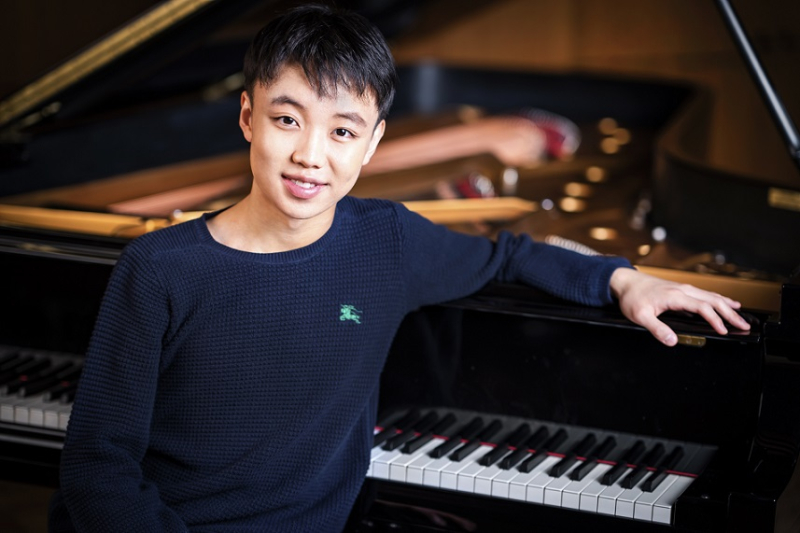
    Lee_Nathan3CreditChrisLee

    Above: pianist Nathan Lee, photo by Chris Lee

    ~ Author: Oberon

    Wednesday February 19th 2020 matinee – Young Concert Artists continued their popular series of noontime concerts at The Morgan Library today as pianist Nathan Lee played works by Ludwig van Beethoven, Chris Rogerson, and Robert Schumann in succession with nary a break in between.

    The youthful pianist, clad all in black with subtly bejeweled shoes, opened his program with Beethoven’s Sonata No. 27 in E-minor, Op. 90 – a lovely gift to us for the composer’s 250th birthday celebration. Unlike most traditional sonatas, this one has only two movements; the composer’s tempo markings are in German rather than the usual Italian.

    The opening phrases are alternately robust and subtle, and as the music develops there is a continual shift between thoughtful and intense passages. Mr. Lee’s playing of swift downward scales was exhilarating, and he moved effortlessly from drama to delicacy as the piece evolved. The second movement offers a sweet flow of melody with contrasting moments of animation. Mr. Lee is as engaging to watch as to hear, his facial expressions reflecting the moods of the music, his eyes often closed.

    The music of Chris Rogerson, who was Young Concert Artists‘ composer-in-residence from 2010-2012, made a very positive impression on me when I first encountered his String Quartet #1 performed by the Omer Quartet at a YCA  concert at Merkin Hall in December of 2018. Ever on the lookout for music that might capture the imagination of one of my choreographer/friends, I sent this quartet on to Claudia Schreier. Long story short: Ms. Schreier is choreographing a ballet to Mr. Rogerson’s String Quartet #1 for Chamber Dance Project in Washington DC, which will premiere in June 2020.

    This afternoon, Mr. Lee played Chris Rogerson’s ‘Til it was dark; the work was Mr. Rogerson’s first YCA Commission in 2010. The composer’s program notes reveal the nostalgic background for ‘Til it was dark, and made me think of my own boyhood in the little town when we’d play tag and hide-and-seek outdoors as the sun set slowly on summer evenings.

    The work’s first movement, Break, seems to speak of the noisy euphoria we felt as kids when school let out. Mr. Lee was called on to bang emphatically on the keyboard or to reel off swirling festoons of notes. As the music turns dreamy, then mysterious, and finally pensive, Mr. Lee caught all these moods thru his canny use of piano/pianissimo gradations. Later, when virtuosity is called for, the pianist delivers in spades. 

    “Three more minutes!” was the warning call of Chris’s dad that it was almost time to come indoors. The music seems to depict the frantic desire to get as much fun out of the dwindling daylight as one could. By turns sprightly and loudly animated, things eventually calm before a final propulsive rush to a witty end.

    Important Things takes on a more serious tone; Mr. Lee’s playing becomes thoughtful, almost tender. In his program note, Mr. Rogerson writes of those “…quieter moments with friends, when you wanted to say something that was on your mind…but of course, you never did.” By turns expansive, wistful, and passionate, the music finally alternates short dreamy phrases with harsher ones. Dreaminess prevails, and quietude settles over us. In this very personal (yet also universal) reflection – which put me in mind of Samuel Barber’s evocative Knoxville: Summer of 1915 – Mr. Rogerson could not have asked for a finer interpretation that Mr. Lee’s.

    The young pianist then immediately commenced on Robert Schumann’s Carnaval for piano, Op. 9, written in 1834-1835. In these twenty-one miniatures, Schumann depicted himself (with Florestan and Eusebius representing his split personalty), his beloved Clara (Chiarina), his friends, and also characters from the commedia dell’arte. In 1915, Michel Fokine choreographed the music for his ballet of the same title, created for Diaghilev’s Ballets Russes. Amazingly, I’d never heard the entire Schumann score until today.

    Art_63_06_13

    Above: the legendary ballerina Tamara Karsavina as Columbine in Fokine’s ballet Carnaval

    Nathan Lee took us on a delightful journey with his brilliant playing, and thru his coloristic gifts introduced us to – among others – the lively Pierrot, the smug wit of Harlekin, the scampering Coquette, and the youthful gaiety of Chiarina. From the grand introduction, the music’s rhythmic subtleties and irresistible waltzes drew us onward thru this 30-minute panorama wherein the essential element – charm – was in abundance in Mr. Lee’s playing.

    The pianist returned for an encore: the Sarabande from Bach’s 4th Partita, subtly played.

    ~ Oberon

  • 20th Century Masterworks @ The NY Philharmonic

    _DSC9923

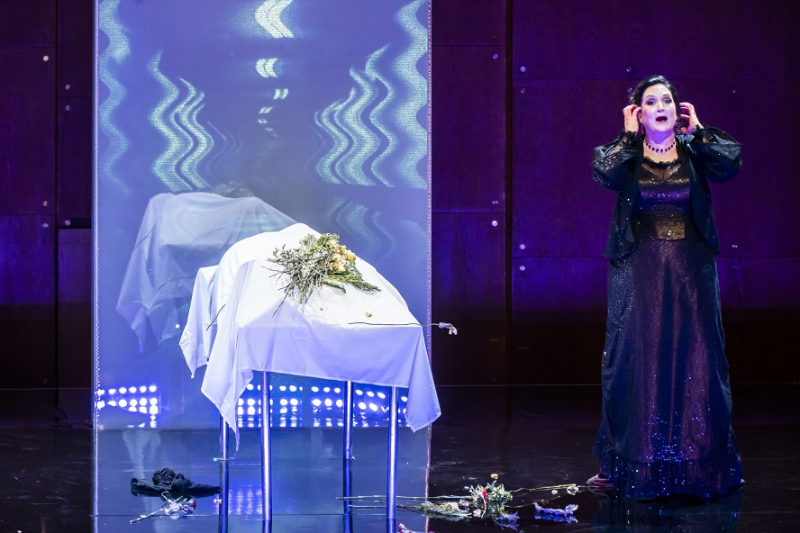
    Above: Katarina Karnéus in ERWARTUNG at The New York Philharmonic; photo by Chris Lee

    ~ Author: Oberon

    Thursday September 26th, 2019 – This long-awaited program by The New York Philharmonic paired Arnold Schoenberg’s monodrama ERWARTUNG with Béla Bartók’s expressionist opera BLUEBEARD’S CASTLE. The Philharmonic’s music director, Jaap van Zweden was on the podium, and a trio of esteemed singers took on the demanding vocal roles. The orchestra was simply splendid, from first note to last.

    In 1989, the Metropolitan Opera presented these two works on a double bill, conducted by James Levine. Jessye Norman sang both The Woman in the Schoenberg and Judith in the Bartók; Bluebeard was sung by Samuel Ramey. It was a magnificent evening musically, though the setting and direction for the Bartók left a lot to be desired. But the staging of the Schoenberg was unforgettable: just a grand piano, hundreds of white candles, and Ms. Norman. How I would love to see it again!

    The idea of presenting these two works in a semi-staged concert setting at Geffen Hall seemed intriguing on paper but was less successful in practice. The singers performed on a raised platform behind the musicians, who were seated in near darkness. The addition of silent actors – portraying medical staff and a crime-scene photographer in ERWARTUNG, and Bluebeard’s previous wives in the Bartók – neither added to nor distracted from the flow of the two works. From where we were sitting, we could not discern what was under the sheet of that autopsy table, which was revealed when they came to take The Woman away. One small screen sufficed for the projections, which were neither here nor there. The lighting effects, however, were well-integrated into the music, especially a blood-red drenching at one point.

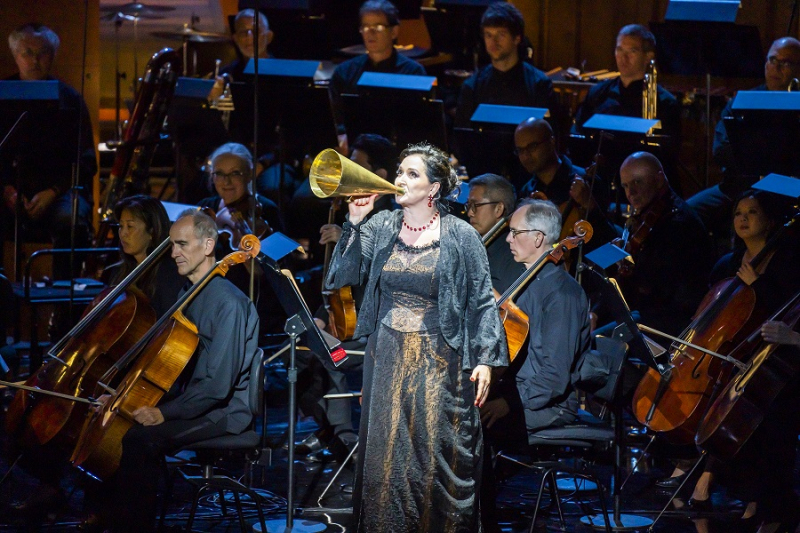
    The monodrama and the opera were linked theatrically by having Katarina Karnéus, who had just given a phenomenal performance in the Schoenberg, re-appear as the prologue to BLUEBEARD’S CASTLE. Here, Ms. Karnéus (using a megaphone) proved to be every bit as engaging as a speaker as she has been in her singing of The Woman. And while, in the end, the evening could have just as thrillingly been presented in straight-up concert form, that would have deprived us of Ms. Karnéus’s inspired acting of her role.

    The concert opened with a performance of the song Erwartung, from Schoenberg’s Vier Lieder, his opus #2, composed in 1899. This gorgeous piece of music, which I had never heard before, was originally written for voice and piano but was tonight performed in a setting for voice and harp. The Philharmonic’s harpist Nancy Allen played divinely, creating a poetic atmosphere. In a black gown shot with silver and holding a large bouquet, soprano Nina Stemme’s voice seemed beset by a wide tonal beat or fluctuation which rather undermined the strange beauty of the song. Ms. Stemme fared much better in BLUEBEARD, where she was fully warmed-up and with the voice profiting from the cushioning orchestra.

    Katarina Karnéus was the Cardiff Singer of the Year in 1995 and from there went on to a grand worldwide career. She came to The Met in 1999, debuting as Varvara in KATA KABANOVA and also appearing as Siebel, Olga in EUGEN ONEGIN, as Rossini’s Rosina, and as Cherubino. I had the pleasure of meeting her while I was working at Tower Records, and of attending a lovely recital she gave in 2001 with pianist Brian Zeger. She last sang at The Met in 2005; in the interim she has developed into a fascinating singing-actress.

    _DSC0141

    Above: Katarina Karnéus as The Woman in ERWARTUNG; photo by Chris Lee

    What a performance of ERWARTUNG Ms. Karnéus gave tonight! The voice encompasses an impressive vocal span, with a silvery sheen on the high notes and a dusky, dramatic throb in the lower range. Her wide-ranging singing is pointed and subtle in terms of word colourings, has a lovely vein of lyricism running thru it, and is possessed of striking power in the climactic moments. It’s an expressive, even bewitching, instrument. Beyond this, Ms. Karnéus is a compelling physical presence, and she captured the emotional state of The Woman with her vibrant and detailed physicality; at one point her entire body was overcome with trembling agitation. Mixed in with the madness were passages that were extraordinarily moving, as in the moment she tells her absent lover that he has “…not even the grace to let me die with you.”

    In recent years, only a handful of operatic performances have captivated me in the way Katarina Karnéus did tonight in ERWARTUNG. She is truly one of a kind.

    Here’s a sampling of the Karnéus voice:

    Katarina Karneus – Mahler ~ Ich bin der Welt abhanden gekommen

    _DSC0348

    Above: Katarina Karnéus in the spoken prologue to BLUEBEARD’S CASTLE at The New York Philharmonic; photo by Chris Lee

    After the interval, BLUEBEARD’S CASTLE commenced with a re-appearance of Ms. Karnéus in a speaking role; I must admit that I found myself wishing she was also singing Judith, for while there is no denying the power and commitment of Nina Stemme’s performance in that role, hers is a voice that has never reached me on a deeper level. That said, the soprano was in full-tilt form for the Bartók tonight and was much admired by the audience.

    In the role of Bluebeard himself, it gave me great pleasure to see onstage again the excellent baritone Johannes Martin Kränzle who, in 2014, was an ideal Beckmesser in his (to date) only Met appearances. We simply must have this man back at The Met, for he is a singing-actor (and an acting-singer) of the highest calibre. 

    _DSC0651

    Above: Johannes Martin Kränzle and Nina Stemme in BLUEBEARD’S CASTLE; photo by Chris Lee

    Ms. Stemme and Mr. Kränzle made the Bartók glow in all its dark radiance with their powerful vocalism and intense acting. They played beautifully off one another, seeming to feed off each others energy as well as off the astonishing sounds being produced by the artists of the Philharmonic.

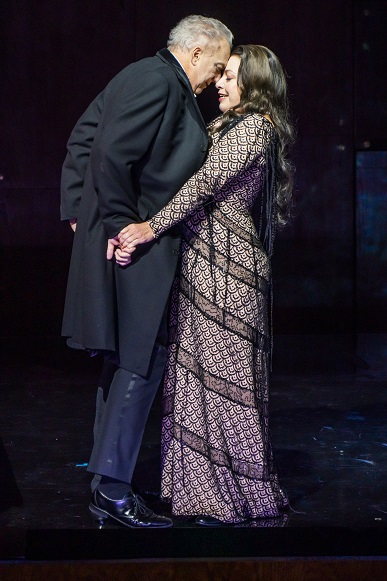
    It was a performance to immerse oneself in totally, and by the time the harp and horns marvelously underscored Mr. Kränzle’s spectacular vocalism at the opening of the fourth door, I was thoroughly enthralled. Ms. Stemme’s blockbuster high-C at the opening of the fifth door was followed by simply mind-bogglingly impressivel singing from the baritone. Ever a compelling mover, Mr. Kränzle even executed a little dance, and then led his soprano is a waltz.

    Responding to Judith’s questions about the mysterious white lake, Mr. Kränzle was hauntingly moving as he replied: “…tears, Judith…tears!” And then – incredibly – he took his performance to an even higher level with his gorgeous singing of the passage where Bluebeard describes how he met his previous wives and what they mean to him: morning, noon, and evening have been personified for him by these women, and with Judith joining them, his world is complete. “Now it will be night forever!”

    _DSC1438

    Above: from BLUEBEARD’S CASTLE, photo by Chris Lee

    Throughout the evening, the playing of The New York Philharmonic was darkly dazzling, glorious, sublime. Maestro van Zweden reigned over the music with a sure sense of its enormous emotional range, from eerie piani to unfettered, magnificent fortes. The musicians played their hearts out, creating sonic textures that sent chills thru me time and again, and the numerous solo passages were given extraordinary clarity by these remarkable artists.  

    ~ Oberon

  • Shostakovich ~ Beethoven @ The NY Philharmonic

    Mdd-wn-main

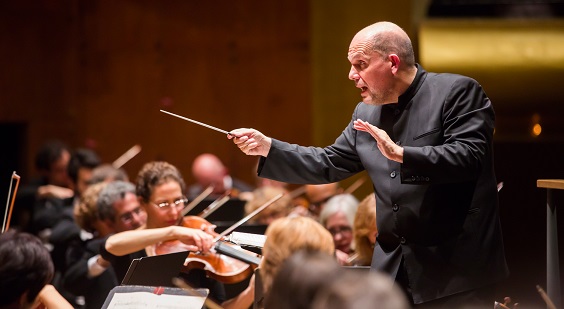
    Above: Maestro Jaap van Zweden; photo by Chris Lee

    ~ Author: Oberon

    Wednesday May 22nd, 2019 – As their 2018-2019 season winds down, The New York Philharmonic offered a well-contrasted pairing of works tonight at Geffen Hall: Shostakovich’s Chamber Symphony and Beethoven’s 3rd symphony: the Eroica. The Philharmonic musicians were on top form, and the orchestra’s Music Director, Jaap van Zweden, led a performance that ended with an enthusiastic ovation.

    For all the concert’s musical excellence, extraneous factors made the evening something of a trial. The lobby at Geffen Hall during the half-hour leading up to the performance’s start time has lately become weirdly chaotic: it has the feeling of an airport, with staff folks yelling at you to go here or there, and long, snaking lines between the velvet ropes to pass thru the “non-invasive” scanner only to be wanded once you’ve gotten the green light. It’s quite stressful, and hardly conducive to the state of mind one hopes to be in when a concert starts: calm, focused, receptive.

    The opening minutes of the Shostakovich featured a chorus of coughers from the audience; the woman next to us coughed throughout the concert while the fellow in front of us nearly busted a lung with one coughing fit: I actually thought he might pass out. Aside from ruining the music, germs are being spread. If you are sick, be courteous enough stay home.

    But the performance of the Shostakovich Chamber Symphony was simply thrilling. This work is an arrangement of the composer’s 1960 String Quartet No. 8, Op. 110, by Rudolf Barshai, a renowned violist and conductor who founded the Moscow Chamber Orchestra in 1956. Barshai’s transcription honors the original instrumentation: it’s set for large string ensemble. And it’s simply magnificent to hear.

    The symphony is in five movements, played without pause. From a somber start emerges a soft, sorrowing violin melody (beautifully played by concertmaster Frank Huang). Six basses bring a sense of grandeur to the music, which is richly layered. Suddenly, a sizzling energy flares up: the basses dig in, with swirling violins and slashing celli, as the music becomes a huge dance. For a spell, violins and violas compete; then the music comes to a sudden halt.

    The violas set the pace for a waltz, played by the violins, which later slows down and fades away. A dirge-like passage is followed by a poignant lament. Carter Brey’s cello sings to us in its highest range, a song which Mr. Huang’s violin takes up. The music meanders a bit, ebbing and flowing, before a magical fading finish.

    This work, and the Philharmonic’s playing of it, was one of the highlights of the season for me. Mssrs. Huang and Brey were enthusiastically applauded as they rose for a bow. I was surprised to read that this was The Philharmonic’s premiere performance of this symphony.

    I must admit that I don’t find Beethoven’s Eroica all that interesting. Its initial theme:

    Images

    …reminds me of a simple melodic scrap I wrote for a compulsory exercise in music theory class in high school. We hear it repeatedly in the symphony’s Allegro con brio, and to me it’s tiresome.

    Sherry Sylar’s oboe solos and some warm-toned horn playing captured my interest in the Adagio assai, but I don’t think Beethoven’s idea of a funeral march shows much imagination. It feels aimless, missing the weighted grief of Chopin’s or the epic grandeur of Wagner’s (and for wit, there’s always Gounod). The hunting horns in the Scherzo again reminded me of high school, where I struggled to be a proficient horn player, but without success. Ms. Sylar and clarinetist Anthony McGill illuminated their solo bits in the Finale, but I found my mind wandering. 

    Whenever a musical work that is highly regarded by many fails to reach me, it makes me feel deficient. What am I not getting? So it was interesting to read in the program notes that Beethoven’s 3rd was not initially regarded as a masterpiece, but seemed instead overly long and lacking a sense of unity.

    Still feeling that the Eroica has eluded me, I went to a classical music chat room to see if anyone else felt as I do about this symphony. Among the many posts heaping praise on Beethoven’s 3rd, someone wrote: “I would never deny the power and genius of the Eroica, but I never want to sit through it again.”

    Anna_rabinova

    The evening honored musicians who are retiring from The Philharmonic this season. One who I will especially miss is violinist Anna Rabinova (above), whose dedicated artistry I have come to know thru her appearances at the Philharmonic Ensembles concerts at Merkin Hall. I hope she’ll continue to be part of the City’s musical scene in the coming years.

    ~ Oberon

  • Fire in my mouth @ The New York Philharmonic

    NY Phil ~ Chris Lee

    ~ Author: Brad S. Ross

    Thursday January 24th, 2019 – Thursday evening at David Geffen Hall was one to behold as music director Jaap van Zweden led The New York Philharmonic in its most exhilarating performance of recent memory and more.  The night’s all-American program included the New York premiere of a late master, an American repertory standard, and one of the most hotly anticipated world premieres of the entire U.S. concert season.  One to behold, indeed.

    The evening began with Elegy, an instrumental interlude from the oratorio August 4, 1964 by the late American composer Steven Stucky.  Stucky, who died rather unexpectedly from brain cancer three years ago at the all-too-young age of 66, was one of America’s foremost contemporary composers, having written numerous concerti, one gorgeous symphony, an impressive opera, and two concerti for orchestra, the latter of which won him a long-overdue Pulitzer Prize for Music.  As the title suggests, August 4, 1964 details one fateful day during the presidency of Lyndon B. Johnson, including fallout from the Gulf of Tonkin incident and news of the discovered bodies of the murdered civil rights activists Andrew Goodman, Michael Schwerner, and James Chaney in Mississippi.  A Dallas Symphony Orchestra commission, the work was given its world premiere under the baton of van Zweden himself in September 2008.

    Maestro van Zweden wasted no time at the podium before setting things into motion.

    Elegy opened on a great crash—one that was sure to alert the senses of even the most droopy-eyed concert attendee.  The piece then descended into more somber territory as a quiet oboe, horns, and strings set its decidedly hymn-like tone.  The work possessed an almost filmic sense for drama, often building to thundering crashes followed by slow descents into haunting suspended dissonances.  Stucky aptly captured the turmoil of his subject matter, which seemed a prophetic meditation upon much of our current political turmoil.  Nevertheless, he ended the piece on a long-held major chord—one that seemed to offer a glimmer of hope in the face of uncertainty.  van Zweden milked this finale to tremendous dramatic effect, only lowering his baton after every note had its chance to reverberate throughout the hall several times over.

    Up next was Aaron Copland’s Concerto for Clarinet, Strings, and Harp.  Originally commissioned and performed by the great jazz clarinetist Benny Goodman, the concerto was one of handful of Copland works that incorporates elements of jazz in its composition.  It was written between 1947 and 1949, and went on to become one of the most-programmed clarinet concerti of the entire orchestral repertoire.  Performing tonight was Anthony McGill, the Philharmonic’s principal clarinetist.

    The piece began on a sorrowful elegy in the strings.  Copland’s voice here was its most stubbornly tonal—his broad rhythmic intervals and warm orchestration evoking the great open spaces of North America.  A lively and showy cadenza divided the work between its slow opening and an energetic climax, which Mr. McGill played with remarkable precision and zest.  The pace was then quickened as the orchestra performed a lovely call and answer in typical Copland fashion.  A final ascending glissando in the clarinet and upward rush in the strings brought the work to an animated close.  This exuberant finale brought some much appreciated levity to an otherwise solemn musical evening.

    If the program had ended here, it still would have easily been a great night at the Philharmonic.  What followed, however, transported the merely beautiful to the realm of the sublime.  This, of course, was the long-anticipated world premiere of Fire in my mouth by the celebrated American composer Julia Wolfe.

    Ms. Wolfe, who co-founded the contemporary classical music organization Bang on a Can in 1987 with the fellow composers David Lang and her husband Michael Gordon, has steadily earned a reputation as one of the world’s finest living composers.  Among her notable works are the concerto for string quartet My Beautiful Scream, the chamber/vocal work Steel Hammer, and her Pulitzer Prize for Music-winning oratorio Anthracite FieldsFire in my mouth, a gargantuan work for girls’ choir, women’s choir, and orchestra, marks her largest composition to date.

    A New York Philharmonic commission, the piece is based on the infamous Triangle Shirtwaist Factory fire that took the lives of 146 New York City garment workers, most of whom were young immigrant women, on March 25th, 1911.  The owners had locked the doors factory doors to prevent theft, leaving the workers trapped inside when the fire broke out.  They died of burns, smoke inhalation, or jumping to their deaths trying to escape the inferno.  The political fallout and public outcry for change that followed was as much an inspiration for Wolfe as the tragedy itself.  The work’s title, somewhat to my surprise, comes from a quote by the labor activist Clara Lemlich, who, reflecting on her years of activism, said, “Ah, then I had fire in my mouth.” The text of the piece was compiled from various interviews, speeches, and accounts of the event in addition to folk songs from the era.  Spanning roughly one hour, the piece is cast in four movements.

    50625251_10158453673037293_5445700866956853248_n

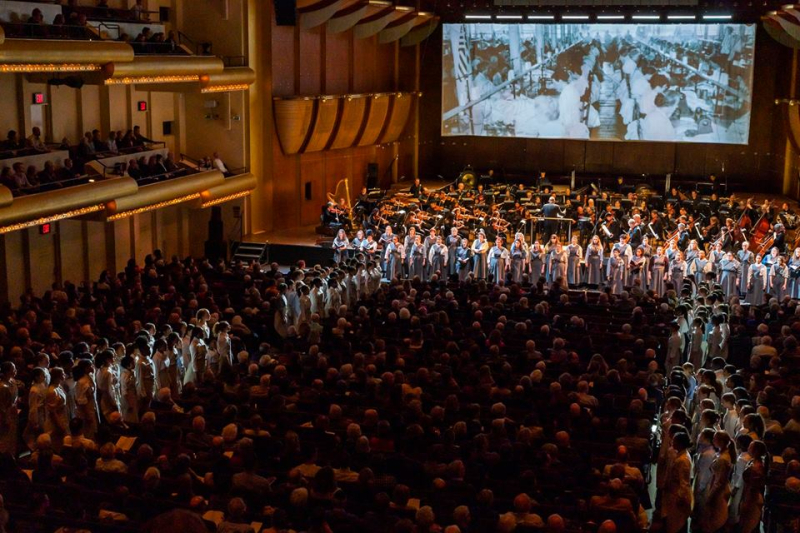
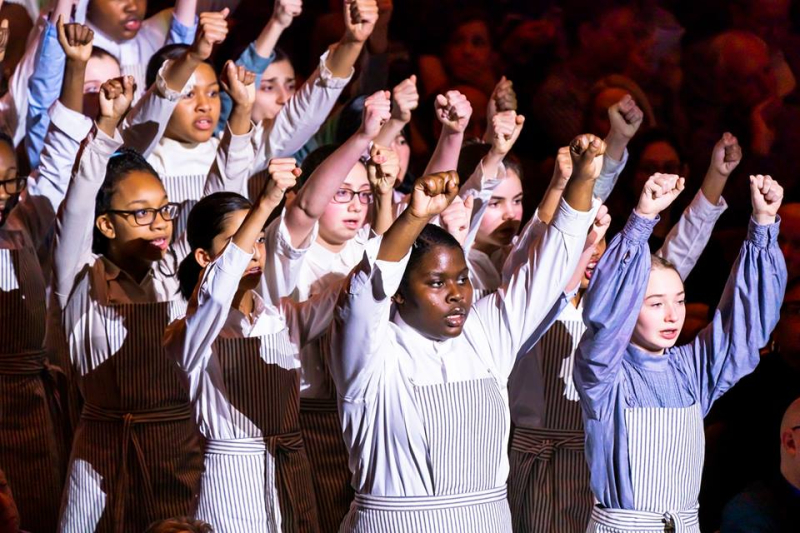
    The orchestra was joined in performance by the Philadelphia-based choral ensemble The Crossing (above) and The Young People’s Chorus of New York City (below). The photos are by Chris Lee.

    51068976_10158453669887293_5221514500502454272_n

    The text of the piece was compiled from various interviews, speeches, and accounts of the event in addition to folk songs from the era.  Spanning roughly one hour, the work is cast in four movements.

    The first movement “Immigration” began with chilling suspended high strings as the women’s chorus, decked in period regalia, began toning, “Without passports or anything we took a boat…”  Blueprints of passenger ships overlaid with footage of foaming ocean waves were projected behind the ensemble as brass swells harkened to the rolling seas of the Atlantic as these young women made their voyage to America.  Propulsive percussion and winds shifted under suspended vocal lines as familiar images of the Statue of Liberty and immigrants arriving to the United States were projected above.  This built to a great crash and silence fell throughout the hall as the first movement came to a close.

    The second movement “Factory” began to the sights and sounds of industry; images of machinery were cast on the screen above while the strings made eerie slaps that echoed the sounds of a sewing machine.  A growing menace emerged from the lower voices of the orchestra as the threat of disaster grew.  Splatting brass notes and unrelenting tremolo in the strings played on as the chorus mimed the actions of Sisyphean industrial labor.  Grainy images of factory workers punching their cards were projected overhead while dissonant vocals, driving bass, and unnerving glissandi rose to a violent and tragic crescendo—the effect was genuinely terrifying.  The chorus then used pairs of scissors to create a peculiar, yet distinct percussive beat as the work quietly transitioned into its third movement.

    The women’s choir then descended to the front of the stage for the start of the third movement “Protest,” singing, “I want to talk like an American, I want to look like an American.”  Rhythmic pulses in the strings played as newspaper headlines of protests and strikes were projected above.  Among the cacophony could be hear the whistles of policemen trying to contain the disorder.  The girls’ choir then emerged from the back of hall, marching and swaying in choreographed motion down the center aisle, as they sang in protest, “I want to say a few words.  I am a working girl.  One who is striking against intolerable conditions.”  The women’s chorus professed, “Ah—then I had fire in my mouth!” as the girls hauntingly repeated, “fire fire fire”—a harbinger of the tragedy to come.

    The girls’ choir joined the rest of the ensemble on stage as the final movement, “Fire”, began.  The string players created the haunting sound of breath by swinging their bows through the air.  Here Ms. Wolfe played up tragedy over terror as faded photographs of women interlaid with abstract images of smoke, fire, and rubble beamed overhead.  Fierce crashes, perhaps the loudest thing I’ve ever heard in David Geffen Hall, deafened the auditorium as musical hellfire consumed the ensemble (“I see them falling, see them falling…”).  A somber vocal line emerged, an indictment of social apathy, pronouncing, “I would be a traitor to those poor burned bodies if I were to speak of good fellowship.  I have tried you good people of the public and found you wanting.”  The chorus then sang the name of every soul who perished that day as Fire in my mouth quietly faded to silence; it was perhaps the greatest musical elegy since John C. Adams’s On the Transmigration of Souls.

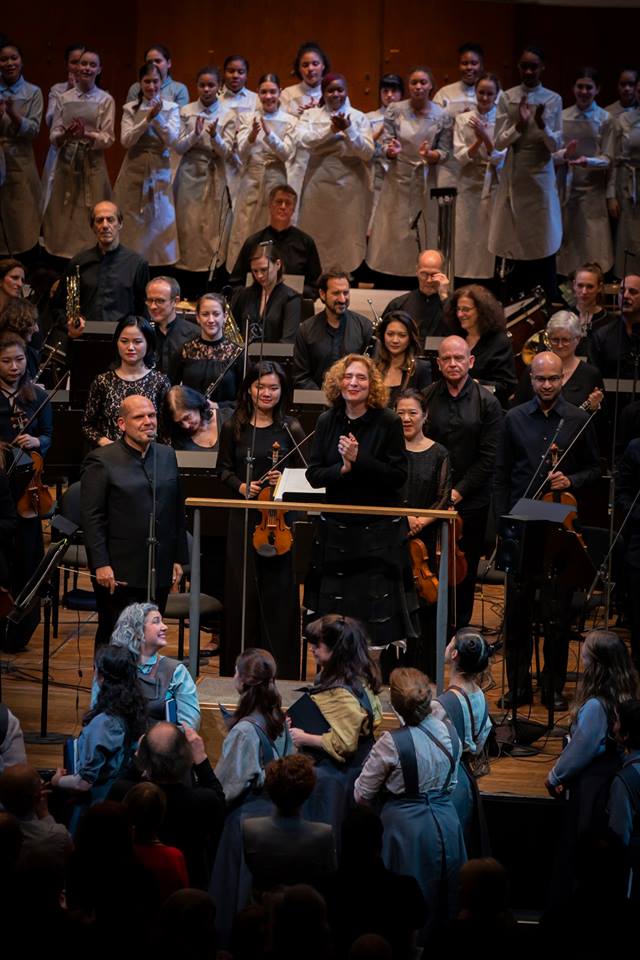
    The standing ovation that ensued lasted for several curtain calls as Ms. Wolfe, Maestro van Zweden, and company each had a chance to take their bows.  No one, save a few wheelchair-bound patrons, was still seated by the time the applause finally died out, something I’ve never seen at David Geffen Hall and don’t expect to see again for some time.  Indeed, it was the finest world premiere I’ve yet had the good fortune to attend.  I can only hope that many other metropoles may be graced with its performances in the near future.  Brava, maestro!

    50896920_10158453670227293_703449887135498240_n

    Above, the ovation: the conductor and composer onstage at the end of Fire in my Mouth. Photo by Chris Lee.

    ~ Brad S. Ross

  • Shaham|Sokhiev @ The New York Philharmonic

    43631700_10158224011972293_9087441948343533568_n

    Above: violinist Gil Shaham and conductor Tugan Sokhiev, photo by Chris Lee/NY Philharmonic

    ~ Author: Oberon

    Thursday October 25th, 2018 – An all-Russian evening at The New York Philharmonic. Tugan Sokhiev, Music Director of Orchestre National du Capitole de Toulouse, was making his Philharmonic debut on the podium, with Gil Shaham as violin soloist.

    Alexander Borodin composed In the Steppes of Central Asia to honor Tsar Alexander II on the 25th anniversary of his coronation. The eight-minute work has an ethereal start, from which emerges a plaintive clarinet solo played by Pascual Martínez-Forteza; this artist’s sumptuous tone was a joy to hear throughout the evening. Maestro Sokhiev held sway over the music, which was gorgeously played – especially by the celli. Solos for English Horn and flute, a rich passage for the horns, and the violins in a tutti of cinematic sweep kept the ear constantly allured. The music becomes majestic, worthy of a venerable Tsar.

    As the work progressed, I was very much put in mind of the composer’s opera Prince Igor, and found myself wondering where Peter Gelb’s expensive poppy field might be languishing.

    Mr. Shaham then joined the orchestra for Prokofiev’s Violin Concerto No. 1. This work was choreographed by Jerome Robbins in 1979; the ballet, Opus 19/The Dreamer, is by far my favorite from the Robbins catalog, and is frequently performed by the New York City Ballet.  It’s always wonderful to experience music I’ve come to know at the ballet in its original concert setting, and it goes without saying that the choreography danced in my mind during Mr. Shaham’s marvelous performance.

    Prokofiev’s knack for blending lyricism and irony was a continual source of pleasure in tonight’s performance by Mssrs. Shaham and Sokhiev. The concerto’s haunting opening, with the shining, silver – almost astringent – sound of Mr. Shaham’s violin draws us into a dreamlike state. Everything is magical, with the violas pulsing as the soloist engages in shimmering fiorature. The music becomes driven, only to meld into a slow cadenza. Then a chill sets in, with the flute shimmering. Mr. Shaham, returning to the original melody, lets the sound vanish into thin air.

    In the ensuing Scherzo, the music abounds in sarcasm; Mr. Shaham met all the technical demands with impetuous energy, including some really gritty playing. This is such amazing music to experience, right up to its sudden end.

    The the work’s final movement commences with a moderate-tempo, march-like theme, first played by the bassoon, and later by the brass.  Mr. Shaham’s playing of the songful melodies Prokofiev gifts him was luxuriantly modulated. His tone taking on a nocturnal iridescence, the violinist made the concerto’s final moments pure heaven.

    Mr. Shaham played a 30-second delight of an encore his announcement of which I could not hear. It was witty little treat, but a cellphone interjection at the start was not welcome.

    Sokhiev-8-crdit-Patrice-Nin-1024x680

    Above: Maestro Tugan Sokhiev, photo by Patrice Nin

    I last heard Tchaikovsky’s Symphony No. 4 played by the Philharmonic in 2016 in at performance that impressed and even thrilled me sonically, without reaching me on a spiritual level. Tonight, Maestro Sokhiev achieved that last distinction in a performance of soaring lyricism and searing passion, played splendidly by the orchestra. Perhaps it is true that it takes a conductor with a Russian soul to find the deepest resonances of Russian music.

    Tchaikovsky’s fourth symphony grew out of a highly emotional period of the composer’s life. After a disastrous attempt at marriage, he suffered from writer’s block whilst also struggling with depression and pondering his sexuality. He finished the symphony in 1877 and it was premiered in 1888.  The the opening bars of music stand as a metaphor for Fate; in Tchaikovsky’s own words: “…the fatal power which prevents one from attaining the goal of happiness”.

    This evening’s performance was thrilling in every way. From the splendid opening and straight thru to the end, the orchestra were on peak form. The depth of sound from the ensemble – and the numerous solo passages that frequently sing forth – constantly impressed, and the Maestro had everything under fingertip control. From the grandest imperial passages to the uncanny delicacy of the more restrained moments, his mastery of colour and balance seemed ideal. My companion for the evening, Ben Weaver, who knows this music inside out, was very taken with Sokhiev’s pacing ,which made the symphony seem fresh to him.

    The Philharmonic’s soloists produced an endless flow of enchanting playing: Mr. Forteza and his colleagues – Robert Langevin (flute), Sherry Sylar (oboe), and Judith LeClair (bassoon) – seized upon the generous melodic gifts which Tchaikovsky lavished upon them. The horns were plush, the trumpets and trombones commanding in their fanfares. The timpanist was a marvel of velvet touch is the waltzy passage of the first movement, and in the ‘interlude’ of the otherwise Allegro finale, the triangle sounded with a pristine glimmer.

    There seemed to be a particular sheen on the string playing tonight, and they made the pizzicati of the Scherzo dazzlingly alive. Watching Maestro Sokhiev cue them and entice their keen manipulation of the dynamic range during this captivating movement was a treat in itself.

    In recent days, the feeling that we are poised now of the edge of an abyss makes music, poetry, art, and Nature seem more vivid and essential than ever. A beautiful face among the crowd tonight captured my imagination, but filled me with apprehension that such innocence may soon be swept away in a tide of hatred.

    ~ Oberon