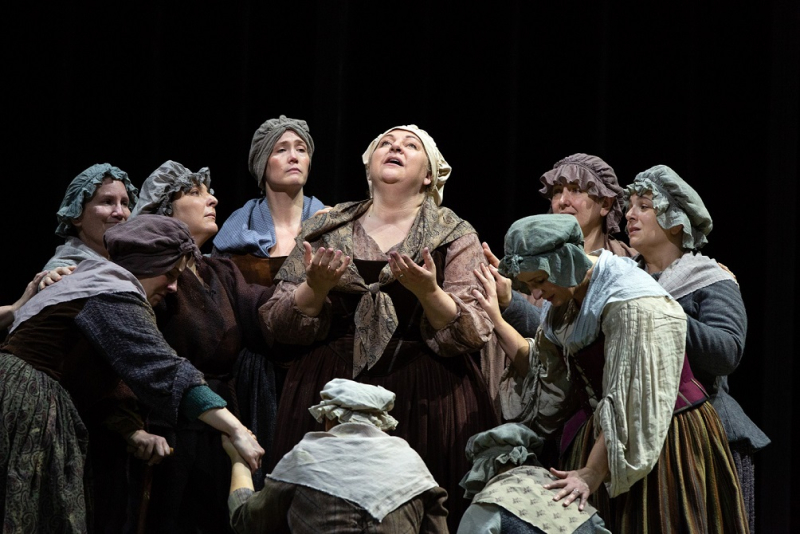
Above: Christine Goerke as Mme. Lidoine with Eve Gigliotti as Mother Jeanne, and their sister-nuns; photo by Marty Sohl/Metropolitan Opera
Saturday January 28th, 2023 matinee – An incredibly powerful performance of Francis Poulenc’s masterpiece, Dialogues des Carmélites, at The Met this afternoon. The John Dexter production, one of the treasures of the Company’s repertoire, never fails to move me with its utter simplicity and the clarity of its story-telling. It was lovely to see several small groups of nuns among the audience this afternoon.
The performance was somewhat compromised by the conducting of Bertrand de Billy; though his tempi and feel for the music were spot-on, he too often allowed the orchestra to cover the voices. This seems to be a trend at the Met these days, for the recent RIGOLETTO(s) and TRAVIATA I saw, conducted by Speranza Scapucci and Marco Armiliato respectively, suffered from the same problem. As there are no huge voices around nowadays – no Nilsson, nor even a Grob-Prandl, and no Cossotto, del Monaco, or Norman Treigle either – such waves of sound rising from the pit cause singers to either force or simply be drowned out. The Met’s huge space is hard enough fill in and of itself; having to compete with mega-decibels of orchestral sound must be daunting indeed. Perhaps some people feel that a high-volume orchestra makes opera more “exciting”…? Well, it doesn’t.
The cast today was peopled by expressive singing-actors, down to the smallest roles. Benjamin Taylor (Thierry), Paul Corona (Dr. Javelinot), Siphokazi Molteno (Sister Mathlde), and Jeongcheol Cha (Jailer) did well, though the last-named’s task – reading the names of the nuns condemned to death – was lessened in impact by the orchestra’s loudness; it’s an affecting moment, deserving to be better-handled.
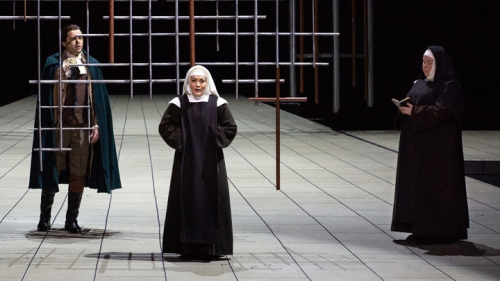
Above: Piotr Buszewski as Chevalier de la Force, Ailyn Perez as his sister Blanche, and Jamie Barton as Mother Marie; photo by Marty Sohl/MET Opera
The Polish tenor Piotr Buszewski, in his Met debut role, displayed a handsome timbre and fine sense of nuance as the Chevalier de la Force. Laurent Nouri made his mark as the Marquis de la Force. Tony Stevenson was excellent as the Chaplain, and Eve Gigliotti made much of the moving role of Mother Jeanne. It is Mother Jeanne who brings forth the figurine of the Christ Child, the breakage of which seems to signify the breakup of the convent. In the end, Mother Jeanne, using her cane, walks with great dignity to the guillotine. Ms. Gigliotti made the character seem essential, and her warm, plush mezzo timbre is always appealing. Tenor Scott Scully and basso Richard Bernstein are the Commissioners who come to shut down the convent; Mr. Bernstein, ever the effective stage creature, eyed each nun with suspicion; his voice is strong and steady.

As Blanche de la Force, the opera’s central character, Ailyn Pérez (above, in a Marty Sohl photo) brought gleaming lyricism with a sense of fragility to her music. She forms a bond with the naive, optimistic young Sister Constance (Sabine Devieilhe); in their prayer following the death of the Old Prioress, their timbres meshed to magical effect. And in the scene where her brother visits her and asks her to return home, Ms. Pérez and Mr. Buszewski did some of the loveliest singing of the afternoon. Having fled the convert, Blanche seeks refuge, working as a maid in her old family home; but Mother Marie tracks her down and urges her to return to the fold. Here Ms. Pérez’s desperation becomes palpable. But at the end, stepping from the crowd to bid farewell to Sister Constance and to face her own death calmly, Blanche finds release.
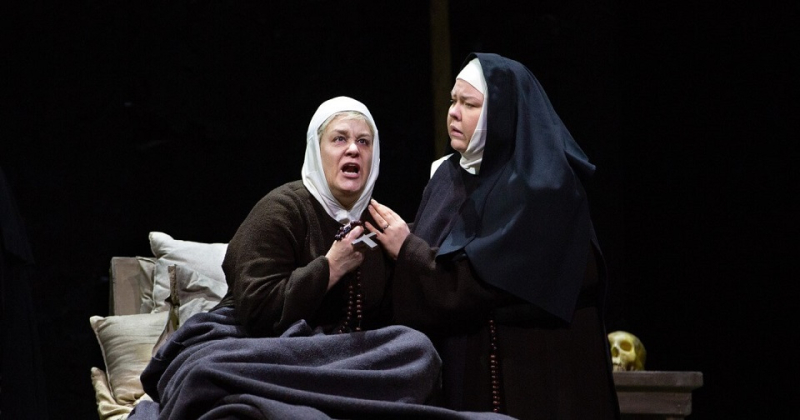
Above: Alice Coote as Madame de Croissy and Jamie Barton as Mère Marie; photo by Marty Sohl
During the pandemic, I often turned to YouTube to keep music vividly in my life whilst live performances ceased, and I came upon a film of Alice Coote singing Mahler’s “Ich bin der welt abhanden gekommen” which moved so deeply. Watch and listen here.
Today, as Madame de Croissy, Ms. Coote held the House under a spell as the character’s horrific death scene was played out. For a woman whose faith was always deep and seemingly unshakable, the Old Prioress finds herself terrified as she faces her end, wracked with pain. Ms. Coote, a wonderfully word-conscious singer, made the scene the centerpiece of the performance. Both vocally and dramatically, she was living the role: a riveting singer and personality. Rapturous applause greeted her at her solo bow at the opera’s end.
Jamie Barton has a perfect role in Mother Marie, and she made a splendid vocal impression. Her wide-ranging voice, from dusky chest tones to searing top notes, was in peak form. She held the stage with authority, and finely captured the character’s desperation and guilt on having been separated from her sisters during their final hours on Earth.
![Devieilhe-Sabine-04[Caroline_Doutre]](https://oberonsglade.blog/wp-content/uploads/2025/09/e9e883afc4758f1e5a1bdab77e21233d.jpg "Devieilhe-Sabine-04[Caroline_Doutre]")
Above: Sabine Devieilhe, photo by Caroline Doutre
How wonderful to see the French soprano Sabine Devieilhe on the Met stage! Having attended her Weill Hall recital in 2019, I have been hoping to see and hear her again…and now she is here with us. As Sister Constance, the petite and lovely Ms. Devieilhe was ideally cast. Her silvery, shimmering tones gleamed in the House, a contrast to the opera’s deepening darkness and sense of impending doom. In the end, her hope of seeing Blanche again gives her the courage to walk to the guillotine, her lone voice the expression of innocence and human fragility. Then the voice of Blanche is heard: she has stepped from the crowd to join her sisters in death. The two girls have a last moment together before fate overtakes them. Incredibly touching.

Above: Christine Goerke as Madame Lidoine and Jamie Barton as Mother Marie
Towering, literally, over the sisterhood, Christine Goerke made a splendid impression as Madame Lidoine. If some of the highest notes did not bloom as one might wish, Ms. Goerke’s presence – and her vocal authority – gave the afternoon its center. Her portrayal, so dignified, so lovingly maternal, so…human…was touching to experience. It is Madame Lidoine who leads the procession to the guillotine, by which time I was already weeping.
The audience, the quietest and most attentive to have been part of in recent seasons, hailed the singers with great affection and admiration at the end. I felt a desire to go to the stage door, where a large crowd had gathered; I particularly wanted to greet Ms. Coote, Mlle. Devieilhe. and Ms. Gigliotti.

The French soprano was in a rush, probably to catch a flight, but was very gracious and charming; she told me she is already booked for a return to The Met. Ms. Gigiotti signed my program in a distinctive way, matching her distinctive personality; I thanked her for some unique videos she has made (watch here) and for her past performances in works of Nico Muhly and Sergei Taneyev. Ms. Coote walked briskly thru the crowd; undoubtedly she had someplace she needed be.
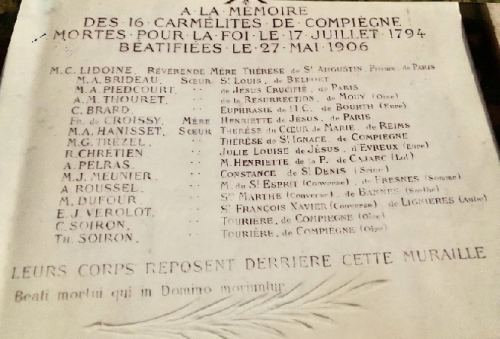
The story of the martyrdom of the Carmelite nuns becomes even more poignant when one realizes that their execution took place just ten days before the end of the Reign of Terror. The women were beatified in 1906; this plaque commemorates their deaths:
It is always difficult to return to the real world after a performance like this; there was so much to ponder after experiencing this opera about man’s inhumanity to man. What harm had these nuns done that merited a death sentence? Why is cruelty so rampant in the history of mankind? Why do people feel a need to control the beliefs and lifestyles of others?
~ Oberon

 Oberon's Glade