Tag: City Center Studios

  • New Ravel @ New Chamber Ballet

    L1680670

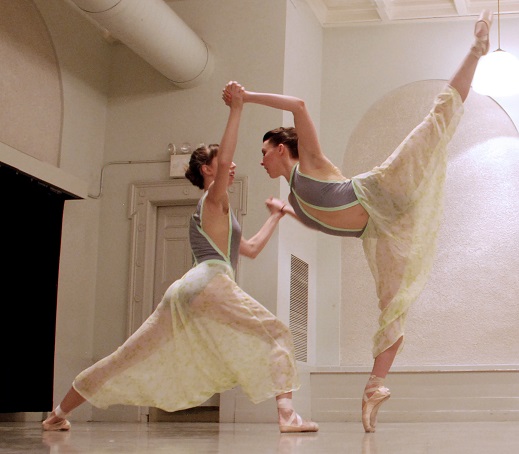
    Saturday February 27th, 2016 – Miro Magloire’s New Chamber Ballet presenting five Magloire ballets, including a premiere, at City Center Studios. Exceptional music, played live, is always on offer at NCB; then there’s the bevy of ballerinas: five distinctive dancers who bring Miro’s classically-based but sometimes quirky – and always demanding – choreography to life.

    Tonight, the house was packed; extra chairs had to be set out, and some people were standing. The program was one of Miro’s finest to date – and he’s had an awful lot of fine evenings. Two classic French violin sonatas – Debussy’s and (part of) Ravel’s – were in the mix, along with some Schoenberg (the more Schoenberg I hear, the more I like), and works by Beat Furrer and Friedrich Cerha (who just celebrated his 90th birthday). 

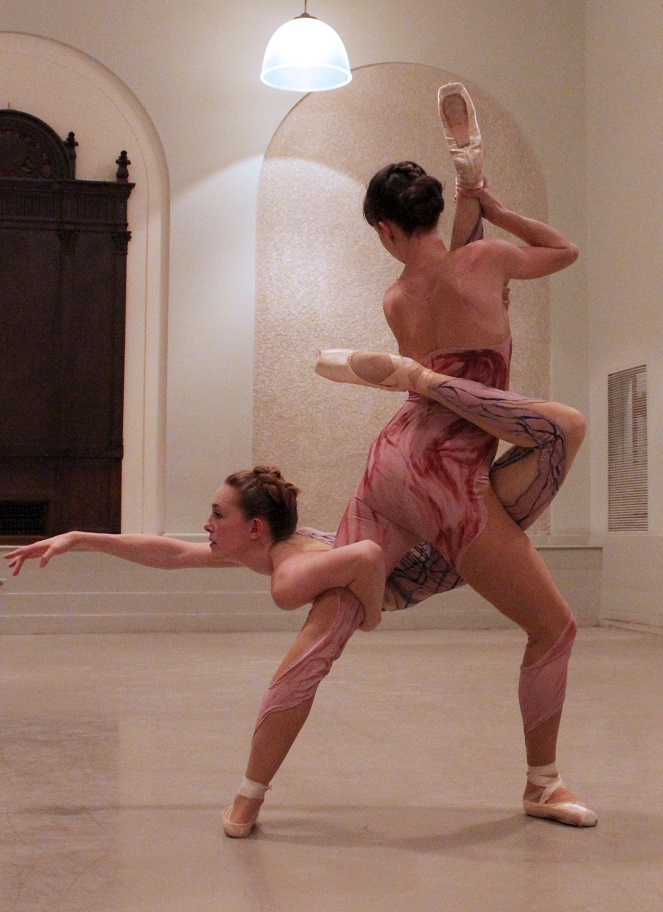
    The opening (premiere) work, RAVEL’D, is still “in-progress”; tonight we saw the first movement, with Miro promising the rest of it for his April performances. Doori Na and Melody Fader played beautifully, and Sarah Thea’s fringed tunics added an unusual flair to the movement. Stylized motifs – eating, praying, biting – are woven into the dance. One girl’s toe-shoed foot rests upon another girl’s head: this is one of several unexpected balancing devices. A space-filling unison trio stands out, and the closing section finds Sarah Atkins in a reverential pose as Amber Neff and Shoshana Rosenfield ‘converse’ in a series of mutually dependent balances. 

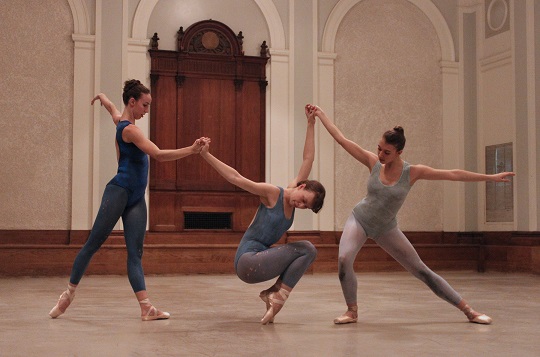
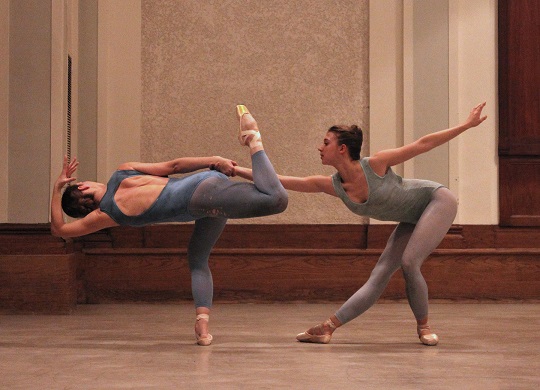
    The space was again well-utilized in GRAVITY; we were seeing the finished version of this work that Miro had started on last year. Doori Na’s expert playing of the Cerha score was something to marvel at: great subtlety and control are called for, and Doori delivered. The three dancers – Elizabeth Brown, Traci Finch, and Amber Neff – are engaged in extended paragraphs of the partnering vocabulary Miro has been exploring of late. Extremely challenging and movingly intimate, the intense physicality of these passages push the boundaries of what we expect from women dancing together. Miro’s dancers have taken to these new demands with great commitment: watching some of their improbable feats of balance and elastic strength gives us a fresh awareness of possibility. Adding yet another dimension to the work: when not actively dancing, each ballerina curls up on the floor to sleep. 

    Pianist Melody Fader evoked an air of mystery with her superb playing of Arnold Schoenberg’s Six Little Piano Pieces for the ballet QUARTET. Here Mlles. Atkins, Brown, Finch, and Neff appear in elegant, backless black gowns. They take seats at the four corners of the playing area, facing outward. With her hair down, a waif-like Shoshana Rosenfield dances in the center with a feeling of halting insecurity; her character seems dazed, perhaps drugged. Periodically, the four seated women move their chairs towards the center, slowing encroaching on Shoshana’s space. The four become aware of the lone ballerina as a potential victim: they turn and observe her intently. In the end, the four women have Shoshana trapped; as she sinks down in surrender, they caress her and run their fingers thru her hair. Eerie, and leaving us full of questions, QUARTET is as intriguing to watch as to hear.

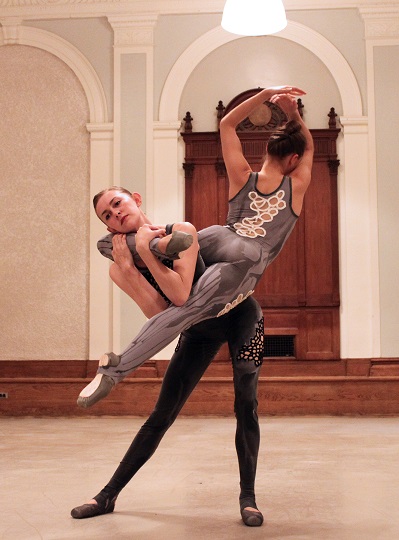
    In VOICELESSNESS, Beat Furrer’s mystical score was performed by Melody Fader; her playing had a fine air of somber quietude. Dancers Amber Neff and Shoshana Rosenfield, in Sarah Thea’s sleek body tights, become fervently entwined and mutually dependent in a duet that develops further elements of Miro’s intense and engrossing partnering technique.

    For a revival of TWO FRIENDS, Doori Na and Melody Fader had the lovely experience of playing Claude Debussy’s violin sonata, the composer’s last completed work. Wearing black gauzy tunics and black toe shoes, Elizabeth Brown and Sarah Atkins are the eponymous duo; they partner lyrically, and all seems right with the world. Then Traci Finch appears out of nowhere and the ballet’s dynamic shifts and splinters, with fleeting pair-ups as alliances form and vanish in a trice. The subtexts of attraction and jealousy are very subtly threaded into the movement; an in-sync duet for Elizabeth and Traci is one outstanding moment, and the sonata’s final movement calls for large-scale virtuosic dancing from all three. But then Sarah impetuously rushes off. 

    True to life, TWO FRIENDS often finds multiple narratives developing at the same time, and over-lapping. There is so much to watch and to savor: I especially relished a brief passage where Elizabeth Brown, suddenly finding herself standing alone, quietly runs her hands up and down her arms in a caressive gesture. Elizabeth, a dancer who always lures the eye with her confident technique and personal mystique, turned this fleeting moment into something of deeper resonance.  

    Having followed Miro’s New Chamber Ballet for several seasons now, what I’ve come to appreciate most about him is his musical integrity. His tastes are eclectic, but always sophisticated, and he’s able to win us over to some very unusual and not always ‘easy’ music thru his own personal enthusiasm for the works he presents. The benefits of having the music played live are numerous, and greatly enhance the atmosphere at NCB‘s performances. And Miro’s excellent dancers take up each new musical and choreographic challenge that he sets for them with a wonderful mixture of strength, musicality, willingness, and grace.

    The dancers tonight were Sarah Atkins, Elizabeth Brown, Traci Finch, Amber Neff, and Shoshana Rosenfield, with the music played by Doori Na (violin) and Melody Fader (piano) and costuming by Sarah Thea. Kudos to all, and to Miro for yet another fascinating evening of dance.

    During the intermission, I really enjoyed re-connecting with Melissa Barak, the former New York City Ballet ballerina who now runs her own Los Angeles-based company Barak Ballet. Melissa is currently here in New York City as the inaugural Virginia B. Toulmin Fellow for Women Choreographers at the Center for Ballet and the Arts at NYU. We shared an awful lots of news and ideas in our 15-minute chat. I love her energy!  
  • An Evening @ New Chamber Ballet

    11229387_10153700794988571_1643682530134201836_o

    Friday November 20th, 2015 – Miro Magloire’s New Chamber Ballet presenting works by Miro and resident choreographer Constantine Baecher in a nicely-mixed programme of new and olde music – expertly played – and danced by Miro’s uniquely talented band of ballerinas. In the intimate setting of the City Center Studios, there’s a sense of immediacy – both of the music and the dancing – that no other dance company in Gotham can quite match.

    In his most recent works, Miro’s choreography has been daring in its exploration of female partnering. Tonight’s concert opened with the premiere of a full version of Gravity, excerpted earlier this season and which I’d seen in a formative rehearsal.

    First off, a salute to violinist Doori Na for his impressive rendering of “Six Pieces for Violin” by Friedrich Cerha. The venerable Austrian composer, soon to celebrate his 90th birthday, is currently in the news locally as The Met is offering a new production of Alban Berg’s LULU which Mr. Cerha completed upon Berg’s death.

    Gravity was danced tonight by Elisabeth Brown, Traci Finch, and NCB’s newest member Cassidy Hall. The dancers alternate between posing and partnering: a duet for Elizabeth and Traci is observed by Cassidy, who then inserts herself into the dance. Elizabeth’s solo comes as the music falls silent; she then dances with Cassidy in a duet where Elizabeth, at full stretch, is nearly parallel to the floor in displaying a superb line.

    IMG_8922-edited-sm

    The dancers then polish off the ballet with a trio (Traci, Elizabeth and Cassidy, above). 

    More images from Gravity, photographed by Amber Neff:

    IMG_8883-edited-sm

    Cassidy Hall and Traci Finch

    IMG_8906-edited-sm

    Elizabeth Brown and Cassidy Hall

    Someone once wrote of Aristotle Onassis: “He was not the first man to want both his wife and his mistress.”  That very notion was the starting point of The Other Woman, Miro’s ‘classic triangle’ ballet set to a classic score: Bach’s B-minor violin sonata. 

    An en travesti Sarah Atkins, wearing a jaunty fedora, faces the age-old dilemma of the married man as he vacillates between his wife and his lover. Elizabeth Brown and Holly Curran offer contrasting attractions of face, form, and personality; in this very theatrical piece, their dancing is urgent and nuanced. The rival women confront one another while Sarah dances a space-filling solo. In the end it seems no real decision has been reached, and it feels like more chapters are yet to come before this story ends.

    Doori Na and pianist Taka Kigawa played the Bach so attractively, and moments later Taka returned play Beat Furrer’s ‘Voicelessness. The snow has no voice’ for Miro’s second premiere of the evening: Voicelessness. Taka’s playing was marvelous right from the murmuring start of the piece; he was able to sustain a pianissimo misterioso atmosphere throughout with great control. This was punctuated with the occasional emphatic high staccato.

    IMG_8328-edited-sm

    In this duet the two dancers – Amber Neff and Cassidy Hall, (above) – perform extremely demanding and intensely intimate feats of partnering. The two girls, abetted by Taka Kigawa’s keyboard, sustained the tension of the work most impressively.

    IMG_8354-edited-sm

    Above: Amber Neff and Cassidy Hall in Voicelessness

     
    More images from Voicelessness; these photos are by Sarah Thea who also designed the costumes for four of the five works seen tonight:
     
    IMG_8170-edited-sm
     
    Amber Neff, Cassidy Hall
     
    IMG_8201-edited-sm

    Amber Neff and Cassidy Hall
     
    Following the interval, Richard Carrick’s score ‘In flow’ for solo violin provided another showcase for Doori Na as Miro’s Friction unfolded. The ballet opens in silence before Doori’s violin sounds hesitantly; the angular, sinuous music includes an alarming forte ‘scrunch’ at one point. Dancers Holly Curran and Amber Neff moved thru the intricate partnering motifs with total assurance and dealt with the technical demands Miro makes on them with cool confidence.
     
    The evening closed with Constantine Baecher’s lively and very original ballet, Mozart Trio, set to excerpts from the composer’s piano sonatas played with genial clarity by Taka Kigawa.
     
    In this ballet about beginnings and endings, the dancers speak: they speak not only of where they are and what they are doing at the moment, but also – more cosmically – of where they are in their lives.
     
    Traci Finch narrates solos by Elizabeth Brown and Sarah Atkins in turn, describing their dancing and giving us bytes of biography. In the second movement, Sarah’s solo takes an autobiographical approach (“I’m in the middle!” she calls out – of her dance, of her career, of her life?). The third movement is an abstracted trio for all three dancers, full of energy and wit, until they reach the self-declared “end of the end!”
     
    New Chamber Ballet‘s next performances are set for February 26th and 27th, 2016. More details will be forthcoming as the dates draw nigh.

  • New Chamber Ballet: Gallery

    Entangled ncb

    Images from New Chamber Ballet‘s February 2015 performances at City Center Studios have come my way. Read about the evening here. Above, from Miro Magloire’s ballet ENTANGLED; the dancers are Sarah Atkins and Traci Finch. The above photo and the following images from Miro’s ballet RAW are provided by courtesy of New Chamber Ballet:

    IMG_6772_edited

    From RAW: the dancers are Traci Finch and Amber Neff

    IMG_6804_edited

    RAW: Traci Finch, Amber Neff

    IMG_6819_edited

    RAW: Amber Neff, Traci Finch

    IMG_6836_edited

    RAW: Amber Neff, Traci Finch

    IMG_6983_edited

    From Miro Magloire’s RAW: Amber Neff, Traci Finch

    The costume designs for both RAW and ENTANGLED are by Sarah Thea. She provided the following photos from ENTANGLED, used with permission:

    DSC_0571_edited

    Traci Finch, Sarah Atkins

    DSC_0926_edited

    Traci Finch, Sarah Atkins

    10987575_821115211937_7307417082433706898_n

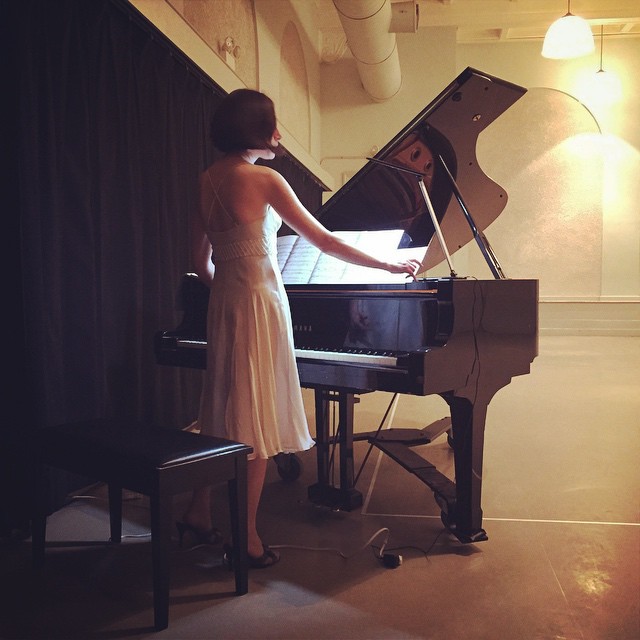
    Above: pianist Melody Fader; photo by Cherie B

    Live music is a key element at all New Chamber Ballet performances. Pianist Melody Fader has been Miro’s collaborator for several seasons and, along with violinist Doori Na, she makes the music an integral factor in the audience’s enjoyment of NCB evenings. Melody is currently in the midst of a Kickstarter campaign to develop funding for her chamber music project, something that’s dear to her heart. You can find out all about it – and help make it happen – here.

    New Chamber Ballet‘s next performances will be April 17th and 18th, 2015. Information about repertory and tickets will be forthcoming.

  • Ian Spencer Bell’s PASTE-UP

    Paste-up (LJ, JT, CL, SO)

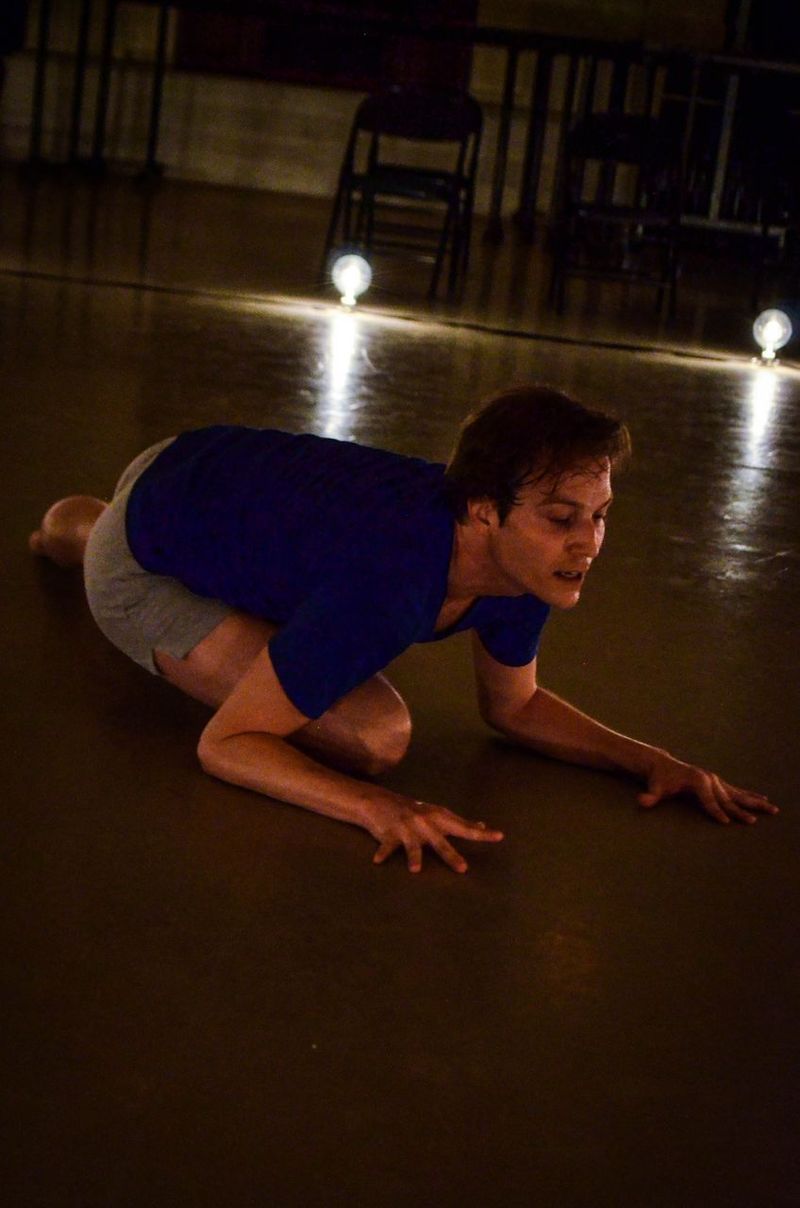
    Wednesday May 22, 2013 – Ian Spencer Bell’s PASTE-UP was performed at City Center Studios this evening. On entering the studio, the dancing area has been created: a square has been taped off on the floor, studded along its perimeter with large light bulbs. The viewers are seated along all four sides of the square; as the house lights dim, the self-illuminated space comes to life.

    There is no music for PASTE-UP though one of its sources of inspiration is Benjamin Britten’s Young Person’s Guide to the Orchestra. The only sounds we hear are the voices of the dancers calling out individual words.

    The ballet commences with the ten dancers leaping across the space one by one; they repeatedly execute flying jetés from one side of the square to the other, or on the diagonals. As each dancer’s jump reaches its apex, he/she calls out the word “Lift!”. Yes, I know: it sounds terribly simplistic – even naive – but in fact it weaves a particular spell.

    Paste-up (ISB, LJ, JT)

    A trio evolves, danced by Ian Spencer Bell, Lindsey Jones and Joshua Tuason (above), and the word being said now is “Left!”. The movement vocabulary expands cautiously, with straight-armed salutes and more variety of steps and self-expression.

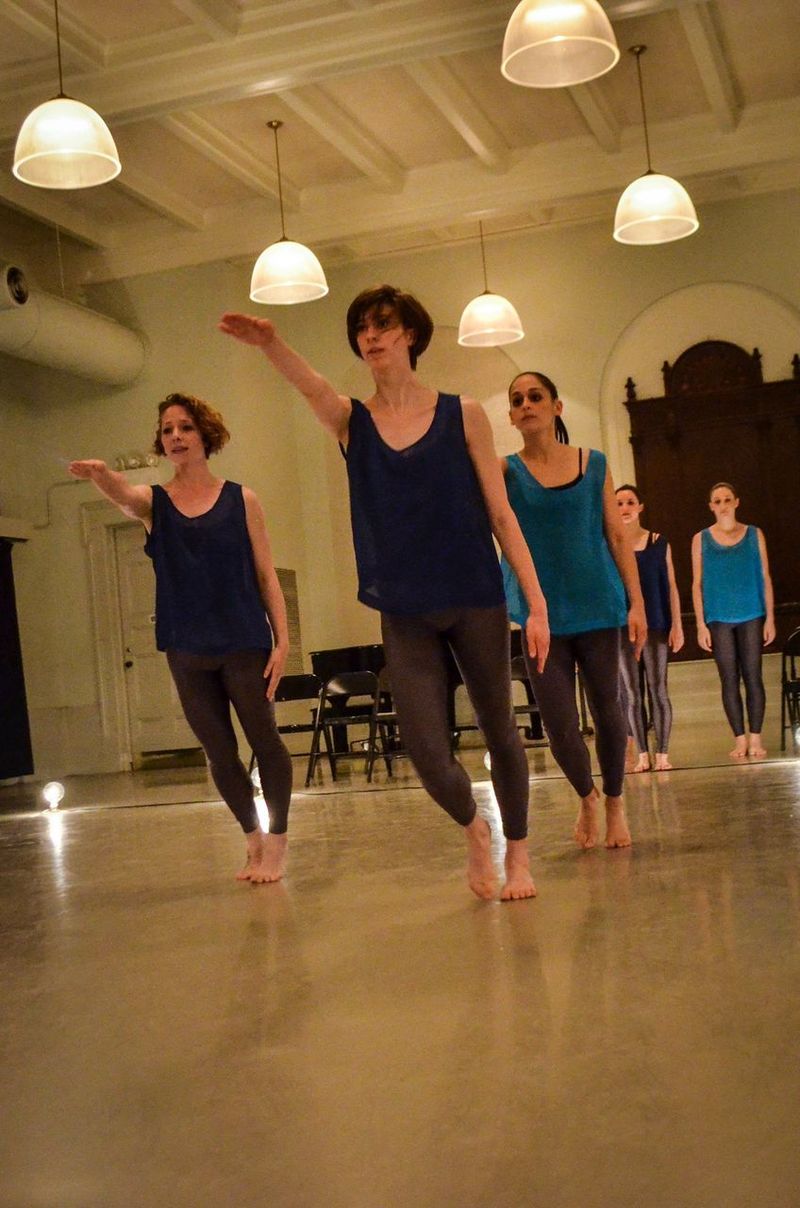
    Switching to “Loft!”, the full company enter the space; they begin to touch one another, there are partnering elements and lifts along with seemingly improvisational self-contained solos. The work’s opening leaping patterns are repeated, now executed in trios.

    Paste-up (ISB)

    Introspection comes in Ian’s solo; we seem to be eaves-dropping on the dancer as he works alone in the space. He’s talking to himself: musing on Britten and on the music only he can hear, quietly infatuated with the sound of his own voice. Other dancers intrude, calling out things like “a beautiful melody!” where there is none.

    Paste-up (SO, LJ, CL, MD, DB)

    Above: Stevie Oaks, Lindsey Jones and Courtney Lopes

    In an animated quartet – Lindsey, Joshua, Courtney Lopes and Stevie Oakes – the individual instruments of the orchestra are named along with descriptive words. The finale builds with the full ensemble, their voices becoming more urgent and their dancing more extroverted and complex. One by one the dancers exit, leaving Ian alone in the twilight, his voice fading to nothing. 

    I have described the facts of PASTE-UP but it’s rather more complicated to describe the atmosphere of the piece which has an odd intensity and a dreamlike quality. It evokes memories of innocence and of the simplicity of dancing alone, unobserved, discovering oneself with music that comes from within.

    Ian’s works are distinctive and seem to evolve from simple and highly personal musings, finding a connection to the viewer thru the movement and the expressive gifts of his individual dancers. He certainly has a unique place in the current NYC dance scene and I look forward to seeing more of his work. 

    Appearing in PASTE-UP are: Ian Spencer Bell, Lindsey Jones, Courtney Lopes, Stevie Oaks, Mara Driscoll, Debra Bona, Oceane Hooks-Camilleri, Sally Kreimendahl, Vani Ramaraj, Joshua Tuason, and Justin Rivera. The lighting design is by Nicholas Houfek.

    Photos by Taylor Crichton.