Tag: Classical Music

  • Batiashvili/Mäkelä/Royal Concertgebouw

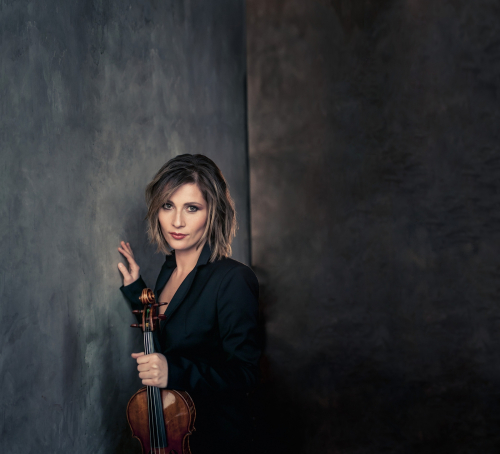
    Batiashvili

    Above: Lisa Batiashvili, photo by Sammy Hart/DG

    ~ Author: Oberon

    Friday November 22nd, 2024 – Tonight at Carnegie Hall, the Royal Concertgebouw Orchestra opened their program with the US premiere of Body Cosmic by the orchestra’s composer-in-residence, Ellen Reid. One of my all-time favorite musicians, Lisa Batiashvili, then offered Prokofiev’s Violin Concerto No. 2. Following the interval, the Concertgebouw’s Chief Conductor Designate Klaus Mäkelä led a seemingly endless performance of Rachmaninoff’s 2nd Symphony.

    Annoyances put us in a bad mood as we waited for the concert to begin: the Hall was freezing cold, and the start time ran late. Then came the silly tradition of the musicians making an entrance, obliging the audience to applaud as they leisurely took their places. Most people don’t get applause just for showing up at their job. After the music started, a squirmy (but silent) little girl next to us had a squeaky seat that made a metallic grinding noise every time she moved, whilst the young man behind us kept kicking the backs of our seats (he must have been man-spreading to cover so much territory). At last the house lights dimmed, and the conductor took the podium.

    The US premiere of Ms. Reid’s Body Cosmic was indeed what – back in the days of smoke and wine – we’d have called kozmic. The piece has a magical start, with rising passages lifting us out of the ordinary world into an airy, buzzy higher place. Is that a vibraphone I hear?

    A key player in the work is the Concertgebouw’s harpist, though I cannot tell you which of the orchestra’s two principals was playing since my view of her was blocked by her harp. Meshing with the flutes, the harp evokes a drifting feeling. The concertmaster – or ‘leader’ as he is listed in the Playbill – Vesko Eshkenazi, has much to do in this 15 minute piece, and his sound has a luminosity that delights the ear. Likewise, the trumpet soloist is really impressive, though again their are two possibilities listed in the roster.

    The music becomes increasingly rich in texture; it’s beautiful in an other-worldly sense. Muted trombones sigh, and then things get a bit jumbled. The violins, on a sustained high tone, clear the air. The harp again makes heavenly sounds, as distant chimes are heard. Flutes and high violins have a counter-poise in the deep basses (the Concertgebouw’s basses are particularly impressive). The music comes to a full stop.

    A violin phrase sets the second movement on its way; did someone whistle? The flutes trill and shimmer, with the concertmaster playing agitato; the basses and celli plumb the depths. The music turns fluttery, and then brass fanfares sound. A continuous beat signals a sonic build-up; with large-scale brass passages, things turn epic, only to fade as the harp sounds and the flutes resume their trilling. The world seems to sway, the trumpeter trills. A march-like beat springs up and then speeds up, evoking a sense of urgency. Following a sudden stop, a massive chord sounds: thunderous drums seem to announce a massive finish, but Body Cosmic ends with a solitary note from the violin. 

    I can’t begin to tell you how absorbing and ear-pleasing this music was: so much going on, and all of it perfectly crafted and fantastically played. The composer, who was awarded the 2019 Pulitzer Prize in Music for her opera, p r i s m, looked positively dishy in her unique blue and white frock – which featured a leggy mini-skirt and a charming train – when she was called onto the stage for a bow. She was greeted by both the audience and the players themselves with fervent applause. Ben Weaver, who is with me – and who is often resistant to “new music” – admitted that he’d enjoyed it. 

    Ms. Batiashvili then took the stage, having stepped out of the pages of Vogue in her stunning black gown: the very picture of elegance. Back in the days when Alan Gilbert was in charge of the NY Phil, Lisa appeared there often; she and the Maestro had a very special rapport, and I recalled how much I always loved to watch their interaction…almost like partners in a dance. Ms. Batiashvili sounds as gorgeous as she looks; her timbre has a particular fragrance, something no other violinist of my experience can quite capture.

    The Prokofiev concerto opens with the soloist playing alone: a hushed lament. The ensemble joins, taking up the theme. As the music becomes more animated, the violin sails thru fast figurations over the beating accompaniment of the basses. The music slows, and a fresh mood is then established, rather jaunty, with the soloist busily employed with reams of notes or with lyrical motifs, whilst unison basses and celli add a darker colour. Fanfares sound, and with Ms. Batiashvili playing at high-speed, everything breezes along…and then the music stalls. The low strings get things back on track, carrying the movement to a quirky finish.

    The Andante assai is a gracious slow dance; it has a dotty start as the familiar theme sounds over plucking strings. Ms. Batiashvili was mesmerizing here, her control and phrasing so enticing: both her presence and her playing tell of her innate grace and loveliness. This theme then repeats itself, now with the feel of a swaying rubato, and here Lisa is just plain magical. A sort of da capo finds the orchestra taking up the theme and the violin playing rhythm.

    In Prokofiev’s final Allegro ben marcato, Ms. Batiashvili dazzled us with with her virtuosity. Introducing fresh colours to the music, the composer adds castanets, the triangle, and the snare drum to his sonic delights. In a fascinating passage, Lisa’s slithering scales are underscored by the bass drum and double bass before we are swept along into the finale.

    Having put us under her spell for a half-hour, Ms. Batiashvili responded to our heartfelt applause with a Bach encore (I’ll have the details of the piece soon, hopefully…and some photos, too!) and then she was called back for a final bow, the musicians joining the audience in homage to this sublime artist.

    Update: Lisa’s encore was J. S. Bach’s Chorale Prelude on “Ich ruf’ zu dir, Herr Jesu Christ” (arranged for Violin and Strings by Anders Hillborg).

    Following a drawn-out interval, the Rachmaninoff 2nd made its deep start with the strings and horns sounding darkly gorgeous. I was taking notes, thoroughly engaged in the music. But after a while, things began to wear thin. The playing was simply grand – the solo voices among the orchestra all marvelous – and so is the music…so why am I losing my focus? By the time the big, ultra-familiar cinematic theme of the Adagio commenced, I was getting restless. It all seemed like too much of a good thing. The final movement was a succession of ‘finales’ which turn out to be culs de sac, forcing the players back to the main road, seeking an exit.

    After nearly an hour, the symphony ended to an enormous ovation and everyone in the Hall immediately leapt to their feet. My sidekick Ben Weaver and I hastened out into the rain. Ben was actually angry about the way the Rachmaninoff was done; he blamed the conductor. Then he told me that the composer had realized the work was too long and had later sanctioned cuts; tonight we’d heard the original, which is what made the music – which has a richness of themes and of orchestration that would normally thrill me (and it did, for the first quarter-hour) – feel like overkill to me. Often a composer’s second thoughts are more congenial to the ear than his original concept.

    ~ Oberon
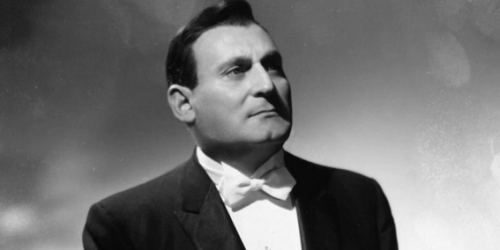
  • The Tucker Gala @ Carnegie Hall ~ 2024

    Richard-Tucker

    Above: Rlchard Tucker

    ~ Author: Oberon

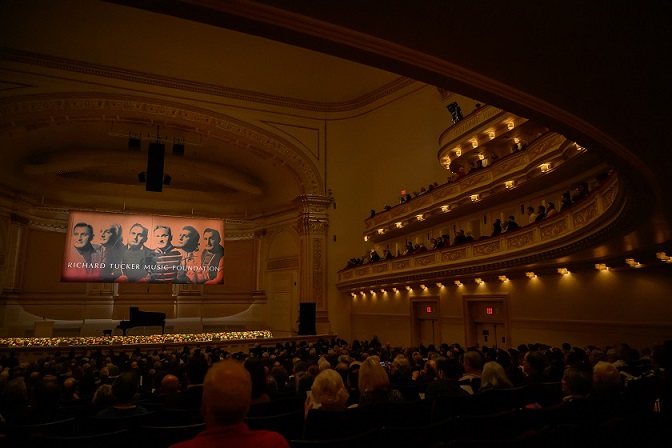
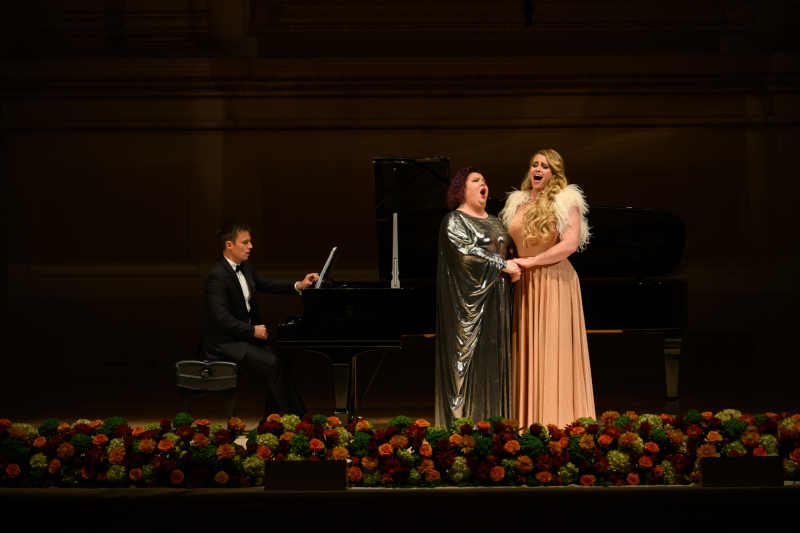
    Sunday October 27th, 2024 – The 49th annual Richard Tucker Music Foundation gala took place this evening at Carnegie Hall. It was an excellent program – including one aria that is rarely performed – with much impressive vocalism. The evening descended into silliness during the encores, but the audience overwhelmingly approved of la commedia, leaving me feeling like an old stick in the mud.

    You always run into people you know at the Tucker Gala. I was especially happy tonight to run into my friend – and fellow Patricia Brooks fan – from back in the day: Matthew Epstein.

    003-RICHARD_TUCKER_GALA_2024-0025

    Photo by Dario Acosta

    Following tradition, the first voice we heard was that of Richard Tucker singing the “Addio alla madre” from CAVALLERIA RUSTICANA. The power and passion of his voice are immortal.

    014-RICHARD_TUCKER_GALA_2024-0214

    Above: Nadine Sierra, photo by Dario Acosta

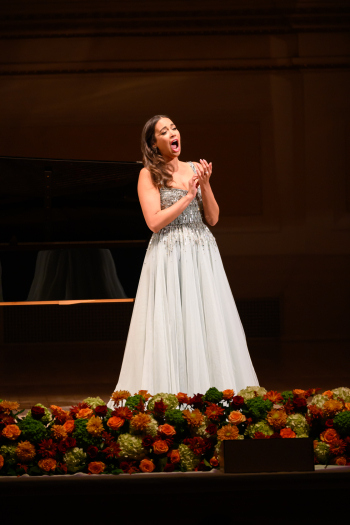
    After Barry Tucker’s welcoming speech, the program commenced with Mimi’s narrative “Mi chiamano Mimi” from LA BOHEME; this brought Nadine Sierra and pianist Bryan Wagorn together in a rendition that was a bit slower than we might be accustomed to, but which gave us more time to savour Nadine’s luxuriant phrasing and lovely tone. She made the slow rise to B-natural before commencing “…ma quando vien o sgelo…” which makes such a magical effect. Listening to her this evening made me think that Nadine could now venture into roles like Mimi, Liu, and Amelia Grimaldi, and even Desdemona and the TROVATORE Leonora.

    028-RICHARD_TUCKER_GALA_2024-0340

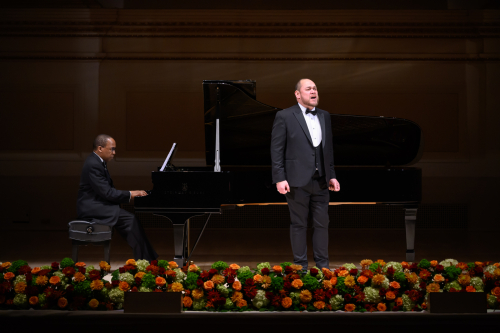
    Quinn Kelsey (above, photo by Dario Acosta) then took the stage, accompanied by Howard Watkins, for a truly magnificent “Eri tu” from BALLO IN MASCHERA. This was opera at its grandest, the singer filling the Hall with a flood of golden tone, achingly heartfelt in the character’s distress and his sense of defeat and resignation. This is a baritone voice to rank with the greatest of my experience: Warren, Merrill, MacNeil, Milnes, and the unforgettable Dmitri Hvorostovsky.

    047-RICHARD_TUCKER_GALA_2024-0506

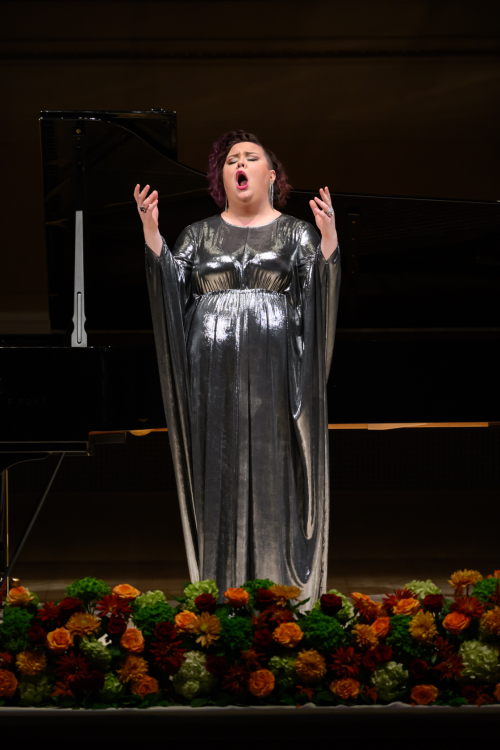
    Jamie Barton (above, photo by Dario Acosta), looking like an errant Valkyrie in her metallic-silver frock, was hilarious in the Witch’s aria from HANSEL & GRETEL. Mr. Watkins at the piano was a perfect accomplice to Jamie’s rowdy, riotous performance. Later, we would hear Jamie in bel canto mode, and finally as a top-flight songstress.

    071-RICHARD_TUCKER_GALA_2024-0704

    Rachel Willis-Sorenson (above, photo by Dario Acosta), who the day before had joined Jamie Barton and Michael Fabiano in a rousing Met matinee of TROVATORE, today gave us the immortal “Casta viva” from Bellini’s NORMA. Although this bel canto jewel really needs an orchestra-and-chorus setting, Ms. Willis-Soremson and Mr. Wagorn were so persuasive that such concerns became irrelevant. With her impressive breath control, the soprano commanded the long phrases, introducing subtle nuances along the way. She concluded the aria with a gorgeous cadenza and then spun out an incredible inverted trill before sustaining the final note.

    082-RICHARD_TUCKER_GALA_2024-0805

    Above: Michael Fabiano, photo by Dario Acosta

    At yesterday’s Met TROVATORE, a commotion in the wings after “Di quella pira” had raised questions; this evening they were answered: Michael Fabiano had fallen on exiting the stage and sustained an injury; he had managed to finish his Manrico – but, as anyone who has taken a fall knows – it’s the day after that the soreness manifests itself. The poor tenor – heroic, but obviously in deep pain – was slowly helped onto the stage by Mr. Watkins. Michael spoke briefly of the incident, then regaled us with a sublime rendering of Henri Duparc’s “Phidylé“, displaying his lyrical side after yesterday’s powerhouse Manrico.

    096-RICHARD_TUCKER_GALA_2024-0910

    Above: Elena Villalón, photo by Dario Acosta

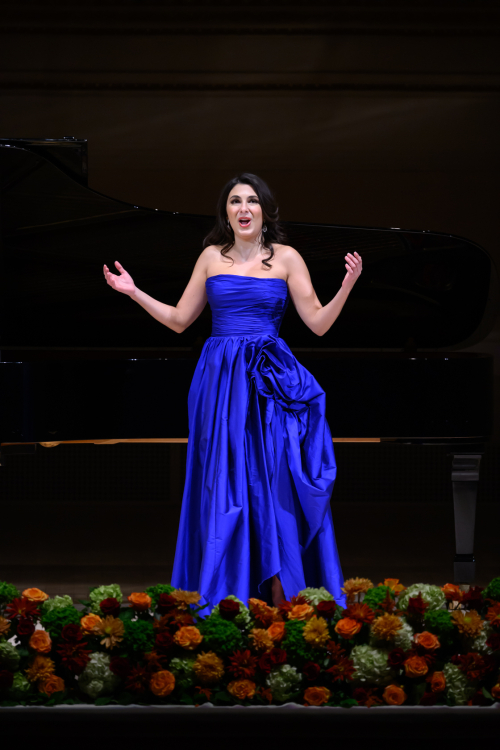
    Giving us some the most delightful singing of the evening was the soprano Elena Villalón, a Tucker Grant winner and currently at The Met in the Golijov AINADAMAR, having debuted there in the previous season as a charming Amor in ORFEO ED EURIDICE. Tonight, looking ravishing in her deep blue gown, the Cuban-American soprano sang Manon’s double aria from the Cours la Reine scene from the Massenet opera, with Mr. Watkins a gallant companion. The Villalón Manon is captivating, and she won my heart just as Patricia Brooks, Jeannette Pilou, and Lisette Oropesa have done in the role over the years.

    115-RICHARD_TUCKER_GALA_2024-1040

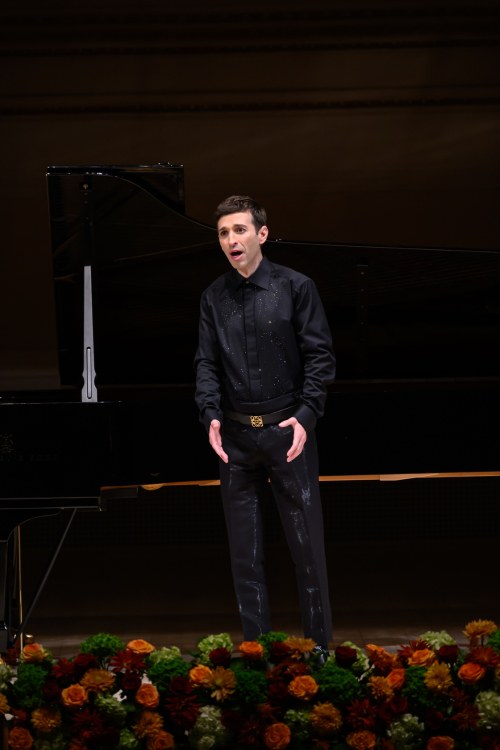
    Anthony Roth Costanzo (above, photo by Dario Acosta), in a sparkly shirt, was simply magnificent in Handel’s Stille amare from TOLOMEO. The voice is so delectable to hear in the Carnegie acoustic. Anthony’s emotional connection to the music – and his sublime pianissimi – were truly touching to experience.

    140-RICHARD_TUCKER_GALA_2024-1241

    Above: J’nai Bridges, photo by Dario Acosta

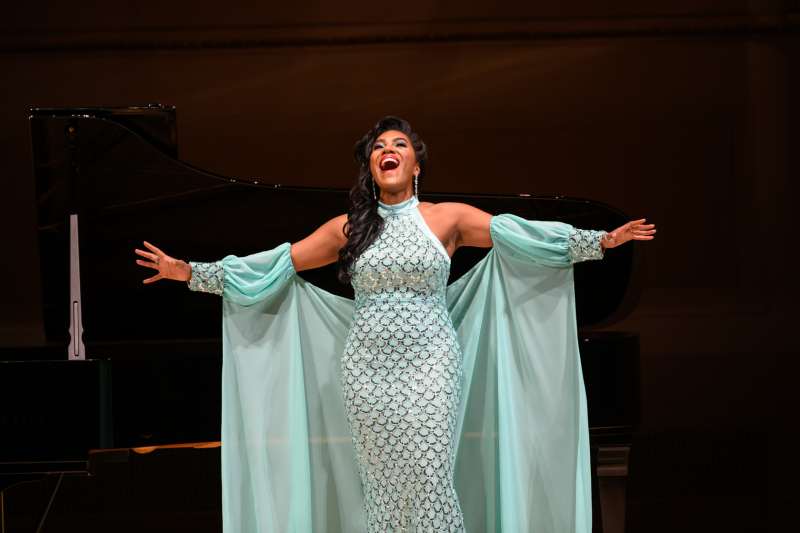
    Til tonight, I’d never heard Sapho’s grand final aria from the Gounod opera named after her sung live; but I’ve thrilled to its sense of grandeur and doom since by chance hearing a recording of Heather Begg singing it in English many, many moons ago. Thank you, J’nai Bridges, for bringing this splendid aria to currency. Mr. Wagorn was again simply perfect as the mezzo, resplendent in a mint green gown, delivered the poignant recit and majestic aria – which ends on a thrilling top note that Ms. Bridges sustained mightily – so convincingly that the vision of the heroine hurling herself into the ocean at the end was palpable.

    156-RICHARD_TUCKER_GALA_2024-1369

    Above: Anthony León, photo by Dario Acosta

    Anthony León, 2022 1st prize and the Zarauela prize winner at the Operalia competition, sang a poetic “Una furtiva lagrima” from ELISIR D’AMORE with Mr. Watkins giving the youthful tenor wings on which to fly. The voice is sweet and clear, the singing so sincere, the words lovingly set forth, and the final phrase finely controlled. 

    166-RICHARD_TUCKER_GALA_2024-1406

    Above: Ryan Speedo Green, photo by Dario Acosta

    After hearing his Serenade this evening, we must have Ryan Speedo Green’s Don Giovanni in the next Met revival of the Mozart masterpiece: such a suave singer, with charisma to burn. Ryan had sung a commanding Ferrando in yesterday’s TROVATORE, and I look forward his Spirit Messenger in the upcoming Met revival of FRAU OHNE SCHATTEN…to say nothing of his impending Zankel Hall recital on January 22nd, 2025…check out the program here!

    190-RICHARD_TUCKER_GALA_2024-1590

    Above: Nadine Sierra and Quinn Kelsey; photo by Dario Acosta

    In the great duet of Gilda and her father from RIGOLETTO, Nadine Serra and Quinn Kelsey seemed to give us the very essence of opera. With perfect musical support from Mr. Watkins, the two singers wandered about the stage, seemingly unable to face one another after the jester’s beloved Gilda’s had been defiled at the hands of the Duke. From “Piangi, piangi fanciulla…”on, Quinn held Nadine in his consoling arms. Their singing was so compelling, and Mr. Watkins’ playing so true to the music, that for a brief time we were transported to that poetic place that only opera can carry us up. By the end, Nadine was weeping. The audience response was delirious, and rightfully so.

    216-RICHARD_TUCKER_GALA_2024-1725

    Mlles. Willis-Sorenson and Barton (above, photo by Dario Acosta) brought bel canto to the fore with “Mira, O Norma” from the Bellini opera, Mr. Wagorn playing a key role in this beloved duet of rivals who become – if only briefly – fast friends. The voices made for a very congenial blend, the harmonies lingering so endearingly in he ear. Following the slow section, a dramatic exchange between the women was resolved with Ms. Willis-Sorenson’s “Trovo un’amica ancor”. and then they set off the vocal fireworks “Si, fino all’ore estreme”, even etching is some delicious harmonized turns before joining together on the penultimate note. 

    227-RICHARD_TUCKER_GALA_2024-1799

    Above: Angel Blue, photo by Dario Acosta

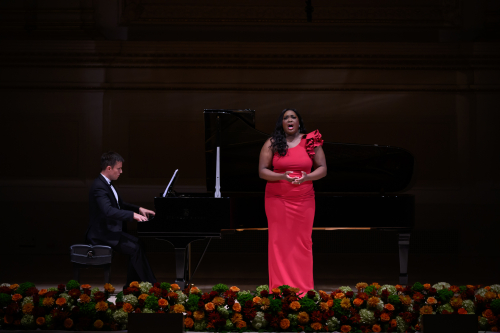
    The previously unannounced Angel Blue made a striking entrance in her red diva-gown. With Mr. Wagorn, she sounded like a goddess; she sang “America The Beautiful” with great ardor, then moved directly to Lee Hoiby’s touching “Lady of the Harbor”, a hymn to the Statue of Liberty. Angel sang with mythic power and pride, an iconic presence as she sang of the hope and the blessings of the American dream.

    Encores now commenced with Anthony Roth Costanzo duetting with himself in the cat-and-mouse scene of Susanna and Count Almaviva from NOZZE DI FIGARO

    As a child, I had a Swiss music box that played Stephen Foster’s “Beautiful Dreamer”; I was thinking of this when Nadine Serra and her college pal Bryan Wagorn gave the song a glowing lustre. They ended with a hug of genuine affection.

    Mr. Leon was affectionately welcomed back for an ardent, “Non puede ser” with Mr Watkins; and then – singing unaccompanied – Ryan Speedo Green sang “Deep River” straight from the heart. Ms. Bridges returned for a passionate “My man’s gone now” from PORGY AND BESS, and then Jamie Barton sang “It’s You I Like”: a Jake Heggie charmer that mixes Chopin and Fred Rogers.

    The evening ended with Nadine, Anthony, and Mr. Wagorn in a musical three-way spoof that was pretty silly, but the audience loved it. 

    313-RICHARD_TUCKER_GALA_2024-2145

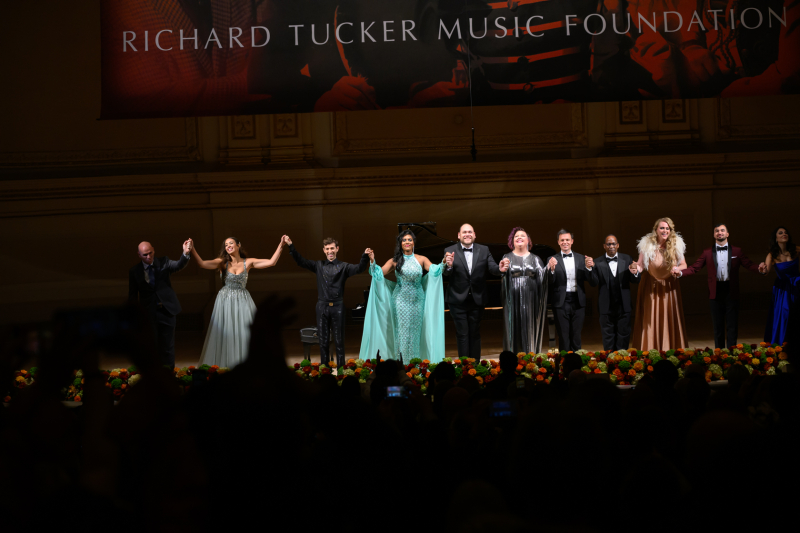
    Final bow. This, and all performance photos, by Dario Acosta.

    My thanks to Mallory McFarland of Morahan Arts and Media for arranging things for me.

    ~ Oberon

  • @ My Met Score Desk for TROVATORE

    Daniele-callegari-jpg

    Above: Maestro Daniele Callegari

    ~ Author: Oberon

    Saturday October 26th, 2024 matinee – What made this performance outstanding was the conducting of Daniele Callegari; he made the music come alive with brisk but never rushed tempi, whilst keeping the volume under control, helping the singers to sing without forcing. At a few points, the musicians fell back on the Y N-Z approach: play loud and fast. But mostly, the performance was immeasurably satisfying. It wasn’t until I got home and checked the archives that I realized I’d heard a Callegari TROVATORE in 2013; the awfulness of his cast that night had made me purge the memory from my mind.

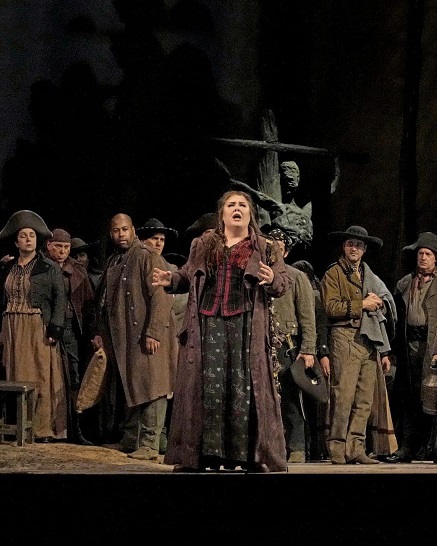
    This afternoon, TROVATORE started with a bang: Ryan Speedo Green’s Ferrando immediately established the singer’s vocal authority, seizing our interest – and holding it – throughout his monolog, which was expertly supported by the Maestro. Ryan’s diminuendo on “All’inferno!” was chilling. The scene’s finale, and the sounding of the castle’s alarm bells, assured us we were in for some vibrant Verdi.

    As Inez, Briana Hunter’s appealing voice and sense of urgency in her exchange with Rachel Willis-Sorenson’s Leonora engaged us in their story right from the start. At first, Ms. Willis-Sorenson’s tone showed a steady beat, and passing hints of sharpness, but the voice would come under control as the opera progressed. Maestro Callegari kept the forward impetus of “Tacea la notte placida” flowing, and the soprano went on to regale us with her deft vocalism in “Di tale amor“, etching in some very fine trills.

    Igor Golovatenko gave the Count di Luna’s opening lines a quiet, sustained feeling; then the power of his voice came into play.  All afternoon, he would prove himself an excellent Verdi baritone. The harp sounds, and Michael Fabiano’s instinctive phrasing and passionate delivery of the words of his serenade were a joy to experience. Coming forward, Mr. Fabiano’s scornful “Infida!” raised the performance’s temperature to the boiling point. Ms. Willis-Sorenson scorchingly brilliant “M’odi” staved off the duel until the dynamic stretta ended with a joint high D-flat from the soprano and tenor, and the adversaries’ swords clanged as they rushed off.

    Barton azucena

    After a truly rousing Anvil Chorus with the blacksmiths’ thunderous hammerings, Jamie Barton (above in a MET Opera photo) commenced Azucena’s iconic “Stride la vampa” and I was soon thinking this would be Jamie’s best Met role to date. She could be deliciously subtle one moment and richly chesty the next, and her trills and top notes were really impressive. She ended the brief aria with a bang, but there was no applause. Jamie’s very sustained “Mi vendica!” was another perfect touch. Ned Hanlon’s powerful summons from the Old Gypsy made its mark.The gypsies headed off.

    Now mother and son are alone, and Jamie commences the old woman’s story: what perfect support the Maestro and his players gave to her great narrative, and how persuasive the mezzo’s story-telling. As Azucena is about to tell her son the ironic truth of those moments at her mother’s execution, Fabiano/Manrico takes a poignant diminuendo of “Tu forse…?” and then the fire music of the high strings gives him an answer even before his mother can say the words. Jamie nailed the top B-flat of the story’s climactic moment, then sang her final lines in a sustained, chilling hush. Back in the day, this kind of singing would have stopped the show,  but today there was only a brief round of applause.

    A vividly expressive conversation between mother and son brings on Fabiano’s “Mal reggendo” in which his lyricism and sense of ebb and flow captivates, as does his marvelously quiet “Non ferir!” This great scene now races to its end with the striking duet “Perigliarti ancor...” with some plummy chest notes from Jamie, and as well as a colorful, wide-ranging cadenza.

    Maestro Callegari gave us a wonderfully stealthy opening to the Convent Scene, and then Mr. Golovatenko’s great voicing of the recit leads to an exchange with Ryan Speedo Green before cresting with Di Luna’s powerfully delivered “Leonora di mia!. The great aria “Il balen...” was taken slightly faster that usual; overall it was beautifully sung though there were traces of sharpness along the way. Mr. Golovatenko was heartily cheered. Another exchange with Mr. Green, with some urgent chorus passages, led to di Luna’s brief cabaletta, which fades away as the nuns are heard approaching.

    Fab igor

    Above: Michael Fabiano and Igor Golovatenko as Manrico and Count di Luna; a MET Opera photo

    There was a lovely exchange of farewells between Mlles. Willis-Sorenson and Hunter before all Hell breaks loose and Manrico returns from the dead. Ms. Willis-Sorenson launches the ensemble in hesitant wonder at her beloved’s re-appearance…radiant top notes, and the poignant “Sei tu dal ciel discendere?” from Leonora, and then a trading of insults between her rival lovers. Suddenly Manrico’s men rush in crying “Urgel viva!” and Manrico greets them with one of my favorite lines in the opera: “Miei prodi guerrieri!” The ensemble rushes to a finish but is halted for Ms. Willis-Sorenson to again beautifully voice her wonderment at her beloved’s resurrection.

    After the interval, Ryan Speedo Green is again superb as he urges the Count di Luna’s men to victory in the coming siege. Azucena is apprehended lurking about the camp; Jamie Barton’s “Giorni poveri” is expressively sung, with nice subtleties of phrasing, but after Mr. Green calls the old gypsy out, Jamie turns fiery with “Deh, rallentate…!” 

    Inside his besieged castle, Manrico tries to calm Leonora though his fate seems predestined. Mr. Fabiano’s recit and his gorgeously phrased “Ah, si, ben mio” won him vociferous applause, though I was sensing a bit of tension in the highest notes. After a tenderly harmonized duet passage with his beloved, Ruiz (played by Daniel O’Hearn) rushed in to tell of Azucena’s impending execution. Manrco’s “Di quella pira” was taken at breakneck speed…very exciting…though again, Mr. Fabiano’s highest notes were not thoroughly comfortable.

    After the applause had died down, there was a very odd sound of someone screaming from the stage-left wing; this was followed by a moan, and the sound of someone talking on a cellphone. No idea what the problem was.

    (Update: on Sunday evening at the Tucker Gala, I found out the reason for the offstage commotion. After singing the Di quella pira“, Michael Fabiano walked into the wings and tripped over something. He let out a scream and then a moan, and you could hear a walkie-talkie call summoning medics. He finished the opera, but last night at Carnegie Hall, he had to be walked unto the stage by the pianist, moving stiffly and very slowly. Kudos to Michael for keeping his commitment to the Tucker event.)

    Now Ms. Willis-Sorenson regaled us with her spectacular singing in the great scene where Leonora comes to the tower where her lover is awaiting execution; she seeks to bargain with di Luna and save Manrico’s life. As Ruiz, Mr. O’Hearn brings her to this dark place; his voicing of his despair over Manrico’s imminent death was infinitely touching when a trace of a gentle sob spoke volumes of his devotion. 

    The the Met stage was now Ms. Willis-Sorenson’s to own, and own she did. Absolutely phenomenal singing here! Her recit was finely phrased, then came the beloved aria “D’amor sull’ali rosee” in which the soprano held her own against memories of great Leonoras from the past. Her line was beautifully sustained, the trills lovingly defined, her tone richly lyrical. In the cresting lines “Ma deh! non dirgli, improvvido, le pene del mio cor!” did not spin the piano/pianissimo effects that many sopranos favor, but instead sounded more resolute. Her cadenza featured a lovely piano top note, on which she did a thrilling crescendo. She finished the aria with the lower ending.

    In the Miserere that follows, a vivid sense of fate developed at the soprano’s “Quel suon, quelle prece”, and her anguish at hearing Manrico’s voice singing an ardent farewell to her was palpable. Ms. Willis-Sorenson then sailed thru her cabaletta, dispensing the coloratura with aplomb and capping the scena with a house-filling high-C.

    Both the diva and Mr. Golovatenko were cooking in their great duet, sung with great abandon and dramatic pointing of the text. Some people will doubtless say that the soprano left out the high-C at the end, but…it’s not in the score. 

    In prison, awaiting execution, Manrico tries to calm his anxious mother; Mr. Fabiano sang with consoling beauty of tone whilst Ms. Barton delivered a fearsome “Parola orrendo!“. Jamie’s superb control made “Si, la stanchezza” so moving, and then the two singers found a lovely blend in “Ai nostri monti“, with a perfect fadeway at the end. Mr. Fabiano’s anger at Leonora makes sparks fly, but Jamie interrupts them with a dreamy reprise of “Ai nostri monti“. 

    Fab w-s

    Above: Michael Fabiano and Rachel Willis-Sorenson in the opera’s final scene; a MET Opera photo

    Leonora reveals that her death is at hand: she has taken poison. Ms. Willis-Sorenson’s “Pria che d’altri vivere” was so poignant. Her death releases di Luna from his promise, and Manrico is swiftly executed. Jamie Barton then gave the opera a flaming finish with her powerful “Sei vendicata, o madre!” 

    Bravi, tutti!

    Trovatore.jpg r-2

    I went to the stage door after the performance where I met Maestro Callegari; he very kindly signed my program (above). 

    ~ Oberon
  • Beth Taylor ~ Voce di Donna

    Beth2

    Scottish mezzo-soprano Beth Taylor sings La Cieca’s aria “Voce di Donna” from Ponchielli’s LA GIOCONDA from a concert performance given by the Deutsche Oper Berlin in 2020, during the pandemic.

    Watch and listen here.

    In 2023, Beth was a finalist at the Cardiff Singer of the World competition; many people, myself included, felt she was the rightful winner.

    In May 2025, Beth will be at Carnegie Hall with the English Concert under Harry Bicket’s baton, singing Cornelia in Handel’s GIULIO CESARE. Details here

  • Raehann Bryce-Davis ~ La Luce Langue

    Raehann

    Raehann Bryce-Davis (above) sings Lady Macbeth’s “La Luce Langue” at a 2021 concert given at Antwerp. Alejo Pérez conducts the Opera Ballet Vlaanderen Orchestra. 

    Watch and listen here.

    In 2019, Ms. Bryce-Davies sang the mezzo-soprano part in the Verdi REQUIEM with Oratorio Society of New York at Carnegie Hall; she was truly impressive.

  • Evgeny Kissin @ Carnegie Hall ~ May 2024

    Kissin 2

    Above, Yvgeny Kissin at Carnegie Hall; performance photo by Steve J Sherman

    ~ Author: Ben Weaver

    Friday May, 24th, 2024 – Evgeny Kissin is giving back-to-back concerts of the same program at Carnegie Hall this month. I attended the first one this evening, and it was a magnificent night of music, one of the best things I have heard in a concert hall this season. Kissin’s program is so popular, in fact, that not only were additional seats added on the stage (more about that later), but he will repeat this program on May 29th.

    Surprisingly this was my first time hearing Kissin live, though I have admired his many recordings over the years. He is a very unaffected performer, seemingly almost shy. His very sincere physical presence and unpretentious playing made an enormously positive impression throughout the night.

    Kissin began the program with Beethoven’s Piano Sonata No. 27 in E minor, Op. 90, composed in 1814. It reflects Kissin’s overall demeanor that he began with one of Beethoven’s least performed piano sonatas. Made up of only two movements – unusual for Beethoven – it open with a familiar Beethovenian bombast, but that falls away almost immediately and an achingly lovely melody takes over; it will return throughout the movement. The tonal contrasts throughout the the work can be hard to weave together. Kissin’s cleared those hurdles effortlessly. His playing was very clean and unfussy, each note etched like a diamond. Despite the Sonata’s Romanticism, Kissin seemed to be connecting it to Haydn and Mozart.

    Throughout the night one noticed Kissin’s very judicious use of the pedal, never letting the sound get murky and messy. This gave a great clarity to Chopin’s Nocturne in F-sharp minor, Op. 48, No. 2 and Fantasy in F minor, Op. 49 (both composed in 1841.) The long, melancholic melodies of the Nocturne – a particular specialty of Chopin’s – was played gently and without undue sentimentality. At each carefully built climax, Kissin pulled back just in time before falling into schmaltz. He launched into the Fantasy’s opening march right away. It felt like another example of Kissin not milking the crowd for affection.

    With Brahms’ Four Ballades, Op. 10 (composed in 1854) Kissin again reigned in much bombast, reminding us that Brahms, though composing at the height of Romanticism, was more of a classicist in temper. Which is not to suggest that his playing was lacking in brimstone. But Kissin’s very carefully chosen moments of when to let things blow up were fascinating to hear. The focus was always on the music and not the individual at the keyboard.

    Prokofiev’s Piano Sonata No. 2 in D-minor, Op. 14 (composed in 1912) is an early composition for the young composer (he was still a student at the St. Petersburg Conservatory), and it shows him trying out new ideas that would become trademarks in his future works. The Scherzo in particular sounds like echt Prokofiev: a playful melody played with demonic speed and attitude. Kissin’s hands were flying over the keyboard in a blur. With Prokofiev, Kissin ended the official program with the most outwardly virtuosic  piece played as dazzlingly as one can imagine.

    Kissin i

    Photo by Steve J Sherman

    The audience response was predictably wild. Kissin quickly offered 3 encores, all played superbly and all connected to the main program. A Mazurka by Chopin, March from Prokofiev’s opera “The Love for Three Oranges,” and Brahms’ gentle Waltz, Op. 39, No. 15. 

    During the opening Beethoven piece, the audience had been remarkably quiet. Perhaps making a note of this in my head jinxed the situation because what followed during the rest of the program was people repeatedly dropping things (probably their cell phones) and ringing cell phones. There is also always a risk in placing members of the audience onstage: one young girl in a white dress, sitting near the edge of the stage, was very bored and was swinging her legs the entire 1st half of the program. Thankfully her father probably took her home during intermission because they did not return. And just as Kissin launched into Prokofiev’s sonata, an elderly couple decided to exit the stage, down the steps, and out the door. Audience etiquette remains an untamable beast.

    ~ Ben Weaver

    Performance photos by Steve J Sherman courtesy of Carnegie Hall

  • Sejong Soloists @ Zankel Hall

    240522 Sejong Here & Now Festival-5

    Above: Maestro Earl Lee, photo by Emilio Herce

    Author: Oberon

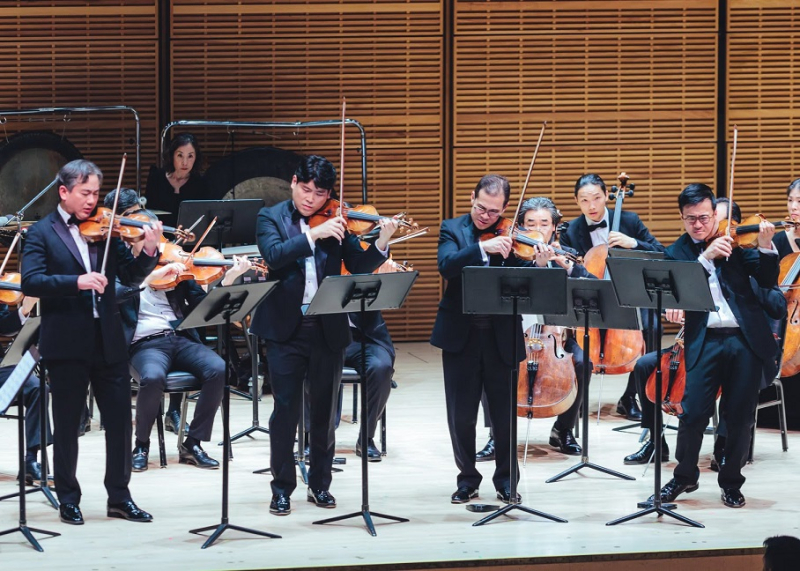
    Wednesday May 22nd, 2024 – Celebrating their 30th anniversary this evening at Zankel Hall, Sejong Soloists presented the US premiere of Unsuk Chin’s “Puzzles and Games” from Alice in Wonderland, and the world premiere of Texu Kim’s With/out book-ending a spectacular performance of Felix Mendelssohn’s Octet. It was one of most enjoyable concerts of the season, joining such Springtime delights as violinist Lun Li’s Young Concert Artists recital at the Morgan Library, the Orchestra of St. Luke’s splendid Brahms REQUIEM at Carnegie Hall, and Chamber Music Society of Lincoln Center’s thrilling program, Songs and Snow, on my list of musical events that have kept my spirits up in these chaotic times.

    240522 Sejong Here & Now Festival-13

    Making her Carnegie debut tonight, soprano Juliana Zara (above, photo by Emilio Herce) was the soloist in the Unsuk Chin work, a daunting 20-minutes of singing which at times carries the singer into the highest range of the soprano voice. Ms. Zara never seemed daunted by the vocal writing: in fact, she seemed to revel in it. Conductor Earl Lee and his musicians gave the singer perfect support, whilst also seeming to savor the composers’ quirky and colorful writing for the ensemble.

    One by one, oboe, clarinet, flute, and bassoon join in the introductory phrases to Alice – Acrostic before Ms. Zara’s clear, lyrical voice is heard. This brief song ends with deep chords. Pizzicati are passed about in the introduction to If I Never Reach the Gardens, with gentle (slightly eerie) passages for the strings (and did I hear a harmonica?) before the music turns woozy; the soprano speaks much of the poem. The third and fourth songs, on the Curiouser and Curiouser theme, seem to run together. The music stays groggy, the words largely spoken, until a crashing chord is struck. Dotty rhythms and semi-singing in Who In The World Am I? are underscored by by insectuous strings and burbling winds before the flute has a final say.

    The piano introduces The Tale-Tail of the Mouse, with melodramatic sprechstimme from the soprano. Spaced-out harmonies and scurrying flutes lead to the final words: “Condemned to Death”. I thought I detected a musette in the atmospheric lullaby Sleep Tight My Ugly Baby, though my ears may have deceived me. The music is filled with droopy sighs; a sense of quietude settles in, and night chimes are heard. In Cat’s Aria, Ms. Zara ventured impressively into the upper extremes of the soprano range, lingering there is a series of amazing (and intentionally annoying) meows-in-alt.

    Twinkle, Twinkle Little Star has a delightful delicacy about it; then the music turned livelier and a catchy xylophone ‘cadenza’ established a playful mood. The music fades away at the end. The final song is Speak Roughly To Your Little Boy, introduced by a drum roll. A pulsing beat accompanies this mean mother’s lecture, with tambourine and bassoon interjecting. Now the vocal line goes completely bonkers – Ms. Zara didn’t simply manage it, she triumphed over it – as cymbal crashes bring this dazzling, quirky piece to a close. The soprano basked in a shouting ovation from the crowd, so truly deserved; she graciously signaled her thanks to the musicians and the Maestro.

    240522 Sejong Here & Now Festival-31

    Above: Ms. Zara, Maestro Lee, and the ensemble; photo by Emilio Herce

    The first time I heard the Mendelssohn Octet played live was at the New York City Ballet, where, in 2004, Peter Martins created a lovely ballet to this score, written by the composer at the ripe young age of 16. It is a veritable treasure chest of melodic and rhythmic felicities, and tonight it elevated my mood – constantly dragged down of late by the darkness that is spreading throughout the world – to one of great joy. 

    240522 Sejong Here & Now Festival-57

    An octet of prestigious string players (above photo by Emilio Herce) was led this evening by the Metropolitan Opera’s concertmaster David Chan, and the NY Philharmonic’s concertmaster, Frank Huang. From the Sejong Soloists’ roster, violinists Daniel Cho and Andrew Wan, violists Brian Chen and Paul Laraia, and cellists Ole Akahoshi and Jesús Castro-Balbi joined to create an ensemble alive with multi-hued timbres which created a very cordial blend.

    The Mendelssohn Octet is a four movements, with the opening Allegro moderato con fuocoin my opinion, one of the greatest movements in all the string quartet repertoire – being the longest by far. It opens with joyous arpeggios and vibrant accompaniments. A more lyrical second theme has an elegant feel. The Andante brings restfulness, but with a rather intense middle section that offers contrast. Mendelssohn is the King of Scherzi, and here we are offered a feast of trills and an ethereal lightness of textures. The concluding Presto is both deliciously agitated and cunningly witty. There were times when the piece seemed almost like a concerto, thanks to David Chan’s virtuosity. 

    240522 Sejong Here & Now Festival-69

    Above, taking a bow after the Octet; photo by Emilio Herce

    240522 Sejong Here & Now Festival-82

    Above, the soloists for the Texu Kim premiere: David Chan, Daniel Cho, Andrew Won, and Franck Huang; photo by Emilio Herce

    Violins remained in the spotlight for the world premiere of Texu Kim‘s With/out, which was positively brilliant. This is a concerto for four violinists, with string orchestra and a single percussionist. Frank Huang now took the lead, with Mssrs. Chan, Cho, and Wen again creating a stellar quartet. 

    The opening movement, lonesome and fluorescent, starts with a hesitant pulse; the musicians interject melodic fragments and quirky sighs. There are touches of humor, and a fresh bass beat is taken up. A short downward motif is passed among the four soloists (it will recur in the final movement), and the music becomes briefly grand, with repetitive pulsings. Then there’s a whirlwind…until a whip cracks, restoring order. A brief da capo leads to an other-worldly conclusion.

    The second movement, subdued and imploding, is darker and a bit eerie. The four violins play in unison, and then a shivering misterioso mood sets in. The basses strike up, again the whip cracks, and the beating timpani feels like a slow, swaying dance. The sound-textures are varied, holding our keen interest; each soloist shines in turn. After briefly turning epic, there is a passage of harmonizing for the orchestra’s violins. A sustained trill from Frank Huang leads to a sudden stop.

    The final movement, festive!!, has an oddly familiar start: an homage to Stravinsky with a brief quote from his Violin Concerto. This gave my companion and I a jolt, as we are both Balanchine fans. The timpani plays a role, setting up a forward impetus. There is an intermezzo, with the descending motif from the first movement popping up again. The music becomes cinematic and, after a lull, rebounds to a finale.

    240522 Sejong Here & Now Festival-90

    Above: composer Texu Kim joins the musicians for a bow following his with/out, photo by Emilio Herce

    The hall erupted in a lively ovation which doubled in intensity when the charming, youthful-looking composer (he’s 34) hoisted himself onto the stage as cries of bravo! rang out. A perfect end to a perfect evening. 

    ~ Oberon

    Performance photos by Emilio Herce, courtesy of Beverly Greenfield/Kirshbaum Associates


  • In Recital ~ Ema Nikolovska @ Weill Hall

    Ema-Nikolovska-Photo-by-Kaupo-Kikkas jpg

    Above: Ema Nikolovska, photo by Kaupo Kikkas

    Author: Oberon

    Thursday March 28th, 2024 – Earlier this year, I was looking to add a vocal recital – by a singer I had never previously heard, in an intimate setting, including some songs that would be brand new to me – to my late-winter calendar.  Flipping thru the Carnegie Hall brochure, I zeroed in on tonight’s offering at Weill Hall: Macedonian-Canadian mezzo-soprano Ema Nikolovska, with Howard Watkins at the piano. I listened to about ten seconds of her singing on YouTube and requested a ticket. I’m so glad I was there.

    I must say at the start that it was a recital wherein the encore proved the highest highlight of the evening. Ms. Nikolovska announced this work, which she had commissioned, prior to singing it, and now I am casting about, trying to find more information about it, since I did not catch the name of the composer. 

    But to begin at the beginning, the mezzo-soprano and her collaborating pianist offered four songs by Franz Schubert. She chose songs somewhat off the well-trodden Schubert path, some of which were brand new to me.

    Im Frühling” was the most familiar. From its opening phrases, I sensed a large voice that had been tamed and polished. It took a few warm-up measures before things began to flow, but within seconds Ms. Nikolovska was ravishing the ear with her keen sense of nuance, and her expressive diction.

    Howard-watkins

    In “Dass sie hier gewesen” it became clear that Mr. Watkins (above) was so much more than an accompanist: his artistry is deep, and he plays from the heart. Ms. Nikolovska here displayed her gift for introducing straight tone into her singing, and the effect was enchanting. Mr. Watkins opened “Herbst” with a rippling restlessness, and then the music took on a sense of urgency. The song has an Erlkönig feel to it. Ms. Nikolovska’s subtle inflections and Mr. Watkins’ marvelous playing drew us deeper and deeper into the music.

    The Schubert set ended with the longest of the songs, “Der Unglückliche” which felt like an intimate mini-opera. The piano opens with a darkish sense of doom, and the voice moves from pensive to intense. We pass thru many moods in this dramatic and engrossing song.

    Ms. Nikolovska then spoke, rather at length, about the program. When the music resumed, it was Richard Strauss’ very brief “Nichts” that re-established the mood with its big piano intro and its final vocal outburst. A thoughtful atmosphere is established in “Gefunden“, which turns melodic and ends with Ms. Nikolovska on a gorgeously sustained, dreamy final note. We remain in dreamland with the opening of “Das Rosenband“, which soon gives way to rapture. Ms. Nikolovska was simply sublime here, her soft singing so engaging, and so beautifully controlled. The straight tone moments were spine-tingling, with awesome dynamic control, and a high-lying passage near the end which was magical. Mr. Watkins, in the piano postlude, was equally impressive.

    Songs of the Seasons, by Margaret Bonds, sets four poems of Lankston Hughes. A touch of jazz inflects Autumn, while a slow sway and dreamily sustained pianissimi evoke a cozy afternoon before the fire as snow falls outside in Winter. Mr. Watkins sets a music hall mood with sparkling motifs for Spring; this song has a big finish, and leaves it to Ms. Nikolovska to spin out a delectable diminuendo. The pianist introduces Summer with animated playing which becomes an infectious rhythm.

    An over-long intermission threatened to break the spell, but at last we were drawn back into the alternate universe by Debussy’s atmospheric Ariettes oubliées. The first song, “C’est l’extase langoureuse“, is aptly named, as its sense of languor is so finely evoked by the composer…and so perfectly captured by pianist and singer. The sweet sadness of “Il pleure dans mon coeur” was immediately conjured up by our two musicians: Ms. Nikolovska exploring the wide vocal range with uncanny dynamic control, and Mr. Watkins at his most poetic. The pianist was exceptional in “L’ombre des arbres“, while the singing was tinged with a sensual glow.

    In a mighty mood-swing. we are suddenly on a carousel for “Chevaux de Bois“; yet even here, the excitement and energy winds down as the circling horses slow their pace. Ms. Nikolovska followed the pianist’s delicate introduction to “Green” with some of her most delicious singing of the evening, finding heaven in her final phrase. For the concluding “Spleen“, the pianist creates a mysterious mood, and the singer ‘speaks’ on one note before a moody melody emerges, which the Nikolovska voice caresses with uncanny pianisssimi.

    Another treat follows with two songs by Nicolas Medtner: “Twilight” and “Sleeplessness“. The first is a hymn to nature, introduced by descending motifs from the keyboard. The song has a lovely lyrical feel, and Ms. Nikolovska’s sustained tones were again an outstanding feature. “Sleeplessness” has a dirge-like start; the singing grows more urgent, then recedes to resignation and ends with a vocalise.

    In a total change of atmosphere, Ms. Nikolovska introduced Nicolas Slominsky’s Five Advertising Songs: cabaret-type numbers that extol, in turn, bed linens, bran muffins, face powder, Fletcher’s Castoria, and Pepsodent toothpaste – the last two very familiar to me from my childhood in the Little Town. Ms. Nikolovska proved a sporting, lively comedienne, moving about the stage and playing to the crowd like a carnival huckster. It was all in good fun, but the best was yet to come.

    The encore – and I will find out its title and composer as soon as I can – was commissioned by Ms. Novolovska and draws on a Macedonian song. The Sun, The Moon, and The Forest are each evoked in turn. The music has an improvisational air, with melismas and winding melodies for the voice. Meanwhile, Mr. Watkins often reaches into the piano to place glissandi like a harp. The vocal line ranges from the subtlety to powerful passion, and it all ends in a whisper. 

    UPDATE: I now have details of the encore. The song, Zajdi, zajdi, jasno sonce, was composed by Aleksandar Sarievski, and arranged for Ms. Nikolovska by Darija Andovska.

    I also found that Ms. Nikolovska gave a second encore at her recital, after I had slipped out to catch my train, Incredibly, it was the Composer’s aria from Strauss’s ARIADNE AUF NAXOS…my favorite opera. I can’t believe I missed it!

    May I suggest to Ms Nikolovska that she make the arrangement of Zajdi, zajdi, jasno sonce an integral part of her recital programs. Everyone should hear it!

    So now, I am in hopes that Ms. Nikolovska will return to our City before too long, and that we might hear her Wesendonck Lieder.

    ~ Oberon

  • Alarm Will Sound @ Zankel Hall

    Alarm will sound


    Above: concert photo by Fadi Kheir


    ~  Author: Shoshana Klein


    Tuesday March 26th, 2024 – Though this concert started with slight technical difficulties, after  about 3 minutes, the whole rest of the show went on without a hitch. The pieces were played with minimal breaks and the show could have gone on with no applause, except that everyone was so excited about the pieces that there was a lot of excitement in between.
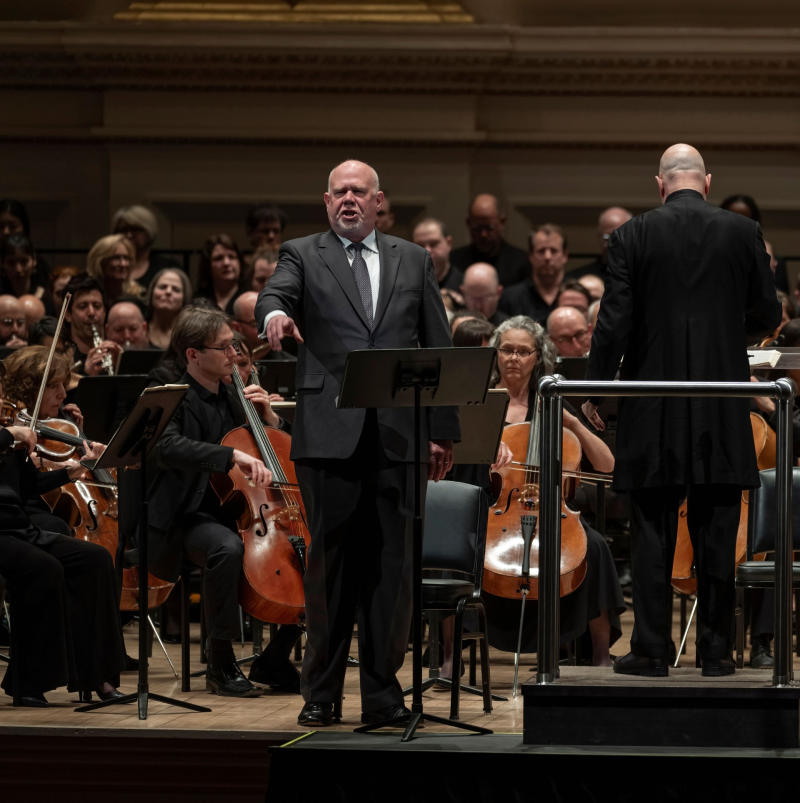
     

    There were audio introductions from each composer, and sometimes they even overlapped with the beginnings of the pieces. This created a really good flow that made the concert seem a little more connected and seamless than a normal program. This was actually my first official Alarm Will Sound concert despite being a fan of them for years. I’ve seen them in other contexts but not a fully programmed concert – it was a real treat! 


    The concert started with a piece by Tania León, who curated the concert in her capacity as the Richard and Barbara Debs Composer’s Chair of Carnegie Hall. Her piece was cool, groovy and fun, scored for small ensemble. 


    The second piece, by Chris P. Thompson, had some basis in drum corps, as explained by his introduction. It was really cool to hear about marching band in the context of “classical music”. I think it often gets ignored as an art form or a rigorous type of music when it’s actually pretty difficult in a way that was contextualized really well by the introduction to this piece, which was also really fun. The piece had a lot of rhythmic complexity and was really upbeat. One effect that was used was these tubes that are swung around by various musicians to create a pitch (and the pitch changes based on how quickly you swing the tube). I’ve been seeing this used in new music spaces more often recently and in this particular instance it did evoke the marching band – the coordination and visual aspects, or maybe more specifically the color guard spinning flags around on the field.


    The next piece was by Christian Quiñones (who I worked with a couple of years ago but we’d never met in person!) His piece was really cool and also had lighting effects attached to the electronic sounds, which was an interesting though slightly jarring experience. The sounds were a little glitchy but rhythmic in a way that sounded really cool. The piece was based on the sound of hearing loss – sounds becoming obscured and distorted throughout. 


    The last piece on the first half, in my opinion, was definitely the show stealer. It was an excerpt of an opera by Damon Davis and he called it in his introduction a “black rap space opera”. I had moments of feeling like some of the music was familiar to the point where I wondered if I’d heard it before – but I think it was just that type of music, kind of magical in its familiarity as well as its novelty. It was well orchestrated, interesting in the way it used members of the ensemble as characters or kind of as set pieces. The songs were beautiful but also definitely post-genre, almost more similar to musical theater than anything. The music and the story were optimistic in a mythological way, almost like Disney or Miyazaki. Everybody seemed to want to hear the whole thing. This was a fragment of a larger work that will hopefully be performed soon!


    The second half started with a piece by Elijah Daniel Smith which had a different tone – more subdued and introspective than the first half. It had a lot of really interesting sound worlds accompanying a narration that was interesting and impactful.


    Next was a piece by Texu Kim that was rhythmic and upbeat and ended a frenzy of rhythm that was perhaps intentionally impossible to keep completely together, which was a nicely unconventional end to the piece.


    Next was a five movement piece by Bora Yoon that was eclectic. There were moments of poetry, moments that felt conversational, and really interesting sound worlds including a prepared piano and an instrument she seemed to have made out of bicycle bells. The last movement particularly struck me – it was really really beautiful around an ocean theme. I wish I had more to say about this piece – it was delightful and brought us through many emotional spaces in a short time.


    Tania and alan pierson


    Above: Tania León and Alan Pierson; photo by Fadi Kheir
     
    Before the last piece, we heard a little bit from Ms. León. She, with the help of Alarm Will Sound‘s Alan Pierson, framed the concert within the context of this question that her father had asked her right before he died. In this conversation she showed him some of her music and he’d asked her where she was in it. Every explanation by the composers in this concert told where they as a human were in their music. It really tied the whole thing together in addition to the fact that after this conversation, The ensemble played the León from the beginning but arranged for the full ensemble. Bringing back the piece from the beginning was a really cool effect. Unfortunately, I didn’t really remember it that well but I still liked the symmetry of it. All in all, it was a little bit of a long concert but everything was so good that I don’t know what I would have been able to leave out!
     
    ~ Shoshana Klein

  • ASO ~ Gurre-Lieder @ Carnegie Hall

    Gurre 4

    Above: tenor Dominic Armstrong (seated), conductor Leon Botstein, and soprano Felicia Moore onstage at Carnegie Hall; photo by Matt Dine

    ~ Author: Ben Weaver

    Friday March 22nd, 2024 – Arnold Schoenberg’s gargantuan Gurre-Lieder, composed in 1900-03 (revised 1910-11), is unlike anything else in his catalog. With this lush and highly melodic work – for soloists, chorus and orchestra – he reached the ceiling of Romanticism and the only way out was to shatter it to smithereens. For Schoenberg, a mix of musical philosophy and observing the ravages of WWI signaled that music could not continue on the path laid out by his predecessors (Bach, Haydn, Mozart, Beethoven, Brahms, Wagner, etc. etc.) Schoenberg may have overreacted quite a bit, but, at a least with Gurre-Lieder, he left us with a grand finale of sorts to the excesses of 19th century music.

    Gurre-Lieder’s libretto is adapted from Jens Peter Jacobsen’s dramatic poem Gurresange, written in 1868. It tells the story of King Waldemar and his love for the beautiful Tove, who is murdered by Waldemar’s jealous wife. Enraged, Waldemar curses God and is condemned to roam every night on wild hunts with his ghostly vassals. Waldemar is redeemed with arrival of Spring, and he and Tove are reunited as they become one with nature. Performances of this work are extremely rare, no doubt because Schoenberg calls for more than 150 musicians, an extravagance few organizations can afford, and none can afford frequently.

    Part I opens with what Gabriel Adorno called “fairy land” music, a shimmering tapestry of harps, celesta, flutes, piccolo and some strings. Waldemar and Tove exchange declarations of love in extended monologues, set to ravishing Wagnerian and Straussian sounds.

    Tenor Dominic Armstrong (above) took on the – let’s face it – impossible role of Waldemar. Schoenberg wrote the part for at least three different voices; not many singers have been able to possess them all. This is a Tristan/Parsifal/Tannhäuser part, with Tamino thrown in for good measure. I honestly don’t know who can really sing all this in a live performance. Dominic Armstrong is a lyrical tenor with a strong top, but sadly the voice disappears in the lower registers. And conductor Leon Botstein was not very kind, allowing the orchestra to cover Mr. Armstrong all evening. Armstrong’s strongest moments were in the lighter passages; his best singing came late in Part 3, in his final aria “Mit Toves Stimme flüstert der Wald”, when Schoenberg’s orchestration relaxed, allowing Waldemar to finally emerge.

    Soprano Felicia Moore (above) possesses a large, blooming voice, that managed to break through the orchestral cacophony, in spite of an insensitive conductor. Her Tove was exotic and warm.

    Gurre 2

    Mezzo-soprano Krysty Swann (above, in a Matt Dine photo), as the Wood-Dove who describes the terrifying details of Tove’s murder, was exciting in her long monologue. The voice is large and steely, the vibrato a bit loose at the top, but Ms. Swann possessed an excellent sense of drama, managing to build to thrilling and hair-raising final moments of the Wood-Dove’s narrative.

    Gurre 3

    Bass-baritone Alan Held (above, photo by Matt Dine) has been a favorite of mine for many years. Though it seemed like James Levine always kept Mr. Held back at the Metropolitan Opera, where he should have been singing Wotan among many other roles, I still vividly recall a searing Wozzeck Mr. Held sang at the Met in 2011. It was wonderful to hear him once again, his large voice easily filling Carnegie Hall as the Peasant who is terrified by Waldemar and his men’s nightly processions.

    Gurre

    Tenor Brenton Ryan (photo above by Matt Dine) was a very memorable Klaus the Jester, starting his long monologue from the house floor, then jumping on to the stage. Mr. Ryan possesses a strong, characterful tenor that made me think he might have been a better choice to sing Waldemar.

    And German bass-baritone Carsten Wittmoser was a magnificent Narrator, his crystal clear diction perfect for the sprechstimme part, which is usually given to older singers nearing retirement or even non-singer actors (Karl Maria Brandauer and Barbara Sukowa, for example.) So it was nice to hear a singer still in his prime take on this role.

    The American Symphony Orchestra was founded by Leopold Stokowski – who conducted the US Premiere of Gurre-Lieder in 1932, so it has a direct connection to this work, and they played quite beautifully, and certainly loudly. Here I must fault Leon Botstein for not being more considerate of his singers. Even the Bard Festival Chorale found itself drowned out by the orchestra, occasionally becoming just a mass of garbled sounds coming from somewhere at the back of the stage.

    Still, any live performance – flaws aside – of this supremely difficult work is was a special treat to be able to experience. How long before another performance is organized in New York City?

    ~ Ben Weaver

    Performance photos by Matt Dine, courtesy of Carnegie Hall