
Above: pianist Beatrice Rana
~ Author: Ben Weaver
Friday June 7th, 2019 – Yannick Nézet-Séguin – music director of the Metropolitan Opera – led his other ensemble, The Philadelphia Orchestra – in an exciting Carnegie Hall concert tonight. The all-Russian program opened with a recently discovered curiosity: Stravinsky’s Funeral Song, Op. 5, written for the memorial of his teacher, Nikolai Rimsky-Korsakov, in 1908. The 12 minute work, in which Stravinsky has different sections of the orchestra take turns “laying down its own melody as its wreath against a deep background of tremolo murmurings,” was lost until 2015 when a St. Petersburg Conservatory’s librarian discovered the complete orchestral parts in the mess of the Conservatory’s renovations. Musicologists long lamented the lost manuscript as the link between Stravinsky’s early works and The Firebird. Its discovery revealed not only the links in Stravinsky’s own development, but his links to Rimsky-Korsakov’s late compositional style, which Stravinsky, late in life, tried to downplay.
Sergei Prokofiev’s popular Piano Concerto No. 3 came next on the program with the exciting pianist Beatrice Rana at the piano. This was my first time hearing Ms. Rana in a live performance, but I have admired several of her recordings for some time. What struck me about her recorded performances – and what was confirmed live – is her deeply felt, yet honest and unaffected musicality. Prokofiev’s “devilishly difficult” (Prokofiev’s own words) writing presented no technical challenge to Rana’s nimble finger work. The often spiky writing can easily become a “pound on the keyboard” type of evening. That is not Rana: her light – but never weak – touch made the pounding Prokofiev requires sound effortless and graceful. Both of those words were also true about the encore: Chopin’s Etude in A-flat major, Op. 25, No. 1 showed off the more lyrical side of Rana’s artistry.

Above: the young Sergei Rachmaninoff
The premiere of Sergei Rachmaninoff’s Symphony No. 1, Op. 13 in 1897 is one of the most famous musical disasters in Western art music. Composer and conductor Alexander Glazunov appears to have been drunk on the podium and unprepared to conduct the difficult score. The reaction from the public and the critics was savage: composer and critic César Cui wrote that the symphony “would have delighted the inhabitants of Hell” and that the “music leaves an evil impression.” The young composer was so devastated by the reception that he quit composing and needed a therapist (and hypnosis) to recover from the trauma. When he fled Russia during the 1917 Revolution, the score of the symphony was lost in the chaos. Interestingly, although the symphony caused him a lot of pain, it appears to have been on Rachmaninoff’s mind for the rest of his life: he quoted its dark opening theme in the first movement of his last work, the Symphonic Dances, in 1940. Since the score of the symphony was lost and no one had heard it in more than 40 years, Rachmaninoff knew the quote would be unknown to anyone but himself. He died in 1943 and two years later orchestral parts of the symphony were discovered after all, in the St. Petersburg Conservatory (again), presumably as everyone returned home after the War. A performance was quickly arranged in Moscow (US premiere was given by The Philadelphia Orchestra and Eugene Ormandy) and finally the public was able to judge this extraordinary composition. We can safely say that César Cui’s deranged opinion was garbage; indeed, history itself has given its verdict on Cui vs. Rachmaninoff’s Symphony No. 1. Cui is nothing but footnote.
One thing that may have confused so many listeners in 1897 was the dark and violent tone of the work; Rachmaninoff’s vivid quotations of the Dies irae may have upset some sensitive constitutions. But the Dies irae would become a common motif in all of Rachmaninoff’s major orchestral works. In the 1st Symphony, even the haunting slow movement is more sinister than calming. Cui may have been correct that the work “would have delighted the inhabitants of Hell,” except any person of taste would have seen that as a positive. Rachmaninoff’s most famous works, Piano Concerto No. 2 and Symphony No. 2, are steeped in romanticism, their flowing, endless melodies unrolling with shameless abandon. The very different tone of the 1st Symphony, however, reveals fascinating depths.
There are few orchestras with a stronger personal and professional connection to a major composer than Philadelphia Orchestra’s is to Rachmaninoff. For a few decades Rachmaninoff played with and conducted them regularly, and he chose them when he recorded his own orchestral works. His last composition, the Symphonic Dances, were dedicated to the Philadelphia Orchestra and Eugene Ormandy led the world premiere performance. This is music they have in their blood the way Bayreuth Orchestra has Wagner and the NY Philharmonic has Mahler. With Maestro Nézet-Séguin on the podium, this Carnegie Hall performance of Rachmaninoff’s 1st Symphony was perhaps the most thrilling and hair-raising I’ve ever heard. Nézet-Séguin’s unflagging energy perhaps a taste for the macabre was the perfect approach to this dark and sprawling work. The Philadelphians responded with a fearlessness that shook the concert hall to the rafters. Is César Cui heard this performance, he might have had a heart-attack.
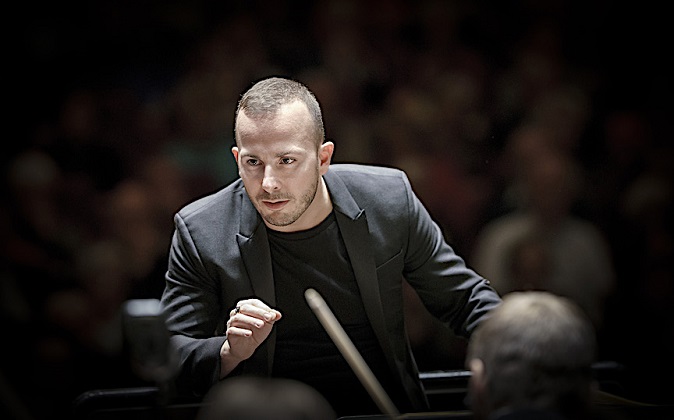
Maestro Nézet-Séguin (above, in a Hans Van Der Woerd photo) is currently recording Rachmaninoff’s complete piano concertos with Daniil Trifonov and the Philadelphia Orchestra. Based on this coruscating performance of the 1st Symphony, it may be time for this group to record Rachmaninoff’s complete orchestral works. The Concertgebouw seems to do a complete Mahler traversal every few years (though the last one, with Daniele Gatti, was abandoned part-way for stupid reasons). Surely the Philadelphians and Rachmaninoff have earned a similar right? Deutsche Grammophon, are you paying attention?
~ Ben Weaver







 Oberon's Glade