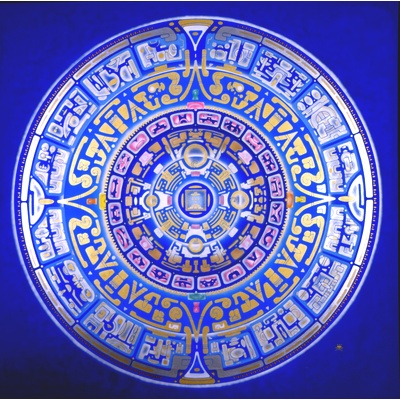
Above: A Toltec star-shield
Wednesday February 27, 2013 – A few minutes into this concert by the Collegiate Chorale, an expression from the 60’s came to me: “Mind-blowing!” The evening, one of the most purely pleasurable I have ever spent in a concert hall, featured two great contemporary works: the Toltec Symphony (#7) of Philip Glass, and OCEANA, a marvel-filled cantata by Osvaldo Golijov. The cumulative sonic effect of this music was like that of a mystical drug: I felt both vividly stimulated and wonderfully relaxed: a paradox, but there it is.
The Glass dates from 2005 when it was commissioned by the National Symphony Orchestra to honor the 60th birthday of conductor Leonard Slatkin. The composer was inspired by the ancient culture of the Toltecs, remnants of which may still be found in Northern Mexico. Like many wise peoples, the Toltecs lived in close harmony with nature; the symphony evokes not only that link but the mysterious harmonies of forgotten rituals.
The term Minimalist doesn’t really apply to Philip Glass; his view of music is in fact panoramic and the Toltec is universes away from Minimalism. It’s a vast and grand piece. The composer’s signature motif of repeated rhythmic patterns is very much in play, but there are layers of sound bulit on that foundation.
The work opens subtly, with harp, maracas and celeste; as the first movement (entitled The Corn) develops, there is a spine-tingling ebb and flow of dynamics and textures from huge tutti passages that pulsate thunderously to trancelike delicacies that float on air. The second movement (The Sacred Root) is a grand choral tapestry, veering in song from seductive sway to hypnotic chant; at one point four singers step forward to deliver a counter-song. The chanting, sustained over timpani, finally dwindles magically into silence.
The symphony’s final movement opens with a chorale of brass and violins into which the woodwinds and harp soon join. At this point there was an annoying late seating which broke the mood of the piece; with only a few minutes of music left, was it really necessary to seat people at that point? Better to have taken a pause between the second and third movements and gotten the stragglers in place before continuing.
Trying to recover my focus, I was intrigued by a passage for harp and strings, interrupted twice by the timpani. The winds join in a grand welling-up only to subside again. A four-square rhythmic, benedictive choral finale develops with halting pauses between segments, inducing an ecstatic feeling. With luminous high-flutes sounding over gently rocking strings, the Toltec vanishes into the mist like a lost civilization.
There was no intermission but rather a longish pause in which the stage was re-set for the Golijov. I’ve recently become fascinated with this composer thanks to hearing his music used by choreographer Lydia Johnson. For OCEANA, the brass and woodwinds leave us as do the percussionists: aside from a quartet of flautists and three musicians playing small percussion instruments, OCEANA is all-strings – including guitars – and singing.

The enigmatic and perfumed poetry of Pablo Neruda (above), from Cantos Ceremonial, gives wing to Osvaldo Golijov’s matchless musical imagination. In this cantata, modeled on Bach, the illusive words of the poet will rise up from the mystic murmurs of harp and guitar and the sounds of the rainforest which open the work.

The sensational Venezuelan vocalist Biella Da Costa (above) revealed a mellow, sultry voice of huge range and capable of entrancing vocal effects woven into her alluring sound. Wow! As the work progressed from one movement to the next, I found myself thinking: “What sonic magic will we experience next?” Between the orchestra, the chorus and the soloist, the ear is constantly seduced while the soul veers madly from the realms of the spiritual to the sensual.
In a splendid aria, the jazzy singer bounces her voice around a big range, joyously carefree in this litling vocalise which percolates over guitar, bass and flutes. Then the chorus takes over, rocking and rolling like a sailing ship on a breezy day. Folkish percussion with harp and guitar tingle as a group of young women from the Manhattan Girls Chorus join in the music-making: wind and waves carry us forward, making me want to dance.
Finally we reach the choral finale: the Oceana chant, a dreamlike invocation, makes us feel like we’re in church. The vision of the sea and the clouds fades like a dream as the music evaporates into a hush.

Conductor James Bagwell (above, in an Erin Baiano photo) is to be praised not only for his steering of the musical ship tonight but for this imaginative and wonderfully satisfying programming. Ms. Da Costa was nothing short of a revelation, and let’s have some special roses for harpist Sara Cutler who played so marvelously all evening.
Osvaldo Golijov susrprisingly joined the singers and musicians onstage during the applause; I’m not sure the audience recognized him though.
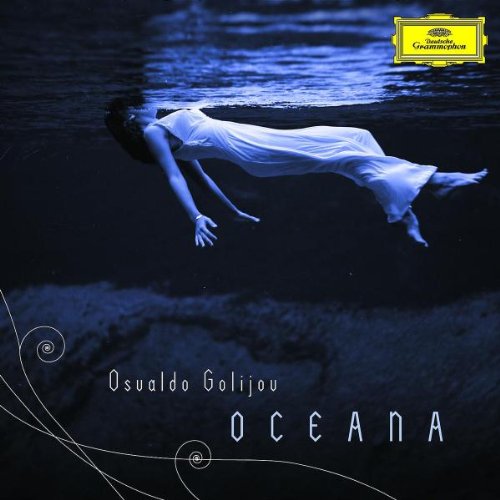
OCEANA is available on CD…

…as is Glass’s Toltec Symphony.

![Duncan-Tyler-01[Colin-Mills]](https://oberonsglade.blog/wp-content/uploads/2012/10/dae97-6a00d8341c4e3853ef017c32d96229970b.jpg "Duncan-Tyler-01[Colin-Mills]")
 Oberon's Glade