Tag: Concert

  • Mariana Paunova

    Paunova_1

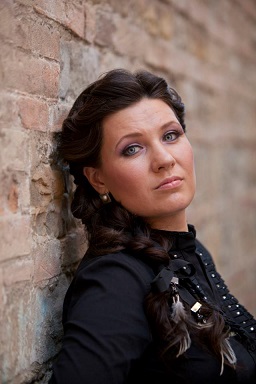
    The Bulgarian mezzo-soprano Mariana Paunova (above) made her operatic debut in 1977, as Pauline in PIQUE-DAME at the Spoleto Festival in Charleston, South Carolina. I saw her as Isaura in a concert performance of Rossini’s TANCREDI at Carnegie Hall in 1978, and she sang at the Met in 1979, as Olga in EUGENE ONEGIN.

    In 1983 I heard her as Laura in a broadcast of LA GIOCONDA from San Francisco and was very much taken with her darkish, plushy sound. In that same year, she recorded Dukas’ ARIANE ET BARBE-BLEUE for Erato, conducted by Armin Jordan.

    Paunova’s career continued apace in the US, Canada, Mexico, and Europe; she sang the role of La Comandante in Riccardo Zandonai’s I CAVALIERI DI EKEBU at Alice Tully Hall in 2000.

    Mariana Paunova taught at the Manhattan School of Music until her untimely death in 2002.

    GIOCONDA – Act II exc – M Paunova – Slatinaru – Bonisolli – Manuguerra – San F 1983

  • Hadelich/Honeck @ The NY Philharmonic

    Hadelich

    Above: violinist Augustin Hadelich

    Thursday May 28th, 2015 – Earlier this season, Dmitry and I heard Augustin Hadelich give a memorable performance of the Samuel Barber’s violin concerto at Carnegie Hall. I was keen to hear the violinist again, and tonight the opportunity came with his appearance at Avery Fisher Hall with The New York Philharmonic playing Mozart’s “Turkish” concerto. Manfred Honeck was on the podium, opening the evening with the FLEDERMAUS overture; following the interval, we had Brahms’ 4th symphony.

    The tuneful FLEDERMAUS overture was given a brisk, opulent rendition by the Philharmonic; Maestro Honeck gave this infectious music a vibrant sway, and Liang Wang’s oboe solo was a highlight. Toe-tapping and nodding in three-quarter time seized the audience, an inevitability whenever this overture is played.

    Mozart’s 5th violin concerto (K. 219) is popularly referred to as “the Turkish” though there’s little feeling of the exotic in the music until near the end of the final movement. Mr. Hadelich, who I feels ranks very high among today’s top violinists for sheer beauty of tone, made his mark immediately when the opening Allegro aperto movement is surprisingly interrupted for a radiant adagio theme for the soloist. In the slow movement – the Adagio proper – the violinist was at his most persuasively lyrical, his warmth of tone and innate sense of the phrasing giving enormous pleasure. The final movement seems pretty much a standard rondo until Mozart suddenly tosses in a sustained passage of witty “Turkish” music that he used so charmingly in The Abduction from the Seraglio. After this diversion, a minuet sweeps graciously by and the concerto ends gently.

    There’s a cadenza near the end of each of the concerto’s three movements, and as there are no ‘official’ versions for these miniature showpieces, Mr. Hadelich composed his own and they ideally showcased both his dulcet tone and his nimble technique.

    A warm reception from the audience drew an encore from the violinist: a staggeringly virtuosic Paganini piece with slithering mile-a-minute scale passages expertly set forth by Mr. Hadelich. The audience listened in awestruck silence to this coloratura display, then erupted in cheers; the soloist was called out twice to a standing ovation, which he so thoroughly merited. 

    Following the interval, Maestro Honeck and the orchestra treated us to a sonorous Brahms 4th. This symphony, full of inspiring melodies, sounded particularly plush tonight. The composer himself conducted the 1885 premiere of this, his last symphony, and since then it has stood among the great musical masterworks of all time…and it certainly seemed so tonight. Though sometimes described as ‘tragic’, the fourth symphony prompted Clara Schumann to write to Brahms with this summation: “It is as though one lay in Springtime among the blossoming flowers, and joy and sorrow filled one’s soul in turn.” That is exactly how I felt listening to it this evening.

  • All-Brahms @ Chamber Music Society

    Cho-liang lin

    Above: violinist Cho-Liang Lin

    Friday April 24th, 2015 – With their customary flair for matching great music with great musicians, Chamber Music Society of Lincoln Center put together an inviting all-Brahms programme and gathered a world-class ensemble to perform it. It would be fair to say this concert was a highlight of the season to date, but then that seems to be true of each of the Society’s offerings.

    Cho-Liang Lin has always been a particular favorite of mine; he boasts a wonderful discography, with his Stravinsky/Prokofiev disc one I especially like. Tonight he joined pianist Wu Qian for the opening Brahms work: the Violin Sonata in A major Op. 100.  The piece opens with brief, hesitant violin interjections before sailing forth into melody. The second movement – an unusual setting in which Brahms seems to combine an andante and a scherzo (and it works!) – opens with a theme of tenderness and longing, so expressively played by Lin and Qian. Later, when more animated passages arise, their clarity of articulation was most welcome. The serene melody recurs, with major/minor shifts giving an affecting quality. A plucky little dance makes for a sprightly interlude before returning to the andante where the violin now lingers on high. An unexpected little coda gives the movement a brisk finish.

    The sonata’s final movement opens with a poignant theme, lovingly ‘voiced’ by Mr. Lin while Ms. Qian’s piano ripples gently. The music becomes more animated – each player alternately carries the melody by turns – but retains its lyrical heart and eschews virtuosity in favor of something more heartfelt. A friend of the composer said: “The whole sonata is one caress,” and that’s how it seemed this evening in such a beautifully dovetailed rendering from our two artists.

    The Trio in C minor for Piano, Violin, and Cello dates from the same year as the sonata, and follows it immediately in the composer’s catalog of works. Both pieces were written while Brahms was on vacation (a ‘working vacation’, obviously) at Lake Thun, Switzerland; he is thought to have been inspired by the scenery, which is understandable: 

    Lake thun
    The Piano Trio No. 3 was a favorite of Brahms’ dear friend Clara Schumann; she is said to have turned pages for Brahms when he played the work with his two friends – the cellist Robert Hausmann and violinist Joseph Joachim.
     
    This evening’s performance marked the Chamber Music Society debut of the Sitkovetsky Trio. Although  violinist Alexander Sitkovetsky has appeared with the Society before, tonight marked his first performance there with his established chamber music colleagues Richard Harwood (cello) and Wu Qian (piano). Their playing of the C-minor trio drew a well-deserved, vociferous reception from the Tully crowd.
    Concert_pic
     
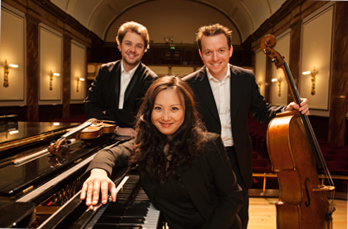
    Above: The Sitkovetsky Trio
     
    In the Trio’s opening Allegro energico the three musicians got off to a grand start, the melodies pouring generously from the Brahmsian font. The blend of violin and cello was particularly enriching whilst at the Steinway, Wu Qian brought the same lyrical glow to the music that had made her performance in the sonata so impressive. A unison passage for violin and cello had a richly burnished quality, and all three players displayed both technical precision and real passion for the music.
     
    The charming and subtle second movement – Presto non assai finds the violin and cello plucking delicately; but beneath the lightness of touch there’s an inescapable quality of sadness. Then a feeling of gentle nostalgia develops in the Andante grazioso that follows, and the strings and piano trade expressive passages. This leads directly into the dynamic opening of the Allegro molto in which reflective phrases mingle with more extroverted ones; the trio concludes with in a rockingly positive mood.
     
    After the interval, we jumped back 20+ years in Brahms’ compositional career for the Sextet #2 in G Major (Opus 36); Mssrs Sitkovetsky and Harwood were joined by Cho-Liang Lin, violists Paul Neubauer and Richard O’Neill, and – fresh from his marvelous Carnegie Hall concerto debut – cellist Nicholas Canellakis. As the musicians settled in and did a bit of tuning, my level of anticipation shot up: we were in for something special.  

    When Brahms started work on his second sextet, it seems he was in a highly emotional state, having been secretly engaged to a young singer named Agathe von Siebold. Realizing that marriage was not for him, the composer sent her a brusque message terminating the engagement. But he managed to preserve the memory of his brief love in this second Sextet: the letters of Agathe’s name ‘spell’ a theme in the work’s first movement; he later wrote: “Here is where I tore myself free from my last love.”

    Paul Neubauer launched the performance with a gently rocking two-note motif in continuous repetition; this motif is later passed from one player to another, giving a continuity to the music. Outstanding beauty of tone from Nicholas Canellakis and plenty of viola magic from both Mr. Neubauer and the passionate Richard O’Neill as the melodies make the rounds of the ensemble, passing from artist to artist.

    The scherzo (rather restrained and thoughtful, actually) opens on high and features delicate plucking and curling drifts of melody. Halfway thru there’s a joyous dance which subsides into into rolling waves before its boisterous conclusion.

    Cho-Liang Lin’s playing had a searching quality in the opening of the Andante which wends its way at a stately pace thru rather doleful minor-key passages until there’s an unexpected lively outburst. Calm is restored, and now major and minor phrases alternate to lovely effect; Mr. Lin’s melodic arcs sailed sublimely over the finely-blended lower voices; the music becomes almost unbearably beautiful, leading to a peaceful coda. 

    In the final movement, a brief agitato introduction settles into a lilting flow with some lively interjections. The music cascades on: bold and sunny, its energy carries us forward with inescapable optimism. A perfect finale, and the Tully audience could scarcely wait til the bows were off the strings give the six superb players the standing ovation they so surely merited.

    The Repertory:

    The Participating Artists:

  • Score Desk for DONNA DEL LAGO

    Loch_Katrine

    Above: Loch Katrine, Scotland – the setting of LA DONNA DEL LAGO

    Saturday February 28th, 2015 matinee – This performance of Rossini’s LA DONNA DEL LAGO was a late addition to my opera plans for the season. The Rossini repertory no longer interests me much, but I thought it might be good to experience one of his operas again in-house, and I’ve always liked Juan Diego Florez, so…why not?

    Back in 1982, I heard Rossini’s LA DONNA DEL LAGO in a concert performance at Carnegie Hall; the principal roles were taken by Frederica von Stade, Marilyn Horne, Rockwell Blake, and Dano Raffanti. It was quite a night. Then in 2007, the New York City Opera staged it with a cast that included fine performances by mezzo-soprano Laura Vlasak Nolen, and tenors Barry Banks and Robert McPherson.

    After taking some cuts in the prelude, conductor Michele Mariotti rushed the opening chorus with some resulting disunity. Someone tried to start entrance applause for Joyce DiDonato, but it didn’t catch on; it might have been the same person who tried to get some applause going after her opening aria, but he ended up with three solo hand-claps.

    It seemed to me today that Elena (the opera’s eponymous heroine and triple love-interest) suits Ms. DiDonato much better than Donizetti’s Maria Stuarda did. She did some genuinely lovely singing – with persuasive coloratura – along the way; a slight flutter in her timbre at low-to-mid volume sometimes intrudes on complete enjoyment of her singing. But overall this is a fine role for her. 

    Juan Diego Florez sang with his usual fluency and expressiveness, tossing off added high notes and blending beautifully with Ms. DiDonato. Fleeting traces of sharpness in the tenor’s singing didn’t detract from the overall handsomeness of his vocalism, I should have stayed to hear the luminous aria “O fiamma soave” in Act II, but I didn’t.

    I can recall the favorable impression Daniela Barcellona made singing Maddalena in RIGOLETTO at a special all-Verdi concert performance which The Met offered on September 22, 2001, as a benefit for the families of 9/11 first responders. She subsequently sang Bellini’s Adalgisa twice at The Met (also in 2001), and has since had an extensive career in Europe. Her return to The Met as Rossini’s Malcolm Groeme was a main factor in my decision to go to today’s matinee, but alas her voice now shows a widening vibrato – and a quick look at her bio shows the telltale reasons: Amneris and Santuzza are not roles one would think of for her type of voice, and once ventured it is not easy to switch back to bel canto. She had some beautiful low notes today, and managed the coloratura quite well. But sustained notes revealed an unsteady quality.

    John Osborn (Rodrigo di Dhu) pricked up our ears and perked up the performance with his powerful forays to the top register and the overall conviction of his singing. It is not the most ingratiating tenor sound you will hear, but he knows what to do with it in this demanding music, Oren Gradus, though not a bel canto specialist, did what he could with the role of Duglas D’Angus.

    Musically, the opera moves in fits and starts. A ravishing melody or brilliant passages of fiorature will be followed by rum-ti-tum filler. Rossini’s idea of introducing a solo harp into the Act I finale stirs our interest, but the vocal melody that follows in pedestrian. This is followed by a jog-trot stretta to end the act.

    It it hadn’t been for the looming Gelb intermission, I would most likely have stayed on to hear that Florez cavatina in Act II. The house was reasonably full and very attentive, but I did notice several fellow-defectors after the first act.

    Metropolitan Opera House
    February 28, 2015 Matinee

    LA DONNA DEL LAGO
    Gioachino Rossini

    Elena...................Joyce DiDonato
    Giacomo V/Uberto........Juan Diego Flórez
    Malcolm Groeme..........Daniela Barcellona
    Rodrigo Di Dhu..........John Osborn
    Duglas..................Oren Gradus
    Albina..................Olga Makarina
    Serano..................Eduardo Valdes
    Bertram.................Gregory Schmidt

    Conductor...............Michele Mariotti

  • Schubert’s WINTERREISE @ CMS

    Huber-Gerharer

    Above: Gerold Huber and Christian Gerhaher

    Tuesday February 24th, 2014 – Baritone Christian Gerhaher and pianist Gerold Huber performing Schubert’s immortal masterpiece, Winterreise, as part of Chamber Music Society of Lincoln Center‘s Winter Festival, Intimate Expressions. The performance comes to us in the midst of a particularly cold and somber Winter.

    Composed in 1827, when Franz Schubert was 30 years old and had less than two years remaining in his life, the twenty-four songs of Winterreise are set to poems of Wilhelm Müller. The poet, who had earlier provided the texts for the composer’s song cycle, Die schöne Müllerin, was a nearly-exact and equally short-lived contemporary of Schubert. They never met, and Müller died just as Schubert was beginning work on Winterreise.

    Winterreise is not a narrative song cycle, but rather a collection of vocal miniatures on themes of solitude and despair, set against a relentless and unforgiving wintry landscape. Though the subject matter is overall quite gloomy, there is some variety of tempo and rhythm among the songs. But in the final twelve of the Winterreise songs, we experience a feeling of darkness gathering about Schubert, and his sense of impending doom. The last Winterreise songs evoke feelings of great beauty overshadowed by death. The composer died in 1828.

    Tonight’s performance had all the makings of a superb musical experience – which, in fact, it was – yet the overall effect of the cycle was somewhat compromised. In her opening remarks, CMS co-artistic director Wu Han announced that the pianist Gerold Huber was suffering from a heavy cold. He had generously agreed to perform, but we were cautioned that he might be in need of taking a break midway thru the cycle. This was indeed the case; after about a half-hour, pianist and singer walked offstage and the audience took the opportunity to stretch, chat, and check their cellphones. This intrusion of reality broke the spell of the music. When the artists returned, it took a while for the hall to settle in again, and there were further minor disruptions in the second half of the performance, with a corresponding decline in focus.

    Mr. Gerhaher has a wonderful lyric instrument capable of both power and shaded nuance; and yet it was the pianist – Mr. Huber – who most thoroughly entranced me with the subtle delicacy of his playing in the cycle’s most intimate moments. Together the two gave as fine a rendering of Winterreise as one might hope under the circumstances. The great benefit for me was, it sent my estimation of this cycle, which I have never previously appreciated and have in fact avoided, soaring. Perhaps that is one of the gifts of growing older.

    I look forward to hearing Mr. Gerhaher on March 1st singing the Brahms GERMAN REQUIEM at Carnegie Hall. And I will hope to encounter Mr. Huber again at some point for he is an artist of intrinsic expressiveness.

  • NYCB: Opening Night|Winter Season 2015

    Balanchine-Stravinsky-1965

    Above: George Balanchine and Igor Stravinsky

    Update: Happy Birthday Mr. B ~ January 22nd!

    Tuesday January 20th, 2015 – An all-Balanchine evening to open the New York City Ballet‘s Winter 2015 season. In the days leading up to the performance there were several changes to the originally-announced casting, and it all turned out very well. Clothilde Otranto was on the podium to bring us the three contrasting scores, and the spirit of Balanchine hovered overall. 

    SERENADE received a performance aglow with lyricism; having recently heard the score played at Carnegie Hall, I was again thinking how Balanchine’s choreography is so intrinsically linked to the music: when you hear it played anywhere you immediately see the dance.

    Sterling Hyltin graced the enchanting melodies with her unique mixture of sophistication and impetousity; I wonder what perfume Mr. B would have chosen for her? There was a wonderful chemistry between Sterling and Robert Fairchild, especially in the passage where he pursues her around the stage: she draws him onward, elusive but always looking back to gently reassure him. This was just one of many such nuanced moments in their partnership tonight. As the ballet seems to take a darker turn, Sterling’s vulnerability came into play…so movingly. During the intermission, we sought superlatives to describe this ballerina’s performance: yet none seemed to suffice, really. So we simply basked in her beautiful glow.

    Erica Pereira could celebrate her birthday a day early with a new role: the Russian Girl, to which she initially brought an airy charm; as the ballet progressed, Erica found deeper hues of feminine resonance in her role. She was especially lovely in the opening of the third movement, dancing with the her four sisterly demi-solistes (Mlles. Adams, Dronova, Mann, and Sell) and later, her lustrous black hair flowing free, Erica rushed into Ask LaCour’s waiting arms with a sense of urgent grace.

    Teresa Reichlen, after swirling thru her elegant pirouettes earlier on, drew sighs of admiration for her sustained supported arabesque in the final movement, always a heart-filling moment. She danced radiantly, whetting the appetite for her upcoming debut in CHACONNE.

    Throughout the ballet, the corps ballerinas provided so many moments to savour, both as individuals and in the ensemble passages which Mr. B wove for them with such an imaginative sense of visual poetry. I wanted to throw roses onstage for all of them.

    AGON tonight was a triumph, with a powerful performance of the central pas de deux by Maria Kowroski and Amar Ramasar. At their charismatic finest, these two dancers displayed the amazing stretch, uncanny pliability, and dynamic counter-balances that Mr. B demands of them. Their bold physicality clearly captivated the crowd who wouldn’t stop applauding until Maria and Amar had bowed three times.

    Andrew Veyette’s wonderfully strong and supple dancing and his brazen high kick put a personal stamp on his solo. The masculine vigor of his presence held our focus whenever he was onstage. Likewise, Megan LeCrone made an excellent impression with her poised, steady balance and authoritative movement. Demi-solistes get to shine in AGON and tonight we had Lauren King, Ashley Laracey, Devin Alberda, and Daniel Applebaum all on peak, opening-night form. The quirky Stravinsky score continues to prick up our ears, no matter how many times we’ve heard it.

    That bountiful ballerina, Ashley Bouder, took command of the opening movement of SYMPHONY IN C. Dancing with her emblematic generosity, technical dazzle, and a touch of playful rubato, she not only illuminated the Allegro Vivo but continued to dance with outstanding clarity and musicality in the ballet’s demanding finale. Chase Finlay kept pace with her and was a handsome-as-ever cavalier. Particular pleasure was derived from watching the two ballerina demis in this opening movement: Claire Kretzschmar and Meagan Mann. They have a lot to do and they did it brillliantly.

    Sara Mearns, dancing with velvety sumptuousness and her own particular mystique, was partnered with gallant grace by Jared Angle. They made the Adagio – one of the wonders of Balanchine’s world – as breath-taking as it should be, with a slow, gorgeous melt into the final pose. Their artistry and lyrical poise made this duet a bulwark of beauty in a darkening world. 

    Further illumination came as Lauren Lovette and Gonzalo Garcia filled the space with swirling vibrancy in the Allegro Vivace. They are a marvelous match-up: a fetching ballerina and a prince of a cavalier. Let’s see them together again soon: so many possibilities.

    Brittany Pollack opened the finale with some sparkling combinations, soon joined by the fascinating Adrian Danchig-Waring, a man who mixes classicism and dynamic strength in perfect measure. The stage then filled with all my beloved NYCB dancers and the evening swept on to its imperial conclusion.

    A word of praise for all the demi-solistes in the Bizet; their role in this ballet is so much more than decorative. So thanks to all: Meagan and Claire (already noted for their excellence), Andrew Scordato, Joshua Thew, Jenelle Manzi, Sarah Villwock, Lars Nelson, Devin Alberda, Mary Elizabeth Sell, Gretchen Smith, Peter Walker, Daniel Applebaum, Alina Dronova, Ralph Ippolito, Troy Schumacher and Kristen Segin (who had also made her mark in SERENADE)…and indeed to everyone who made this a grand night for dancing.

  • AIDA @ The Met: First of Two

    Tamara_wilson

    Monday December 29th, 2014 – A chance to hear two new-to-The-Met sopranos in the title-role of Verdi’s AIDA within the space of five days. Tamara Wilson (above) made an auspicious House debut last week; I caught up with her tonight. On Saturday, another soprano, Marjorie Owens, is scheduled for a single performance as the Ethopian princess. Score desks were the solution for this thrice-familiar production, the $12 price tag meaning I needn’t feel I’m throwing money away if I decide not to stay for the whole thing. Despite numerous distractions and some sub-par singing from other cast members, I was determined to hear Tamara’s “O patria mia”, so I stuck with it…and it was worth the wait.

    Tamara Wilson made an excellent impression earlier this year in a performance of Max Bruch’s oratorio MOSES at Carnegie Hall. Her Met debut came about when she was called upon to replace Latonia Moore in this series of AIDAs, Ms. Moore being pregnant. I was very glad to hear Ms. Wilson again so soon, and her performance overall was truly impressive. 

    The house seemed fuller than on many recent evenings, and the performance begain auspiciously with an evocative playing of the prelude. Marco Armiliato, both here and in last week’s TRAVIATA, seemed to be taking a more thoughtful approach to these two operas he’s conducted so often; in the past his Verdi has often felt perfunctory and over-emphatic. This season he seems more tuned-in to the niceties of the scores.

    Marcello Giordani’s voice sounded wobbly and unsuppported as the opera began. He has absolutely no resonance in the lower range now, tending to ‘speak’ the words rather than sing them. In the past, his powerful upper-middle and high registers have managed to compensate for this fault, but tonight the top notes had a steady beat and a glare that was unpleasant. “Celeste Aida”, a tenor test-piece that can defeat even singers on top form, was touch-and-go tonight as Giordani tried to a get a line going with little success. The climactic B-flat veered sharp. Two shouts of ‘bravo‘ and tepid applause.

    Violeta Urmana, after several seasons of singing soprano repertoire with variable success, has reverted to singing Amneris. Her tone was unsteady, with an unpleasantly wide vibrato. The voice is unrecognizable as belonging to the same woman who was a thrilling, contralto-rich Kundry in her Met debut in 2001. The wear and tear of such demanding roles as Isolde, Aida, Gioconda, and Odabella have worn the velvet off the tone and it was sad to hear her unpleasant singing tonight. She has power, and all the right instincts, but the voice just won’t cooperate.

    At last some balm for the ear as Ms. Wilson arrived onstage; it’s a pleasing sound, a full-lyric-to-spinto voice with Met-filling amplitude and clarity. Her phrasing and dramatic nuances served the music very well, and I very much anticipated her “Ritorna vincitor” which she began excitingly by seizing the opening phrase the moment the preceding ensemble had ended. With this impetus, she was making a fine expressive effect with the music when suddenly the sound of loud talking from the lighting bay in the auditorium ceiling broke the spell. This problem has cropped up many times at the Met over the years, but this was by far the most blatant and disruptive incident. People around me began to mutter and whisper; one man went in search of an usher to complain. Meanwhile the soprano’s “Numi pieta…” went for nought.

    The talking continued throughout the quiet opening of the Temple scene – maring Jennifer Check’s attractive voicing of the chant of the Priestess – and throughout the ballet interlude. At last the strong-voiced Ramfis of Dmitry Belosselskiy re-captured our attention: the light in the bay was extinguished and the music again became our focus. Mr. Giordani was in such pallid voice in this scene that I truly expected him to withdraw at the interval.

    After a coma-inducing forty-minute intermission, the house lights dimmed very slowly and I was sure an announcement of a new tenor was forthcoming. But no, the show went on with Giordani.

    Ms. Urmana managed by hook or by crook to sing Amneris’s tricky “Ah, vieni…vien amor mio” entrances, but it was Ms. Wilson who carried the scene between the rivals. Ms. Urmana’s voice, which has shrunk in size, was sometimes covered by the orchestra; a few of her dramatic interjections showed the desired spark, but mostly she seemed to be just getting by in parlous voice. Ms. Wilson’s “Pieta ti prenda del mio dolor..” was beautifully voiced, but Urmana’s spreading tops really deterred from their duet. Once Urmana made her exit we could finally savour Ms. Wilson’s heartfelt, dynamically poised reprise of “Numi pieta…”

    For the Triumphal Scene ballet I stood up to see if I could spot any of my dancer-friends doing the very animated Ratmansky choreography. The wigs and makeup are very disguising, but I did find Emery LeCrone at last, which made me smile.

    Once the dust had settled after the ballet and parade, the tensions and inter-play of the ensuing ensemble were quite vivid. Giordani was at sea, talking his lines, but the two bassos (Mr. Belosselskiy and Soloman Howard as the King) were nicely sonorous. The entrance of Amonasro showed off George Gagnidze’s power and dramatic word-colouring, whilst Ms. Wilson was able to sail nicely over the orchestra and massed chorus, taking a shining top-C at the climax of the great concertato. After Amneris has been awarded to Radames, the concluding ensemble went forward with a real swing to it and here Mr. Giordani’s voice perked up and he hurled forth some stentorian B-flats. Ms. Wilson was not to be out-sung, and Ms. Urmana and Mr. Gagnidze and the bassos all got into it, with an exciting result.

    I managed to survive the second intermission by chatting up a nearby Chinese boy who proved both knowledgeable and charming. It’s so nice to find a young person with a genuine interest in this dying art form.

    At last the gentle introduction to the Nile scene was heard (the orchestra doing a fine job all evening) and we were treated to a poised rendering of “O patria mia” with Ms. Wilson very attentive to the markings in the score (which I was following closely); she took an unusually powerful approach to the low-range phrase “No…no..mai piu, mai piu…” and moments later made a shining ascent to a silvery and sustained high-C; it’s been a while since I’ve heard a soprano carry this off so well. Then a wonderful swelling tone on the high-A reprise of ‘O…patria mia…” and then the final float tapering off. Excellent! 

    George Gagnidze brought crisp dramatic accents to Amonasro’s attempts to ensnare his daughter in his plan for revenge; Ms. Wilson, nicely lyrical at first, became more intense as she realized what her father’s intentions were. The baritone rose to an excitingly loud and sustained “…dei Faraoni tu sei la schiava!” and then summoned up a persuasive legato for “Pensa che un popolo…vinto…straziato.”

    Arriving to meet his beloved, Giordani did his best singing of the evening, perhaps inspired by the soprano in their duet. Tamara’s spun-silk phrasing of “La tra le foreste vergine…” had a seductive glow and the tenor tried hard to match her for phrasing and nuance, doing the best he could with a fractured instrument. And then Ms. Wilson floated up to a dreamy high B-flat.

    After their well-voiced stretta, the drama quickly built with Gagnidze’s revelation and his urgent plea that they should flee. Giordani belted out “Sacerdote! Io resto a te!” with as much authority as he could summon, but it wasn’t enough.

    Much as I wished to hear Tamara Wilson in the Tomb Scene, the thought of Urmana and Giordani slugging it out in the Judgement Scene (my favorite scene in all Verdi) proved too daunting, so I snuck out and headed home. I hope the soprano got the ovation she so truly deserved.

    Note: I sent a message of complaint to The Met early the next morning about the disruption from the lighting bay and received almost immediately a reply that there had been a “flood” which caused emergency repairs to be made during the opera and the workmen had been talking. A flood, in the lighting bay, next to the chandeliers in the ceiling of the opera house?  OK, if you say so. But the sound of talking from that location has spoiled several Met performances over time and I find it hard to believe that this wasn’t just another incident of someone working in the bay, babbling away to a colleague or on his cell-phone. 

    Monday December 29th, 2014

    AIDA
    Giuseppe Verdi

    Aida....................Tamara Wilson
    Radamès.................Marcello Giordani
    Amneris.................Violeta Urmana
    Amonasro................George Gagnidze
    Ramfis..................Dmitry Belosselskiy
    King....................Soloman Howard
    Messenger...............Eduardo Valdes
    Priestess...............Jennifer Check
    Dance...................Jennifer Cadden
    Dance...................Scott Weber

    Conductor...............Marco Armiliato

  • New York String Orchestra @ Carnegie Hall

    Augustin-hadelich-1

    Above: violinist Augustin Hadelich

    Sunday December 28th, 2014 matinee – An matinee concert by the New York String Orchestra at Carnegie Hall brought us the scores of two favorite ballets: Tchaikovsky’s Serenade for Strings (the setting of Balanchine’s beloved classic) and the Barber violin concerto (one of Peter Martins’ finest creations). In addition, Beethoven’s Pastoral symphony (#6) rounded out the afternoon.

    A huge crowd filled the venerable hall, perhaps drawn as much by attractive ticket pricing as by the inviting programming. Although betraying a lack of sophistication by applauding between movements – and even during one movement of the Serenade – they were on the whole very attentive and appreciative, and there were lots of young people present, a hopeful sign that live classical music still has the power to inspire in an age of I-phones and ‘clouds’. We could have done without the baby, though.

    Jaime Laredo took the podium, mustering a lush and soul-lifting sound from his young musicians in the Tchaikovsky. I sometimes wonder if people who’ve never seen Balanchine’s ballet get the same spine-tingling raptures on hearing this score played in a concert hall. For ballet-goers, this is music indelibly linked to movement: to toe shoes and ice-blue tulle; so much so that, even though we know full well the order of the last two movements will be reversed, it’s still a bit of a jolt when it happens. The musicians (so many Asian players – always a treat!) simply reveled in the rich textures and broad melodies with which the composer both seduces and inspires us. It was a – indeed, an inspiring – performance, loaded with sonic ravishments.

    Augustin Hadelich then appeared, slender and dapper, and together with Maestro Laredo and the orchestra (enhanced by winds, piano, and timpani) gave a marvelous reading of the Barber concerto. Mr. Hadelich has an extraordinary gift for lyricism, his tone remaining blessedly sweet in the highest register whilst meanwhile showing an almost viola-like resonance in the lower range. Sweeping thru the poignant themes that the composer has lavished on the work, the violinist seemed to be reaching the hearts of the listeners; and in the insanely swift and dancing coloratura of the final presto, he was indeed impressive. 

    Barber gives shining moments to some of the orchestral voices as well, most notably the oboe solo heard early in the second movement, played lovingly today by Emily Beare. Horn, flutes, clarinet and bassoon each have their say, and I love the way the piano is woven into the tapestry, Amalia Rinehart making a fine impression at the keyboard. I also greatly enjoyed the female timpanist, Yibing Wang.

    Mr. Hadelich was rightly given a warm ovation and he very much deserved the Paganini encore which was granted, though I think I would have preferred to carry my deep enjoyment of the Barber right into the interval.

    Beethoven’s Pastoral is a very nice symphony: the music is overwhelmingly lovely and cordial, and even the momentary storm (which passes as swiftly as Rossini’s witty thunderbolts in Barbiere di Siviglia) can’t detract from the sheer serenity of the music. Well-played by the young musicians, I found the symphony too lulling and too long to sustain interest over its 40-minute duration. But the first half of the concert was entirely satsfying.

  • Score Desk for TRAVIATA

    Rebeka

    Above: soprano Marina Rebeka

    Saturday December 27th, 2014 matinee – The Met’s lame production of La Traviata – yet another attempt to make opera ‘relevant’ – isn’t worth seeing, but I thought this particular cast might be worth hearing, so I bought a score desk for today’s matinee. In the event, Marina Rebeka (Violetta) and Quinn Kelsey (Germont) made for a particularly exciting afternoon: their singing of the great Act II duet – the heart of the opera – was indeed memorable. And both of them were in fact excellent throughout. It’s good to experience this kind of singing in a standard-rep work at The Met, for there’s no guarantee of it in this day and age. 

    On the podium, Marco Armiliato seemed more intent than usual on molding a convincing rendering of the score: sometimes he is too hasty, too loud, too provincial. But today he showed great attention to details of tempo and dynamic, and allowed his singers plenty of leeway to linger on favorite notes and pamper beloved phrases. The orchestra played very well.

    Aside from Maria Zifchak (Annina) and James Courtney (Dr. Grenvil), the singers in the smaller roles were more serviceable than memorable.

    In a role which has been sung in living memory at The Met by such luminaries as Richard Tucker, Alfredo Kraus, Carlo Bergonzi, Nicolai Gedda, Neil Shicoff, Placido Domingo, and Jonas Kaufmann, Stephen Costello – today’s Alfredo – seemed like a case of sending a boy to do a man’s job. A feeling of uncertain pitch pervaded quite a bit of Costello’s singing, and despite a lovely passage here and there, he seemed unsure as the music ventured higher, and his breath-line sometimes didn’t sustain. His offstage serenade in Act I was flat, and he struggled with the cabaletta “O mio rimorso”, sounding tentative and uneasy. It’s sad to hear a young and promising voice in this state; it might be a good idea for him to take a break and address the problems that seem to have cropped up in his singing.

    But Marina Rebeka and Quinn Kelsey swept Verdi’s immortal score to triumph with their outstanding vocalism all afternoon. Ms. Rebeka, who has proven vastly pleasing in Rossini’s Moïse et Pharaon at Carnegie Hall and in Don Giovanni at The Met, moved into the upper echelons of the many Violettas I have encountered in-house – more than 60 of them to date – in my many years of opera-going. Her voice has a pearly sheen; she displays impressive dynamic control, appealing turns of phrase, vibrant top notes, agile coloratura; and it’s a voice with a personality behind it. Her singing of the Act I scena was some of the most aurally stimulating I have heard in recent seasons, with plenty of verve in “Sempre libera” and a nicely placed E-flat to polish it off.

    In Act II, the soprano met her vocal equal in Quinn Kelsey, who had sung an excellent Marcello in Boheme earlier this season. This vocal duo of Met-sized voices brought to this scene the kind of tonal allure, dramatic nuance, passion, and sheer vocal glamour that made the theatre seem to pulsate with emotion. Trading phrases, each seemed to produce one magical effect after another: the sopranos pppp “Di due figli?”, the baritone’s twinge of heartache at “Deh, non mutate in triboli…” and later his deeply felt “…tai detti a un genitor!” led us to Ms. Rebeka’s superbly delicate “Dite alla giovine…”: the absolute turning point of the opera. Throughout this duet, the two singers gave the kind of involved, emotionally engaging singing that seems often to be missing in performances today. I scrawled the word “Wow!” in my Playbill. 

    Q Kelsey

    Mr. Kelsey (above) returned for a big-toned, finely-modulated and tender “Di Provenza”, winning a burst of sincere applause from the crowd (who were rather stingy with aria-applause today but went nuts at the end of the opera). I kind of wish they’d left off the baritone’s cabaletta – which Kelsey sang very well but which seems musically trite to me and de-rails the impetus of the drama.

    In the scene at Flora’s, Mr. Costello sounded flattish and seemed to lack reserves of power for the denunciation scene, but Mr. Kelsey upbraided his son with some grand singing to which Costello’s response was perhaps his best moment of the evening. Ms. Rebeka sailed over the ensemble with gleaming tone, having sung the opera’s most moving passage – “Alfredo, Alfredo…di questo core…” (where she prays that God will spare her beloved from remorse for his callous behavior) – beautifully.

    Moving directly from the country-house to Flora’s party scene to the final scene in succession, without pause, makes for a very long sing for the soprano, but Ms. Rebeka took it all in stride and did some of her most ravishing singing in “Addio del passato” where she worked some piano magic along the way and for once made the second verse seem necessary. Despite Mr. Costello being again off-pitch in “Parigi, o cara” the soprano managed to carry it off, moving on to a pensive “Ma se tornando…” as the reality that Alfredo’s love cannot save her sinks in; she bursts out thrillingly in “Gran dio, morir si giovine”, though the tenor’s response is effortful…and later in an ensemble passage he seems quite taxed by a couple of B-double-flats.

    Her chance for happiness has come too late; but with a big build-up of hope, Violetta speaks of her pain having vanished. Rising to a stunning top-A on “O gioia!”, Ms. Rebeka draws the opera to a heart-rending close.

    Big ovations for the soprano and baritone at their curtain calls; the House was still resounding with cheers as I left. If my upcoming two performances of Aïda come close to the level of today’s Traviata, I’ll be more than pleased. 

    Metropolitan Opera House
    December 27, 2014 matinee

    LA TRAVIATA
    Giuseppe Verdi

    Violetta.....................Marina Rebeka
    Alfredo......................Stephen Costello
    Germont......................Quinn Kelsey
    Flora........................Maya Lahyani
    Gastone......................Eduardo Valdes
    Baron Douphol................Jason Stearns
    Marquis D'Obigny.............Kyle Pfortmiller
    Dr. Grenvil..................James Courtney
    Annina.......................Maria Zifchak
    Giuseppe.....................Juhwan Lee
    Messenger....................Joseph Turi
    Guest........................Athol Farmer
    Gentleman....................Paul Corona

    Conductor....................Marco Armiliato

  • Bartok & Bruckner @ The NY Philharmonic

    Medium_071220_bronfman

    Above: Yefim Bronfman

    Friday October 24th, 2014 – After experiencing Yefim Bronfman’s magnificent renderings of all the Beethoven piano concertos (and the triple concerto!) in a series of New York Philharmonic concerts last season, my friend Dmitry and I were keen to hear the pianist live again. Tonight, Mr. Bronfman’s playing of the Bartok 3rd marked the first of two concerts we’ll be attending this season which feature the pianist, the second being his performance of the Brahms 2nd concerto with the Chicago Symphony under Riccardo Muti at Carnegie Hall on January 31st, 2015.

    Bela Bartok, who had fled Europe for America in 1940 to escape the rise of National Socialism, composed his third piano concerto as a birthday gift for his pianist-wife Ditta Pasztory-Bartok, working on it during the summer of 1945 at Saranac Lake, New York. Already in the final stages of lukemia, the composer returned to New York City where he died on September 26th, 1945, leaving the concerto unfinished. The task of orchestrating the final 17-measures, drawing from Bartók’s notes, eventually fell to the composer’s friend Tibor Serly.

    Tonight’s performance found Mr. Bronfman at his finest, his fleetness of technique to the fore as his hands rippled up and down the keyboard, summoning forth one Bartokian marvel after another. He and Maestro Alan Gilbert formed a very simpatico union over this music, and the orchestra were at their best also: their many colourful eddies of sound swirling around the solo piano line. Mr. Bronfman’s dynamic range, his delightful dexterity, and his wonderfully genial personality combined to make this a truly enjoyable half-hour of music-making. The pianist, basking in enthusiastic applause at the end, bowed graciously to his fellow musicians, celebrating their mutual admiration.

    Following the intermission, a genuinely thrilling experience for me: hearing the Bruckner 8th live for the first time. Everyone who follows my blog knows that, after decades of devoting myself to opera and dance, I’m now exploring the symphonic and chamber repertories; works that are thrice-familiar to most  classical music lovers are new discoveries for me. Of course, having worked at Tower Records for almost a decade before they closed up shop, I did hear a lot of symphonic music day in and day out, some of it subconsciously absorbed; but there was no opportunity to stop and savor anything. So despite the familiarity of many thematic passages in the Bruckner tonight, it was all fresh and fantastic to me.

    At a time when performances of Wagner’s music here in New York seem increasingly rare (The Met has only MEISTERSINGER to offer us this season, following on their ‘No Wagner’ season of 2013-2014) tonight’s Bruckner, with its Wagnerian sonorities, was a welcome treat.

    Bruckner’s 8th opens murmuringly, but soon the composer begins to expand into marvelous arches of sound. The huge orchestra, resonating in the dense textures of intermingling voices of strings and winds, maintained clarity under Alan Gilbert’s steady baton. The 8th’s opening movement has been described as “simply shattering, destroying every attempt at criticism.” And Bruckner himself referred to the passage where the brass ring out the main theme repeatedly as “the announcement of Death…” This is followed by a surprising silence and the gentle, faltering heartbeat of the timpani.

    In the scherzo, a big familiar theme dances forth; and then its in the adagio where I finally lost my heart to this symphony. This incredibe movement, marked in the score as  “Solemn and slow, but not dragging”, opens up great vistas of panoramic sonic-painting. The harps are evocative indeed, and the massive waves of sound wash over us, suddenly to evaporate in a delicate waltz-like theme. The horns then blaze forth majestically; the overall sensation is life-encompassing.

    Throughout this cinematic symphony, the ear and the soul are equally gratified. In the culminating fourth movement Bruckner’s architecture evokes a great cathedral wherein the listener is alternately overwhelmed by epic grandeur or sinks into a state of reverent contemplation.

    In the end, this performance of this massive symphony – surely Wagnerian in its looming grandeur but also at times making me think of Tchaikovsky – gave so much pure satisfaction. I found myself wishing that Bruckner had written operas: what a thrill it would be to hear huge, dramatic voices soaring over his glorious orchestral soundscapes.