Tag: Concert

  • Les Arts Florissants/Zankel Hall Center Stage

    CH11515039

    Above: William Christie, photo by Richard Termine

    ~ Author: Lane Raffaldini Rubin

    Tuesday January 28th, 2025 – Tonight,  Les Arts Florissants made what has become the rare appearance of an early music ensemble on a Carnegie Hall stage.

    To celebrate the eightieth birthday of its founder and co-musical director William Christie, the group presented selections from the core of its repertory, including scenes from the operas of Marc-Antoine Charpentier (1632-1704), Jean-Baptiste Lully (1632-1687), and Jean-Philippe Rameau (1683-1764). Christie has been a champion of these composers since the 1970s and it was with a 1986-87 production of Lully’s Atys – an opera that had not been staged since 1753 and whose music was excerpted at Tuesday’s performance – that Les Arts Florissants made its first big break.

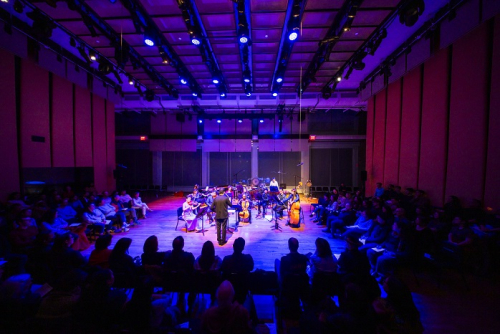
    Seeing the thirteen players and six vocalists take the stage of Zankel Hall’s intimate in-the-round configuration, one might get the sense that Les Arts Florissants is simply a small group of musicians dedicated to the French Baroque. Back in France, however, this group is just one component of a multifaceted institution that includes early music performance, music pedagogy, professional development for young singers and instrumentalists, a historic country house with fanciful Baroque-style gardens (themselves home to many of the group’s activities), training for gardeners, and a garden studies research center. Christie himself (an American, mind you, who left the States as an objector to the Vietnam War) is the godfather of this musical-cultural web.

    Tuesday’s performance was a testament to the group’s decades-long legacy of learning and teaching, its total grasp of this body of music, and the kinship of its members, who played and sang together like family.

    CH11515040

    The chosen excerpts reveal the dramatic directness and emotional turbulence of French Baroque opera. We heard none of the repetitive music of Italian da capo arias or strophic forms. Instead, we heard through-written works that interweave recitative dialogues and monologues with airs and duets. The transitions between air and recitative were at times fitful and at times seamless, but always served a clear dramatic function. That formal range and psychological charge were on display in the excerpts from Charpentier’s 1693 Médée, where a dialogue between Médée and her confidante Nérine is interrupted by outbursts of jealousy and vengefulness. This all culminated in the aria “Quel prix de mon amour”, sung by mezzo-soprano Rebecca Leggett, a lamentation undergirded by fleeting but searing dissonances in the orchestra.

    Another characteristic of this music is its emphasis on French diction. Lully, the favorite composer of Louis XIV, explicitly sought to differentiate his music from the florid and opaque sounds of Italian opera of the time. In excerpts from the later acts of Atys of 1676, the tenor Bastien Rimondi sang with clarity and shapely elegance as he communicated his character’s yearning and anguish.

    The highlight of the program was Rimondi’s “Règne, Amour” from Rameau’s Pigmalion (1748). Rameau’s opera music, which dominated the evening, was presented simultaneously as a development of Lully’s legacy as well as an innovation upon and a perversion of it. In the Pigmalion excerpts we hear varied instrumental colors, free-spirited use of the recorders and reeds, heavy basso continuo inversions that drive harmonic motion, and a Handelian rhythmic motor. Rimondi sang his part with pure joy. His exquisitely crisp diction permeated ornate passages and more straightforward melodic lines, never hindering a sweet, clear tone and blooming vibrato on sustained notes.

    The program concluded with two scenes from Rameau’s 1735 Les Indes galantes, the flagrantly cancelable opera-ballet featuring unrelated tales of exotic places and their inhabitants. Both scenes were drawn from the act “Les sauvages” depicting North American landscapes and natives. One might think the inclusion of the “Forêts paisibles” chorus to be pandering to the New York audience, but this scene also includes the famous dance of the savages which serves as Les Arts Florissants’s frequent sendoff at the end of their concerts. They tossed off this music with swung beats and confident restraint.

    CH11515089

    As an encore, Christie and Les Arts Florissants offered the quartet “Tendre amour” from the third act of Les Indes galantes (which Rameau cut from the opera after its first performances). Christie described this music as “one of the most beautiful pieces of the eighteenth century” and indeed it was gorgeous and pastoral with vocal lines floating high in the air. It was a birthday gift from Christie to the audience.
    CH11515067

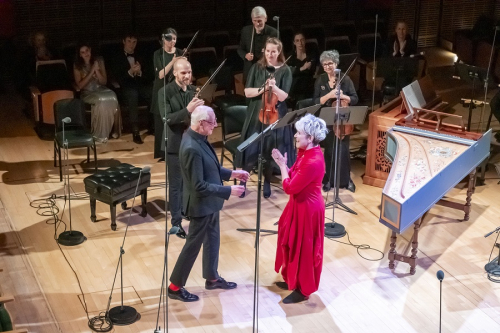
    Above: Maestro Christie greets Joyce DiDonato; photo by Richard Termine

    But the ensemble members had something else up their sleeve. The star mezzo-soprano Joyce DiDonato emerged onto the stage and lavished praise on Christie, whom she met while rehearsing for his 2004 production of Handel’s English-language opera Hercules. In tribute to Christie, she and the ensemble presented “As with rosy steps the morn” from the oratorio Theodora (why didn’t they choose something from Hercules?). After a full program of Charpentier, Lully, and Rameau, DiDonato’s Handel seemed monumentally scaled, possessing a different species of substance and intensity. The strophic form of this piece (repeating sections of music with new verses of text) set an obvious contrast with the French music of the main program and put the French works’ organic, dramatic, and transparent value into focus.

    The program was, after all, a didactic showcase of French Baroque music and its performance techniques. Among early music groups, Les Arts Florissants is a champion of craft, forgoing the temptations to produce the highly biting, peppery sound that is so en vogue these days. Surrounding the ensemble on all sides, it was as if we the audience could simply enjoy overhearing a reading of this music being shared among friends.

    Performance photos by Richard Termine, courtesy of Carnegie Hall

    ~ Lane Raffaldini Rubin
  • Roomful of Teeth/Tambuco Percussion Ensemble

    CH11514760

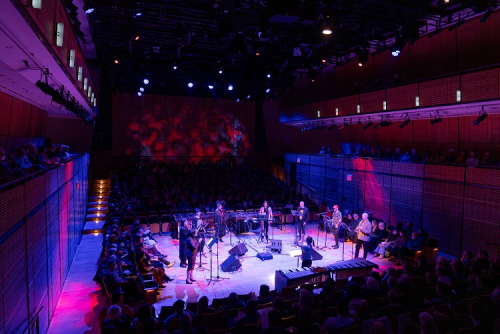
    Above: performance photo by Jennifer Taylor

    ~ Author: Lili Tobias

    Saturday January 25th, 2025 – Tonight, I had the joy of hearing Roomful of Teeth and Tambuco Percussion Ensemble perform at Carnegie Hall’s Zankel Hall. Between the two ensembles, I got to hear music by six different composers, from familiar favorites of mine like Caroline Shaw, to names that were completely new to me (but who I will certainly listen to again)

    Both Caroline Shaw’s and William Brittelle’s pieces were exceptionally chaotic—which is completely on brand for Roomful of Teeth! The eight singers performed a vast variety of vocal techniques and styles, including but not limited to guttural croaking sounds, throat singing, really really high notes, muttering repeated syllables, low glissandos, and speaking normally. Shaw’s piece, The Isle, in which she set text from Shakespeare’s The Tempest, also contrasted the chaos at times with more homophonous singing—hearty choral triads and flowing solo melodies—which provided a good balance so we could still hear the words.

    The text of Brittelle’s piece, Psychedelics, was very different. He explains in the program notes that the surreal collection of words in this music are “meant to form a swarm of images, not a literal, linear narrative.” And they certainly did just this! As I listened, I caught snippets of the words, such as “I watch for dogs,” and these fragments created a very joyful experience in their meaninglessness. Throughout this piece, I never knew what to expect in the best possible way!


    The bridge between the vocal portion of the concert and the percussive potion was the composer Gabriela Ortiz. Ortiz is Carnegie Hall’s composer in residence this year, and both Roomful of Teeth and Tambuco Percussion Ensemble performed a piece of hers in this concert.


    In Canta la Piedra-Tetluikan (of which this would have been a world premiere performance if not for the group of elementary school kids who got to sit in on a rehearsal), Ortiz set the words of poet Mardonio Carballo. And these words were in Nahuatl! Nahuatl is a language (sometimes considered a group of languages) spoken in Central Mexico, and I was very excited to hear it in a musical context. Ortiz’s setting of Carballo’s poem was joyously animated. The mesmerizing repetitions—“atl, atl, atl” (water, water, water), “tlitl, tlitl, tlitl” (fire, fire, fire), and more—and energetic (and very difficult!) rhythms grounded the music in the natural world. 


    I had been especially looking forward to hearing the voiceless alveolar lateral affricate (tɬ), since that sound is common in many variants of Nahuatl (and doesn’t appear whatsoever in English), but if the singers were singing it, the distinctly fricative sound didn’t come across prominently. Perhaps they were singing in a variety of this language that doesn’t include this consonant though, and no matter what, it was very exciting to hear music in Nahuatl!


    CH11514773


    Photo by Jennifer Taylor


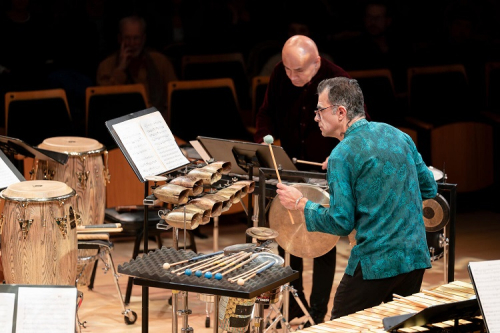
    After intermission, Tambuco Percussion Ensemble performed the movement “Liquid City,” from Ortiz’s 2014 piece, Liquid Borders. The four members of the ensemble played facing each other in a circle (the perfect set-up for the central stage!) and the blooms of sound radiated outwards into the hall. The diverse timbres of the instruments certainly reflected the diverse borders of urban and rural Mexico which Ortiz aimed to reflect in this music, the sounds mixing and shifting into unique and beautiful shapes.


    CH11514777


    Photo by Jennifer Taylor


    The other three pieces on the program were very different in that they were far more homogenous in terms of the instrumental inventory: Jorge Camiruaga’s Cuarteto en chico for four drums, Leopoldo Novoa’s Sábe cómo e’? for four guacharacas (and briefly one marímbula), and Steve Reich’s Mallet Quartet for two vibraphones and two marimbas. While these pieces were certainly reigned in the chaos compared to the first half of the program, they also proved that you could still create a wide variety of sounds and musical textures even among more similar instruments. 


    CH11514766


    Above: Gabriela Ortiz, photo by Jennifer Taylor


    It was especially fun to see how many of the composers on the program were in the concert hall enjoying the music alongside me and the rest of the audience! I enjoyed this concert so much, and I have a feeling they did too.

    ~ Lili Tobias

  • Ensemble Connect ~ Up Close

    CH11514851

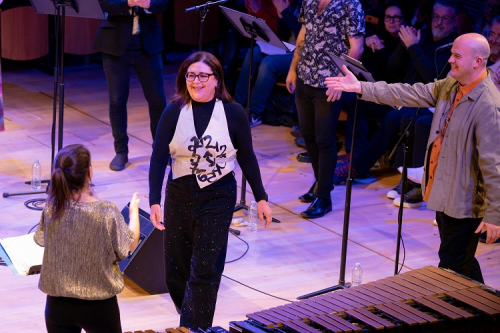
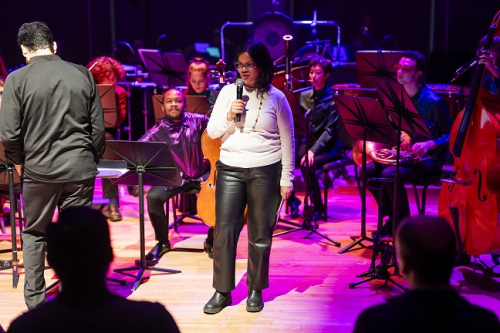
    Above, composer/curator Gabriela Ortiz welcomes the crowd; photo by Chris Lee

    ~ Author: Oberon

    Monday January 27th, 2025 – Ensemble Connect is a joint program of Carnegie Hall, The Juilliard School, and the Weill Music Institute in partnership with the New York City Department of Education. In tonight’s Up Close presentation, curated by composer Gabriela Ortiz, the young artists of the Ensemble performed at the Hall’s Resnick Education Wing, an intimate venue which I’d never been aware of until Carnegie’s Meg Boyle gently twisted my arm into giving it a try.

    CH11514901

    Above: Chelsea Wang and Ryan Dresen playing Ortiz; photo by Chris Lee

    The evening opened with the New York premiere by of Pigmentum by Ms. Ortiz, a four-movement work presented in collaboration with visual artist Martirene Alcántara that was performed by Ryan Dresen (horn) and Chelsea Wang (piano) whilst a film by Ms. Alcántara was shown on a hanging screen.

    Each of the work’s four movements is named for a shade of blue, the first being Indigo. This music veered from dreamy to jazzy; some of the piano’s tones had been ‘prepared’, giving a quirky, off-kilter sound. Mr. Dresen’s playing has beauty and power throughout the range, and passages played with a mute were intriguing. Chime-like piano notes introduce Lapislazuli, with horn calls leading to a duet in the instruments’ lower ranges. The music gets wild, and a sudden ending takes us by surprise. The rippling delicacy of Ms. Wang’s playing in Cobalto is joined by the dusky sound of the horn. The music gets grand, then pensive. In the concluding Ultramar, Mr. Dresen’s horn rambles and stutters. There is a false ending, and then the enigmatic sound of toneless air being blown thru the horn. 

    CH11514949

    Mexico’s Carlos Carlos Sánchez-Gutiérrez presented Luciérnagas (photo above Chris Lee) for which three alumni of the Ensemble – Yasmina Spiegelberg (clarinet), Joanne Kang (piano), and Mari Lee (violin) – joined percussionist de luxe Oliver Xu and cellist Frankie Carr, who introduced the piece. A chord introduces the insectuous music of a swarm of fireflies, whilst the cello vibrates. The clarinet trills, the sneaky piano intones, cello and clarinet sound in unison. The xylophone heralds an explosion causing the violin to go crazy. A rhythmic passage turns spacey, thunder rolls, the bass clarinet rumbles deeply whilst awesome percussion motifs sound. An intriguing marimba solo is interrupted by an urgent one-note motif from the violin, and then the xylophone goes off like a fire alarm; the insistent piano sounds urgently. Silence falls. This seemed like a perfect place to end, but no…we go on, savouring some rhapsodic playing from Ms. Kang at the piano. But then the music turns dark and scary; a cymbal crash leads to a total wipe-out. Somehow, thru all of this, it was the cellist who seemed the central figure, both thru his noble playing and his poetic face.

    For “La Hamaca” from La Hamaca (NY Premiere) by the Venezuelan composer Ricardo Lorenz, the players were Chelsea Wang (piano), alumna Mari Lee, and cellist Thapelo Masita. The music opens softly with the piano joined by the violin; the cellist enters with a pinging motif before taking up a gorgeous theme wherein Mr. Masita’s tone was matched by the sweetness of the violin and magical sounds from the piano. The music turns passionate, then staccati introduce new themes, with rich playing from the cello. The staccati resume before Ms. Lee’s violin sings on high; dense harmonies emerge before an agitato outburst. A bouncy rhythm springs up…fabulous playing from the trio as the music wafts to heaven and then fades away.

    CH11514870

    Above, in a Chris Lee photo: Joanne Kang and Oliver Xu playing the Cuban composer Ileana Perez Velazquez’s Light echoes, having its New York premiere this evening. This piece gave us a virtuoso percussion display from Oliver Xu, who moved amidst his array of instruments with assured grace, as if in a choreographed solo. No less marvelous was Ms. Kang, who was back at the piano to make more magic. Bass drum rolls, bongo beats, and gong tones set off a jazzy piano theme. The swaying rhythm gets big as Mr. Xu moves swiftly from xylophone to ancient hanging bells to every type of drum. Ms. Kang  commences a keyboard interlude, laced with various percussive comments. Suddenly, there’s a kind of cabaletta, fast and florid, before things quieten and the mysterious gong sounds; a rhythmic coda ensues. Brilliant playing from start to finish!

    CH11514918

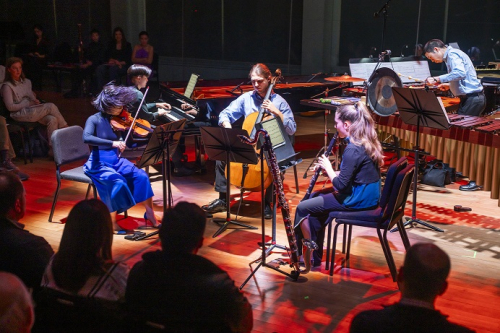
    The Costa Rican composer Alejandro Cardona’s Axolotl (a US premiere) brought three wind players to prominence: Ms. Spiegelberg (clarinet), Anjali Shinde (flute), and Joseph Jordan (oboe) with Joanne Kang at the piano, Mr. Carr with his cello, and the lovely violinist Isabelle Ai Durrenberger (photo above by Chris Lee).  

    CH11514915

    Above: Joseph Jordan and Anjali Shinde, photo by Chris Lee

    The piece develops gradually clarinet and oboe are heard in sync, and the piano music is jazzy. Stillness, and then a haunting flute passage is heard over delicately sustained string tones creating a wonderful air of mystery. The clarinet gets jazzy as a sexy beat rises; more jazz from the violin, whilst the cello is strummed like a guitar. Wailing clarinet and oboe slowly sputter out, and a thoughtful flute solo ensues, with piano and cello commenting. Bass clarinet and flute converse over the deep cello and piano; these voices then make an incredible fade-away.

    CH11514944

    The concert ended with the world premiere of Gritos de fuego, patrias de papel by the Colombian composer Carolina Noguera (above, photo by Chris Lee). This work brought together the largest ensemble of the evening, with Leonardo Pineda conducting. Joining Mlles. Shinde, Spiegelberg, Wang, Ai Durrenberger, and Mssrs. Jordan, Dresen, Xu, and Masita were flautist Catherine Boyack, bassoonist Marty Tung, violist Ramon Carrero-Martinez, and bass-player Marguerite Cox.

    CH11514858

    Photo: the ensemble playing the Noguera, photo by Chris Lee

    From an explosive start, announced by three massive strikes of the bass drum, eerie strings emerge; the flutes blow air as more thunder claps, wailing winds, and rumbling piano depict the storm, which gives way to the amazingly subtle and sustained violin supported by cello tremelos. A long flute trill sounds as the oboe blows air and a quiet sense of ecstasy settles overall. The piano and eerie shimmers from the violin bring on a repetitive 4-note rising motif from the violin. From a perpetual quietude, raindrop piano notes accompany a sweet and serene solo from Ms. Ai Durrenberger’s violin. The bassoon chimes in, the viola plays a repeated phrase. Big chords are repeated, and then the music vanishes into thin air as a sensationally sustained cello tone from Mr. Masita fades to silence.

    CH11514920

    Above: the composers take a bow; photo by Chris Lee

    Audience members lingered to greet the artists and the composers; except for congratulating Mr. Masita, I was too shy to speak to anyone. But I did have a chance to meet and thank photographer Chris Lee, whose remarkable gift for capturing the essence of Carnegie Hall concerts I have been lucky enough to share on my blog these past few years.

    CH11514895

    Above, the finale: this, and all the performance photos, are by Chris Lee, courtesy of Carnegie Hall

    ~ Oberon

  • Zwilich & Barber @ Carnegie Hall

    Zwilich

    Above: composer Ellen Taaffe Zwilich

    ~ Author: Oberon

    Saturday December 28th, 2024 – The New York String Orchestra were back at Carnegie Hall this evening, following up their Christmas Eve concert in the same Hall with a program of Zwlilich, Barber, and Brahms. I’d been down with flu-like symptoms for a couple of days, and debated whether I should attend tonight’s concert, but I couldn’t pass up a chance to experience the Barber violin concerto played live in this hall. Whether I could make it to the evening’s end remained to be seen.

    1983 Pulitzer Prize-winner Ellen Taafe Zwilich’s composed her Prologue and Variations for string orchestra on a commission from the Chattanooga Symphony, which premiered it under the baton of Richard Cormier in 1984. In her remarks on this piece, the composer spoke of her wish to celebrate “the special sonorities, character, and expressiveness of the string orchestra”. In tonight’s performance, the young players of the New York String Orchestra truly did the composer proud. 

    The violins open the piece, with start-and-stop phrases, soon picked up by the cellos. The violins then soar over an insistent beat. After a passage of luminous softness, the celli and basses cushion sizzling violins motifs. The opening theme recurs, and then a series of slow, mysterious sustained tones lead to a full stop.

    An animated section quietens to a slightly ominous lulling atmosphere. Then an agitato springs up, full of scale-work and insistent bowing. The music turns pensive, with brooding celli and deep basses. A trudging rhythm and fading violins lead to the work’s eerie ending.

    Enthusiastic applause greeted the musicians, and then Maestro Laredo gestured to Ms. Zwilich in her first tier box to rise for a bow; well-deserved bravas greeted the composer, now in her 85th year.

    Koh jpg

    Above: Jennifer Koh – I borrowed this stunning photo from her Facebook page

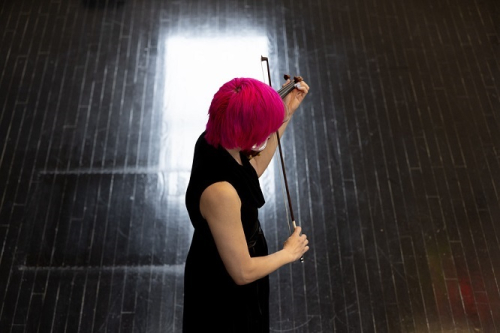
    Violinist Jennifer Koh then took the stage for the Barber, my enduring favorite among all the violin concertos I have heard thru the years. Ms. Koh looked striking in a silver-gray gown, her hair a bright, fiery red.

    This was Barber’s first effort in the concerto genre, written on a 1939 commission for the then-astonishing sum of $1000. When the originally scheduled soloist, Iso Briselli, found the concerto’s third movement too short and inconsequential, the work was premiered in 1941 by Albert Spalding; it was great success, and became one of Barber’s most beloved works, perhaps second only to his Adagio for Strings.

    Aside from concert performances, I have heard this music many times at New York City Ballet, where in 1988 Peter Martins premiered his ballet of the same title at the Company’s American Music Festival. The  ballet brings together a pair of ballet dancers and a pair of bare-footed modern dancers. The original cast starred Merrill Ashley and Adam Lüders as the classical couple, and Paul Taylor Dance Company’s delightful Kate Johnson and the charismatic choreographer/dancer David Parsons as the modern couple. Tonight’s performance was spectacular both for Ms. Koh’s fascinating way with the music, and for Maestro Laredo’s savvy exploration of the score, which allowed us to savour the composer’s gift for orchestral detail.

    Ms. Koh’s timbre has a vast colour-palette, ranging from burnished purple to shimmering silver. The very opening note of the piece always intrigues me, as Barber has the piano intone the first phrase along with the violin; Bo Zhang, at the Steinway, highlighted the keyboard’s participation throughout the concerto. 

    Ms. Koh’s playing of the familiar opening melody immediately seized my imagination; her tone has a special, spiritual quality that always gives meaning to the music. The gorgeous main theme, played by the entire orchestra, inevitably stirs my soul. Oboe (William Dunlop) and clarinet (Keyu (Frank) Tao) sing clearly over a steady pulse; violin and piano mesh, Ms. Koh rising to a shining top note. Pianist and violinist unite. The music turns grand, with a huge build-up and then my favorite moment of all: a dramatic plunge to the basses’ deepest notes. Now Ms. Koh’s violin hovers on high, descends, rises again to a delicate, suspended note; her cadenza is entrancing. Oboe, clarinet, and timpani draw us on to the movement’s conclusion. Throughout, the pianist has managed to be both prominent and unobtrusive…really impressive.

    Mr. Dunlop’s playing of the oboe solo that opens the Andante was hauntingly beautiful. The celli take up the theme, the basses sound richly, the horn solo (Engelberth Mejia-Gonzalez) glows. Out of the marvelous sonic blend, Ms. Koh’s violin rises poignantly to a shimmering trill as the trumpet (Bailey Cates) and piano interject before the violinist takes up the andante‘s opening melody with heart-rending passion. A sense of grandeur fills the hall. But then, a loudly dropped object somewhere upstairs killed the movement’s marvelous finish. Why do these things always happen at the worst possible moment?

    The timpani commences the final, brief Presto, in the course of which Ms. Koh plays what feels like thousands of notes with amazing dexterity and commitment. The celli scamper up the scale. So many notes!  All this rhythmic energy comes to a sudden halt after a final violin flourish.

    The audience cheered Ms. Koh’s intense and thrilling performance. My companion – who had played the Barber in his schooldays – and I were feeling a kind of elated exhaustion, and so we took leave of Carnegie Hall for 2024.

    ~ Oberon

  • Christmas Eve 2024 @ Carnegie Hall

    Mozart

    ~ Author: Oberon

    Tuesday December 24, 2024 – I spent Chrstmas Eve with a dear, long-time friend at Carnegie Hall, where the The New York String Orchestra were offering their customary Christmas Eve concert. The all-Mozart program brought us an overture, a concerto, and a symphony – all by the Master, and all beautifully played by the young musicians of this large and unique orchestra.

    Maestro Jaime Laredo opened the evening with the overture to The Impresario, a comic singspiel which Mozart composed in 1786. This overture is short…I might even say too short!

    Morales

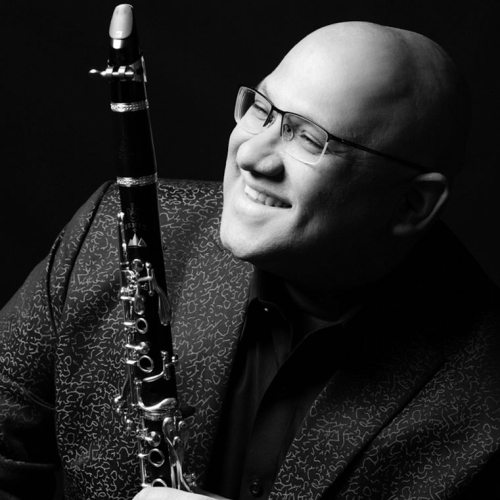
    Ricardo Morales (above) then took the stage as soloist in Mozart’s heavenly Clarinet Concerto. I’ve never forgotten hearing music from this celebrated piece for the first time: in the film Out of Africa, Baroness Blixen (Meryl Streep) and Denys Finch Hatton (Robert Redford) are on safari; Finch Hatton has brought along a gramophone, and he puts on an old 78 rpm of the concerto, which attracts a pair of curious monkeys who – after listening raptly for a few moments – attack the gramophone.

    The first movement, Allegro, has a pulsing, melodious start. Dulcet clarinet roulades immediately introduce us to Mr. Morales’ mastery of dynamics, and his gift for incredible subtlety in his playing. His silky-smooth sound is captivating, and his agility astounds, with  fabulously clear scale-work and a charming passage where he deftly bounces from low to high notes. A mini-cadenza leads to the movement’s finale, where the Morales clarinet warbles like a magical bird over the orchestra’s plush playing.

    The Adagio – the heart of the concerto, and perhaps of Mozart’s entire oeuvre – introduces the clarinet’s simple but heartfelt melody, soon taken up by the orchestra. A fresh, wide-ranging theme evolves, in which Mr. Morales’ control and breath support are mind-boggling to experience. Following a brief cadenza, the main theme returns, hauntingly lovely; a heavenly trill from the clarinet draws the movement to a close.

    The concerto’s final Rondo has a sprightly start; Mr. Morales commences a flow of fantastical fiorature. The orchestra has an exotic, minor-mode passage, and then the clarinet’s wide range – from gleaming highs to velvety low notes – is explored in colorful playing. A magical performance, full of wonders. Bravissimo, Mr. Morales! 

    Symphony No. 36, “Linz”, closed the evening. Mozart was en route to Vienna when he stopped at Linz to visit an old friend, Count Thun-Hohenstein. On learning that a concert was scheduled just 5 days after his arrival at Linz, Mozart worked feverishly to compose a new work for the occasion: the result was a symphony in C-major, which soon earned the nickname the “Linz” Symphony.

    The first movement has a regal start. In the ensuing melody, bassoon and oboe stand out. A wistful mood sets in for a bit, then more joyous music sounds…with an odd rhythmic echo of Handel’s Hallelujah chorus. The music flows on, by turns thoughtful and grand.

    The ensuing Poco adagio begins elegantly. The music darkens, but only slightly, with the timpani evoking a sound of distant thunder. Somber moments alternate with courtly ones. The third movement – Menuetto – feels stately and grand at first, then becomes a conventional minuet, with some outstanding playing by bassoonist Laressa Winters.

    Mozart’s chose a Presto rather than a Rondo for the symphony’s finale, wherein swift and gracious themes alternate with lyrical lulls.

    Heading to the train home, I asked my companion if he felt that Mozart sometimes went on and on in his symphonies – something one rarely feels in his operas. He replied: “I was just thinking the same thing!” 

    ~ Oberon

  • An Eric Whitacre Holiday @ Carnegie Hall

    Cms-1 jpg

    ~ Author: Lili Tobias

    Tuesday November 26th, 2024 – I don’t celebrate Christmas, but I do love the traditions of music written for the holiday, especially when that music is choral! So this past Tuesday, I attended An Eric Whitacre Holiday at Carnegie Hall. This annual concert is a celebration of Whitacre’s Christmas music, his Christmas-adjacent music, and some other Christmas music by different composers (including Melissa Dunphy who was in the audience!).

    Whitacre himself conducted the Distinguished Concerts Singers International (DCSI), part of Distinguished Concerts International New York (DCINY), which produces concerts around New York that bring together singers from around the globe. This concert featured two different 250-member choirs, accompanied by pianist Kelly Yu-Chieh Lin and the Distinguished Concerts Orchestra. These musicians had only been rehearsing all together for the past two days, but they performed so well together that the short time wasn’t at all apparent. I was impressed with the clarity of the singers’ diction, as well as their ability to reach incredibly low volumes despite how many of them there were. I always enjoy the sound of a really large choir too, since the diverse array of different voices actually enhances the blend of sound.


    Whitacre is best known for the enchanting harmonies he uses in his music, in particular his tone clusters. The majority of the program for this concert was indeed very harmony-focused and, overall, very slow moving. While this aspect of Whitacre’s music is certainly beautiful, I find that his music really shines when it’s faster and more rhythmic. There were a few moments of quick music that I absolutely loved, including in the “An Unexpected Turn” scene from his opera The Gift of the Magi. In particular, Whitacre is really good at utilizing odd time signatures to drive the music forward while still maintaining the flow. These moments were a refreshing change, and I bet the singers had so much fun singing them too!


    Thumbnail_image0-48


    As I briefly mentioned earlier, this concert also included Whitacre’s Christmas opera, The Gift of the Magi. This was actually the world premiere of the orchestrated version, orchestrated by Evan L. Snyder and Whitacre. I was impressed with how the staging was done, given that most of the stage was taken up by 250 singers and a small orchestra. The action took place in the areas on either side of the orchestra, so the characters could travel across the stage for the different scenes. The singers also used the conductor’s podium to sit on or lay down props such as gift boxes. I felt that the production was just right for the venue, and the singing was wonderful too!


    This concert had an extremely warm and welcoming atmosphere. It was a family affair all around, as the audience was largely made up of the choir members’ relatives coming to support them. And not only that, but Whitacre’s wife, soprano Laurence Servaes, starred as Della in the opera, and his son (for whom he had written Goodnight Moon) was in the audience. While I won’t be celebrating Christmas this year, I certainly celebrated an Eric Whitacre holiday on Tuesday night!


    The performance photos are by Dan Wright.


    ~ Lili Tobias

  • Concertgebouw: Schoenberg & Mahler

    Untitled

    Performance photo by Chris Lee

    ~ Author: Ben Weaver

    Saturday November 23rd, 2024 – The Royal Concertgebouw Orchestra gave two sold-out concerts at Carnegie Hall last week under the baton of its chief conductor designate Klaus Mäkelä. The second concert on Saturday, November 23rd featured beloved works by Arnold Schoenberg and Gustav Mahler.

    Between the two concerts, this evening’s playing of Schoenberg’s Verklärte Nacht, Op. 4 was the strongest performance of the orchestral works the Concertgebouw presented this week. Originally composed for string sextet in 1899, Schoenberg made an arrangement for a string orchestra and it’s become one of his most beloved and most frequently performed works. The string section of the Concertgebouw was on absolute peak form with its lush yet concentrated sound. Schoenberg’s score is by turns dark, ominous, romantic, and shimmering, and the orchestra reflected each emotion and turn with beautiful clarity. Maestro Mäkelä conducted it without a score, so it appears to be a work that is close to his heart. Maybe that’s why he managed to keep the tension throughout the entire composition. 

    When it comes to playing Mahler, I think the Concertgebouw’s only rival is the New York Philharmonic. These symphonies are close to their hearts and they perform them frequently. The Symphony No. 1 in D major received its Dutch premiere in 1903 under Mahler himself. This evening’s performance under the orchestra’s young incoming chief conductor was somewhat mixed.

    The first movement was something of a mess that echoed the very unfortunate performance of Rachmaninoff’s Symphony No. 2 the previous evening: while Maestro Mäkelä can build to a climax, he was unable to connect any of the climaxes together, the tension and structure of the music disintegrating every few minutes. So it was here, unfortunately. Low voltage would be one way to describe it, a flicker of color quickly draining into something dull and gray.

    Fortunately things improved as the performance continued, and Mäkelä managed to keep the symphony moving. The second movement is filled with sections of chamber music, interrupted by full orchestral blasts. There was some wonderful playing from individual sections of the Concertgebouw, the winds in particular covering themselves in glory.

    The Funeral March was the best part of the performance. The double bass solo (principal Dominic Seldis) was appropriately weary and somber. The mocking tune that interrupts it was nicely paced and delightfully almost jazzy. The Finale was largely well handled, but lacked enough frenzy to be truly satisfying until the very last moments.

    With Maestro Mäkelä taking over two of the world’s top orchestras – the Concertgebouw and the Chicago Symphony Orchestra – these performances left me concerned if he is the right person for these jobs at this time. But time will soon tell if the confidence he has inspired in others pays off.

    ~ Ben Weaver

  • Concertgebouw: Schoenberg & Mahler

    Untitled

    Performance photo by Chris Lee

    ~ Author: Ben Weaver

    Saturday November 23rd, 2024 – The Royal Concertgebouw Orchestra gave two sold-out concerts at Carnegie Hall last week under the baton of its chief conductor designate Klaus Mäkelä. The second concert on Saturday, November 23rd featured beloved works by Arnold Schoenberg and Gustav Mahler.

    Between the two concerts, this evening’s playing of Schoenberg’s Verklärte Nacht, Op. 4 was the strongest performance of the orchestral works the Concertgebouw presented this week. Originally composed for string sextet in 1899, Schoenberg made an arrangement for a string orchestra and it’s become one of his most beloved and most frequently performed works. The string section of the Concertgebouw was on absolute peak form with its lush yet concentrated sound. Schoenberg’s score is by turns dark, ominous, romantic, and shimmering, and the orchestra reflected each emotion and turn with beautiful clarity. Maestro Mäkelä conducted it without a score, so it appears to be a work that is close to his heart. Maybe that’s why he managed to keep the tension throughout the entire composition. 

    When it comes to playing Mahler, I think the Concertgebouw’s only rival is the New York Philharmonic. These symphonies are close to their hearts and they perform them frequently. The Symphony No. 1 in D major received its Dutch premiere in 1903 under Mahler himself. This evening’s performance under the orchestra’s young incoming chief conductor was somewhat mixed.

    The first movement was something of a mess that echoed the very unfortunate performance of Rachmaninoff’s Symphony No. 2 the previous evening: while Maestro Mäkelä can build to a climax, he was unable to connect any of the climaxes together, the tension and structure of the music disintegrating every few minutes. So it was here, unfortunately. Low voltage would be one way to describe it, a flicker of color quickly draining into something dull and gray.

    Fortunately things improved as the performance continued, and Mäkelä managed to keep the symphony moving. The second movement is filled with sections of chamber music, interrupted by full orchestral blasts. There was some wonderful playing from individual sections of the Concertgebouw, the winds in particular covering themselves in glory.

    The Funeral March was the best part of the performance. The double bass solo (principal Dominic Seldis) was appropriately weary and somber. The mocking tune that interrupts it was nicely paced and delightfully almost jazzy. The Finale was largely well handled, but lacked enough frenzy to be truly satisfying until the very last moments.

    With Maestro Mäkelä taking over two of the world’s top orchestras – the Concertgebouw and the Chicago Symphony Orchestra – these performances left me concerned if he is the right person for these jobs at this time. But time will soon tell if the confidence he has inspired in others pays off.

    ~ Ben Weaver

  • LA GIOCONDA ~ Madrid 1970

    Gulin

    Above: soprano Ángeles Gulín

    Audio-only…Ponchielli’s LA GIOCONDA from Madrid 1970.

    So fun to find this unusual assembly of singers all in one place: recalling Gulin’s NY debut in HUGUEOTS at Carnegie Hall: biggest soprano sound I ever heard…I was at Glossop’s Met debut…Casoni was my first-ever Cherubino…a young Domingo…Ruggero Raimondi, always a favorite…and Pecile’s beautifully-sung ‘Voce di donna‘…some radio static, and singers and orchestra sometimes part company…but I’ve had a blast listening to it.
     
    I have to confess: GIOCONDA has always been my favorite Italian opera. It all boils down to this: love or death! Isn’t that the essence of opera?

    Listen here.

    CAST:

    La Gioconda – Angeles Gulín; Enzo – Plácido Domingo (debut in Madrid); Barnaba – Peter Glossop; Laura – Biancamaria Casoni; Alvise – Ruggero Raimondi; La Cieca – Mirna Pecile.

    Conductor – Anton Guadagno

  • LA GIOCONDA ~ Madrid 1970

    Gulin

    Above: soprano Ángeles Gulín

    Audio-only…Ponchielli’s LA GIOCONDA from Madrid 1970.

    So fun to find this unusual assembly of singers all in one place: recalling Gulin’s NY debut in HUGUEOTS at Carnegie Hall: biggest soprano sound I ever heard…I was at Glossop’s Met debut…Casoni was my first-ever Cherubino…a young Domingo…Ruggero Raimondi, always a favorite…and Pecile’s beautifully-sung ‘Voce di donna‘…some radio static, and singers and orchestra sometimes part company…but I’ve had a blast listening to it.
     
    I have to confess: GIOCONDA has always been my favorite Italian opera. It all boils down to this: love or death! Isn’t that the essence of opera?

    Listen here.

    CAST:

    La Gioconda – Angeles Gulín; Enzo – Plácido Domingo (debut in Madrid); Barnaba – Peter Glossop; Laura – Biancamaria Casoni; Alvise – Ruggero Raimondi; La Cieca – Mirna Pecile.

    Conductor – Anton Guadagno