Tag: Constantine Baecher

  • An Evening @ New Chamber Ballet

    11229387_10153700794988571_1643682530134201836_o

    Friday November 20th, 2015 – Miro Magloire’s New Chamber Ballet presenting works by Miro and resident choreographer Constantine Baecher in a nicely-mixed programme of new and olde music – expertly played – and danced by Miro’s uniquely talented band of ballerinas. In the intimate setting of the City Center Studios, there’s a sense of immediacy – both of the music and the dancing – that no other dance company in Gotham can quite match.

    In his most recent works, Miro’s choreography has been daring in its exploration of female partnering. Tonight’s concert opened with the premiere of a full version of Gravity, excerpted earlier this season and which I’d seen in a formative rehearsal.

    First off, a salute to violinist Doori Na for his impressive rendering of “Six Pieces for Violin” by Friedrich Cerha. The venerable Austrian composer, soon to celebrate his 90th birthday, is currently in the news locally as The Met is offering a new production of Alban Berg’s LULU which Mr. Cerha completed upon Berg’s death.

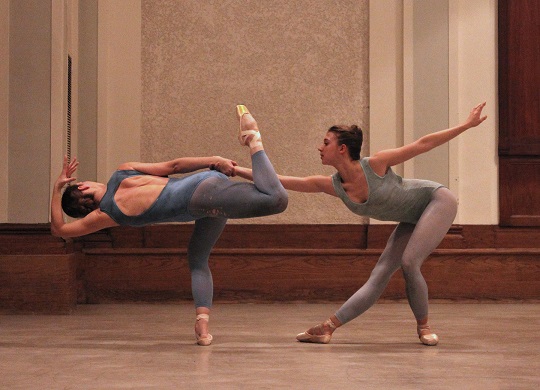
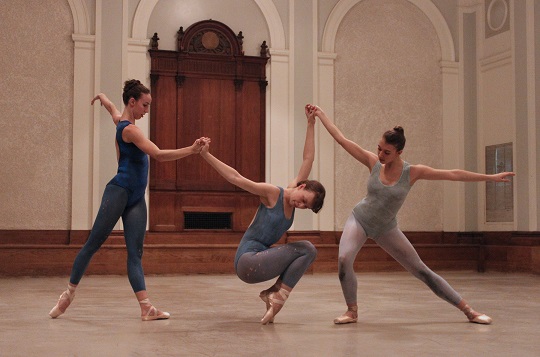
    Gravity was danced tonight by Elisabeth Brown, Traci Finch, and NCB’s newest member Cassidy Hall. The dancers alternate between posing and partnering: a duet for Elizabeth and Traci is observed by Cassidy, who then inserts herself into the dance. Elizabeth’s solo comes as the music falls silent; she then dances with Cassidy in a duet where Elizabeth, at full stretch, is nearly parallel to the floor in displaying a superb line.
    IMG_8922-edited-sm

    The dancers then polish off the ballet with a trio (Traci, Elizabeth and Cassidy, above). 

    More images from Gravity, photographed by Amber Neff:

    IMG_8883-edited-sm

    Cassidy Hall and Traci Finch

    IMG_8906-edited-sm

    Elizabeth Brown and Cassidy Hall

    Someone once wrote of Aristotle Onassis: “He was not the first man to want both his wife and his mistress.”  That very notion was the starting point of The Other Woman, Miro’s ‘classic triangle’ ballet set to a classic score: Bach’s B-minor violin sonata. 

    An en travesti Sarah Atkins, wearing a jaunty fedora, faces the age-old dilemma of the married man as he vacillates between his wife and his lover. Elizabeth Brown and Holly Curran offer contrasting attractions of face, form, and personality; in this very theatrical piece, their dancing is urgent and nuanced. The rival women confront one another while Sarah dances a space-filling solo. In the end it seems no real decision has been reached, and it feels like more chapters are yet to come before this story ends.

    Doori Na and pianist Taka Kigawa played the Bach so attractively, and moments later Taka returned play Beat Furrer’s ‘Voicelessness. The snow has no voice’ for Miro’s second premiere of the evening: Voicelessness. Taka’s playing was marvelous right from the murmuring start of the piece; he was able to sustain a pianissimo misterioso atmosphere throughout with great control. This was punctuated with the occasional emphatic high staccato.

    IMG_8328-edited-sm

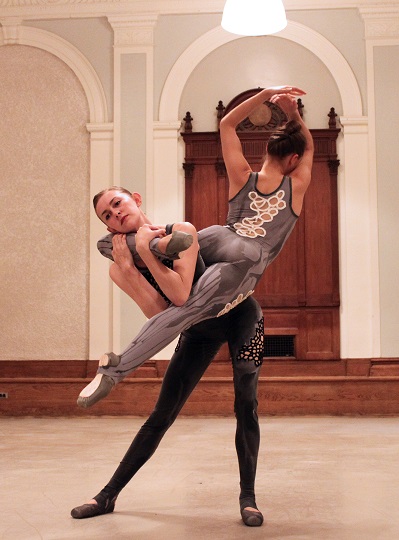
    In this duet the two dancers – Amber Neff and Cassidy Hall, (above) – perform extremely demanding and intensely intimate feats of partnering. The two girls, abetted by Taka Kigawa’s keyboard, sustained the tension of the work most impressively.

    IMG_8354-edited-sm

    Above: Amber Neff and Cassidy Hall in Voicelessness

     
    More images from Voicelessness; these photos are by Sarah Thea who also designed the costumes for four of the five works seen tonight:
     
    IMG_8170-edited-sm
     
    Amber Neff, Cassidy Hall
     
    IMG_8201-edited-sm

    Amber Neff and Cassidy Hall
     
    Following the interval, Richard Carrick’s score ‘In flow’ for solo violin provided another showcase for Doori Na as Miro’s Friction unfolded. The ballet opens in silence before Doori’s violin sounds hesitantly; the angular, sinuous music includes an alarming forte ‘scrunch’ at one point. Dancers Holly Curran and Amber Neff moved thru the intricate partnering motifs with total assurance and dealt with the technical demands Miro makes on them with cool confidence.
     
    The evening closed with Constantine Baecher’s lively and very original ballet, Mozart Trio, set to excerpts from the composer’s piano sonatas played with genial clarity by Taka Kigawa.
     
    In this ballet about beginnings and endings, the dancers speak: they speak not only of where they are and what they are doing at the moment, but also – more cosmically – of where they are in their lives.
     
    Traci Finch narrates solos by Elizabeth Brown and Sarah Atkins in turn, describing their dancing and giving us bytes of biography. In the second movement, Sarah’s solo takes an autobiographical approach (“I’m in the middle!” she calls out – of her dance, of her career, of her life?). The third movement is an abstracted trio for all three dancers, full of energy and wit, until they reach the self-declared “end of the end!”
     
    New Chamber Ballet‘s next performances are set for February 26th and 27th, 2016. More details will be forthcoming as the dates draw nigh.

  • New Chamber Ballet: Four Works

    L1550484

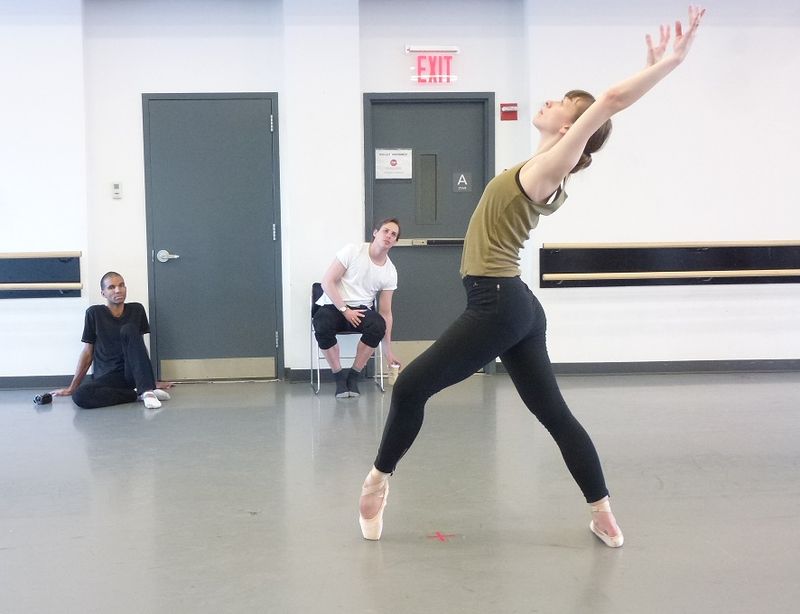
    Above: Elizabeth Brown of New Chamber Ballet rehearsing the solo Moments, observed by choreographers Miro Magloire and Constantine Baecher

    Saturday April 18th, 2015 – “Ballet is Woman,” said George Balanchine; and Miro Magloire‘s New Chamber Ballet seems to be living proof of it. Miro’s obvious delight and skill in choreographing for female dancers has resulted in a series of works which honor the ballerina tradition whilst at the same time pushing boundaries, especially in the realm same-sex partnering. Tonight, the customary New Chamber Ballet formula of women dancing in an up-close-and-personal setting to live music brought us works by both Miro and NCB‘s resident choreographer Constantine Baecher, including two world premieres.

    Now celebrating their tenth anniversary, New Chamber Ballet have always presented an ensemble of finely-trained ballerinas with vivid, individualized personalities. The current quartet maintains the high standard: these are women who are comfortable with having their audience literally within reach, able to dance with confidence and poise in an intimate setting. Their dancing is enhanced by the accomplished musicality of violinist Doori Na and pianist Melody Fader who are always ready, willing, and able to tackle whatever music Miro hands them – and that’s saying a great deal.

    Entangled, a quartet for on- and off-pointe dancers, is performed to Paganini’s Caprices expertly played by Doori Na. The girls, in Sarah Thea’s minty-green sheer costumes with a harem feeling, are paired off: two on pointe (Sarah Atkins and Traci Finch) and two in slippers (Elizabeth Brown and Amber Neff). 

    L1550289

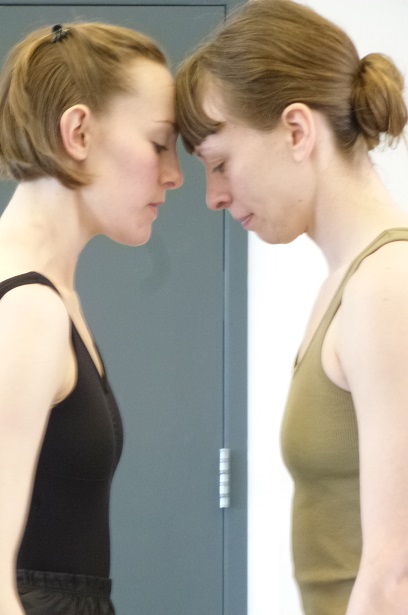
    The ballet opens with Amber and Elizabeth face to face (rehearsal image, above); they rush away from one another and then meet again – repeatedly – in an approach-avoidance sequence. Their dance becomes spastic; they struggle on the floor and there are shakes and shapes. Doori, the violinist, is meanwhile making fast and furious with the demanding Paganini score. The pointe couple appear: Sarah and Traci in stylized balletic poses with stretched arabesques and sculptural port de bras. The couples alternate; the soft-slipper girls have a shuffling little jig. As the adagio begins, the pointe pair lean into one another before they are left alone to a high violin shimmer. Innovative floor choreography follows. We half expect a faster final movement, but instead the ballet ends quietly.  

    Elizabeth Brown, a founding member of New Chamber Ballet, has been thru a serious injury episode and has come back in phenomenal physical condition and more expressive than ever. A unique dancer, Elizabeth performed Miro’s solo Moments to Salvatore Sciarrino’s Caprices 5,2, and 6. Doori Na plays the annoying (in a good way) and demanding score with touches of wit. The opening section is all about line and control, and Elizabeth here reveled in these beautiful, slow-to-still poses. The choreography becomes more animated, gestural, and space-filling, with a spirited circle of piqué turns. New Chamber Ballet audiences tend to be rather reserved, but lusty cheers went up after Moments.

    L1550245

    Above: Traci Finch and Amber Neff rehearsing Miro Magloire’s newest ballet, La Mandragore

    La Mandragore (The Mandrake) is a new duet by Miro set to Tristan Murail’s solo piano work of the same title. Melody Fader at the keyboard showed a particular affinity for this music which begins misterioso, becomes turbulent, then sinks back into eerie calm. Dancers Traci Finch and Amber Neff meet Miro’s complex partnering demands head-on; they are fearless, strong and supple as they wrap around one another, performing lifts and mutually supportive feats in an unusual mixture of power and intimacy. Miro pushes the two dancers to extremes and they respond with compelling assurance and grace.  

    The world premiere of NCB resident choreographer Constantine Baecher’s Two Tauri and A Tiger marked yet another success for Constantine, who has created several works for New Chamber Ballet over the years. Two Tauri opens with Elizabeth Brown rushing on to a stimulating Mozart theme played by Melody Fader; Elizabeth’s solo is questing and energetic. Traci Finch enters next, followed by Sarah Atkins, each dancing a restless and animated solo. The movement has a playful, windswept feeling with an aspect of childlike joy, as when Elizabeth and Traci join hands and spin mirthfully about. 

    The music pauses and we hear the dancers breathing; they re-group in silence, have a walkabout, and a bit more spinning. As Melody intones a more staid Mozart theme, the ballet becomes pensive. The girls circle around, holding hands and relying on counter-balance. This passage recalls Balanchine’s fondness for similar linkings, and also evokes Matisse’s La Danse. As the music animates, the dancers rush about and a pair will playfully drag the third as in a children’s game. This recedes into a more temperate passage with some stretching motifs. Overall, Two Tauri seems like a romping, good-natured piece; yet I feel there might be some underlying shadows, too. I’ll need to see it again to get a deeper sense if it. One thing for sure: the three dancers seemed to be genuinely having a good time dancing it.

    So nice to see Candice Thompson, Amy Brandt, Emery LeCrone, and Lauren Toole among the audience tonight.

    New Chamber Ballet will conclude their 10th anniversary season with performances on June 12th and 13th, 2015. Further details will be forthcoming.

  • New Chamber Ballet: Baecher and Magloire

    1426491_541344345952393_316149436_n

    Saturday November 23, 2013 – New Chamber Ballet‘s 2013-2014 season continued this evening with a program featuring a Miro Magloire premiere and a revised version of a Constantine Baecher ballet. As always at New Chamber Ballet, live music was an essential component of the performance: pianist Melody Fader and violinist Doori Na were in their element, particularly in the very demanding (commissioned) score by Michel Galante for Miro’s new ballet.

    In Miro’s “A Present” which opened the evening, three women (Elizabeth Brown, Holly Curran, and Amber Neff) go to great lengths to have and to hold onto a necklace which has been sent them by an unknown admirer. A note is enclosed with the gift, but we never learn who it is from or what it says. After some under-handed pilfering and a frantic chase, the bauble is destroyed and the note torn to shreds. Doori Na played a suite of melodies from Tchaikovsky’s Nutcracker, arranged for solo violin, while the three girls fought for possession of the mysterious gift.

    Another conflict ballet comes in the form of Miro’s “Sister, My Sister” wherein dancer Amber Neff is annoyed – to the point of becoming homicidal – by her sister, soprano Charlotte Mundy. The Morton Feldman score calls for Ms. Mundy to vocalize on single, sustained notes. This gets under her sister’s skin. Melody Fader and Doori Na (unseen) played the angular Feldman score as the two women battled it out.

    “Stay With Me”, the new Magloire/Galante collaboration, is perhaps Miro’s finest achievement to date. There are narrative undercurrents but no specific scenario is suggested: the ballet is essentially two duets – the first for Holly Curran and Traci Finch and the second danced by Ms. Curran with Sarah Atkins. The girls wear simple tights and halter tops. In the first duet, Holly and Traci dance an entwined mirror-image adagio; Traci at one point executes a wonderfully fluid backbend. Sarah Atkins silently observes the end of the Traci/Holly duet and then she takes Traci’s place – as the latter walks away – and continues the dance with Holly. The choreography presents a stylized language of intimacy, and the mystery of who these women are and what they mean to one another remains unsolved as the ballet ends.

    IMG_20131117_220510_edited

    Above: dancers Holly Curran and Traci Finch in a rehearsal image by Amber Neff

    The Galante score for “Stay With Me” is fascinating and it challenges the two musicians in terms of both technique and stamina. The piece opens with both piano and violin playing in the highest range. Doori’s violin slithers up and down rapid chromatic scales or lingers for measure after measure on a single pinging tone, while Melody at one point produces a series of sweeping downhill glissandi covering the full keyboard; elsewhere the piano writing favors ethereal high shimmers. Kudos to these two musicians for their spell-binding performance. “Stay With Me” is a ballet I will want to see and hear again soon.

    Constantine Baecher’s “Allow You To Look At Me” was originally a sort of joint-biography of Mr. Baecher and dancer Elizabeth Brown and their long-time association. In tonight’s revision, now titled “Allow You To Look At Me Again” that intensely personal element has been discarded in favor of a more generalized narrative about what it means to perform and to expose oneself to public scrutiny. Narrator Jonathan Parks-Ramage now reads the biographies of each of the three participants – Ms. Brown, Holly Curran and Mr. Baecher – rather than the former poetic story of Constantine and Elizabeth’s mutual admiration. At the piano, Melody Fader plays familiar melodies which underline the personal facets of each dancer’s self-view. The solo for Elizabeth Brown, danced to Debussy’s ever-poignant Clair de Lune, was the evocative apex of the ballet and a lovely portrait of this dictinctive dancer. The work, though now less personal, remains powerful.