
Above: Curtis Stewart & Kebra-Seyoun Charles
~ Author: Shoshana Klein
Wednesday October 30th, 2024 – I’ve had a thing about the concept of borders since the US border patrol incinerated my innocent house plants at the US Canada border in 2022. The name of this concert by the American Composer’s Orchestra was “The New Virtuoso: Borders” and at the beginning, Curtis Stewart framed the concert in a way that sounded really great. He talked about using virtuosity in new ways, rethinking the way the instruments work, and considering the use of borders. This included the concept of good borders (like healthy boundaries) versus harmful borders – like those used to start wars, and those that mark our identities without causing harm. I really wondered if the music would live up to this deep description.
The program:
Michael Abels: Borders
Kebra-Seyoun Charles: New Work (ACO Commission, developed via EarShot CoLABoratory/World Premiere)
Curtis Stewart, Embrace (ACO Commission)
Paul Novak, Forest Migrations (ACO Commission/World Premiere)
Victoria Polevá, The Bell
The first piece was by Michael Abels, who has written the music to a bunch of blockbuster movies. The description of the piece and the inspirations for it that was printed in the program was beautiful – the idea was that in the first movement, the guitar is within the borders of the bar lines and in the second movement it’s not. The second movement also depicts a child running – sometimes in joy and sometimes in fear. It was a little hard to hear all of that in the music but in the second movement the guitar was definitely leading more and there were complicated rhythmic sections where the guitar and orchestra were definitely in different meters, which was a cool effect.
The Paul Novak piece “Forest Migrations” was about trees and ecological borders – he used the orchestra of the metaphor for forest and forest migration caused by climate change. He described how the movement of the piece would be slow – each player playing one at a time, and also mentioned that musicians owe a debt to the trees that their instruments are made of, which I thought was really interesting. I really liked the concept but I was not convinced that the effect was going to be unique. In reality, it was really well done but not what I expected from the description – there was a lot more movement and melody than I was expecting. I like the way the concept of borders were explored and discussed in this new way, but once again, I was not sure I heard it in the music the way it was described.
Before the start of Kebra-Seyoun Charles‘ piece, Curtis Stewart asked if they wanted to say anything else about it and they said “have fun.” The piece was all about blending musical styles – so mostly genre borders were those being addressed. There was harpsichord in the orchestration, which was really cool juxtaposed against some of the other musical styles that were played, and in the first movement the piece kept falling into a sort of Bach sound. The idea of the first movement was walking down the street in New York and catching snippets of lots of different things and I think it achieved that relatively well. The whole piece was very virtuosic and seemed really technically difficult for the bass soloist (though it was the composer, so they did a great job and obviously knew what they were getting into!). The second movement started very schmaltzy and almost sounded like a quote from something. Charles seemed to be having fun and they actually got the orchestra to sound kind of raucous in a way that you don’t hear often in a concert hall, which was refreshing.
The Victoria Poleva piece had dark and interesting sound worlds – it definitely explored the concept of a bell and the concept of war, though in reality a lot of the peace was actually really uplifting and bright. Another thing that was bright was the soloists dress which was right yellow and sparkly! This piece felt a lot more cinematic than Michael Abel’s piece, ironically. One movement was almost entirely an ascending major scale with various harmony changes. There were some really cool whistling wind whistling sounds going along with string string sounds that were like ghost noises. It was kind of interesting that this Ukrainian composer who mentioned Ukraine and mentioned the war didn’t really mention borders, though maybe it’s just implicit enough that it wasn’t necessary.
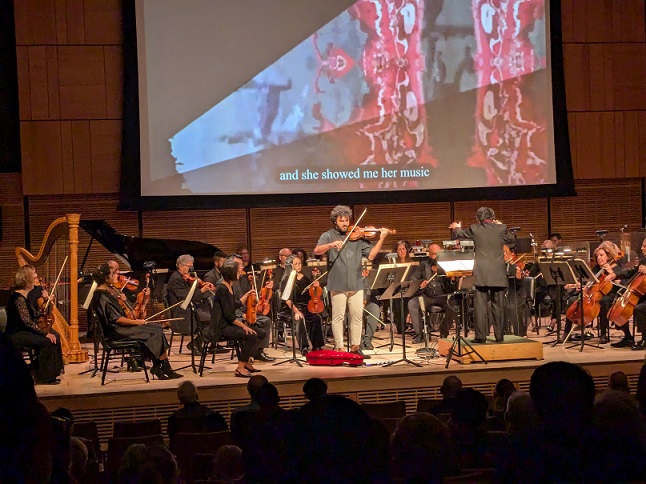
The last piece was by Curtis Stewart (above), who is also the artistic director of the ACO. This was probably the most involved piece of the program. There was a video and there was audio recording and there was audience participation! I’m always impressed when a composer tries to incorporate audience participation. In this context it worked pretty well, we basically sang chords in a progression. I wasn’t that much of a fan of the video but having the audio was nice. It was a compilation of his mother’s voice talking about music, interspersed with the composers from the concert and school kids from the ACO’s young composer program answering the same questions that she had. One of those questions that he mentioned before he started stuck with me was “how does music carry you through the changes in your life.” The piece was less full of electronics than I was expecting given his setup, but I did really like the music.
Conductor Mei-Ann Chen, who I’ve heard great things about, seemed like a dynamic, clear, and energetic leader who would be fun to play under. Overall, I suppose the theme of the concert for me was something along the lines of “great thoughts and concepts that don’t always come through in the music” but in some ways that’s par for the course in new music, and honestly I still prefer it to a lack of contextualization or tying things together – I love a concert that ties ideas together and brings up relevant issues. Many things were tried and many of them were successful.
~ Shoshana Klein
 Oberon's Glade