Tag: Danish String Quartet

  • Danish String Quartet @ Chamber Music Society

    Danish qt

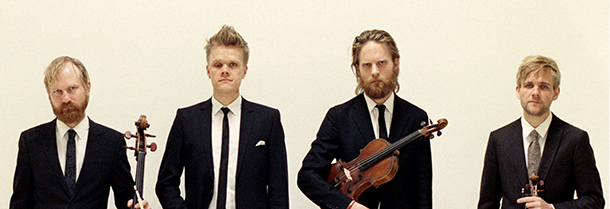
    Above: the Danish String Quartet, photographed by Caroline Bittencourt. From left: Rune Tonsgaard Sørensen (violin); Fredrik Schøyen Sjölin (cello); Frederik Øland (violin); Asbjørn Nørgaard (viola)

    NOTE: I again apologize for the “look” of this post. Due to a prolonged downtime at Typepad, the photo may not appear.

    Sunday October 30th, 2022 – How wonderful to hear the Danish String Quartet live again! Their iconic sound is really quite unlike that of any other string quartet, though how to describe what actually sets them apart is nearly impossible. You simply have to be there.

    This evening they brought us music of Mozart, Britten, and Schumann, all of it played with silken smoothness of tone and technique. One nice thing about the Danish: the two violinists switched seats in the course of the program, so that today we got to experience Rune Tonsgaard Sørensen taking the lead for the two Mozart works, and Frederik Øland in the Britten and Schumann.

    A large audience greeted the Danes with warm applause; the players sat down, and immediately set the evening sailing with Mozart’s Divertimento #15, K. 138. Expert timing marked their playing of the uplifting opening Allegro; world weariness was quickly banished as polished phrase after phrase drew us in. What sounds! The sustained line of the Andante allowed us to savour the textures of Mozart’s harmonies, which become quite delicate for a while. Mr. Tonsgaard Sørensen’s sublime phrasing, and the velvety warmth provided (all evening) by cellist Fredrik Schoyen Sjölin were most welcome. From its lively start, the concluding Presto swept us along, its charming and witty mid-section an added attraction. This short and sweet Divertimento was a perfect concert opener.

    How wonderful to hear Benjamin Britten’s Three Divertimenti the day after experiencing the composer’s masterwork PETER GRIMES at The Met. These brilliant miniatures make a nicely-contrasted concert set, and The Danes played them to perfection. The amusingly off-kilter March highlights the quartet’s outstanding violist Asbjørn Nørgaard. The music steps along, with a brief detour for some Mendelssohnian lightness, before gaining speed to a sudden finish. The second divertimento, Waltz,  features gently plucking rhythms, the violin and viola topping things off. We dance blithely along, faster and faster, to a cute conclusion. The agitato start of Burlesque soon has the players strumming, plucking, and tapping their instruments. The music accelerates to a brisk conclusion.

    Now for another Mozart treat: the Quartet in E-flat major, K. 428. The opening Allegro non troppo commences with the players in unison, Mr. Tonsgaard Sørensen leading the way. Such gracious music: the violist much (and marvelously) occupied, the cellist the beating heart, the violin’s upward runs providing a gentle lift to the spirit. It’s magical music, and magically played. The Andante con moto has a lovely start, with bending harmonies sweetly blended.  The intrinsic beauty of Mozart’s melodies creates a timeless feeling, with Mr. Tonsgaard Sørensen‘s silken tone giving us the blessing of calm. I wanted it to go on and on.

    But, instead, a Minuet must be danced: such elegance! A minor-key interlude provides contrast, and Mr.  Tonsgaard Sørensen‘s demonstrates perfect control before passing a theme off to Mr. Øland. We now arrive at the final Allegro vivace, bustling and blithe, with coy hesitations. The abounding charm of the music gives the feeling that all’s right with the world….an illusion, I know, but…illusions are, by their nature, sweet.

    Following the interval, Robert Schumann’s Quartet in A-major, Op.41, No, 3, made for a spectacular finish to the program. A feeling of sweet sadness permeates the opening movement, in which the intertwining voices mingle expressively. An agitato figuration for the cello draws a response from the other three voices. There is an underlying anxiousness at the start of the second movement which creates a restless feeling, and the cello takes the lead with a tender theme; the music – rich and dense – becomes a slow dance. Again, the blend the players achieve is simply miraculous.

    Now comes the crowing glory of the evening: the Adagio molto. Following a poignant start, the viola draws us in with a searching feeling. The violin and viola play a rising phrase that seems to draw us heavenward, whilst a captivating density of tone from the lower voices carries us deeper and deeper into the music; the sounds of the violins seem to hypnotize us. The end of the movement is so profoundly gorgeous that all else is forgotten. 

    But Schumann has an Allegro molto vivace up his sleeve to delight us: from an agitato start, scurrying motifs pop up. Then a trudging beat commences, dancing us on the the finish.

    Reveling in a full-house standing ovation, the Danish String Quartet offered an encore from Papa Haydn’s very first work for string quartet, giving us yet another sublime musical experience.

    ~ Oberon

  • Danish String Quartet ~ CMS Beethoven Cycle – Part 2

    Beethoven 250

    Author: Ben Weaver

    February 2020 – The Danish String Quartet continuing their Beethoven marathon at Chamber Music Society of Lincoln Center. Ben Weaver wrote about earlier concerts here, and he completes the story below:

    I suspect that the Danish String Quartet’s cycle of all 16 Beethoven String Quartets for Chamber Music Society of Lincoln Center in 2020 will long be remembered as one of this great organization’s finest moments. The raggedy long-time friends who make up the quartet (its two violinists and violist have been friends since childhood), with their casual wear, messy hair and reserved physical presence, may not at first glance strike one as deeply probing and philosophical musicians. But they are that, and more. The clean, beautiful lines they produce as part of the ensemble, with a full grasp of structure and context, could hardly be improved upon by another quartet. They truly are one of the finest chamber ensembles performing today.

    The cycle’s final concert featured Beethoven’s final two quartets: String Quartets Nos. 15 & 16. No. 16 being notable for being the very last piece of music Beethoven ever composed. (The only other thing he is known to have written is the alternative final movement to Quartet No. 13, replacing the Große Fugue.)


    With Quartet No. 15, Op. 131, composed in 1825-26, Beethoven created something unique in the canon: an extended, played-without-pause composition that is still divided into multiple (seven!) movements that are all connected to one another. The opening fugue morphs into a set of variations leading into a demented scherzo – so on and so forth. Almost as if recapping his life’s achievements and all the musical forms he has perfected, this may well be Beethoven’s version of “This is my life.” The Danish Quartet’s performance of this was ravishing, with stunningly sustained slow tempi over long periods, without ever losing focus or tension or structure. Violinists Frederik Øland and Rune Tonsgaard Sørensen, violist Asbjørn Nørgaard, and cellist Fredrik Schøyen Sjölin made time stop.


    The last Quartet No. 16, Op. 135, composed in 1826, would become Beethoven’s last completed composition. How does a musical giant, who has shaken the world, say goodbye? With another outburst, a challenge to the world? Hardly. Like the final Piano Sonata No. 32 – and so unlike the last Symphony No. 9 – Beethoven’s last will and testament is actually a thing of lyricism and beauty, not defiance (ok, with an occasional outburst of crankiness, like the opening pages of the last movement where anger quickly dissipates.) In all, perhaps knowing that is health was failing and that he may not have the strength to complete another piece of music, Beethoven seems to reminisce about his younger self and the music that he composed as a student of Haydn and when Mozart had only just died.


    The first movement opens with Viola leading a playful tune, like something Beethoven rescued from an early sketchbook: but with an old man’s wisdom tempering the enthusiasm. It’s like an echo of youth, playful but with a denser sound than a younger Beethoven would have employed, the viola and especially the cello better integrated into the ensemble instead of accompanying the violins. 


    The slow movement, Lento assai, tantalite e tranquillo, is one of those works of art shared with us by the gods. Rune Tonsgaard Sørensen on first violin in this performance (the two violinists alternated), as the more lyrical player, was the perfect musician to lead this magical piece. (I’d watched a performance of this movement on YouTube that was recorded in an airplane hangar. Someone wisely commented that even an airplane hangar could not contain everything this movement has to say.)


    And then the final movement – Allegro – pulls in ideas from the previous ones and then turns them into dance. It is the perfect ending, like Verdi’s “Falstaff” (still to come) or Shakespeare’s “The Tempest” (long past): to finish laughing and free would be the greatest gift of all.


    ~ Ben Weaver

  • Danish String Quartet @ Zankel Hall

    Danish-Quartet

    Wednesday October 26th, 2016 – The Danish String Quartet (above) in concert at Zankel Hall in a program pairing final masterworks by Shostakovich and Schubert, with cellist Torleif Thedéen joining the Quartet for the Schubert. It was an extraordinary evening of music-making, with the two vividly contrasted pieces superbly played.

    The program opened with a performance of the last of Shostakovich’s fifteen quartets. Composed in 1974, it consists of six inter-connected movements and has the mood of a farewell to life; indeed, the composer died the following year, after a career periodically darkened by deep conflicts with the Soviet government. The ailing Shostakovich created a work of lyrically spare, bleak textures alternating with violent rhythmic gestures.

    The atmosphere of the 15th quartet precludes note-taking; from its quiet opening passage played by the second violin, we are drawn into a unique sound-world of severe beauty and grim intensity. The Danish String Quartet’s playing of the opening movement – which the composer indicated should be performed so slowly that listeners would flee the hall out of boredom – took on an almost religious aspect: a sustained and intimate meditation.

    The Quartet’s hallmark mastery of dynamics, the natural flow of the music from voice to voice, and their finely-balanced layering of sound, created an incredible atmosphere which was sustained throughout the 40-minute work. Moments of great delicacy stood in contrast to jagged slashings; an off-kilter waltz, sustained notes that spring out of nowhere, vibrant trills, a resonant viola cavatina, deep passion from the cello, an overall sense of desolation. Despite a few Playbill-flippers seated near me, the audience was held in a rapt state throughout the piece; the applause – deep and sincere, but not boisterous – signaled the impact the music and the musicians had made.

    Feeling both drained and enriched by this monumental musical experience, I remained in my seat throughout the intermission, deep in thought.

    Following the interval, the Schubert string quintet in C-major, with cellist Torleif Thedéen joining the ensemble. This quintet, written in 1828, was Schubert’s last extended piece of chamber music. It seems that the composer never heard this final masterwork performed; he died on October 2nd, 1828, and the quintet was not performed publicly until 1850.

    One of the longest works in the chamber music repertory, Schubert’s C-major quintet sounds more like a celebration of life than a prelude to death. The composer was desperately ill while composing it, but the work has a feeling of optimism – as though he felt he might actually re-bound and compose for another 30 or 40 years. It was not to be, and – as with Mozart, Chopin, and Pergolesi – we are left to ponder what might have been. 

    The Danish String Quartet’s traversal of the Schubert was so persuasive both in tonal beauty and rhythmic inflection that the work sped by. The songful-to-stormy opening movement, with its return to tranquility in C-major, is followed by one of music’s most marvelous adagios, underscored by plucked lower notes. The players seemed to be having serious fun in the Scherzo, and then moved on to the gypsy-flavour of the finale.

    At the close of the Schubert’s joy-filled final Allegretto, the Danes were given an enthusiastic ovation from the audience. The players responded with an encore: a lyrical, chorale-like quintet that was lovingly played.

    The Participating Artists:

    The Danish String Quartet:

      ~ Frederik Øland, Violin
      ~ Rune Tonsgaard Sørensen, Violin
      ~ Asbjørn Nørgaard, Viola
      ~ Fredrik Schøyen Sjölin, Cello

    Torleif Thedéen, Cello

    The Repertory:

    • SHOSTAKOVICH String Quartet No. 15 in E-flat Minor, Op. 144
    • SCHUBERT String Quintet in C Major, D. 956

  • CMS Beethoven Cycle: The Danish!

    Danish string quartet

    Above: the Danish String Quartet, photo by Caroline Bitten

    Sunday February 21st, 2016 – Chamber Music Society of Lincoln Center‘s festival performances of the Beethoven string quartets drew to its close today with the Danish String Quartet playing the last music Beethoven ever wrote.

    This was my first encounter with The Danish. Their story is probably unique among music-making ensembles, for three of them met as kids and fellow foot-ballers: so they literally grew up together. This may account for their wonderfully integrated sound. Along the way, a Norwegian cellist joined the family, fitting in perfectly.

    This evening, as each voice was introduced to us at the start of the C-sharp minor quartet, I felt transfixed. I suddenly didn’t want to take notes, but rather to immerse myself in the music that was casting a spell over the wonderfully hushed, packed-to-the rafters Tully Hall.

    The C-sharp minor quartet evidently seemed incomprehensible when it was first heard publicly in 1835, after the composer had already passed away. Certainly a first glance at the Playbill listing strikes one as very odd: seven movements?  But Beethoven had been experimenting with structure over the years, and so she set this Opus 131 in seven sections, to be played without pause.

    Richard Wagner, reflecting on the first of these seven movements, said that it “reveals the most melancholy sentiment expressed in music”. Today it perhaps seems more pensive than sorrowful. The second movement, marked Allegro molto vivace, is lively and extroverted. Following a brief ensemble recitative, we come to the slow movement, so expressive of yearning and tenderness.

    In the Presto that follows – a whirlwind scherzo really – wit prevails in a lively, scurrying mode: here the Danes were at their most charming, and as this merry movement raced to its conclusion, the audience, thinking an end had been reached, were on the verge of unleashing a gust of applause. Then, with tongue-in-cheek irony, the players go on to a brooding Adagio and then a brilliant finale.

    Upon finishing, the members of the Danish String Quartet were engulfed in a flood of applause and cheers. They were called out three times, a rather unprecedented happening.

    During the intermission, I sat thinking about how – from my eleventh year until rather recently – so much of my musical focus has been on opera. Beethoven’s FIDELIO has never really attracted me – aside from Leonore’s glorious “Abscheulicher!” – and so the composer’s other works, iconic as they might be, have never really lured me. In fact, it’s only in the past three or four years – since I started attending Chamber Music Society and The New York Philharmonic regularly – that Beethoven’s music has begun to attract me. Better late than never!

    Earlier in this CMS Beethoven cycle, the Miró Quartet’s playing of the “Razumovsky” quartets was a revelation. Of the symphonies, I’m most enamored of the 4th at present…something other music-lovers will find odd, I’m sure. But: enough rambling. Back to the matter at hand!

    Of his final completed full work – the F-major quartet, Opus 135 – Beethoven reportedly stated that it was short because the commissioning fee was ‘short’; the sponsor would get what he paid for. And it was here, in the third movement marked Lento assai, cantante and tranquillo, that I found the Beethoven I’ve been searching for all these years – without knowing it. This music, which The Danish played so lovingly, really spoke to me. The entire piece, more traditional in both its structure and style than Opus 131, held the Tully audience in a state of rapt attentiveness: and the playing was marvelous throughout.

    The concert concluded with the last music Beethoven ever completed: a ‘Finale: Allegro‘ which would serve as an alternate ending for the B-flat major quartet Opus 130. Here the players of The Danish were at full sail, clearly savouring both the music and the audience’s delight in listening to them. 

    The triple curtain call after Opus 131 was not a fluke, for the four blonde members of the Danish String Quartet reaped a full-house standing ovation at the close of this grand evening.

    As so often happens nowadays, this great music – and the Quartet’s playing of it – turned gloomy thoughts of a world full of strife and woe into an optimistic notion that there’s still hope for humanity. 

    Meet The Danish String Quartet here.

    The Artists:

    Violin: Frederik Øland and Rune Tonsgaard Sørensen

    Viola: Asbjørn Nørgaard

    Cello: Fredrik Schøyen Sjölin

    The Repertory: