
Above: clarinetist Romie de Guise-Langlois
Sunday October 25th, 2015 – Kudos, yet again, to the folks at Chamber Music Society of Lincoln Center for putting together this imaginative program for which some of the outstanding wind players of the day gathered together to form a first-rate ensemble. The genial pianist Jean-Efflam Bavouzet brought his own magic to three of the four works presented.
During the week leading up to this concert, some wonderful news came from the Society – I am sharing this directly from their press release: “Chamber Music Society of Lincoln Center has announced a $4 million unrestricted gift, the largest in its history, from long-time patron and devoted chamber music lover Jane Kitselman, who passed away on March 18, 2015, at the age of 87. The formal announcement was made at a reception following the October 20th Chamber Music Society concert at Alice Tully Hall, which was performed in her memory. Ms. Kitselman, a cellist, was especially fond of string quartet literature, and CMS is dedicating its forthcoming performances of the Beethoven String Quartet Cycle to her. In addition, there will be an annual concert dedicated to Jane Kitselman, to be performed in perpetuity.”
I couldn’t help but feel that this news, which people around us were discussing prior to the start of this evening’s concert, set the atmosphere in Tully Hall at an even higher degree of anticipation that usual.
Ligeti’s Six Bagatelles, as performed this evening, are transcriptions by the composer from twelve piano bagatelles; these pieces are very short, lasting two to three minutes each. In the first bagatelle, Allegro con spirito, a playful, percolating rhythm charmingly peters out. The second bagatelle commences with a sad chorale which evolves with a variety textures and harmonies and ends on an ironic “beep”. In the third, Allegro grazioso, the flute sings over bubbling clarinet and bassoon and there’s a gorgeous horn passage. Bagatelle number four is an exuberant Presto ruvidi, vividly dance-like. The following Adagio, dedicated to the memory of Bela Bartok, begins as a somber dirge but is then enlivened when the flute speaks up; a repeated two note theme underlines an exchange of trills between flute and clarinet, and the piece ends on a benedictive chord. The last bagatelle, marked Allegro vivace, has a quirky start and then pulses along as the horn goes high and the piccolo pipes up. Things turn rather frenetic but in the end, a muted horn solo provides an unexpected finish. In these six Ligeti gems, we have met our five wind soloists and they have displayed their outstanding gifts of technique and artistry; they were called back for a bow.
The least-known composer on the program today was surely Albéric Magnard; his life story ended tragically in 1914 when he stood his ground against the invading Germans and perished when they set fire to his house in Baron, France.
In a program note, pianist Jean-Efflam Bavouzet spoke lovingly of the evening’s Magnard work: “I hope you will leave the concert with lasting memories of having discovered the captivating music of a hitherto lesser-known composer.” My hope, having heard this revelatory quintet, is that the Society will pursue and present other works from the Magnard catalog, which is sadly limited – by his tragic death – to only thirty compositions.
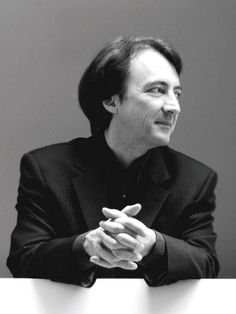
Above: Jean-Efflam Bavouzet
Knowing nought of Magnard’s music, I was thoroughly captivated this evening by his D-minor quintet for which the terrific pianist Jean-Efflam Bavouzet joined Mlles. O’Connor and de Guise-Langlois, Stephen Taylor, and Peter Kolkay. The music is intrinsically “French”, loaded with marvelous melodies, and Mr. Bavouzet proved the ideal maître of the keyboard to lead us on this magical journey.
After an opening piano solo, the wind instruments trade themes over a rippling keyboard motif. Individual voices tantalize, such as in a plaintive passage for Mr. Taylor’s oboe and some delicious trills from Ms. O’Connor’s flute. An unexpected fugue is an intriguing highlight.
In the ensuing slow movement, marked Tendre, Romie de Guise-Langlois stole my heart yet again with her deeply expressive playing of a poignant melody entwined in M. Bavouzet’s poetic piano sounds. This theme becomes passionate and then pensive; I found myself with tears running down my face from the sheer beauty of Romie’s playing. M. Bavouzet draws us on, though, with a solo passage which continues to ripple under a serene chorale from the winds.
Ms. O’Connor’s flute takes on a waltz-like air as she opens the third movement in tandem with M. Bavouzet; the pianist has another vivacious solo before the wind voices enter, evoking Springtime cheer. Mr. Taylor’s oboe seized upon an oddly Mid-Eastern-sounding theme, playing with great control.
By now I was thoroughly engrossed in this Magnard work, only to discover fresh vistas in the final movement, charmingly marked Joyeux. A jaunty oboe solo leads off, the other voices passing the idea around. Peter Kolkay’s amiable sustaining of single tones had an ironic quality, and Ms. O’Connor’s flute wafts over us. A mini-fugue is a fleeting delight, and a two-note theme somehow develops into a march. In a mellowing out, Mr. Kolkay’s bassoon glows in a superb passage with M. Bavouzet. The pianist then takes a dynamic lead thru a few small detours before all join in a final tutti melody.
Have I rambled on too long, sometimes shifting from past to present tense? It’s because, in remembering, I am still there. Does that make any sense?
Following the interval, the only work on the program somewhat familiar to me: the Rimsky-Korsakov B-flat major quintet. This piece was composed in 1876 for a chamber music competition held by the Russian Music Society, but its premiere was spoilt by some indifferent playing. Fortunately, the piece survived this fiasco, for it is – like the Magnard – a thorough delight.
Following a speedy start, the bassoon draws us in. All the wind voices have their say, including a lovely dialogue between flute and bassoon. There’s a rush to the finish, and then the astoundingly plush sound of Radovan Vlatković’s horn intones a serene theme over M. Bavouzet’s piano.
(I must pause here to say, as a frustrated high-school horn player, that Mr. Vlatković’s tone quality has the ideal Autumnal richness that always eluded me; his gorgeous playing here – all evening, in fact – made me envious. I even scrawled “I am jealous!” next to his name in my playbill.)
But – moving on with the Rimsky-Korsakov – clarinet and flute trade dreamy phrases before the piano introduces a new theme, echoed by the ensemble. And then Mr.Vlatković chimed in again – spectacular sound – before the bassoon and clarinet meshed voices leading to a mellow end.
The final Rondo: allegretto starts with a joy-filled skipping rhythm; there is bassoon irony as the voices swirl about before returning to the theme. Romie de Guise-Langlois brought forth a redolent, deeply ‘Russian’ theme which was passed to the horn. A sparkling flute cadenza and another clarinet passage carry the players to a final sprint.
Poulenc’s Sextet for Piano and Winds is a different kind of treasure: including elements of jazz, ragtime, pop songs of the interbellum era, high wit, and gentle sarcasm, there are also stretches of pure lyricism (a bassoon theme, for one) along the way. The players had a grand time of it, and the final Prestissimo felt like a transfusion, an antidote to the world-weariness that’s been creeping up on me of late. Great music, played as it was tonight, does one a world of good.
The Repertory:
- Ligeti Six Bagatelles for Flute, Oboe, Clarinet, Bassoon, and Horn (1953)
- Magnard Quintet in D minor for Flute, Oboe, Clarinet, Bassoon, and Piano, Op. 8 (1894)
- Rimsky-Korsakov Quintet in B-flat major for Piano, Flute, Clarinet, Bassoon, and Horn (1876)
- Poulenc Sextet for Flute, Oboe, Clarinet, Bassoon, Horn, and Piano (1932-39)
The Participating Artists:
- Jean-Efflam Bavouzet , piano
- Tara Helen O’Connor , flute
- Stephen Taylor , oboe
- Romie de Guise-Langlois , clarinet
- Peter Kolkay , bassoon
- Radovan Vlatković , horn
 Oberon's Glade