Tag: Ensemble Connect

  • Decoda ~ Verklärte Nacht

    Schoenberg

    Above: Arnold Schoenberg

    ~ Author: Oberon

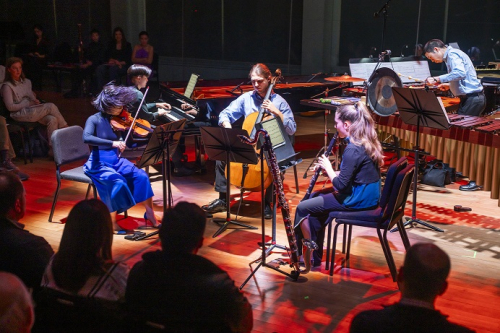
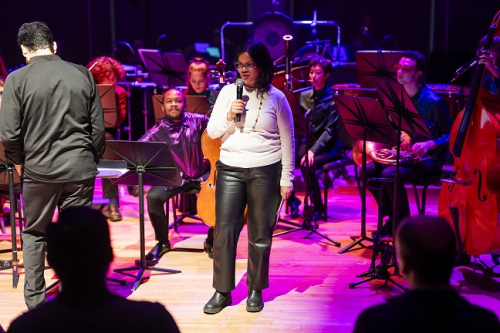
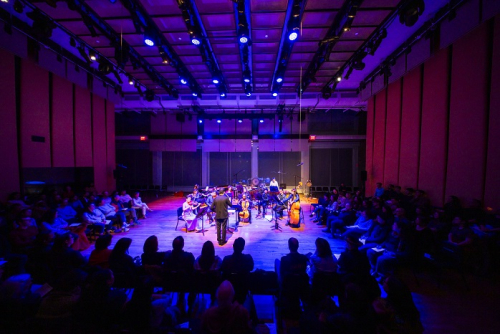
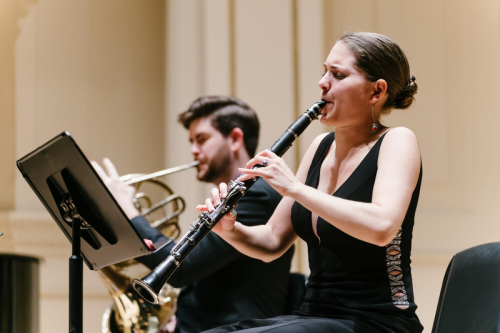
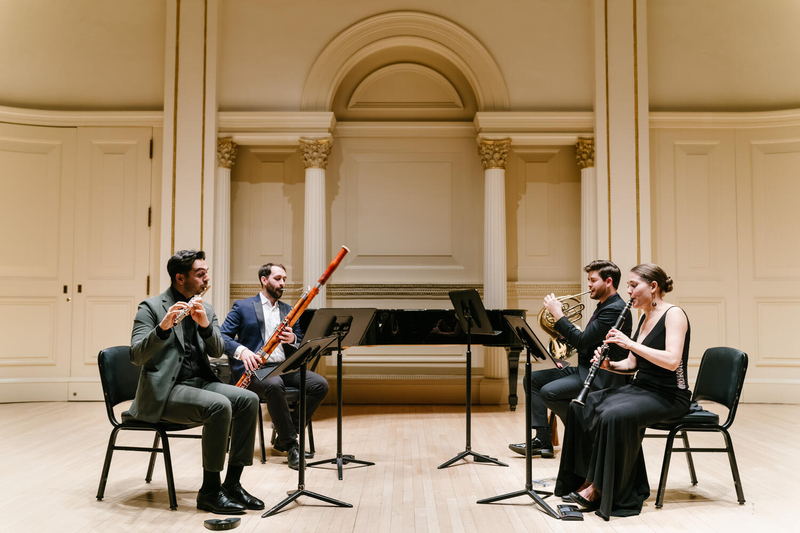
    Tuesday March 11th, 2025 – A rare chance to hear Arnold Schoenberg’s Verklärte Nacht played live drew me to Weill Hall tonight where the work was on a program offered by Decoda, an ensemble of musicians who had first met while playing with Ensemble Connect.

    Songs by two pairs of husband-and-wife composers – the Schumanns and the Mahlers – opened the evening. Pianist Mika Sasaki played Robert Schumann’s “Eintritt” from Waldszenen, a melody that describes entering the forest path. Baritone Thomas Meglioranza and Ms. Sasaki then offered Herr Schumann’s Sehnsucht nach der Waldgegend“; any song with ‘sehnsucht’ (longing or desire) in the title is bound to please me.

    A sextet of string players now joined the pianist for Clara Schumann’s “Geheimes Flüstern“, in an arrangement by Clara Lyon; this brought forth soprano Lucy Fitz Gibbon, her voice light and charming.  

    Mr. Meglioranza stepped forward again for Gustav Mahler’s “Ich ging mit Lust durch einen grünen Wald” (arranged by Brad Balliett), expressively sung.

    Alma Mahler’sLicht in der Nacht” was sung by Ms. Fitz-Gibbon in an arrangement by Terry Cook (could this be the Terry Cook, a popular Met Opera basso who sang nearly 200 performances with the Company from 1983 to 2006?), accompanied by the sextet.

    During this lieder segment of the program, Ms. Fitz-Gibbon and Mr. Meglioranza did not lend an operatic feeling to their singing, but rather sounded like they were performing among friends at the Schumann’s salon.

    [Special note: anyone with an interest in Alma Mahler’s life and work should seek out the film Bride of the Wind.]

    From the concluding Alma Mahler song, the music led directly into the Schoenberg masterpiece, Verklärte Nacht; the players were Anna Elashvili and Clara Lyon (violins), James Thompson and George Meyer (violas), and Hannah Collins and Claire Bryant (cellos).

    The work was inspired by a collection of poems by Richard Dehmel published in 1896. Entitled Weib und Welt (Woman and the World), the saga speaks of a man and a woman as they walk through the moonlit woods on a frigid but clear winter evening. Guilt leads the woman to admit that, craving motherhood, she had become pregnant by another man before meeting and falling in love with her current amour. The woman stumbles miserably on in the silent darkness; but then the man tells her, “Do not let the child you carry burden your soul.” He pledges that he will love and care for the unborn child as if it were his own. They embrace, and they continue their walk on into the night, their love transfigured thru forgiveness.

    Played without break, the score mirrors the five sections of the poem: throughout, Schoenberg continuously transforms themes and motifs into an expressive musical depiction of the poem. The composer travels the road from the opening line of the poem – “Two people walk through bleak, cold woods…” to its marvelous finale: “Two people walk through exalted, shining night….”

    The playing by the Decoda artists was nothing less than sublime; as individual voices, and in their harmonizing and phrasing, the sextet summoned all the magic that the composer packed into his writing. Of special note was cellist Hannah Collins, whose rich-toned playing was both poetic and powerful.

    Despite what seemed to me a riveting performance thus far, audience distractions during the first half of the program were especially annoying, climaxing with a dropped metal water bottle at a particularly poignant moment in the Schoenberg. Although the second half the program certainly sounded interesting –  a work by four composers featuring all the evening’s artists – I decided to head out, taking the memories of the Schoenberg home with me. 

    ~ Oberon

  • Ensemble Connect ~ Up Close

    CH11514851

    Above, composer/curator Gabriela Ortiz welcomes the crowd; photo by Chris Lee

    ~ Author: Oberon

    Monday January 27th, 2025 – Ensemble Connect is a joint program of Carnegie Hall, The Juilliard School, and the Weill Music Institute in partnership with the New York City Department of Education. In tonight’s Up Close presentation, curated by composer Gabriela Ortiz, the young artists of the Ensemble performed at the Hall’s Resnick Education Wing, an intimate venue which I’d never been aware of until Carnegie’s Meg Boyle gently twisted my arm into giving it a try.

    CH11514901

    Above: Chelsea Wang and Ryan Dresen playing Ortiz; photo by Chris Lee

    The evening opened with the New York premiere by of Pigmentum by Ms. Ortiz, a four-movement work presented in collaboration with visual artist Martirene Alcántara that was performed by Ryan Dresen (horn) and Chelsea Wang (piano) whilst a film by Ms. Alcántara was shown on a hanging screen.

    Each of the work’s four movements is named for a shade of blue, the first being Indigo. This music veered from dreamy to jazzy; some of the piano’s tones had been ‘prepared’, giving a quirky, off-kilter sound. Mr. Dresen’s playing has beauty and power throughout the range, and passages played with a mute were intriguing. Chime-like piano notes introduce Lapislazuli, with horn calls leading to a duet in the instruments’ lower ranges. The music gets wild, and a sudden ending takes us by surprise. The rippling delicacy of Ms. Wang’s playing in Cobalto is joined by the dusky sound of the horn. The music gets grand, then pensive. In the concluding Ultramar, Mr. Dresen’s horn rambles and stutters. There is a false ending, and then the enigmatic sound of toneless air being blown thru the horn. 

    CH11514949

    Mexico’s Carlos Carlos Sánchez-Gutiérrez presented Luciérnagas (photo above Chris Lee) for which three alumni of the Ensemble – Yasmina Spiegelberg (clarinet), Joanne Kang (piano), and Mari Lee (violin) – joined percussionist de luxe Oliver Xu and cellist Frankie Carr, who introduced the piece. A chord introduces the insectuous music of a swarm of fireflies, whilst the cello vibrates. The clarinet trills, the sneaky piano intones, cello and clarinet sound in unison. The xylophone heralds an explosion causing the violin to go crazy. A rhythmic passage turns spacey, thunder rolls, the bass clarinet rumbles deeply whilst awesome percussion motifs sound. An intriguing marimba solo is interrupted by an urgent one-note motif from the violin, and then the xylophone goes off like a fire alarm; the insistent piano sounds urgently. Silence falls. This seemed like a perfect place to end, but no…we go on, savouring some rhapsodic playing from Ms. Kang at the piano. But then the music turns dark and scary; a cymbal crash leads to a total wipe-out. Somehow, thru all of this, it was the cellist who seemed the central figure, both thru his noble playing and his poetic face.

    For “La Hamaca” from La Hamaca (NY Premiere) by the Venezuelan composer Ricardo Lorenz, the players were Chelsea Wang (piano), alumna Mari Lee, and cellist Thapelo Masita. The music opens softly with the piano joined by the violin; the cellist enters with a pinging motif before taking up a gorgeous theme wherein Mr. Masita’s tone was matched by the sweetness of the violin and magical sounds from the piano. The music turns passionate, then staccati introduce new themes, with rich playing from the cello. The staccati resume before Ms. Lee’s violin sings on high; dense harmonies emerge before an agitato outburst. A bouncy rhythm springs up…fabulous playing from the trio as the music wafts to heaven and then fades away.

    CH11514870

    Above, in a Chris Lee photo: Joanne Kang and Oliver Xu playing the Cuban composer Ileana Perez Velazquez’s Light echoes, having its New York premiere this evening. This piece gave us a virtuoso percussion display from Oliver Xu, who moved amidst his array of instruments with assured grace, as if in a choreographed solo. No less marvelous was Ms. Kang, who was back at the piano to make more magic. Bass drum rolls, bongo beats, and gong tones set off a jazzy piano theme. The swaying rhythm gets big as Mr. Xu moves swiftly from xylophone to ancient hanging bells to every type of drum. Ms. Kang  commences a keyboard interlude, laced with various percussive comments. Suddenly, there’s a kind of cabaletta, fast and florid, before things quieten and the mysterious gong sounds; a rhythmic coda ensues. Brilliant playing from start to finish!

    CH11514918

    The Costa Rican composer Alejandro Cardona’s Axolotl (a US premiere) brought three wind players to prominence: Ms. Spiegelberg (clarinet), Anjali Shinde (flute), and Joseph Jordan (oboe) with Joanne Kang at the piano, Mr. Carr with his cello, and the lovely violinist Isabelle Ai Durrenberger (photo above by Chris Lee).  

    CH11514915

    Above: Joseph Jordan and Anjali Shinde, photo by Chris Lee

    The piece develops gradually clarinet and oboe are heard in sync, and the piano music is jazzy. Stillness, and then a haunting flute passage is heard over delicately sustained string tones creating a wonderful air of mystery. The clarinet gets jazzy as a sexy beat rises; more jazz from the violin, whilst the cello is strummed like a guitar. Wailing clarinet and oboe slowly sputter out, and a thoughtful flute solo ensues, with piano and cello commenting. Bass clarinet and flute converse over the deep cello and piano; these voices then make an incredible fade-away.

    CH11514944

    The concert ended with the world premiere of Gritos de fuego, patrias de papel by the Colombian composer Carolina Noguera (above, photo by Chris Lee). This work brought together the largest ensemble of the evening, with Leonardo Pineda conducting. Joining Mlles. Shinde, Spiegelberg, Wang, Ai Durrenberger, and Mssrs. Jordan, Dresen, Xu, and Masita were flautist Catherine Boyack, bassoonist Marty Tung, violist Ramon Carrero-Martinez, and bass-player Marguerite Cox.

    CH11514858

    Photo: the ensemble playing the Noguera, photo by Chris Lee

    From an explosive start, announced by three massive strikes of the bass drum, eerie strings emerge; the flutes blow air as more thunder claps, wailing winds, and rumbling piano depict the storm, which gives way to the amazingly subtle and sustained violin supported by cello tremelos. A long flute trill sounds as the oboe blows air and a quiet sense of ecstasy settles overall. The piano and eerie shimmers from the violin bring on a repetitive 4-note rising motif from the violin. From a perpetual quietude, raindrop piano notes accompany a sweet and serene solo from Ms. Ai Durrenberger’s violin. The bassoon chimes in, the viola plays a repeated phrase. Big chords are repeated, and then the music vanishes into thin air as a sensationally sustained cello tone from Mr. Masita fades to silence.

    CH11514920

    Above: the composers take a bow; photo by Chris Lee

    Audience members lingered to greet the artists and the composers; except for congratulating Mr. Masita, I was too shy to speak to anyone. But I did have a chance to meet and thank photographer Chris Lee, whose remarkable gift for capturing the essence of Carnegie Hall concerts I have been lucky enough to share on my blog these past few years.

    CH11514895

    Above, the finale: this, and all the performance photos, are by Chris Lee, courtesy of Carnegie Hall

    ~ Oberon

  • Ensemble Connect @ Weill Hall

    Connect = Photo-Credit-Fadi-Kheir jpg

    Above: the artists of Ensemble Connect; photo by Fadi Kheir

    Author: Oberon

    Tuesday February 21st 2023 – Ensemble Connect offering a wide-ranging program at Weill Hall this evening, opening with Jennifer Higdon’s Dark Wood, a work for bassoon and piano trio. Nik Hooks, the Ensemble’s excellent bassoonist, kicked off his busy evening here (he played in three of the four works); for the Higdon, he was joined by pianist Joanne Kang, cellist Laura Andrade, and guest violinist Stephanie Zyzak. The piece’s title refers to the lustrous, deep-dark polish of the bassoon. 

    Dark Wood opens with staccati for the bassoon and piano; the plucking violin and cello soon join. The music is jagged, buzzing with trills and big accents, full of nervous energy. A prolonged note for bassoon launches a sprightly, animated passage; then the piano begins to rumble, the bassoon and cello playing deep. Another long, dark bassoon tone leads to slithering strings and a pulsing piano motif.

    CH11325029

    Above: bassoonist Nik Hooks; performance photo by Fadi Kheir

    The violin and cello sigh, and things turn dreamy. Dotty violin notes sound over a wistful bassoon melody and then the cello offers a rich theme; this is all quite beautiful to hear. Things perk up, with the bassoon trilling and the strings sizzling, and then Ms. Kang at the keyboard takes over, with big playing, agitated and insistent. Heartfelt strings and a forlorn song for bassoon and piano follow; Ms. Kang offers plucked notes with a “prepared piano” sound, the others playing poignantly. Now the music rushes forward, somewhat chaotically, to a brisk finish.

    Ms. Kang and Mr. Hooks were soon back onstage for Mozart’s delightful Quintet for Piano and Winds in E-flat Major, K. 452, joined by three more of the Ensemble Connect’s brilliant wind players: Amir Farsi (flute), Jasmina Spiegelberg (clarinet), and Cort Roberts (horn).

    Mozart apparently thought highly of this piece, and he would doubtless have loved this evening’s performance of it. It opens rather hesitantly; Mr. Roberts plushy, golden tone immediately grabbed me,  frustrated high-school horn player that I am. The blend of wind voices was sonorous, and after the piano introduces a new and more animated theme, it is passed about from instrument to instrument.

    CH11325032

    Above: Cort Roberts (horn) and Jasmina Spiegeberg, clarinetist; performance photo by Fadi Kheir

    The Larghetto brings us a gracious, courtly melody, with Ms. Spiegelberg’s lambent tone and persuasive phrasing leading the way; flute, horn, and bassoon take up the line in succession. A bel canto atmosphere  develops, with the piano offering accentuations; Mr. Roberts’ horn cavatina is so stylish, with the others harmonizing expressively.

    The final Rondo/Allegretto rolls along, each player showing a vibrant sense of virtuosity: a sustained flute trill from Mr. Farsi was but one of many decorative delights.

    Wiancko

    Above: composer Michi Wiancko

    Michi Wiancko’s 7 Kinships, a Carnegie Hall commission, was having its New York premiere this evening. The composer charmingly introduced the work; she spoke of how 7ths and 9ths express a feeling of longing. I could not agree more.

    CH11325030

    Above: The evening’s wind players – Mssrs. Farsi, Hooks, and Roberts, and Ms. Spiegelberg – giving a sterling performance of the Wiancho; performance photo by Fadi Kheir

    In the work’s seven brief movements, Ms. Wiancho’s thoughtful craftsmanship gave the players ample opportunity to revel in their artistry. The music ranges from lyrical to animated, with moods veering from  whimsical to lamenting. The sounds of the instruments entwine to delight the ear, sometimes in strange harmonies, whilst rhythmically the composer displays touches of wit. The musicians seemed to genuinely enjoy playing this music.

    Before commencing the program’s final work, Robert Schumann’s Piano Quintet, violist Halam Kim read one of the composer’s letters to his beloved Clara; I admit this outpouring of love brought tears to my eyes. And then to recall that it was Clara who played the quintet’s demanding piano part at the work’s public premiere, making it all the more touching.

    CH11325026

    Above, playing the Schumann: Mr. Rengel, with Mlles. Zyzak, kang, Andrade, and Kim; photo by Fadi Kheir

    The Ensemble Connect’s marvelous violinist, Rubén Rengel, led the ensemble, with Ms. Kang honoring Clara Schumann with her delectable playing, and Mlles. Zyzak, Kim, and Andrade all sounding gorgeous.

    This beloved work is bursting with magical passages: the ‘dialogue’ for cello and viola in the opening movement, a theme to which Mozart frequently returns, is especially endearing, and in the dirge-like second movement, Mr. Rengel ‘s playing is exceptional. Mlles. Zyzak and Kim take ups this calmly funereal theme, and Ms. Abdrade’s sumptuous tone is ever at the heart of the matter.

    In the bustling Scherzo, Mr. Rengel is again in his element, and Ms. Kang has much to do, her rising scales setting the scene for a fast dance, her music-making on the grand scale. It is Ms. Kang who initiates the final Allegro ma non troppo with her scintillating playing. A hymn-like interlude arises, and then low rumblings from the piano develop into a slow sway; this then accelerates, dancing us on to the finish.

    All performance photos by Fadi Kheir, courtesy of Carnegie Hall.

    ~ Oberon

  • Ensemble Connect Delights @ Weill Hall

    Screenshot 2022-10-25 at 07-45-30 Ensemble Connect

    Monday October 24th, 2022 – When I saw the announced program for this evening’s concert by Ensemble Connect at Weill Hall, I knew I had to be there: what an enticing line-up of composers…and, in the event,  it was all so dazzlingly played!

    The young musicians of Ensemble Connect are exceptionally talented; all the music tonight sounded fresh and vibrant. They are also appealing to watch. The works on this well-contrasted program spanned the years from 1717 to 1994, and it was a sonic feast from first note to last. 

    CH11266821

    Above, playing the Martinů: Yasmina Spiegelberg, Garrett Arney, Laura Andrade, and Cort Roberts; photo by Fadi Khier

    Bohuslav Jan Martinů’s rarely heard Quartet for Clarinet, Horn, Cello, and Side/Snare Drum, H. 139, dates from 1924. This rather quirky mix of instruments does – as hornist Cort Roberts pointed out in his introductory remarks – represent the four ‘families’ of the symphony orchestra: strings, winds, brass, and percussion. What delightful sounds we heard from Mr. Roberts and his colleagues: Yasmina Spiegelberg (clarinet), Laura Andrade (cello), and Garrett Arney (snare drum).

    The work is full of wit and irony, yet in the central Poco Andante comes a poignant lament that is extraordinarily moving. Snare drum and cello lead off the opening Allegro moderato, which becomes march-like as the clarinet and horn join in. A trudging feeling develops, with a horn solo which later shifts to the clarinet. The music seems about to fade away, but there’s a big bang ending.

    As the Andante commences, my companion and I were simply blown away by the depth and beauty of tone that cellist Laura Andrade produced. Ms. Andrade played in all four works this evening, and maintained her beautiful sound and sterling musicality at every moment. Ms. Spiegelberg joins the cellist with a rather mysterious air; Mr. Arney’s snare drum comments on the women’s duet, and then Mr. Roberts’ mellow horn sounded a somber theme. The cello solo returns to the touching opening passages, played with heart-rending beauty.

    At the jaunty start of the concluding Allegretto, the voices enter one by one: drum, cello, clarinet, horn. The music jogs along, with the horn ringing forth. After the instruments have exchanged lively, wry phrases, there is a little unison coda to round things off. Such a wonderful way to open the evening, and what a stroke of genius on Martinů’s part to center the work on that profound lament.

    The petite but hugely talented pianist Joanne Kang now joined the impressive Venezuelan violinist Rubén Rengel and Ms. Andrade for a simply glorious performance of Clara Schumann’s Piano Trio in G-Minor, Op. 17. Their playing was tremendously beautiful and moving, and they are as attractive to watch as to hear; their performance of this masterwork seem so vital and immediate, making it an outstanding musical experience of recent seasons

    Clara Schumann’s writing shows a mastery of counterpoint and a heartfelt gift for melody. It’s music alive with romantic ardor. The opening Allegro moderato begins in a melancholy mood, and soon develops a passionate flow of lyricism, with dramatic outbursts along the way adding a sense of urgency. Ms. Kang kept the momentum going with her perfect timing, whilst Mr. Rengel and Ms. Andrade displayed rich, abundant tone as one lustrous theme after another sprang up.  The Scherzo – “in the tempo of a minuet” – commences with an elegant passage for violin and piano; it is gentle, pensive music, and again Ms. Andrade’s plush sound warmed the soul.

    Ms. Kang lovingly played the Andante‘s waltz-like opening, soon joined by the hushed, poetic sound of Mr. Rengel’s violin; their blend carries them thru captivating harmonies. The music gets a bit wild, only to be calmed by more gorgeousness from the Andrade cello. Achingly beautiful playing from these young artists, with the cellist rounding everything of with a simple descending scale that brought tears to my eyes. 

    The trio’s final Allegretto brought forth more dazzling playing from the three musicians; Ms. Kang in particular shown here with sumptuous, large-scale playing and – later – passages of glistening arpeggios. Following a mini-fugue, the music gets grand, only to simmer down to a melody of longing, then moving onward to its epic finish. My companion and I were so thrilled by this rapturous performance.

    Eleanor+Alberga

    Following the interval, music by the Jamaican-born composer Eleanor Alberga (photo above): her String Quartet No. 2. As violist Halam Kim remarked before the playing started, the entire 18-minute single movement develops from a very brief descending phrase that opens the piece; this Mr. Rengel dashed off for us as an introductory demo: it lasts less than a second.

    From its active start, dance-like with dazzling dissonances, the piece moves on with complex harmonies and rhythmic shifts as well as witty touches, such as a repetitive figuration for the 2nd violin (Brian Hong) that made me smile. Mellowing to an andante section laced with enticing harmonies, we arrive at an intriguing passage where tremolo shivers from Mlles. Kim and Andrade underscore an eerily harmonized theme for Mssrs. Rengel and Hong. Ms. Andrade’s knockout cello playing continues to fascinate us, whilst plucked notes from Ms. Kim and Mr. Hong support a high-flying passage for Mr. Rengel’s violin.

    CH11266889

    Above, playing the Alberga quartet: Rubén Rengel, Brian Hong, Laura Andrade, and Halam Kim; photo by Fadi Kheir

    The music dances on, getting dense and with a big buildup until it turns heartfelt and lush; we seem to be headed to the finish line, but…no: a delightful return of the tremolo viola/cello combo with woozy violins pops up before the music’s energetic final measures. The piece was enthusiastically received; I was hoping Ms. Alberga might be among the audience so we could hail her for her colorful, marvelous score.

    There was a slight delay before the evening’s concluding piece as a technical glitch with the tablets took some straightening out. Ah, for the simple beauty of a paper score!

    CH11266818

    Above: the ensemble playing Bach; photo by Fadi Kheir

    It was with J. S. Bach’s Brandenburg Concerto No. 5 that the evening closed. The large ensemble featured all the players from earlier in the evening, plus bassoonist Nik Hooks – a player with rich, amiable tone and agile technique – and the proverbially “tall, dark, and handsome” Iranian/Pakistani/American flautist, Amir Farsi: limpid of tone, with a personable presence as he bends and sways to the music. Mr. Hooks and Ms. Andrade provided a very high-class continuo, with Ms. Kim and Mr. Hong the supporting strings. Mr. Rengel and Mr. Farsi played magnificently, and there was truly a sense of magic in the hall as the performance unfolded.

    CH11266826

    Above, Joanne Kang at the harpsichord for the Bach; photo by Fadi Kheir

    Of course, this is “the Brandenburg with the harpsichord”, and Mr. Kang gave us a fleet-fingered and fabulous rendition of the long cadenza. The audience, and her colleagues, could not resist breaking in with applause for her stunning playing, one of the highlights of the evening. Other treats in the Bach were the poignant blending of Mr. Rengel’s violin with Mr. Farsi’s flute in the Affetuoso, and the light and lively finale wherein Ms. Andrade and Mr. Hooks put the continuo in the spotlight.

    CH11266799

    Above, the principal players for the Bach: Rubén Rengel, Joanne Kang, and Amir Farsi; photo by Fadi Kheir

    Such a pleasing and deeply satisfying evening! For two hours, the woes of the world and the cares of daily life were forgotten. A thousand thanks to these dedicated musicians, and to the music that makes life worth living.

    All photos by Fadi Kheir, courtesy of Carnegie Hall.
  • Pierrot Lunaire @ Carnegie Hall

    ~Author: Scoresby

    Thursday April 19 2018 – On a rather chilly Spring day, Carnegie Hall’s Ensemble Connect had one of its last Weill Hall performances of the season. Every two years the ensemble changes over its fellows and this particular set of musicians will move on in June. As this is the last Ensemble Connect concert I was attending this season, it was interesting to see the contrast between when these players first joined and how they play now.

    The program began with Mozart’s incredibly difficult six movement Divertimento for Violin, Viola, and Cello in E-flat Major, K. 563. The program book seemed to have a typo, listing this work as only 15 minutes long (instead of 45) – perhaps thinking of one of the far shorter and earlier Divertimento for String Quartet. This is a virtuosic tour-de-force piece for all involved because it has incredible exposure for all the instruments, here Rebecca Anderson on Violin, Andrew Gonzalez on viola, and Julia Yang on cello. Ms. Yang’s warm, robust sound stood out immediately – she managed to blend well with Ms. Gonzalez and Ms. Anderson matching vibrato perfectly. 

    Screen Shot 2018-05-04 at 12.55.23 PM
    Above: Ensemble Connect

    Stylistically, the group kept the Allegro light and bouncing. During the Adagio Ms. Anderson’s solo passages were played with a touch of sweetness while Ms. Yang’s ascending cello motifs brought a touch of nostalgia. The Andante (the fourth movement) is a charming set of variations – while every instrument gets its line to shine most impressive were the blending between Mr. Gonzalez and Ms. Yang during the active violin variation. They created a supple backdrop for Ms. Anderson to play the sweet melody. In the fifth movement, the group let the music seemed to have fun with the light bouncy textures and brought the music’s humor out by letting the phrases breathe. The duet between Ms. Anderson and Mr. Gonzalez was fully of energy and light-hearted spirit. While there were a few technical glitches – it was a fun performance of a difficult work. 

    The after-intermission performance demonstrated how much the players in ensemble have grown – it was not only a successful performance of Schoenberg’s Pierrot Lunaire – but one of the best performances I’ve heard this year. The instrumentalists were Rosie Gallagher on flute, Bixby Kennedy, on clarinet, Mari Lee on violin, Madeline Fayette on cello, and Mika Sasaki on piano. As is tradition in Ensemble Connect, before the work began there was a short talk about the music – only here Mari Lee interviewed ‘Schoenberg’s Ghost’, who was wearing a Pierrot-like mask. It was a fun and creative way to introduce the music that a more traditional group wouldn’t have dared to do and Ms. Lee’s earnest questions gave both humor and seriousness to it. It seems Ms. Lee adapted some of the material from her own project Salon Séance for the interview.

    Pierrot is one of the landmark works of the twentieth century. Not quite theatre, not quite music – it lies somewhere in-between in a chamber setting. It was Schoenberg’s first major work using free atonality and is before he came up with his twelve-tone system. Musically it is a piece at the height of German Expressionism, set to the brooding poems of Albert Giraud to paint different fragments of the psyche. It feels at once dream-like and nightmarish with extremes of emotion. In order to enhance this feeling, the group used simple lighting to heighten the drama –  they turned off the regular house lights and replaced them with white spotlights during the first section, blood red lights during the second, and back to white spotlights for third. In this darker atmosphere with the glittering Viennese style chandeliers, one really felt immersed into Schoenberg’s world.

    Unfortunately soprano Mellissa Hughes who was originally supposed to sing the soprano part withdrew due to illness. Luckily, Ensemble Connect managed to get one of the most venerable Pierrot singers alive today: Lucy Shelton.  She was simply spellbinding and elevated the level of the young players to match her. In Columbine the Ms. Lee and Ms. Sasaki’s violin and piano duo gave heft to match Ms. Shelton’s Meine banges Leid (my pain) and immediately changed dynamics to match the zu lindern (soothing). Such precise dynamics from moments like that were the hallmark of this performance – but at the same time the players swelled to match the more crazed sections of the piece.  Ms. Shelton for her part, embodied the music taking a no-holds-barred style. Using hand gestures to and acting to portray the different facets of the characters, from the wisps of nostalgia in the last movement to the crazed laughter and anxiety in the Rote Messe to the cackling gossip in the Gallows Song, Ms. Shelton seemed like she was a witch reciting an incantation and with the dream-like lighting she was spellbinding. In the small hall, her voice filled the entire space and one felt completely immersed – it felt like she was telling you a story and drawing you into her world complete with horrors, traumas, sweetness, and nostalgia for the past. Rather than just a “crazy” approach as many singers bring to this piece, Ms. Shelton captured all the nuance of emotions embedded in both the text and music. Her yearning for the past in the end sounded sweet and  wistful as she whispered “And dream beyond for blissful stretches, O old perfume–from fabled times!”

    Screen Shot 2018-05-04 at 12.54.11 PM
    Above: Soprano Lucy Shelton

    The instrumentalists were no less into the music. While perhaps the could have captured some of the softer tones and romanticism in the third book, they were all precise and together.  A powerful moment at the end of the third movement, Ms. Gallagher’s impressive fluttering as Ms. Shelton sung “With a ghostly moonbeam” – Ms. Gallagher capturing the timbres with precise but soft tones. Ms. Fayette during her nervous outburst in Rote Messe mimicked Ms. Shelton’s crazed line. In the interlude before the last song of the second book, Mr. Bixby deep clarinet melded with Ms. Gallagher’s playing. In that last song, Ms. Lee captured the same timbre as Ms. Shelton’s singing – sounding like a dreamed echo. Ms. Sasaki let the piano. During Gemeinheit Ms. Fayette and Ms. Gallagher matched their vibrato perfectly, creating an ethereal dream-like texture. 

    In the Barcarole, Ms. Lee, Ms. Sasaki, and Ms. Gallagher created a disorienting backdrop of what sounded like a drunken boat ride. All in all, this group of musicians worked hard to create an excellent performance – a great end to the last Ensemble Connect performance in Weill.

  • Ensemble Connect @ Weill Hall

    EnsembleConnectBanner

    ~ Author: Scoresby

    Monday October 23rd, 2017 – In Carnegie Hall’s intimate Weill Hall, I attended an eclectic concert of American music performed by Ensemble Connect (formerly Ensemble ACJW). For those that do not know, Ensemble Connect is according to the Carnegie Hall website “a program of Carnegie Hall, The Juilliard School, and the Weill Music Institute in partnership with the New York City Department of Education.”  Each member is a two-year fellow who performs, teaches, and educates mainly (but not exclusively) in NYC. The Carnegie Hall and Paul Hall (at Juilliard) series of performances are always interesting, as the ensemble typically plays adventurous mixes of chamber music repertoire. 

    I was excited to see the program began with the wonderful clarinetist Yonnah Kim and the colorful pianist Lee Dione performing the Bernstein Sonata for Clarinet and Piano. While I had never heard the sonata before, I remembered Ms. Kim from her excellent performance last year in Golijov’s The Dreams and Prayers of Isaac the Blind. The sonata is divided into two movements, the first being having a relatively dissonant skittering melody reminiscent of Hindemith. The second is more in the mode of Bernstein’s popular style, with jazzy sections. I couldn’t help but wonder if Bernstein had been listening to the Rite of Spring when composing the piece, there are a few allusions throughout the sonata. 

    Ms. Kim captured the oscillating clarinet in the first movement part well with a clear, mysterious sound – managing to shade the lower register parts of the work with a dusty timbre. In the second movement, she added flair to the jazzy sections making them come to life. Mr. Lee managed to capture the mood well with subtle dynamic phrasing and finesse in the rhythmic sections. While I can’t say I was fond of the sonata musically, both players sounded as if they had playing together for years.

    After the sonata, Mr. Dione gave a short speech tying together the wide-ranging program; highlighting the need for distinct American voices to be heard. The second piece on the program was Missy Mazzoli’s Still Life with Avalanche, which is for flute (Rosie Gallagher), clarinet doubling as bass clarinet (Yoonah Kim), violin (Adelya Nartadjieva), viola (Andrew Gonzalez), cello (Madeline Fayette), piano (Lee Dione), percussion (Brandon Ilaw), and 3 harmonicas. The work begins with the harmonicas and strings creating an atmospheric drone that is then interrupted by the bass clarinet and piano. These interruptions build and become more frequent until the piece takes shape. It sounds like a mix of a few genres ranging from rock to contemporary classical. The players all gave a committed performance, embracing each different style of music and coordinating well. 

    The last piece on the brief first half of the program was Copland’s Sextet for clarinet (Yoonah Kim), violins (Rebecca Anderson and Adelya Nartadjieva), viola (Andrew Gonzalez), cello (Julia Yang), and piano (Mika Sasaki). The piece is a reduction of Copland’s Short Symphony, though I hadn’t heard either before. The writing is densely packed with complex rhythms, jazzy riffs, and lyrical melodies. It is an excellent piece, though there is almost too much to listen to in the first movement. Despite the difficulty of getting the timing correct on this piece, the ensemble seemed very together capturing the nervous trudging quality of the opening. Balance-wise, it was a pleasure to hear Ms. Yang’s resonant voice, she seemed to capture the bouncing character of the piece well. It keeps its momentum all the way until the first chords of the second movement. There is a dramatic shift to a quiet chorale-like second movement, which slowly builds in intensity. The strings did a good job of providing a resonant sound, contrasting the first movement well. The finale is a more calculated cacophony that really emphasizes jazzy rhythms and slides. Duets between Ms. Kim and the various strings provided a light and entertaining sound.

    The second half of the program was devoted to one of Steve Reich’s most important works: Different Trains. The piece is for a quartet and tape (sound engineer Benjamin Furiga assisting in this performance); the quartet consisting of Adelya Nartadjieva on first violin, Rebecca Anderson on second violin, Andrew Gonzalez on viola, and Madeline Fayette on cello. The tape has tracks of trains, the speech of holocaust survivors from interviews with Mr. Reich, and a taped quartet. The music and the speech imitate each other creating a hybrid between speech and music through the three movements of the piece. While certainly an important milestone in 20th century classical music and a well-crafted composition, I’ve never had an affinity for this piece. It seemed particularly strange to hear such an emotional work about the holocaust and the aftermath of World War II in Weill Hall’s intimate grandiloquent setting with gold trimming and a beautiful chandelier. 

    Nonetheless, the musicians executed the performance well, keeping their place despite the fact that there seemed to be technical issues with the spoken part of the tape (while audible some of the time, it seemed to cut in and out at times making it hard to follow). They all seemed invested in the music and it showed: many audience members around me were bobbing their heads to the hypnotic speech/rhythms. I appreciate that Ensemble Connect goes after diverse sets of repertoire that typically wouldn’t be programmed together, especially when the playing is as high caliber as it was this evening.

    ~ Scoresby