
~ Author: Oberon
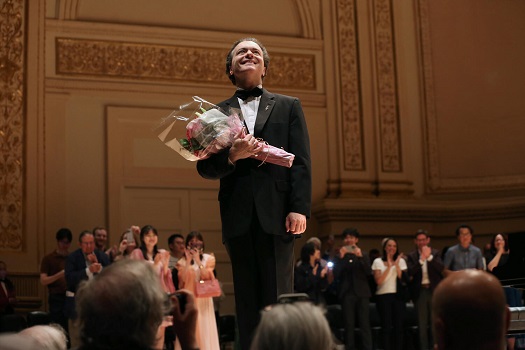
Wednesday May 28th, 2025 – Evgeny Kissin was joined by three renowned string soloists for a program of Shostakovich sonatas this evening at Carnegie Hall. It was one of the most thrilling concerts I have ever attended. The atmosphere in the Hall was palpable; aside from some cellphones going off at the the wrong moments, silence reigned. The musicians seemed bent on preventing applause between movements, keeping their bows poised over the strings in order to sustain the atmosphere. The three sonatas were presented in order of their composition: cello first (1934), followed by the violin (1968), with the viola (1975) played following the interval.
Gautier Capuçon and Mr. Kissin strode onto the Carnegie Hall stage to a warm greeting. Dmitri Shostakovich’s Cello Sonata in D-minor, Op. 40, was composed composed during a period of political and social upheaval in the Soviet Union, and the music reflects the unsettled atmosphere of the time…and of ours, now. The cellist sometimes allowed a touch of grittiness into his tone, which was truly evocative.
The opening Allegro non troppo is gently introduced by Mr. Kissin at the Steinway. A lovely theme gives way to vivid animation from both players. The mood gets dreamy, with M. Capuçon taking up a gorgeous cello melody that turns passionate. A super-pianissimo moment briefly interrupts the music’s flow, and then a sense of longing grows from repeated cello tones, displaying Mr. Capuçon’s marvelous control. Plucking introduces a dance, and mood swings continue – one such bringing a haunting theme: quiet and mysterious. Single notes from the piano invite deep cello playing; Kissin’s tone takes on an almost grumpy sound. Fantastic!
Staying in an Allegro mode, scintillating piano and dancing cello illuminate the second movement. Cello glissandi and insistent keyboard rhythms pop up as the dance sails onward. A sudden stop, and then the Largo commences with incredibly hushed music from M. Capuçon’s cello. The players’ quiet intensity creates a mysterious atmosphere. The cello tears at my heart, rising from its lowest range in music filled with longing and then bursting with passion before returning to the depths. A remarkable quietude fills the Hall, then a crescendo before a fade-out, with the piano on high longing for peace. Things darken; spellbinding control from both musicians casts a spell over us.
With dancing motifs played as if compelled by an unseen force, the final Allegro lets us savour Mr. Kissin’s glorious virtuosity, whilst M. Capuçon produces an amazing stuttering effect with his cello as these two paragons delight us with their magical partnership, bringing the first of the concert’s enthusiastic ovations.
Gidon Kremer walked out onto the Carnegie stage cautiously, to an welcome. Now 78 (two years older than myself!), the legendary violinist responded to Menthisiastic r. Kissin’s straightforward piano introduction of the Shostakovich opus 134 with a sinuous theme. For a while, simple musical lines are exchanged, and then a sprightly dance emerges. The music is subtly playful until there’s a rise of passion. The buzzy tone of the violin then resumes the dance, somewhat hesitantly. The high-register violin filigree creates an insectuous sound before a slow fade-away.
The ensuing Allegretto opens with a nervous dance; this movement is lively, witty, and ironic. It’s music that veers high and dips low, with some sparkly effects from the violin. A sense of urgency takes over as the music presses forward, Kissin playing high and bright as Mr. Kremer handles the music with with amazing dexterity. The violin whines, the piano swirls onward: high, fast, phenomenal music-making!
The sonata concludes with a Largo, the pianist striking single, dotty notes as the violinist plucks away. Mr. Kremer’s playing turns ethereal, poised on high with amazing control. A keyboard dance rhythm draws restless playing from the violin. Now Mr. Kissin introduces a sense of grandeur into the music, leading to an angular violin cadenza. A rocking motif from both players carries them into a series of tremelos as the sonata ends. The Kremer/Kissin duo elicited a fervent ovation from the crowd.
After the interval, an artist new to me – the Ukrainian-British violist/conductor Maxim Rysanov – joined Mr. Kissin for a revelatory performance of the Shostakovich Viola Sonata, opus 147. This fascinating work, which I have only heard played live two or three times previously, really got to my soul tonight: the kind of deeply immersive musical experience that happens so rarely.
The opening Moderato begins very quietly, with soft viola plucking – slow and pensive – as the piano joins, dark and rather ominous. A dirge-like sense of foreboding develops leading to a burst of power. Restlessness overtakes the music; a piano solo and eerie, shivering resonances from the viola develop into a flash of grandeur before an extraordinarily subtle viola passage is heard, ending with staccati, and a sustained fading away.
Now comes the Allegretto, commencing with a dance à la Russe. Mr. Rysanov’s playing is so suave and assured. Boldness from the Kissin keyboard and plucking from the violist lead to a heartfelt unison song, which gets quite grand.
After a pause, the Adagio commences with a sorrowing viola theme which gains poignant support from the piano. Every note from both players seemed like a thing of value, something to treasure…such incredible playing. The spirit of Beethoven hovers on the air as the rhythmic signature of the Moonlight Sonata casts its spell overall. A viola cadenza – lovingly fashioned by Mr. Rysanov – draws us on to the sonata’s magnificent finish. Throughout this movement, I had been in another time and place, far from the chaotic madness of the world. A massive, roaring standing ovation filled the Hall, and it was still resounding as we emerged into the downpour…
~ Oberon

 Oberon's Glade