
The Scottish mezzo-soprano Beth Taylor enjoyed a great success at her Carnegie Hall debut, singing Cornelia in Handel’s GIULIO CESARE with The English Concert.
The Scottish mezzo-soprano Beth Taylor enjoyed a great success at her Carnegie Hall debut, singing Cornelia in Handel’s GIULIO CESARE with The English Concert.
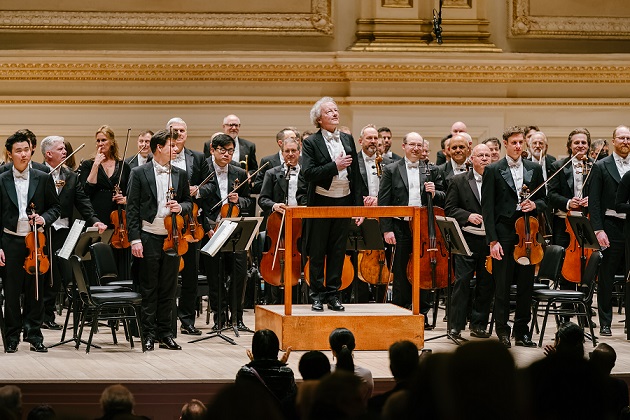
Above: Maestro Welser-Möst and the Cleveland Orchestra onstage at Carnegie Hall; photo by Fadi Kheir
~ Author: Lane Raffaldini Rubin
Tuesday March 18th, 2025 – Tuesday March 18th, 2025 – Franz Welser-Möst led The Cleveland Orchestra tonight in the first of two back-to-back Carnegie Hall performances. The second concert will feature music of Stravinsky and Tchaikovsky, but the Orchestra was forced to make a major change in the program of tonight’s concert after Asmik Grigorian announced her withdrawal for personal reasons. Ms. Grigorian, the Lithuanian soprano, was set to sing Richard Strauss’s Four Last Songs and the final scene from Puccini’s Suor Angelica with the Clevelanders.
Missing a chance to hear the Four Last Songs is a real shame, but Welser-Möst took this opportunity instead to make a timely political statement in what might be one of his last Carnegie Hall appearances before his retirement in 2027:
“This program change has given us a chance to say something important about our world today. As people fight for freedom everywhere, these pieces tell that same human story. Beethoven’s Fifth shows us the journey from darkness to light. Janáček’s From the House of the Dead reveals how human dignity survives even in the most desolate of circumstances. And the Leonore Overture is, to me, simply the greatest music about freedom ever written. These works together create a profound statement that I believe will resonate deeply with our audiences in both Cleveland and New York.”
The first notes of the performance were the V-for-victory theme of Beethoven’s Fifth Symphony. Besides being perhaps the world’s most famous four notes, this music represents Allied Europe’s victory over the Axis in World War II. (Russia, are you listening?)
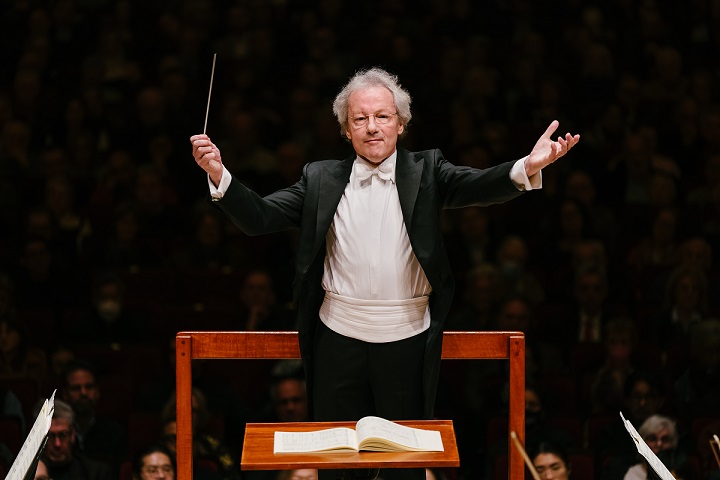
Maestro Welser-Möst (above, photo by Fadi Kheir) mobilized the full forces of the Cleveland Orchestra for the Fifth, making it an orchestra more than twice the size of that envisioned by Beethoven. The result was an impressive, explosive sonority at the expense of contrast and transparency. In the first movement the Clevelanders’ sound was burnished and energetic as it traversed Beethoven’s volatile landscape of darkness and light.
The second movement was beautifully elegant, with notable vibrato-less hushed passages and flawless string crossings throughout the later variations of the theme. The finale was brisk without being breathless and avoided the Indiana Jones clichés that this movement often receives.
The second half of the program featured the suite (arranged by František Jílek) from Leoš Janáček’s final opera From the House of the Dead as well as Beethoven’s Leonore Overture No. 3. These pieces both come from larger dramas about imprisonment and the liberation of the steadfast human body and spirit. If Beethoven’s Fifth Symphony lays out a hero’s abstract journey through conflict toward triumph, the latter two pieces give a much more visceral view into their protagonists’ struggles against adversity and fate.
Janáček’s suite is wonderfully off-kilter and begins with a herculean violin solo—a free-associating kind of playing that involves an almost desperate sawing away at the top of the instrument’s register. Chaotic passages of music played by smaller sections of instruments are interspersed between bursts of the full orchestra with towering clusters of sound, always grounded by the low strings and brass. Inventive sounds made by rachet noisemakers, wood clappers, percussively plucked strings, and relentless repetitive figures all have the effect of boring a hole into one’s skull, slipping toward madness.
Passages drawn from a scene in the opera in which the prisoners stage a play feature macabre oom-pah-pahs, vaudeville fragments, and whiffs of a klezmer band. The final movement of the suite is a fauvist palette of blurry chords, a luxuriously strange and gorgeously dissonant tableau that concludes too optimistically considering all that came before.
It seems odd, then, to conclude the concert with an overture. Rare, too, is the chance to hear Beethoven after Janáček. But the Leonore Overture—from the opera that would become Fidelio—is a concise encapsulation of Welser-Möst’s message for the evening.
This piece was better suited than the Fifth to the large orchestra, which was able to achieve subtle shades ranging from the bright fanfare of the full orchestra (in C-major, like the final movement of the Fifth) to the eerie distance in the flute after the portentous off-stage trumpet call.
Fidelio is ultimately about the triumph of enlightenment values over despotism. Although Welser-Möst’s program had the potential to come off as trite and facile, his linking of these two Beethoven scores to Janáček’s and his reversal of the obvious order of their performance charted an intelligent, moving, and novel course that he hopes—despite our current administration’s unenlightened displays of power—might be followed in Europe.
~ Lane Raffaldini Rubin
Performance photos by Fadi Kheir, courtesy of Carnegie Hall

Above: Samuel Pisar
~ Author: Oberon
Wednesday January 29th, 2025 – Carnegie Hall marked the 80th anniversary of the liberation of Auschwitz with a performance of Leonard Bernstein’s Symphony No. 3, “Kaddish.” A setting of ‘A Dialogue with God’ by the late Samuel Pisar – who had himself been a survivor of Auschwitz – was spoken tonight by Pisar’s wife, Judith Pisar, and their daughter Leah Pisar, with James Conlon leading the Orchestra of St. Luke’s. The Bard Festival Chorus, directed by James Bagwell, and the Brooklyn Youth Chorus, led by Dianne Berkun Menaker, made the choral passages an integral part of the evening’s performance.
The reviews were quite harsh when the Boston Symphony Orchestra, conducted by Charles Munch, premiered this symphony on January 10, 1964; it is dedicated to the memory of President John F. Kennedy, who had been assassinated on November 22, 1963.
Tonight was my first time hearing this work. In preparation, I read some articles and reviews of the piece; these seemed mostly to center on the narrative rather than on the musical setting. My idea was to focus on the music and let the narration flow, but that proved impossible: such is the power of Mr. Pisar’s writing.
Former Secretary of State Antony Blinken, stepson of Samuel Pisar, made an eloquent introductory speech in which he drew a connection between the substance of Bernstein’s Kaddish and the current situation here in the USA. This of course was surely weighing on the minds of most everyone in the audience.
Judith and Leah Pisar had taken their places next to the podium, and Maestro Conlon entered to a warm greeting. Most of my experiences with Mr. Conlon’s conducting have been at the Metropolitan Opera, where he debuted in 1976 and went on to preside over nearly 300 performances, the latest having been Shostakovich’s LADY MACBETH OF MTSENSK, more than ten years ago. I’d love to see him on the Met podium again.
Low humming from the chorus opens the Kaddish, and then Judith Pisar, a petite woman, began to speak. Her voice is deep and profound as she talks of the Age of Anxiety, which seems to be having its second dawning. Leah Pisar’s speaking voice has a sense of passion and urgency which contrasted with Mme. Pisar’s more solemn tones.
A high violin tone is sustained by concertmaster Krista Bennion Feeney until the xylophone sounds an alarm. A melancholy theme of unison celli turns anxious as the basses join. Following a resounding crash, the music gets wild and fast, with the crack of a horsewhip. The chorus’s rhythmic clapping gets a bit jazzy; their song is accented by the xylophone, and it moves to a big finish.
Over quiet percussion and choral humming, Judith Pisar speaks long…and movingly; the essence of the work now becomes evident: where was god when these horrible things were happening to his people? What wrongs had they committed to merit such torment and anguish? Was god angry or simply indifferent?
As questions are raised – “How did the Holocaust, the genocides, and the ethnic cleansings become acceptable?” – and as the spoken words become more haunting and horrifying, the actual music tends to feel less engrossing.
But then, soprano Diana Newman’s high, sweet voice floats over an accompanying harp: clear and reassuring. The female choristers join, and the music turns grand, only to fade with the xylophone sounding. Ms. Newman resumes, supported by high, spun-out sounds of the violins. Angelic voices hum, whilst scurrying music underscores Leah Pisar’s speaking of “incendiary demagogues”.
The music turns delicate; Mme. Pisar speaks until a crescendo obliterates her voice; her daughter speaks of “chaos on Earth”. Aching celli and basses play deep and rich; the music swells with both choruses joining. Stabbing accents turn into an oddly merry passage for clarinet, flute, and bassoon. The Youth Chorus sings; the spoken description of “the warm embrace of democracy” seems ironic now.
A postlude of strings and brass becomes a lament, with muted trumpet and oboe. The music hesitates; Leah Pisar speaks again, with Ms. Feeney’s violin as solo accompaniment. Now Mme. Pisar issues a plea for peace as horn and trumpet sound. There is a fast and jazzy chorus, which Ms. Newman joins. The finale feels a bit extended, but then a dramatic pause leads to a final Amen.
Throughout the work, the eternal question hovers overall: why does god allow these things to happen? And why did he abandon the faithful in their hour of direst need? Another such test seems to loom before us now. Perhaps there are no gods, and we’re simply going to have to make it on our own.
~ Oberon

Above, Alisa Weilerstein/FRAGMENTS 2 ~ performance photo by Fadi Kheir
~ Author: Shoshana Klein
Tuesday January 21st, 2025 – This evening at Zankel Hall, Alisa Weilerstein’s’ Fragments project continued with its the second installation. You may remember the first one, last April.
Like last time, there was no program given until the end – a practice I still find interesting, though slightly frustrating. I had a bit of a conclusion that the ideal listener either knows the Bach suites by heart, or doesn’t know them at all; someone like me (knowing them but certainly not well versed on the particular movements, etc) ends up a little stuck on which is which and where we are.
For the staging, the same light boxes that were set up for the first installment are set up spread around the stage rather than in a circle around the cellist like they were last time. She entered in full darkness – though during that moment, someone’s phone went off and said clearly “calling emergency services” and everyone laughed, which was a fun communal moment.
This setting struck me as more theatrical than the last – it started with a bang and bright lights, and Weilerstein was wearing fishnets, a bright fuchsia short dress, and dramatic stage makeup with her hair curled and all over the place. It seemed to evoke a sort of dramatization and maybe a teenage emotionality.
The way that she played the Bach suite movements were sweeping, very light even though much of the suite is in minor. Her playing of the fast passages is very elegant – bringing out the vocal and conversational qualities of these multi-line pieces written for one instrument.

Performance photo by Fadi Kheir
For the first couple movements there were really smooth transitions and stark lighting changes. The new pieces were lit with green and the Bach was a warmer white/yellow. I wondered if it would continue like that the whole time with the lighting just indicating whether or not we were hearing a new piece, but as it went on the changes became less stark, and the movements had different types of lighting. Maybe adding to this, or reflected by it, particularly in the beginning of the set, the Bach had a more veiled angstyness while the newer pieces had more brash emotionality in the forefront, as if the newer compositions were unearthing the meanings of the Bach and saying them more plainly.
One standout movement near the end had only pizzicati and required Weilerstein to sing along with her playing. It was simple sounding and also grounding, particularly because this person who is at the highest levels of cello playing was singing like a normal person. Not to say it was bad, it just humanized her in a way that brought reality back in a really sweet way.
~ Shoshana Klein
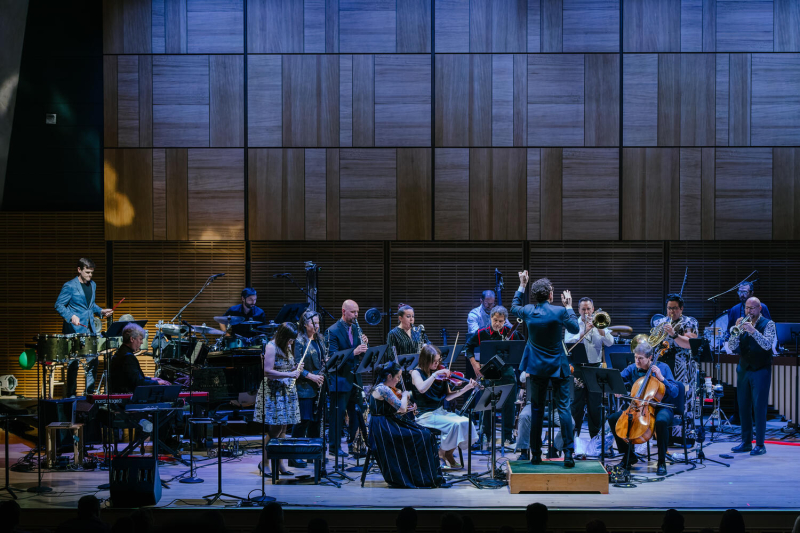
Above: concert photo by Fadi Kheir
~ Author: Shoshana Klein
Tuesday March 26th, 2024 – Though this concert started with slight technical difficulties, after about 3 minutes, the whole rest of the show went on without a hitch. The pieces were played with minimal breaks and the show could have gone on with no applause, except that everyone was so excited about the pieces that there was a lot of excitement in between.
There were audio introductions from each composer, and sometimes they even overlapped with the beginnings of the pieces. This created a really good flow that made the concert seem a little more connected and seamless than a normal program. This was actually my first official Alarm Will Sound concert despite being a fan of them for years. I’ve seen them in other contexts but not a fully programmed concert – it was a real treat!
The concert started with a piece by Tania León, who curated the concert in her capacity as the Richard and Barbara Debs Composer’s Chair of Carnegie Hall. Her piece was cool, groovy and fun, scored for small ensemble.
The second piece, by Chris P. Thompson, had some basis in drum corps, as explained by his introduction. It was really cool to hear about marching band in the context of “classical music”. I think it often gets ignored as an art form or a rigorous type of music when it’s actually pretty difficult in a way that was contextualized really well by the introduction to this piece, which was also really fun. The piece had a lot of rhythmic complexity and was really upbeat. One effect that was used was these tubes that are swung around by various musicians to create a pitch (and the pitch changes based on how quickly you swing the tube). I’ve been seeing this used in new music spaces more often recently and in this particular instance it did evoke the marching band – the coordination and visual aspects, or maybe more specifically the color guard spinning flags around on the field.
The next piece was by Christian Quiñones (who I worked with a couple of years ago but we’d never met in person!) His piece was really cool and also had lighting effects attached to the electronic sounds, which was an interesting though slightly jarring experience. The sounds were a little glitchy but rhythmic in a way that sounded really cool. The piece was based on the sound of hearing loss – sounds becoming obscured and distorted throughout.
The last piece on the first half, in my opinion, was definitely the show stealer. It was an excerpt of an opera by Damon Davis and he called it in his introduction a “black rap space opera”. I had moments of feeling like some of the music was familiar to the point where I wondered if I’d heard it before – but I think it was just that type of music, kind of magical in its familiarity as well as its novelty. It was well orchestrated, interesting in the way it used members of the ensemble as characters or kind of as set pieces. The songs were beautiful but also definitely post-genre, almost more similar to musical theater than anything. The music and the story were optimistic in a mythological way, almost like Disney or Miyazaki. Everybody seemed to want to hear the whole thing. This was a fragment of a larger work that will hopefully be performed soon!
The second half started with a piece by Elijah Daniel Smith which had a different tone – more subdued and introspective than the first half. It had a lot of really interesting sound worlds accompanying a narration that was interesting and impactful.
Next was a piece by Texu Kim that was rhythmic and upbeat and ended a frenzy of rhythm that was perhaps intentionally impossible to keep completely together, which was a nicely unconventional end to the piece.
Next was a five movement piece by Bora Yoon that was eclectic. There were moments of poetry, moments that felt conversational, and really interesting sound worlds including a prepared piano and an instrument she seemed to have made out of bicycle bells. The last movement particularly struck me – it was really really beautiful around an ocean theme. I wish I had more to say about this piece – it was delightful and brought us through many emotional spaces in a short time.


Above: Maestro Andris Nelsons; photo by Fadi Kheir
Author: Ben Weaver
Tuesday April 25th, 2023 – The Boston Symphony Orchestra, under the baton of their music director Andris Nelsons, returned to Carnegie Hall last week. The concert of April 25th, 2023 was a marvelous evening of music by Mozart, Adès, and Sibelius, featuring two outstanding soloist artists.
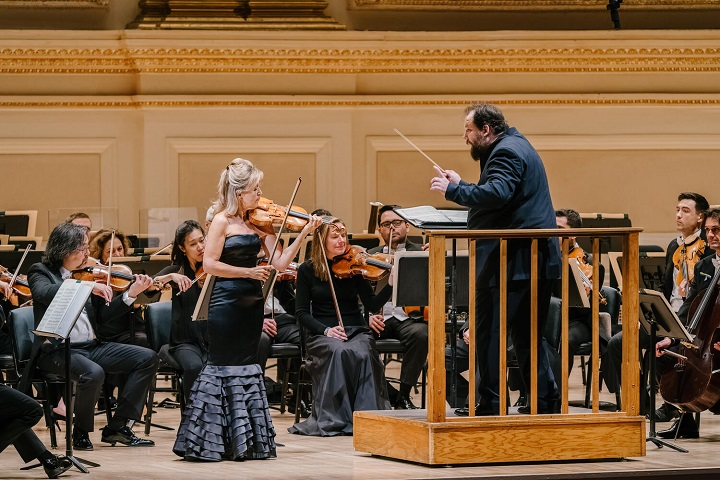
The great Anne-Sophie Mutter (above, photo by Fadi Kheir) performed two works: Mozart’s Violin Concerto No. 1 in B-flat major, KV 207 and the New York premiere of Thomas Adès’ Air (Homage to Sibelius) for Violin and Orchestra.
Mozart’s violin concertos have been part of Mutter’s repertoire for her entire career; it’s music she has played and internalized, and performances she has perfected, through the years. The magical performance on Tuesday night of the 1st Concerto, composed in 1773, was essentially perfect. Mutter’s golden, rich, steady tone never wavered; the soulfulness of her playing made the audience lean in. Mozart’s virtuosic writing gave Mutter no difficulties; she dispatched every run, double stop, and trill with absolute ease.
The new composition by Adès, Air (Homage to Sibelius), is a very different work from Mozart. Composed for Ms. Mutter in 2022, it’s a single-movement, semi-minimalist work (running about 13 mins) that lets the soloist stay in the upper reaches of the instrument for almost its entire run time. While the soloist played a canon – Ms. Mutter’s perfect control and steadiness were wondrous to hear – the orchestra shifted the landscape through orchestration and rhythms. Maestro Nelsons shepherded the forces around Ms. Mutter beautifully, the BSO letting the music ebb and flow. While Mr. Adès explicitly says Air is an homage to Sibelius, I heard more Arvo Pärt and John Adams than Sibelius.
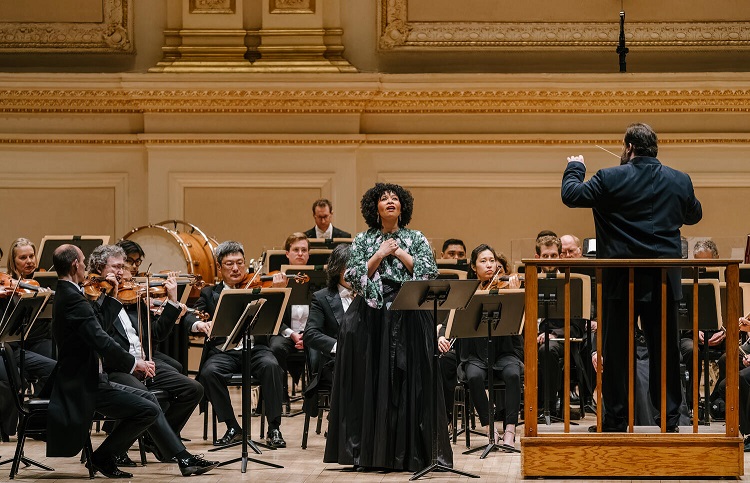
Above: soprano Golda Schultz sings Sibelius; photo by Fad Kheir
Two works by Sibelius book-ended the evening’s program. The vocal tone poem Luonnotar, Op. 70, is one of Sibelius’ most mystical and magical works. With text taken from the first “song” of the Finnish epic national poem Kalevala (a work that inspired several other major works from Sibelius), it tells the story of the (non-religious) Creation. The huge leaps and range of the vocal writing makes Luonnotar one of the most demanding works for a soprano, and South African soprano Golda Schultz was mesmerizing. Her rich voice is even throughout the range, even in the uppermost reaches it remains creamy and ravishing. Her breath control ensured she never ran out of air for Sibelius’ long and achingly beautiful melodies. Maestro Nelsons was sensitive to never let the orchestra drown out the singer. This is a work I wish would be performed more often.

Above: Maestro Nelsons and the BSO; photo by Fadi Kheir
The concert ended with an expansive performance of Sibelius’ Symphony No. 5 in E-flat major, Op. 82. Sibelius’ sound-world is really like no other. I don’t think there is another composer who composed music of such surging coldness and brilliant light. You can feel the winds sweeping across the snow and the icy water glistening in the Sun. The episodic nature of Sibelius’ writing, in the hands of lesser conductors, can be difficult to stitch together. Maestro Nelsons managed it beautifully, and the Boston Symphony – which has a long history of playing Sibelius – responded to every nuance. The orchestra’s marvelous brass section deserves special recognition here because the very exposed writing for the horns in the first and third movements was played perfectly by the ensemble. The final movement, one of Sibelius’ most famous compositions, with the majestic tolling of the horns and sweeping melody from the strings, is one of those rare truly breathtaking glories of music. It’s interesting that this overwhelming section – supposedly inspired by a flock of swans he watched passing overhead – is only played in all its Romantic glory once. When it is repeated in the second half of the movement, it changes to a darker, almost sinister tone. And the work ends with 4 chords and 2 unisons – broken by pauses. A stark and startling conclusion.
The Boston Symphony is second to none playing Sibelius; years ago Sir Colin Davis – one of the great exponents of the Finnish bard’s music – played and recorded his works with the BSO extensively. Andris Nelsons doesn’t miss a beat.
Performance photos by Fadi Kheir, courtesy of Carnegie Hall
~ Ben Weaver

Above: the artists of Ensemble Connect; photo by Fadi Kheir
Author: Oberon
Tuesday February 21st 2023 – Ensemble Connect offering a wide-ranging program at Weill Hall this evening, opening with Jennifer Higdon’s Dark Wood, a work for bassoon and piano trio. Nik Hooks, the Ensemble’s excellent bassoonist, kicked off his busy evening here (he played in three of the four works); for the Higdon, he was joined by pianist Joanne Kang, cellist Laura Andrade, and guest violinist Stephanie Zyzak. The piece’s title refers to the lustrous, deep-dark polish of the bassoon.
Dark Wood opens with staccati for the bassoon and piano; the plucking violin and cello soon join. The music is jagged, buzzing with trills and big accents, full of nervous energy. A prolonged note for bassoon launches a sprightly, animated passage; then the piano begins to rumble, the bassoon and cello playing deep. Another long, dark bassoon tone leads to slithering strings and a pulsing piano motif.
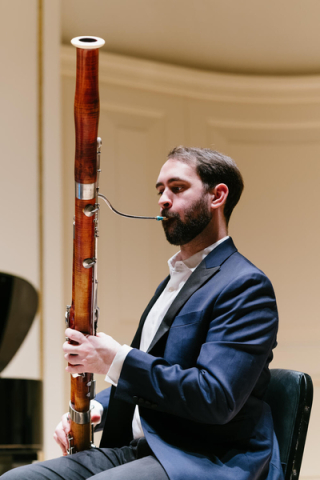
Above: bassoonist Nik Hooks; performance photo by Fadi Kheir
The violin and cello sigh, and things turn dreamy. Dotty violin notes sound over a wistful bassoon melody and then the cello offers a rich theme; this is all quite beautiful to hear. Things perk up, with the bassoon trilling and the strings sizzling, and then Ms. Kang at the keyboard takes over, with big playing, agitated and insistent. Heartfelt strings and a forlorn song for bassoon and piano follow; Ms. Kang offers plucked notes with a “prepared piano” sound, the others playing poignantly. Now the music rushes forward, somewhat chaotically, to a brisk finish.
Ms. Kang and Mr. Hooks were soon back onstage for Mozart’s delightful Quintet for Piano and Winds in E-flat Major, K. 452, joined by three more of the Ensemble Connect’s brilliant wind players: Amir Farsi (flute), Jasmina Spiegelberg (clarinet), and Cort Roberts (horn).
Mozart apparently thought highly of this piece, and he would doubtless have loved this evening’s performance of it. It opens rather hesitantly; Mr. Roberts plushy, golden tone immediately grabbed me, frustrated high-school horn player that I am. The blend of wind voices was sonorous, and after the piano introduces a new and more animated theme, it is passed about from instrument to instrument.
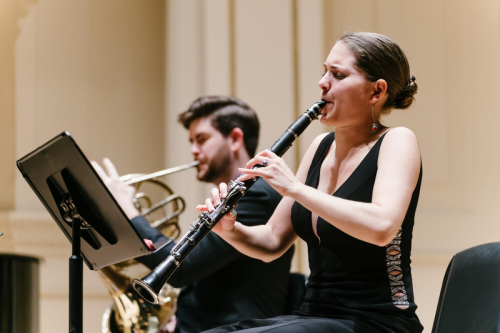
Above: Cort Roberts (horn) and Jasmina Spiegeberg, clarinetist; performance photo by Fadi Kheir
The Larghetto brings us a gracious, courtly melody, with Ms. Spiegelberg’s lambent tone and persuasive phrasing leading the way; flute, horn, and bassoon take up the line in succession. A bel canto atmosphere develops, with the piano offering accentuations; Mr. Roberts’ horn cavatina is so stylish, with the others harmonizing expressively.
The final Rondo/Allegretto rolls along, each player showing a vibrant sense of virtuosity: a sustained flute trill from Mr. Farsi was but one of many decorative delights.

Above: composer Michi Wiancko
Michi Wiancko’s 7 Kinships, a Carnegie Hall commission, was having its New York premiere this evening. The composer charmingly introduced the work; she spoke of how 7ths and 9ths express a feeling of longing. I could not agree more.
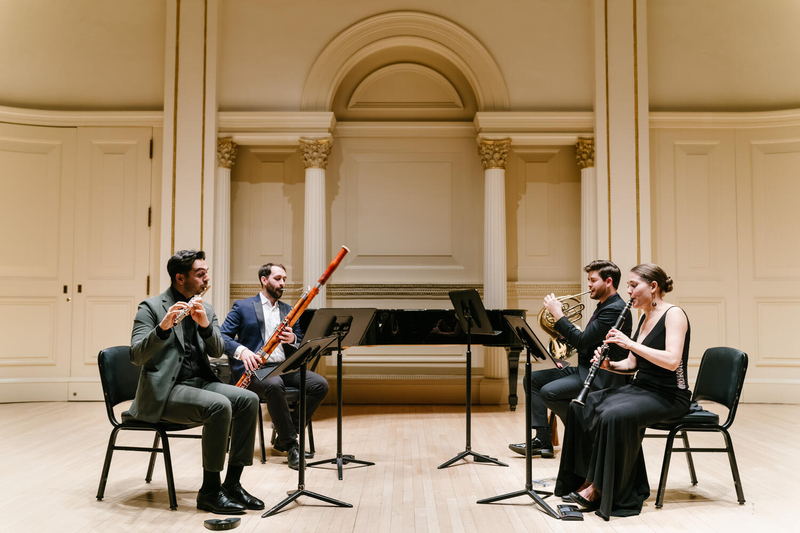
Above: The evening’s wind players – Mssrs. Farsi, Hooks, and Roberts, and Ms. Spiegelberg – giving a sterling performance of the Wiancho; performance photo by Fadi Kheir
In the work’s seven brief movements, Ms. Wiancho’s thoughtful craftsmanship gave the players ample opportunity to revel in their artistry. The music ranges from lyrical to animated, with moods veering from whimsical to lamenting. The sounds of the instruments entwine to delight the ear, sometimes in strange harmonies, whilst rhythmically the composer displays touches of wit. The musicians seemed to genuinely enjoy playing this music.
Before commencing the program’s final work, Robert Schumann’s Piano Quintet, violist Halam Kim read one of the composer’s letters to his beloved Clara; I admit this outpouring of love brought tears to my eyes. And then to recall that it was Clara who played the quintet’s demanding piano part at the work’s public premiere, making it all the more touching.

Above, playing the Schumann: Mr. Rengel, with Mlles. Zyzak, kang, Andrade, and Kim; photo by Fadi Kheir
The Ensemble Connect’s marvelous violinist, Rubén Rengel, led the ensemble, with Ms. Kang honoring Clara Schumann with her delectable playing, and Mlles. Zyzak, Kim, and Andrade all sounding gorgeous.
This beloved work is bursting with magical passages: the ‘dialogue’ for cello and viola in the opening movement, a theme to which Mozart frequently returns, is especially endearing, and in the dirge-like second movement, Mr. Rengel ‘s playing is exceptional. Mlles. Zyzak and Kim take ups this calmly funereal theme, and Ms. Abdrade’s sumptuous tone is ever at the heart of the matter.
In the bustling Scherzo, Mr. Rengel is again in his element, and Ms. Kang has much to do, her rising scales setting the scene for a fast dance, her music-making on the grand scale. It is Ms. Kang who initiates the final Allegro ma non troppo with her scintillating playing. A hymn-like interlude arises, and then low rumblings from the piano develop into a slow sway; this then accelerates, dancing us on to the finish.
All performance photos by Fadi Kheir, courtesy of Carnegie Hall.
~ Oberon
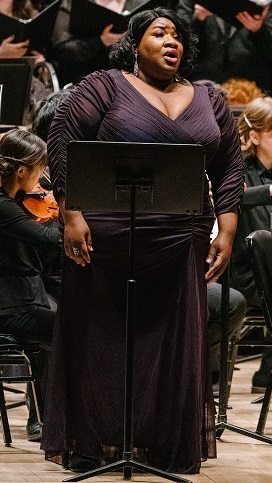
Above: mezzo-soprano Ronnita Miller; photo by Fadi Kheir
I was bowled over by Ronnita Miller’s singing as the 1st Norn in Wagner’s GOTTERDAMMERUNG at The Met in 2019. Soon I’ll have a chance to see Ms. Miller onstage again: she will sing the role of Gaea in a concert performance of Richard Strauss’s DAPHNE with the American Symphony Orchestra at Carnegie Hall on March 23, 2023. Details here.
Sample Ms. Miller’s singing here.
Above: Maestro Raphael Jiménez with the Oberlin Orchestra at Carnegie Hall; photo by Fadi Kheir
Author: Brad S Ross
Friday January 20th, 2023 – On Friday evening, New York audiences were once again treated to a fine performance by the Oberlin Orchestra and Choral Ensembles as they returned to Carnegie Hall for the first time (publicly, anyway) since January 19, 2019. They were conducted by Oberlin Orchestras Director Raphael Jiménez, who led the performers in a unique program that included one repertory standard, one New York City premiere, and one buried gem.
The evening began with long—very long—opening remarks by Oberlin College and Conservatory President Carmen Twillie Ambar and Oberlin Conservatory Dean William Quillen.
Ambar’s remarks focused on two of the evening’s headlining pieces having been written by minority composers and therefore made all the requisite extollations about the need for representing historically marginalized groups. As important as this message is, it would be nice to hear the music of under-appreciated composers like Will Marion Cook, William Dawson, Florence Price, George Walker, etc., without this ever-obligatory preamble. My continued hope is that someday we will be able to let their music simply speak for itself.
Quillen’s remarks, while less political, were a seemingly endless list of “thank you”s, not unlike an Oscar acceptance speech—only this time, there was no hope of the music playing him off. All the parents and staff in attendance no doubt appreciated the acknowledgements, but after a full quarter hour of talking I was getting pretty antsy for things to move along.
Nevertheless, once the opening remarks concluded, the Oberlin musicians were finally able to grace the Isaac Stern Auditorium with their abilities—and what a pleasure they were to hear!
First on the program was Johannes Brahms’s Tragic Overture, Op. 81, from 1880. There’s not much one can say about this work that hasn’t already been expressed over the last one hundred and forty years, so I won’t labor on it here. It’s a pleasant and undemanding symphonic poem, lasting about fourteen minutes and chock-full of the lyrical gestures typical of that Romantic master. Needless to say, the Oberlin musicians tackled the piece expertly, but it did leave me wanting to hear more of their technical skills.
I was not left wanting for long, however, as the second work of the evening—the New York premiere of Iván Enrique Rodríguez’s A Metaphor for Power—immediately livened up the proceedings.
Written in 2018, A Metaphor for Power is a single-movement essay for orchestra lasting about thirteen minutes. Rodríguez—a 32-year-old Puerto Rican native—composed the piece as a comment on the turbulence and inequalities of contemporary life in the United States, despite the promise of its founding (the title, indeed, comes from a quote by James Baldwin). His use of social commentary through music was much more subtle than that of other recent protest works, however (Anthony Davis’s quite overt You Have the Right to Remain Silent comes to mind), making for a composition that was both cleverly referential and electrifying to hear.
The music opened with a bang before quickly diminuendoing into dream-like textures, complete with harp, mallets, and woodwind writing that sounded as though they had descended straight from Maurice Ravel’s Daphnis et Chloé. A contemplative middle section featured, among other memorable effects, distorted quotations from “America the Beautiful” and unsettling vocalizations from the orchestra as they recited overlapping lines from the Declaration of Independence. A great crescendo announced the beginning of the third, final section, which was marked by dramatic gestures that were almost filmic in execution. It all came to an energetic and wickedly engaging ending that lit up the room with excitement.
Above: Maestro Jiménez and composer Iván Enrique Rodríguez take a bow; photo by Fadi Kheir
The composer practically leapt from his seat and ran to the stage to share an emotional embrace with Jiménez before they took their bows together. The moment was as touching as it was well-earned. The composer having been unknown to me until that evening, I must say that I look forward to hearing much more from him in the future.
Above: the vocal soloists for the Dett oratorio: Chabrelle Williams, Ronnita Miller, Limmie Pulliam, and Eric Greene; photo by Fadi Kheir
The final and most substantial work of the evening was Robert Nathaniel Dett’s oratorio The Ordering of Moses. Dett, a Canadian-born American composer of the early 20th century, became the first black man to graduate with a double major from the Oberlin Conservatory in 1908. He initially wrote The Ordering of Moses as a thesis project while completing his Masters of Music from the Eastman School of Music in Rochester in 1932. Dett later revised and expanded the work, however, and it was premiered in its final form by the Cincinnati Symphony Orchestra under Eugene Goosens in 1937.
Clocking just under an hour, the oratorio is divided into nine sections and is cast for orchestra, chorus, and four vocal soloists. Joining the Oberlin musicians for this performance were soprano Chabrelle Williams, mezzo-soprano Ronnita Miller, tenor Limmie Pulliam, and baritone Eric Greene.
Above: soloists Ronnita Miller and Eric Greene; photo by Fadi Kheir
The first section opened on warm instrumentation that favored the lower voices of the orchestra. A lone cello voice emerged for an occasional solo before Greene’s sonorous tones took center stage as “The Word,” describing the bondage of the Israelites under the Pharaoh. He was joined briefly by Miller, who cried out for mercy as the voice of the Israelites. The music was rather languid here, until a great exclamation of “Mercy, Lord” announced an upbeat transition into the second section, “Go Down Moses.”
A recent last-minute Metropolitan Opera debutant, tenor Limmie Pulliam (above, in a Fadu Kheir photo) then entered as the voice of the reluctant Moses, who is given the famous command by God, “Go down Moses, way down in Egypt’s land; tell Pharaoh: ‘Let my people go!’” (this section featured a particularly cheeky musical joke where Moses sings “I am slow of tongue!” at the most sluggish pace imaginable). The drama then moved fairly seamlessly into the third section “Is it not I, Jehovah!” as God affirms his edicts to Moses.
This was followed by a mostly uneventful instrumental interlude as the story was transported forward to Moses’s parting of the Red Sea (“And When Moses Smote the Water”). This exuberant, celebratory section was followed by two more instrumental interludes: “The March of the Israelites through the Red Sea” and “The Egyptians Pursue.” The former was an almost jaunty affair, complete with military snare and wordless chorus, while the latter featured brassy blasts and dramatic descending runs as the crashing waters swept away the pursuers.
Above: soprano Chabrelle Williams; photo by Fadi Kheir
Ms. Williams’s soaring vocals finally entered the proceedings in the waltz-like “The Word,” as the Israelites jovially sang praises to Jehovah. All forces joined for the triumphant finale “Sing Ye to Jehovah,” as the oratorio built to a final satisfying tutti instrumental blast.
Everyone performed splendidly throughout and the piece was met with one of the most enthusiastic standing ovations I’ve seen in a while, yet I couldn’t help feeling slightly underwhelmed by the music itself. Considering the scale of forces at work, the writing was not terribly economical. The instrumentation was often sparse and seldom were all of the elements brought together for fuller effect. The solo parts also heavily favored the male voices, leaving Williams and Miller very little to do for most of its duration.
This isn’t to say it was bad—far from it—, but it did leave me wanting a little bit more. Had Dett not died of a heart attack at the relatively young age of 60 in 1943, one cannot help but wonder what other and more exciting large scale works he might have brought to the concert hall. Nevertheless, it was exciting as always to hear a buried musical gem such as this get dusted off and given new life. It was a grand conclusion to another memorable concert by the Oberlin Conservatory musicians, who will hopefully return again soon to grace New York City audiences with another memorable program.
All performance photos by Fadi Kheir.
~ Brad S Ross

Above: Maestro Raphael Jiménez with the Oberlin Orchestra at Carnegie Hall; photo by Fadi Kheir
Author: Brad S Ross
Friday January 20th, 2023 – On Friday evening, New York audiences were once again treated to a fine performance by the Oberlin Orchestra and Choral Ensembles as they returned to Carnegie Hall for the first time (publicly, anyway) since January 19, 2019. They were conducted by Oberlin Orchestras Director Raphael Jiménez, who led the performers in a unique program that included one repertory standard, one New York City premiere, and one buried gem.
The evening began with long—very long—opening remarks by Oberlin College and Conservatory President Carmen Twillie Ambar and Oberlin Conservatory Dean William Quillen.
Ambar’s remarks focused on two of the evening’s headlining pieces having been written by minority composers and therefore made all the requisite extollations about the need for representing historically marginalized groups. As important as this message is, it would be nice to hear the music of under-appreciated composers like Will Marion Cook, William Dawson, Florence Price, George Walker, etc., without this ever-obligatory preamble. My continued hope is that someday we will be able to let their music simply speak for itself.
Quillen’s remarks, while less political, were a seemingly endless list of “thank you”s, not unlike an Oscar acceptance speech—only this time, there was no hope of the music playing him off. All the parents and staff in attendance no doubt appreciated the acknowledgements, but after a full quarter hour of talking I was getting pretty antsy for things to move along.
Nevertheless, once the opening remarks concluded, the Oberlin musicians were finally able to grace the Isaac Stern Auditorium with their abilities—and what a pleasure they were to hear!
First on the program was Johannes Brahms’s Tragic Overture, Op. 81, from 1880. There’s not much one can say about this work that hasn’t already been expressed over the last one hundred and forty years, so I won’t labor on it here. It’s a pleasant and undemanding symphonic poem, lasting about fourteen minutes and chock-full of the lyrical gestures typical of that Romantic master. Needless to say, the Oberlin musicians tackled the piece expertly, but it did leave me wanting to hear more of their technical skills.
I was not left wanting for long, however, as the second work of the evening—the New York premiere of Iván Enrique Rodríguez’s A Metaphor for Power—immediately livened up the proceedings.
Written in 2018, A Metaphor for Power is a single-movement essay for orchestra lasting about thirteen minutes. Rodríguez—a 32-year-old Puerto Rican native—composed the piece as a comment on the turbulence and inequalities of contemporary life in the United States, despite the promise of its founding (the title, indeed, comes from a quote by James Baldwin). His use of social commentary through music was much more subtle than that of other recent protest works, however (Anthony Davis’s quite overt You Have the Right to Remain Silent comes to mind), making for a composition that was both cleverly referential and electrifying to hear.
The music opened with a bang before quickly diminuendoing into dream-like textures, complete with harp, mallets, and woodwind writing that sounded as though they had descended straight from Maurice Ravel’s Daphnis et Chloé. A contemplative middle section featured, among other memorable effects, distorted quotations from “America the Beautiful” and unsettling vocalizations from the orchestra as they recited overlapping lines from the Declaration of Independence. A great crescendo announced the beginning of the third, final section, which was marked by dramatic gestures that were almost filmic in execution. It all came to an energetic and wickedly engaging ending that lit up the room with excitement.
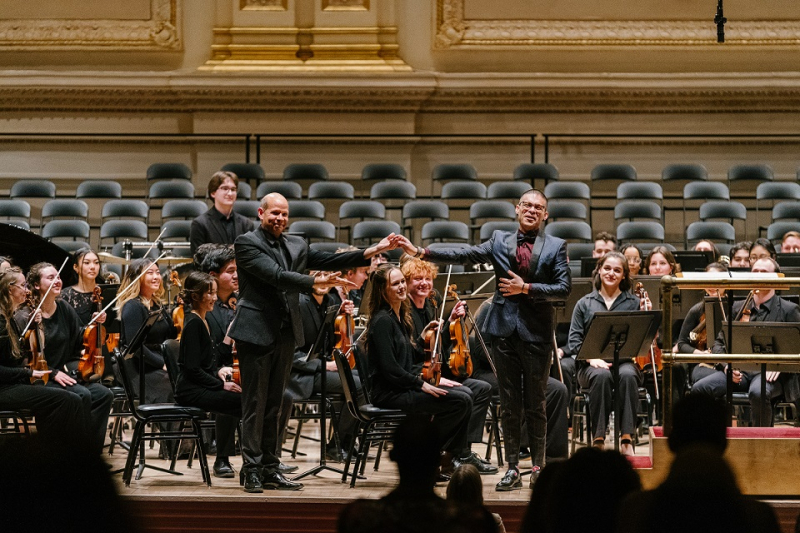
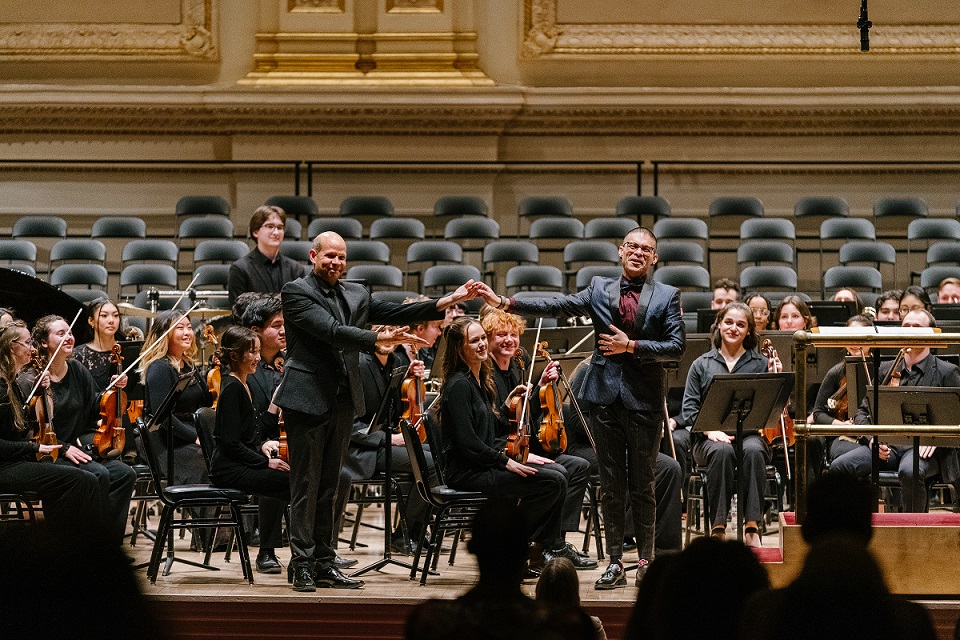
Above: Maestro Jiménez and composer Iván Enrique Rodríguez take a bow; photo by Fadi Kheir
The composer practically leapt from his seat and ran to the stage to share an emotional embrace with Jiménez before they took their bows together. The moment was as touching as it was well-earned. The composer having been unknown to me until that evening, I must say that I look forward to hearing much more from him in the future.

Above: the vocal soloists for the Dett oratorio: Chabrelle Williams, Ronnita Miller, Limmie Pulliam, and Eric Greene; photo by Fadi Kheir
The final and most substantial work of the evening was Robert Nathaniel Dett’s oratorio The Ordering of Moses. Dett, a Canadian-born American composer of the early 20th century, became the first black man to graduate with a double major from the Oberlin Conservatory in 1908. He initially wrote The Ordering of Moses as a thesis project while completing his Masters of Music from the Eastman School of Music in Rochester in 1932. Dett later revised and expanded the work, however, and it was premiered in its final form by the Cincinnati Symphony Orchestra under Eugene Goosens in 1937.
Clocking just under an hour, the oratorio is divided into nine sections and is cast for orchestra, chorus, and four vocal soloists. Joining the Oberlin musicians for this performance were soprano Chabrelle Williams, mezzo-soprano Ronnita Miller, tenor Limmie Pulliam, and baritone Eric Greene.

Above: soloists Ronnita Miller and Eric Greene; photo by Fadi Kheir
The first section opened on warm instrumentation that favored the lower voices of the orchestra. A lone cello voice emerged for an occasional solo before Greene’s sonorous tones took center stage as “The Word,” describing the bondage of the Israelites under the Pharaoh. He was joined briefly by Miller, who cried out for mercy as the voice of the Israelites. The music was rather languid here, until a great exclamation of “Mercy, Lord” announced an upbeat transition into the second section, “Go Down Moses.”

A recent last-minute Metropolitan Opera debutant, tenor Limmie Pulliam (above, in a Fadu Kheir photo) then entered as the voice of the reluctant Moses, who is given the famous command by God, “Go down Moses, way down in Egypt’s land; tell Pharaoh: ‘Let my people go!’” (this section featured a particularly cheeky musical joke where Moses sings “I am slow of tongue!” at the most sluggish pace imaginable). The drama then moved fairly seamlessly into the third section “Is it not I, Jehovah!” as God affirms his edicts to Moses.
This was followed by a mostly uneventful instrumental interlude as the story was transported forward to Moses’s parting of the Red Sea (“And When Moses Smote the Water”). This exuberant, celebratory section was followed by two more instrumental interludes: “The March of the Israelites through the Red Sea” and “The Egyptians Pursue.” The former was an almost jaunty affair, complete with military snare and wordless chorus, while the latter featured brassy blasts and dramatic descending runs as the crashing waters swept away the pursuers.

Above: soprano Chabrelle Williams; photo by Fadi Kheir
Ms. Williams’s soaring vocals finally entered the proceedings in the waltz-like “The Word,” as the Israelites jovially sang praises to Jehovah. All forces joined for the triumphant finale “Sing Ye to Jehovah,” as the oratorio built to a final satisfying tutti instrumental blast.
Everyone performed splendidly throughout and the piece was met with one of the most enthusiastic standing ovations I’ve seen in a while, yet I couldn’t help feeling slightly underwhelmed by the music itself. Considering the scale of forces at work, the writing was not terribly economical. The instrumentation was often sparse and seldom were all of the elements brought together for fuller effect. The solo parts also heavily favored the male voices, leaving Williams and Miller very little to do for most of its duration.
This isn’t to say it was bad—far from it—, but it did leave me wanting a little bit more. Had Dett not died of a heart attack at the relatively young age of 60 in 1943, one cannot help but wonder what other and more exciting large scale works he might have brought to the concert hall. Nevertheless, it was exciting as always to hear a buried musical gem such as this get dusted off and given new life. It was a grand conclusion to another memorable concert by the Oberlin Conservatory musicians, who will hopefully return again soon to grace New York City audiences with another memorable program.

All performance photos by Fadi Kheir.
~ Brad S Ross



 Oberon's Glade