Tag: Franco Corelli

  • @ My Met Score Desk for Roméo et Juliette

    Snapshot

    Above: tenor Benjamin Bernheim as Romeo

    ~ Author: Oberon

    Saturday March 30th, 2024 matinee – Earlier this season, I renewed my acquaintance with Bizet’s CARMEN at The Met, an opera I had not seen for many years. Musically, I enjoyed it thoroughly, and so this afternoon I was hoping for a similar experience with Gounod’s ROMEO & JULIETTE.

    My first encounter with the Gounod opera was an unforgettable matinee in October of 1967, when Jeannette Pilou made a last-minute Met debut as Juliette opposite Franco Corelli’s matinee idol Romeo. I fell in love with Ms. Pilou that afternoon, and made many trips to New York from the little town specifically to see her in her many Met roles in the ensuing seasons. I saw Jeannette as Juliette a second time, and since then I have seen only Colette Boky and Hei-Kyung Hong in the role.

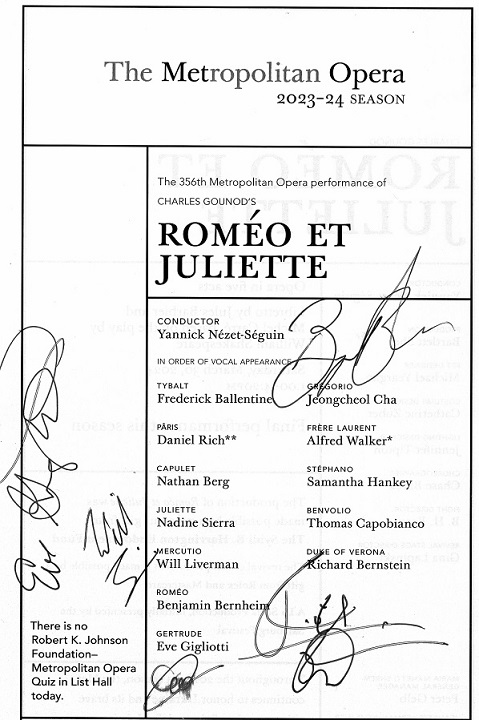
    Today’s matinee started the same way as my first-ever ROMEO in 1967: the news that Nadine Sierra had canceled and was being replaced by So Young Park, whose Met credentials to date have been a handful of recitals with piano in the NY Parks, and a single Queen of the Night in 2019. 

    The Met Orchestra played with its accustomed polish, and the chorus has a lot to do in this opera…and they did it very well. For the most part, Yannick Nézet-Séguin resisted his usual temptation to have the orchestra play too loudly…though there were moments…

    The orchestral opening was heavy-handed, followed by a chorale, and then the poignant love theme sounds from the strings. The first solo voices to be heard are those of Frederick Ballentine as Tybalt and Daniel Rich as Paris; Mr. Ballentine would have more to do later, in the duel scene…and he made a strong impression there.

    Nathan Berg was a fine Capulet; his ‘aria’ at the ball was subtly done, and his scene with Juliet prior to her taking the potion was excellent, as was his expression of remorse over her supposed death. Eve Gigliotti was an impressive Gertrude, making the most of her part in the wedding quartet, and in her scene with the the characterful Grigorio of Jeongcheol Cha. Richard Bernstein’s Duke of Verona made his anger at the dueling factions palpable, and his sentencing of Romeo to exile is a pivotal moment in the story.

    Alfred Walker’s Frère Laurent brought the basso’s warmth of timbre and eloquence of feeling to the scene of the wedding, and his consoling singing gives Juliette the courage to take the sleeping potion. Will Liverman delivered Mercutio’s tricky Queen Mab aria with complete assurance – a highlight of the evening for sure. Will’s handsome timbre is always so appealing, and his delivery was light and lively in the aria’s swift phrases, turning more lyrical in the central, more reflective passages. Bravo! Samantha Hankey’s singing of Stephano’s “Que fais tu blanche tourterelle” was a vocal treat. Melodious in the opening tune, the page chides the Capulet men with her insouciant teasing at “Gardez bien la belle”, finishing off with a mini-cadenza up to a perfectly placed top note which she sustained to brilliant effect. This aria was an early-career success for the great Frederica von Stade; may it bring Ms. Hankey similar good fortune!

    So Young Park has a girlish, clear voice which captured the innocence of the teen-aged Juliette right from her opening lines. At first, the voice was a bit tremulous, but she bravely shimmered up to a sprightly top note in her cadenza. Soon after, she was breezing thru the delectable waltz, in which she had all the coloratura well in-hand; the lovely pensive passage “Loin de l”Hiver morose…” was beautifully sung, and then the soprano sailed up to neat top-C, and lingered there.

    She and Mr. Bernheim were sweetly playful in their first encounter, Mr. Bernheim so persuasive in his gentle flirtation which is dressed up as poetry. Ms. Park’s delight at being so charmed by the handsome stranger vanished into sadness when she learns who he is: an enemy of her family. 

    The balcony duet was alive with the fascination of young love;  Ms. Park, now settled-in vocally, brought sweet lyricism to her lines – and the voice bloomed lovingly in response to the tenor’s ardent “O nuit divine…”. Then they harmonized to ravishing effect with “De cet adieu si douce e la tristesse“, and then Mr. Bernheim melted all hearts with his hushed, gorgeous “Va, repose en paix…” For me, die-hard romantic that I am, this entire scene was enthralling.

    Ms. Park’s voice sailed over the wedding scene quartet, where Ms. Gigliotti and Mssrs. Bernheim and Walker were all vocally aglow. The spine-tingling prelude to the bridal night duet was magically played by the Met Orchestra, and then Ms. Park and Mr. Bernheim gave us some of the most captivating singing imaginable with “Nuit d’hyménée! Ô douce nuit d’amour!”, their voices entwining in quiet rapture. The call of the lark – “the harbinger of the dawn” – draws them out of their reverie: thrillingly, they bid each other farewell. Romeo rushes to his fate, as Juliette sings a quiet blessing. This is the end of their happiness, though they do not know it.

    Ms. Park sang the dramatic Potion Aria effectively, though the conductor’s sudden need to pump up the volume elicited a rather brassy climactic top note from the soprano: so predictable with him on the podium. But such things only matter to a handful of listeners. The soprano finished the opera with her touching farewell to her beloved as they ask god to forgive them.

    The afternoon was a total triumph for Benjamin Bernheim. It is a great pleasure to hear this voice, which is both elegant and passionate. Following the sublime ‘lullaby” of the entr’acte leading up to the balcony scene, the tenor’s “O nuit!” marked the start of Bernheim’s dreamy recitative which carries us to a gorgeous clarinet solo before he takes up greatest love song in all opera: “Ah! Lèvetoi, soleil!” I have heard many 
    superb interpretations of his aria – from the likes of Franco Corelli, Alfredo Kraus, and Neil Shicoff – but none has moved me quite as deeply as M. Bernheim’s. Sung with deep tenderness, and ending with a  thrilling B-flat, the tenor was vociferously hailed by the audience. Listen to a brief clip here.

    Following his anguish at being exiled, the Bernheim Romeo capped the duel scene’s final ensemble with a bold top-C. Yet, for all the excitement of hearing a tenor deploy such golden high notes, it was in the quiet despair of the final scene that Bernheim achingly conveyed the pain of a broken heart: the sublime tenderness of his pianissimo farewell to Juliet, which was followed by the heart-rending echo of “No, ce n’est pas le jour…”, recalling the lovers’ moments of their brief happiness.

    Benjamin Bernheim’s Romeo brought some of the finest tenor singing I’ve heard at The Met in the last half-century. His voice has an innate poetic quality that cannot be taught; it is a voice that touches my heart. Thru the years, I have sometimes felt my deeply romantic soul to be a curse, but today I realized that it’s a gift.

    Now I have rambled on long enough. I went to the stage door after the curtain calls and met Eve, Benjamin, Will, and Richard. They were so kind…I love them all. What intrigues me so much about opera singers is that they can do things we mere mortals can only dream of. I admire their devotion and their courage, putting themselves on the line night after night so that we can bask in the glory of the greatest art form ever. 
    Romeo 2024-1 jpg

    And here are the curtain calls!

    ~ Oberon

  • Tucci & Corelli ~ Vicino a te

    Tucci corelli

    Gabriella Tucci and Franco Corelli sing the final duet from Giordano’s ANDREA CHENIER from a 1971 performance at The Met; Cornell MacNeil is Carlo Gerard, and Fausto Cleva conducts.

    Listen here.

  • Franco Corelli as Radames

    6a00d8341c4e3853ef0224e037634e200d-800wi

    Franco Corelli sings Radames’ great arias Celeste Aida from a 1962 Met broadcast; Giorgio Tozzi sings Ramfis.

    Franco Corelli – Celeste Aida – AIDA – with Giorgio Tozzi – Met b’cast 1962


  • Corelli/Guelfi ~ FORZA DEL DESTINO – scenes

    Forza

    Franco Corelli and Giangiacomo Guelfi in scenes from Verdi’s LA FORZA DEL DESTINO from an RAI broadcast in 1956. Arturo Basile conducts.

    Listen here

  • Corelli/Guelfi ~ FORZA DEL DESTINO – scenes

    Forza

    Franco Corelli and Giangiacomo Guelfi in scenes from Verdi’s LA FORZA DEL DESTINO from an RAI broadcast in 1956. Arturo Basile conducts.

    Listen here

  • Nilsson & Corelli in TURANDOT

    Franco birgit

    I was at the December 3, 1966 Met matinee of TURANDOT, a performance which found the illustrious pairing of Birgit Nilsson and Franco Corelli at the height of their powers. The audience broke in with vociferous applause after “In questa reggia“, and again after Corelli’s interpolated high-C on “…ti voglio ardente d’amor!“.  

    For years, I had this performance on reel-to-reel tape. Eventually, lugging these hundreds of tapes around with me from place to place grew wearisome, and I gave the collection away. So I was happy to find the big scene from Act II on YouTube, audio-only, in excellent sound.

    Listen here.

  • Nilsson & Corelli in TURANDOT

    Franco birgit

    I was at the December 3, 1966 Met matinee of TURANDOT, a performance which found the illustrious pairing of Birgit Nilsson and Franco Corelli at the height of their powers. The audience broke in with vociferous applause after “In questa reggia“, and again after Corelli’s interpolated high-C on “…ti voglio ardente d’amor!“.  

    For years, I had this performance on reel-to-reel tape. Eventually, lugging these hundreds of tapes around with me from place to place grew wearisome, and I gave the collection away. So I was happy to find the big scene from Act II on YouTube, audio-only, in excellent sound.

    Listen here.

  • 55 Years Ago ~ TURANDOT @ The Met

    Birgit (2)

    On September 26th, 1966, I attended my first opera at the New Met: a performance of Puccini’s TURANDOT starring Birgit Nilsson (above), Franco Corelli, Teresa Stratas, and Bonaldo Giaiotti, conducted by Zubin Mehta.

    A few weeks earlier, I had taken an over-night bus from Syracuse to New York City and joined the ticket line for the opening performances at the new opera house. Read about my adventure here.

    I had seen the Met’s Cecil Beaton production of TURANDOT previously, at the Old Met. It was considered quite lavish at the time, but within a couple decades it was wildly surpassed by the elaborate Franco Zeffirelli setting. Birgit and Franco seemed thoroughly at home on the Beaton sets, their by-play with Turandot’s all-day-lollipop/sceptre, was always commented upon by the fans, who gauged the scene to determine how well the two superstars were getting along on a given evening.

    Turandot-1 jpg
    My diary entry was very brief:

    “First performance at the New Met!! Magnificent evening, dazzling experience. After hearing Nilsson and Corelli on Saturday matinee broadcasts, it was electrifying to hear them “live“; you can’t really tell how immense and thrilling their voices are over the radio. They are great stars!

    Teresa Stratas was excellent as Liu, and my favorite bass, Bonaldo Giaiotti, sounded great. Uppman, Nagy, Anthony, and Goodloe – all singers know from the broadcasts – were fine. Mehta tremendous!

    There was huge applause after each act, and many curtain calls. The Corelli fans in particular went crazy.”

    After the ovation finally ceased, I went to the stage door where a huge crowd of people were waiting to meet the artists. They finally came out, and they were all very nice to me. Stratas signed my program, and Birgit signed the photo at the top of this article.

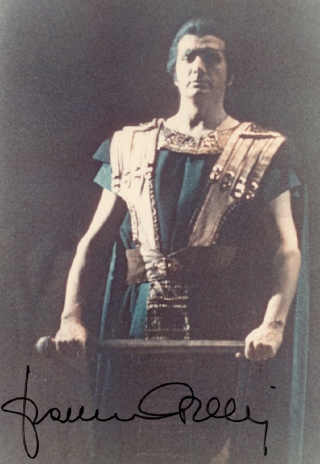
    Franco

    I’d brought along the above photo of Corelli as Radames for him to sign; he seemed genuinely pleased to see this picture of himself, and the fans gathered around him were gasping, “Where did you find this???” 

    I remember that I slept very little after getting back to The Henry Hudson Hotel that night. I was really wound-up: I had been going to the opera sporadically since 1962 – plus catching every Met broadcast and building a big record collection. But this evening marked the start of the next phase of my operatic career. I began coming down to New York for long weekends, taking the over-night bus from Syracuse and staying at the Henry Hudson; opera was everything to me.

    After spending the Summer of 1974 on Cape Cod with TJ, working for a small ballet company, I moved into his dorm room at Sarah Lawrence College where we spent the 1974-1975 academic year together. We went down to the opera (and also the ballet!) constantly, taking a bus from Bronxville to the A train station at 207th Street – the station that’s now a block from where I live.

    After he graduated, we moved to Hartford; we were poor, and trips to New York City were few and far between. But after we broke up, I got my own place place and began spending frequent long weekends in NYC again. My promiscuous phase – can 25 years be considered a phase? – started at this point.

    Finally, in 1998, shortly before my 50th birthday, I moved to New York City. This had been my plan since that first solo excursion to join the Met ticket line in late Summer 1966, but Hartford had been a 22-year detour.

    Now, at last, I was home.

    ~ Oberon

  • 50 Years Ago: WERTHER @ The Met

    Crespin charloitte-1 jpg

    Above: Régine Crespin as Charlotte

    On March 31st, 1971, I saw Massenet’s WERTHER for the first time. It was one of the events of the season, as the beloved soprano Régine Crespin was singing Charlotte with the Company for the first time, and Franco Corelli was repeating his popular success as the melancholy poet of the title-role.

    Mme. Crespin seemed to be transitioning to mezzo-soprano roles at this point in her career. By 1975, she would soon be owning the role of Carmen with her unique portrayal of the seductive gypsy. But while both Charlotte and Carmen had sometimes been sung by sopranos, Crespin’s increasing discomfort in the upper range meant that her days as the Marschallin, Sieglinde, and Tosca were over. Her final Met role with Mme. de Croissy in Poulenc’s DIALOGUES DES CARMELITES, in which she appeared with the Company for the last time in 1987.

    There had been rumors of the French diva’s vocal and personal crises, but on the night of the WERTHER, we were simply happy to be seeing and hearing her again…and in a new role.

    Regine Crespin – Air des Larmes ~ WERTHER

    Here’s what I wrote in my opera diary the morning after:

    “WERTHER – First time. I liked it, for the most part, though only the third act really drew me in. The sets were beautiful, and Alain Lombard conducted well. Fernando Corena as the Bailiff was excellent, as was John Reardon in the rather short role of Albert. Gail Robinson was a fine Sophie; her voice and stage presence are very appealing.
     
    Corelli was an Italianate Werther, and his acting bordered on the hammy. But he was in far better voice than in last season’s DON CARLO. He looked very handsome. Werther’s death scene, which goes on and on and on, made me impatient for the curtain to fall. Corelli’s fans were delirious during the bows.
     
    Crespin had a huge triumph as Chatlotte! Her voice is not all it once was, but she had many wonderful passages. The range of the role suits her well, and she looked beautiful. In Acts I and II she did some lovely soft singing, and in the third act she was really marvelous: both the Air des Lettres and the Air de Larmes were VERY effectively sung and heavily applauded, and she ended the act thrillingly. She had some pitch trouble in the final act, but was still very exciting. BRAVISSIMA!  Crespin was very sweet backstage, after having received a thunderous ovation. Photo! A very nice night!”

    Werther-1 jpg

    I still remember the long ovation after the final curtain, with the principals called out several times. Up in the Family Circle, the mood was celebratory: between the Corelli fans and the Crespin admirers, there was plenty of cheering.

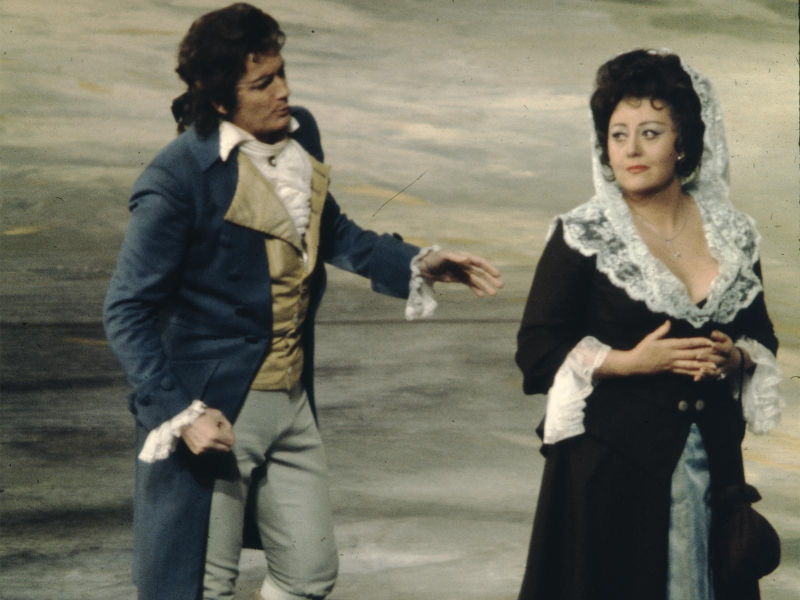
    Corelli crespin

    Above: Corelli and Crespin onstage; a Met Opera photo

    I went backstage after the performance; Mme. Crespin looked radiant and was very charming when I asked to take her photo. I can’t recall why I didn’t ask her to sign my cast page that night, but here’s the happy prima donna

    Crespin-1 jpg

    ~ Oberon

  • O terra addio

    Snapshot aida

    Ilva Ligabue and Franco Corelli in the final moments of Verdi’s AIDA, with Fiorenza Cossotto as Amneris.

    Watch and listen here.