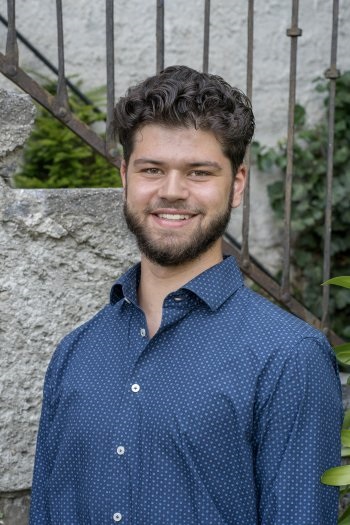
German basso Lukas Lemcke sings Franz Schubert’s Der Wanderer, with Manfred Schiebel at the piano.
Watch and listen here.
German basso Lukas Lemcke sings Franz Schubert’s Der Wanderer, with Manfred Schiebel at the piano.
Watch and listen here.

Tuesday January 24th, 2023 – This year, Chamber Music Society of Lincoln Center‘s annual Winter Festival is centered on the works of Franz Schubert. Tonight’s program featured the eminent pianist Gilbert Kalish and my beloved Escher String Quartet in three masterworks from the composer’s brilliant – but all too brief – career.
The single-movement Quartettsatz in C-minor for Strings, D. 703, was composed in 1820. It seems to have been intended to be the first movement of a full quartet, but the composer never composed additional movements.
From its scurrying start, the Escher Quartet’s performance of the Quartettsatz was a complete delight; their rhythmic attentiveness and tonal appeal were amply on display, their playing full of both vitality and nuance. The silken sheen of Adam Barnett-Hart’s violin made its distinctive mark in solo passages, the music flowing onward to a sudden tempest. This is soon calmed, but Brook Speltz’s restless cello figurations keep things lively. There is a da capo, a sort of coda, which draws on to a full-toned chordal passage; here, the classic Escher blend could be deeply savoured.
Gilbert Kalish then took the stage for Schubert’s Sonata in B-flat major for Piano, D. 960, composed in 1828. This long and demanding work begins with an Allegro Moderato. Mr. Kalish delivers the theme with a sense of serenity; then a low trill sounds, seeming rather ominous – a trill which later brings music of great tenderness. As things become more intense, so does the playing: modulations are beautifully handled by the pianist. The low trill returns before a final recapitulation.
Mr. Kalish brought forth the austere calm – and the poignant colours – of the ensuing Andante sostenuto; the music’s steady rhythmic pulse puts us in a trance. The movement’s ending feels like a benediction.
In a striking volte face, the pianist takes up the boundless animation of the Scherzo. The music breezes along, pausing only for a courtly interlude. The sonata’s concluding Allegro ma non troppo is filled with an uplifting sense of buoyancy and good humor. Passing shadowy clouds momentarily blot out the sun, but by the end, all is bright and fair.
Mr. Kalish was hugely applauded by the packed house at Alice Tully Hall. If Wikipedia is correct, the pianist is 88 years young…simply remarkable!

Above, the players of the Escher String Quartet: Adam Barnett-Hart, violin; Brendan Speltz, violin; Brook Speltz, cello; and Pierre Lapointe, viola.
The gentlemen of the Escher Quartet returned after the interval for the G-major quartet, Opus 161, dating from 1826. From the work’s striking beginning, this music – which I first heard ions ago in the Woody Allen film CRIMES AND MISDEMEANORS – always casts a deep spell over me. Incredibly rich and vividly detailed, the opening movement features tremelo effects – introduced by the Escher’s stellar violist Pierre Lapointe – and achingly beautiful, ethereal themes for Mr. Bernett-Hart’s violin. The music becomes triumphant, reaching a passionate end.
As the sonata moves on, cellist Brook Speltz’s role takes on increasing prominence. In the Andante, his sublime cello melody sets the tone, with his colleagues providing gorgeous harmonies. The music becomes intensely poignant, and Mr. Speltz’s playing has me thoroughly engrossed…hypnotized, really.
But suddenly the music stopped; at first, I thought someone had broken a string, but apparently it was a tuning issue; corrections were made, and, after a few moments, the players resumed. It took a while to re-establish the mood; the music becomes hushed, with 2nd violinist Brendan Speltz and Mr. Lapointe sharing a duet passage. Then tremelos again are heard, and the music draws us on to an elegant finish.
Things had been set to rights following the interruption, and the final Allegro assai should have been the frosting on this delicious cake: a deftly Mendelssohnian affair wherein the cellist has more opportunities to enchant us…which he did. But, a jingling cellphone began to sound. The musicians played on, the music so reminiscent of Mendelssohn’s Italian Symphony. The phone ceased for a bit, then rang again. Could the timing have been any worse?
The players persevered, and the audience hailed them with a boisterous standing ovation at the end. While the intense connection to the music I was experiencing prior to the unexpected lull was never re-established, it was still a wonderful evening.
~ Oberon

Samuel Hasselhorn sings Franz Schubert’s Erlkönig with the Orchestre Régional de Normandie, conducted by David Wroe.
Watch and listen here.
I’ve had the pleasure of hearing Mr. Hasselhorn in two recitals here in New York City. As a Young Concert Artists winner, he sang at Merkin Hall in 2017, and at The Morgan Library in 2018.

Above: Franz Schubert
Sunday February 23, 2014 – A sold-out house at Alice Tully Hall as Chamber Music Society of Lincoln Center continued their series The Incredible Decade, featuring works composed between 1820 and 1830, with octets by Schubert and Mendelssohn.
The evening didn’t quite turn out as I’d hoped; I’ve been fighting off a cold and I thought I had medicated myself sufficiently to get thru the concert. But about half-way thru the Schubert all the symptoms suddenly activated and – since I am always kvetching about people who come to performances when they are coughing – I thought the polite thing would be to leave at intermission. This choice was seconded by the presence of a fidgety woman next to me who kept poking me in the ribs with her elbow. I hated to miss the Mendelssohn – one of my favorite works – but in the end I think I made the right choice because by the time I got home I was really sick.
At any rate, the performance of the Schubert octet in F-major was certainly worth my effort to attend; as is their wont, Chamber Music Society assembled a group of players of the highest calibre and their work – both as individuals and in ensemble – was dazzling. The vociferous ovation at the end was fully merited, the musicians called out twice as the audience’s cheering waves of applause swept over them.
Schubert’s octet in F major, D. 803, was an ambitious project for the young composer. Sometimes viewed as a preparatory ‘outline’ for what would eventually become the Symphony No. 9 in C major, The Great, the octet in itself is a rewarding and innovative work. Performance timing of one hour makes this one of the longer chamber works in the active repertory; its six movements literally brim over with melodic and harmonic riches. The mood runs from sunshine to shadow and the work conveys Schubert’s musical and emotional ebb and flow; it’s a piece that calls for both vrtuosity and spiritual intention, and our stellar band of players tonight gave a performance that was nothing short of spectacular.

I was particularly excited to encounter one of my favorite musicians, Alexander Fiterstein (above), whose prodigious talents as a clarinetist were very much an illuminating factor in this evening’s performance. In the Menuetto, Alexander and violinist Erin Keefe engaged in a courtly dialogue, and earlier in the Adagio it is the clarinet which first ‘sings’ the lovely melody. Ms. O’Keefe’s silken timbre was a joy to hear throughout, and her fellow string players – Sean Lee (violin), David Aaron Carpenter (viola), Jakob Koranyi (cello) and the Society’s formidable double-bass player Kurt Muroki – blended stylishly while the wind trio – along with Mr. Fiterstein – had Bram Van Sambeek (bassoon) and the matchless velvet of Radovan Vlatkovic’s horn playing. Having played the horn in high school, every time I hear Mr. Vlatkovic I develop a case of ‘timbre envy’. How does he do it? My timbre was always too trumpet-like. Special kudos to Mr. Koranyi as well: his ‘variation’ in the Andante was one of the outstanding passages of the evening.
In her pre-curtain speech, co-Artistic Director of CMS Wu Han gave us the exciting news that subscription/ticket sales were already well ahead of projection for the 2014-2015 season. Bravo CMS!
 Oberon's Glade