Tag: Friday August

  • Shaham|Langrée @ Mostly Mozart

    Gil-left-1

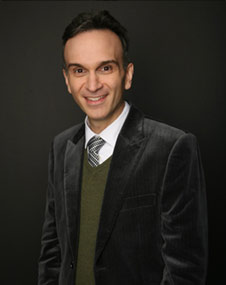
    Above: Violinist Gil Shaham

    ~ Author: Scoresby

    Friday August 18th, 2017 – After a month of recovering from an illness, I was happy to be able hear live music performed by the Mostly Mozart Festival Orchestra in David Geffen Hall led by its music director Louis Langrée with guest violinist Gil Shaham. A month is the longest I’ve gone without hearing live music in years, so it felt like the ultimate psychological panacea to attend. While I have regularly attended the chamber music performances, A Little Night Music, and contemporary music concerts, I hadn’t heard the Festival Orchestra since 2014.  I was glad to be able to attend the penultimate Festival Orchestra concert of the season.

    Louis-Langrée

    Above: Louis Langrée 

    The first piece on the program was the bubbly Prokofiev Symphony No. 1 in D major (“Classical”). The only other time I have heard this piece played live was, coincidentally, also the last time I heard the Festival Orchestra. This evening Mr. Langrée led a taut, lean performance. During the dance-like opening movement, the strings sounded bouncy and light. The low woodwinds provided a warm sheen, even in the most ominous undercurrents of the piece. Mr. Langrée’s sense of balance allowed the bassoon’s counterpoint to easily pop. While certainly an energetic account, none of the structural detailing was missed.

    During the Larghetto, the bassoons and clarinets took the spotlight, providing entertainment combined with artistry. For those who haven’t been to Mostly Mozart before, the stage of David Geffen is modified to allow riser seating in the back of the orchestra by moving up the stage to what would be the first few rows of the hall. This pushes the orchestra significantly closer to audience and creates a much more intimate environment.

    Mr. Langrée takes full advantage of this intimacy by using far quieter dynamics than could ever be used during the normal season’s setup – it feels as if the orchestra is thrust into the audience. The orchestral detailing in the second movement was superb through even the quietest of moments. While this makes the music sound more nuanced and detailed, it feels as if the noises from the crowd are too. Throughout the performance I heard many more pings of hearing aids, coughs, and wrappers of food than I hear during the regular season. However, I am happy to take that trade-off if it makes the music-making substantially more interesting as it did here. In the third and fourth movements, the orchestra kept its momentum and finished to a crowd that roared, obviously excited over the energy of the musicians.

    The second piece on the program was Mozart Symphony No. 25 G minor, K. 183 (one of few Mozart symphonies in the minor key). I’ve never been the biggest fan of the piece, but it was still a pleasure to hear it live in such an intimate space. While at times I felt the orchestra sounded a little muddy through the first movement, every time there was a canonic section Mr. Langrée confidently led transparent and thoughtful introductions for each instrument.

    These structured sections sounded just as buoyant as the Prokofiev. While a welcome change in dynamics, some of the rhythms and accents in the Andante felt over-accentuated to my ear.  Nonetheless, one could hear every instrument clearly singing its line. The trio of the third movement brought another warm passage with the bright woodwinds followed by an incisive final movement.

    After the intermission, the crowd seemed to be buzzing to hear the final piece on the program: the Tchaikovsky Violin Concerto in D major played by violinist Gil Shaham. I’ve never been a fan of this piece, but here it was played in a refreshing way that would make want to listen again. Mr. Shaham took an understated approach to the first movement (at least as much as is possible for a virtuosic warhorse), languishing in the phrasing of lines.

    Again, because of the setup of the lean orchestra and intimacy of the venue, there was no need to play loud. Thus he was able to bring a supple legato phrasing that never sounded harsh. After a measured performance of the cadenza by Mr. Shaham, the principal flautist Jasmine Choi gave one of the clearest and mellowest solos I’ve heard for that section of the piece. Mr. Shaham seemed more effective in the second movement, managing to illicit a rounder, ghostly tone during the introduction. The orchestra responded, with the clarinet’s extensive accompaniment matching the misty mood.

    Throughout the piece Mr. Shaham seemed to play for the musicians rather than for the audience – the whole experience seemed have more of a chamber music feel than that of a virtuosic concerto. The orchestral musicians and Mr. Langrée were smiling from start to finish and it was a joy to watch them exchange phrases with Mr. Shaham. While perhaps not the most technical or dazzling performance of this piece, witnessing and feeling that rare warmth between the artists is something that can only be experienced in a live performance.

    During the final movement, Mr. Shaham dispatched the technical sections with ease and the crowd gave him a roaring ovation. He played as an encore the third movement of the third E-major Bach Partita. While charming, to me the highlight of the concert was witnessing intimate collaborative music-making that is rare to see in an orchestra.

    ~ Scoresby
  • Finding Isadora’s ‘DANCE OF THE PRIESTESSES’

    L1460609

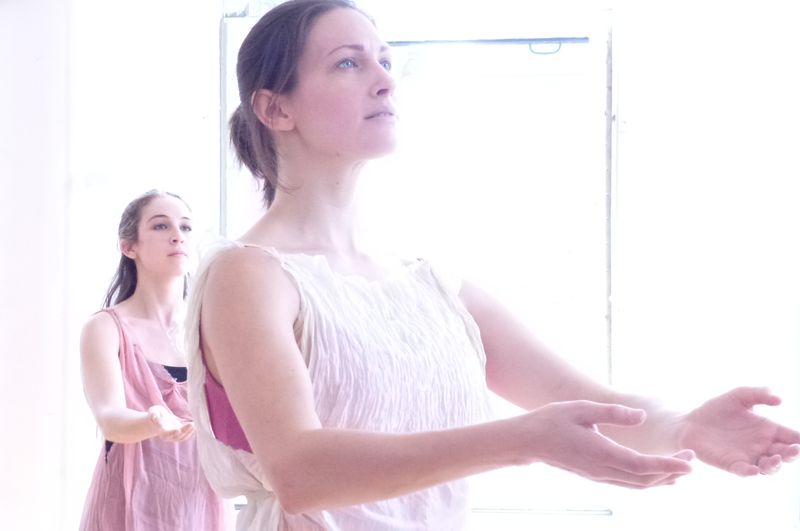
    Above: dancers Morgana Rose Mellett and Emily D’Angelo of the Isadora Duncan Dance Company

    Friday August 29th, 2014 – Today I went down to the Gibney Dance Center where friends of the Isadora Duncan Dance Company had been invited to an intimate studio session in anticipation of the upcoming renewal of a ‘lost’ Duncan work, DANCE OF THE PRIESTESSES.

    Lori Belilove, artistic director of the Company, welcomed us and then told the story of how DANCE OF THE PRIESTESSES has miraculously re-surfaced after several decades of being nothing more than a bit of legend.

    There had been talk of a film of the work having been made in 1963 and featuring one of the original Isadorables, Anna (Denzler) Duncan. Incredibly the film surfaced and was presented to Lori by some benevolent angel.  Lori set to work with her dancers to re-construct the piece, and we will be able to see it danced both on the film and live at a presentation at the Gibney Dance Center on September 17th, 2014, at 6:30 PM.  Further details of this event will be forthcoming.

    The dancework is drawn from the story of Iphigenia, daughter of Agamemnon, who was rescued from her fate as a human sacrifice by the goddess Artemis. Iphigenia becomes a priestess at the temple of Artemis in Tauris, a position in which she has the gruesome task of ritually sacrificing any foreigners who land on that kingdom’s shores.  Iphigenia is eventually confronted with the necessity of sacrificing her long-lost brother Orestes but that horrific duty is averted by the intercession of the goddess Athena.

    The story was immortalized in Christoph Willibald von Gluck’s gorgeous opera, IPHIGENIE EN TAURIDE. And it is to Gluck’s music that DANCE OF THE PRIESTESSES is performed.

    After providing us with this background, Lori asked each of us to cross our hands over our sternum and to breathe deeply; we can immediately sense our own center and the connectedness of the entire body. Her dancers then demonstrate some of the exercises with which they warm up: similar to a ballet barre, and yet the movement emanates from the torso rather than being guided by the limbs.

    The dancers looked so beautiful doing these deceptively ‘simple’ exercises which actually call for great concentration and control. The movement has a slow and ecstatic quality as the wheel-like flow of the arms, radiating from the sternum, reach down to the Earth and then soars skyward.

    Having shown us these stylistic elements, the dancers then performed a brief passage from DANCE OF THE PRIESTESSES. The ritualistic pouring of the libation oil and the stately pacing of the celebrants, arms opening in eloquent gestures of offering and supplication, create a timeless atmosphere of feminine power and beauty.

    The dancers – Kim D’Agnese, Faith Kimberling, Emily D’Angelo, and Morgana Rose Mellett – each have distinguishing physical characteristics which maintain their individuality even when dancing in unison. Watching them was a truly savorable experience.

    I’m hoping to see a rehearsal of the full work prior to the Gibney showing on September 17th.

    Watch a brief film clip of Anna Duncan performing at Jacob’s Pillow in 1942 here.

  • US Open Qualifying Tournament 2014 #4

    L1470420

    Above: Japan’s Yoshihito Nishioka

    Friday August 22nd, 2014 – Really nice day at the US Open Qualifying Tournament. Clouds kept the heat index at a comfortable level, and there was a breeze stirring. Around 3:00 PM, a ceiling of dark clouds settled over the Tennis Center, and just as Yoshihito Nishioka finished signing autographs after his win, the rains came down. I had really wanted to see the end of Hiroki Moriya’s match and to see Tatsuma Ito, a player I realy like and whose first two matches I missed this time around. But the rains were heavy enough to send the crowds scurrying, and it was obviously more than just a passing shower. I knew that even if play resumed within an hour, it would take an additional hour or more to dry the courts. So I left, though I didn’t really want to. 

    L1470317

    I started my day watching Japan’s Taro Daniel (above) in a hard-fought match against the experienced Canadian player Peter Polansky. Polansky took the first set convincingly, and Taro was showing visible frustration and fatigue in the second set when I had to walk away so as not to miss any of Steve Darcis’ match on Court 17. I was a bit surprised to find – after the truncated Darcis match – that Taro was still playing: he had apparently pulled himself together and taken the second set, and he was just a couple of games away from winning the third. He played really well, and the crowd was loving him. After the final point, he sank to his knees in disbelief. He had to sign a ton of autographs.

    L1470376

    Above: Taro Daniel after his win

    L1470327

    Over at Court 17 (above), I was totally psyched for the Darcis match. I found a nice seat very high up with no one in my immediate vicinity and a breeze to keep me cool. Tennis heaven! Steve played a stupendous first set. His opponent Emilio Gomez of Ecuador simply couldn’t get anything going against the Darcis Machine. Gomez managed to take one game in the first set but otherwise it was all-Darcis, all the time; Steve won the first set in 23 minutes, concluding with a superb passing shot. 

    Steve won the first game of the second set and then Emilio walked over to the chair umpire and asked for the trainer. After a long wait the trainer showed up, taped Emilio’s ankle, and play resumed. But as soon as Steve finished the second game, Emilio limped off the court and retired. So Steve’s victory, however assured, was a bit bittersweet. Nevertheless, it’s good he’s into the main draw and I hope he has a success.

    L1470335

    Above: Steve Darcis of Belgium

    After watching the end of the Taro Daniel/Peter Polansky I went over to Courts 4/5/6 where four Japanese players were to be playing their matches in succession. Yuichi Sugita was over-powered by Germany’s Matthias Bachinger today. Yuichi didn’t show the same energy as he had in his previous match. He had the trainer out during the second set for his ankle; though hobbled, he was still able to play out the match. Hiroki Moriya, following his thrilling match on Wednesday, seemed subdued today as he met the powerful Swiss Marco Chiudinelli. Marco thoroughly dominated the first set, but Hiroki came out swinging for the second set and fought hard to take it in a tie-breaker. However, he could not sustain the momentum and in the end Chiudinelli was the winner.

    L1470400

    Yoshihito Nishioka (above) held the Japanese banner high with a stunning win over Turkey’s hard-hitting Marsel Ilham. Like Sugita and Moriya, Nishioka is small of stature. But he was able to answer Marsel’s blistering strokes with well-placed, authoritative hitting. Nishioka only had one patch of trouble: a long service game where he kept being stalled at deuce. But once past that it was smooth sailing for the Japanese boy. The lopsided score (6-3, 6-1) does not really reflect the threat posed by Marsel Ilhan. But the crowd was over-joyed to celebrate Nishioka’s win, and he was engulfed by fans at the end.

    L1470487

    Above: Yoshihito Nishioka signing autographs after winning his match

    The rain prevented me from seeing Tatsuma Ito; I’m following his match now on the website. 

  • US Open Qualifying Tournament 2013 #3

    L1200157

    Above: Victoria Duval of the USA

    Friday August 23, 2013 – A beautiful day at the US Open qualifiers, marred only by an on-court temper tantrum from Canadian Frank Dancevic. The sky grew overcast as the day went on, but no rain fell and there was a nice afternoon breeze…ideal conditions both for playing and watching.

    L1200137

    I started off at Court 17 watching – for a change – a women’s match. America’s Victoria Duval (above) gave an impressive display of her talents in a fast-moving match against Croatia’s Tereza Mrdeza. Victoria pretty much dominated throughout; Tereza managed to get her foot in the door, and she pulled off some nice shots; but she just didn’t have the weaponry to respond to Victoria’s steady onslaught. I love Court 17 by the way: the new and oddly cozy stadium-style court.

    L1200193

    Above: Maximo Gonzalez of Argentina threw a monkey-wrench into Amir Weintraub’s hopes for a win today; the crowd was very much behind the Israeli but the crafty Argentine seemed to have a sharp overall game plus the passion needed to overcome his taller and – perhaps – more polished opponent. 

    L1200302

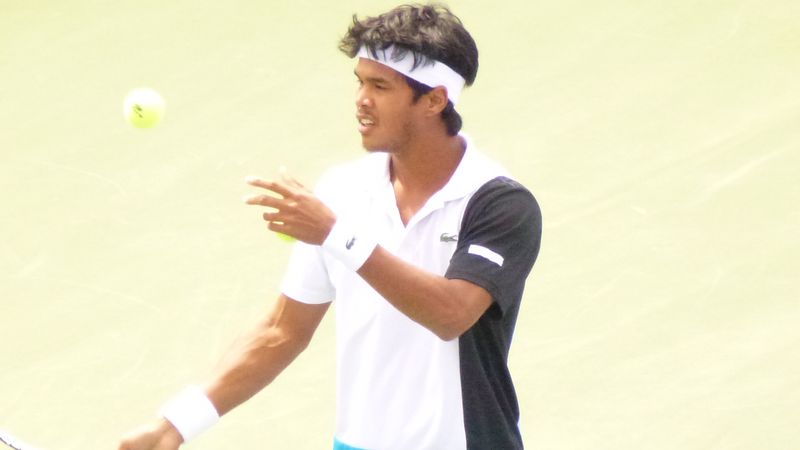
    Above: Somdev Devvarman of India had to overcome a very strong showing by Britain’s James Ward. Ward pulled off some impressive shots; after Somdev won the first set the Englishman took control and evened things up. It looked like it could go either way, but Somdev’s steady style prevailed. I really like watching him play.

    L1200295

    Above: Somdev Devvarman

    L1200232

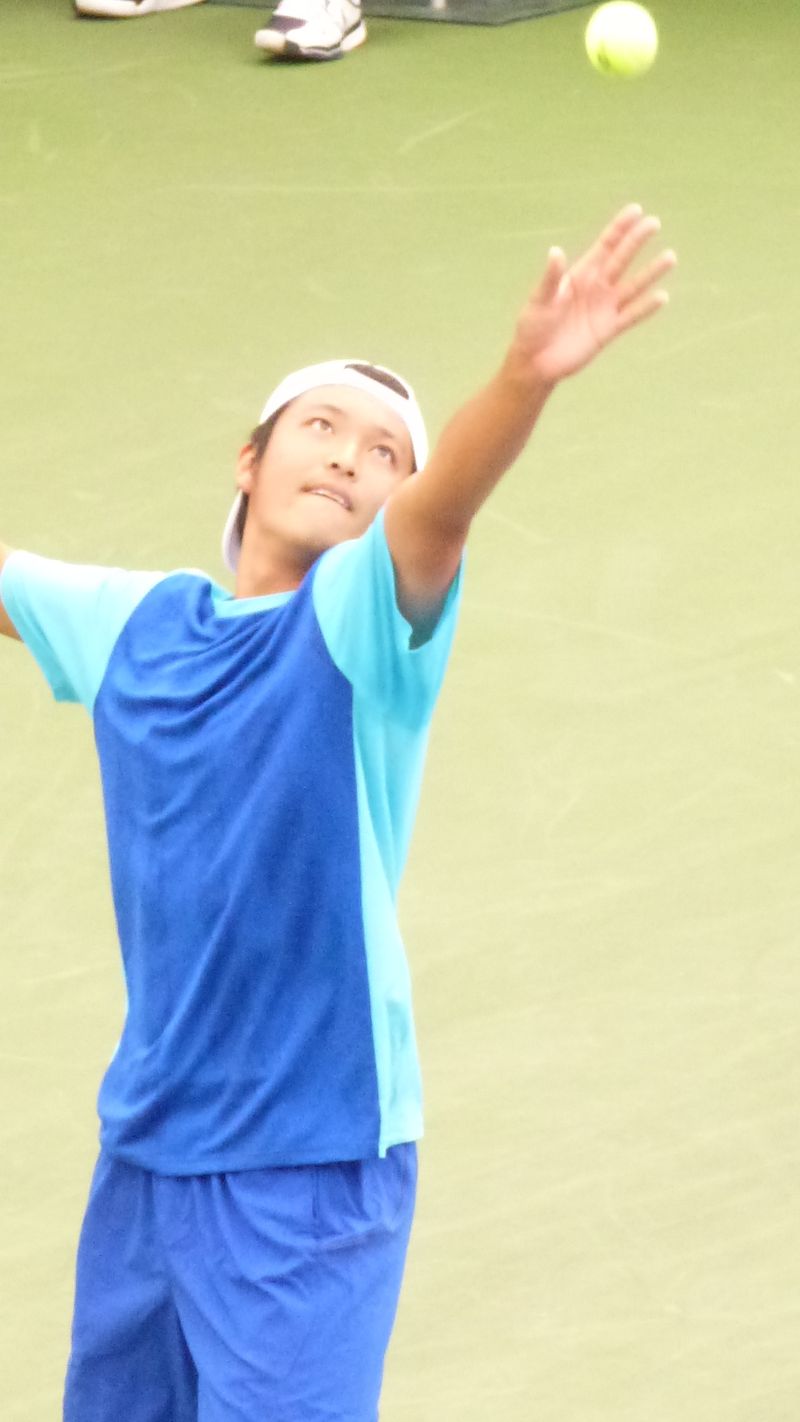
    Above: Go Soeda of Japan; Go’s been a favorite player of mine for several seasons now and today I got to watch him having a practice session and then – later – his match against Jan Hernych of the Czech Republic.

    I like Hernych, he plays a good game and it didn’t surprise me that he took the first set, following an extended tie-breaker.

    L1200338

    Then Go dug in and persevered thru two more hard-fought sets. The crowd was pro-Go all the way and  there was an air of celebration when the Japanese secured the win.

    L1200395

    Go Soeda after the match

    L1200376

    Japan’s Tatsuma Ito (above) took the first set of his match against Frank Dancevic. Ito plays beautfully, strong and steady. Dancevic took the second set. Throughout the first two sets, Dancevic threw minor hissy-fits whenever he felt he’d gotten a bad call. But in the third set he staged a full mad scene, halting play completely while he debated with the chair umpire at length as Ito stood waiting patiently at his end of the court. The crowd finally gave Dancevic a much-deserved round of booing; in my view he should have been fined a point for delaying play.

    Dancevic finally resumed playing and eventually he won the match, but his behavior was inexcusable. Everyone gets bad calls…and I hate to tell you this, Frank, but I watched a couple of your shots go long today and they weren’t called out. Poor sportsmanship leaves such a sour taste; I’ll never want to see another Dancevic match. He may have won today, but Ito is the classier player.

  • Jessica Lang Dance @ The Joyce

    6a00d8341c4e3853ef016761100c9b970b-800wi

    Above: dancers Clifton Brown and Kana Kimura of Jessica Lang Dance; photo by Kokyat

    Friday August 16th, 2013 – The Joyce’s Ballet V6.0 festival draws to a close with performances by Jessica Lang Dance making their Joyce debut with in a visually rich and musically inspired programme. Jessica Lang’s
    choreography has been on my A-list since I saw her Astor Piazzolla ballet Oblivion danced by the ABT Studio Company a few years ago. Jessica comes to The Joyce fresh from her operatic-directing debut at Glimmerglass (Pergolesi’s STABAT MATER) and a sold-out run for her Company at Jacob’s Pillow. Tonight’s performance at The Joyce was also a sell-out.

    The evening commenced on a high note and soared onward from there. To music of Antonio Vivaldi, Jessica’s 2010 A Solo in Nine Parts seemed to immediately captivate the audience. Her excellent company of dancers came on, all clad in summer-white, and danced their hearts out in this ballet which drew to mind Paul Taylor’s most joyous works.

    Performed against a sea-green back-panel, Jessica’s choreography looked clean and clear. and she has ideally visualized the Vivaldi score. Woven thru the ensemble passages are solos for each of the nine dancers. The central slow movement is a pas de quatre for Julie Fiorenza, Laura Mead, Kirk Henning and Milan Misko. Each dancer in the ensemble made his or her mark: Sarah Haarmann, Claudia MacPherson, Kana Kimura, Todd Burnsed, and Clifton Brown. Clifton in particular danced superbly in three of the four works shown tonight; he’s one of the most fluent and charismatic dancers of our time.

    Clifton Brown’s partnership with Kana Kimura, a striking dancer with a mystical presence, was the highlight of the second work, i.n.k. In this ballet which fuses music, dance and film to hypnotic effect, Kana and Clifton perform a remarkable adagio which ends with a thrilling slow backbend from Kana, supported in Clifton’s arms. The audience seemd to hold their collective breath as the dancers executed this unusual passage with complete control.

    i.n.k. overall is enthralling. The black-clad ensemble move before a glaring white back-panel, sometimes dancing with their shadows. Meanwhile drops or waves of dark ink splash across the screen. The crystalline score by Jakub Ciupinski, the costuming of Elena Comendador, Nicole Pearce’s lighting, and the captivating film elements (KUSHO by Shinichi Maruyama, edited by Tetsushi Wakasugi) all combine to make this poetic dancework a 21st century jewel: imaginative and beautifully executed.

    The evening’s second half kicked off excitingly with Aria, a quartet set to Zenobia’s tragic/frantic aria “Son contenta di morire” from Handel’s RADAMISTO. In this world premiere performance, three boys (Todd Burnsed, Kirk Henning and Milan Misko) in grey tights and bright red shirts sail thru the strongly musical choreography with the delicious Laura Mead the object of their attention. Laura, in a flame-red frock and dancing on pointe, gave a vivid and impetuous performance. Mr. Burnsed is her primary partner, though she often seems to want to evade contact altogether. My only slight concern here was that the singer on the chosen recording sometimes seemed slightly below pitch.

    Pianist Taka Kigawa took the keyboard to play Schumann live for the evening’s concluding work, From Foreign Lands and People; Taka’s playing was refined and beautifully supportive of the dancing. Like everything else on the programme tonight, this ballet was visually impressive. The midnight-blue-clad dancers move on, over, and under glossy black architectural pieces which they skillfully manipulate and re-arrange throughout the ballet. Pools of white light enhance the shifting landscape as the dancers clamber onto, slide down, and even partner the oblong boxes. The mood of the piece veers from playful to poetic, dictated by Taka’s playing.

    Milan Misko, a long-limbed dancer I have seen performing with TAKE Dance and the Lubovitch company, seems to have found an ideal dance-home in Jessica Lang’s style.  And Clifton Brown’s dancing – all evening – was a marvel: his solo in the concluding work was astonishing in its clarity and expressiveness. If Mlles. Mead and Kimura stood out among the other dancers by virtue of their featured roles, the entire ensemble deserve bouquets for their impressive performances in this vastly pleasing evening of dance.

  • Alison Cook Beatty for Ballet Next

    AlisonBalletNext_4454

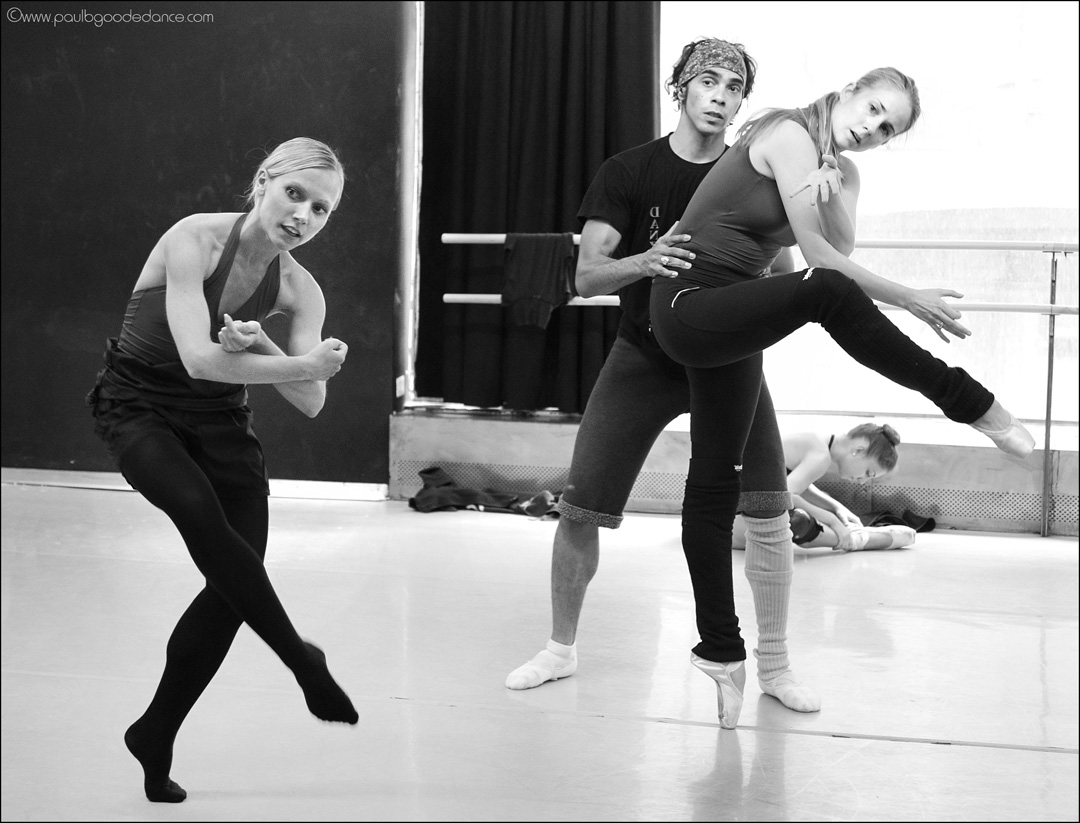
    Friday August 17, 2012 – Alison Cook Beatty (with Michele Wiles and Jason Reilly in the above photo by Paul B Goode) is choreographing a new work for Ballet Next; entitled TINTINNABULI, the ballet is set to Arvo Pärt’s Tabula Rasa. Today I stopped in at the DANY studios to have a look at this new creation, which will have its premiere during Ballet Next‘s upcoming season at The Joyce.

    The dancers were having a breather when I arrived but after a few minutes they gathered their energies (they’d already been rehearsing for 2 hours) and ran thru the new ballet’s completed first section and the nearly-finished second part. 

    TINTINNABULI begins with the women on a diagonal (watch a rehearsal sample here) which evolves into a solo for Michele Wiles – stylized, mystical movement but highly emotive in expression. Her solo is observed by Jason Reilly – principal dancer from Stuttgart Ballet, guesting with Ballet Next this season – a charismatic dancer and excellent partner. As their pas de deux commences, there’s a nice chemistry between Jason and Michele Wiles, even though for the longest time they don’t actually touch. But when they do, it’s luminous. Jason has a dynamic solo passage of his own.

    AlisonBalletNext_4391

    Alison Cook Beatty, Michele Wiles and Jason Reilly in a Paul B Goode photo, above.

    The quartet of soloists form chains with joined hands; they crouch is a circle. Their linked, ritualistic movements evoke images of Matisse and Balanchine as they move along the diagonal. The girls of the ensemble – Lily Balogh, Lily Di Piazza, Kristie Latham, Tiffany Mangulabnan and Erin Arbuckle – each bring a distinctive element to the work while functioning as a unit.

    Michele and Jason resume their duet, really gorgeously set on the music, and they give it a strong emotional context even though it’s just a rehearsal. A brief flurry of virtuosity follows.

    Alison went on from the finished passages, exploring possible phrases as the ballet moves to a conclusion. I’ll have to go back one of these days and find out how she resolves things.

    AlisonBalletNext_4501

    Charles Askegard is a wonderful presence in the studio, supportive of the young choreographer and offering meaningful suggestions without intruding on the process. At one point, a lift was being pondered and Charles suddenly swept Alison overhead with the signature effortlessness of a prince among cavaliers.

    Really nice atmosphere in the studio, and I look forward to seeing Alison’s ballet costumed and lit at The Joyce. My special thanks to Paul Goode for his evocative rehearsal images.

    You can catch Ballet Next at the 92nd Street Y in the Fridays at Noon series: Friday October 19th at 12:00 noon. It’s free!