Tag: Friday December

  • Joshua Bell|NY String Orchestra

    JoshuaBell-696x329

    Above: Joshua Bell

    ~ Author: Oberon

    Friday December 28th, 2018 – Holding forth at Carnegie Hall over the holidays, the New York String Orchestra presented a Christmas Eve concert (which Ben Weaver wrote about here) and then followed up with this evening’s program which brought us Joshua Bell as soloist for the Brahms Violin Concerto, book-ended by George Walker’s Lyric and Tchaikovsky’s Pathétique Symphony.

    George Walker‘s Lyric for Strings opened the program. From its very soft opening, this music was drawing us in and clearing our minds of the worries and woes that abound in these troubled times. Guest conductor Karina Canellakis and the young musicians savoured the rich themes, the Romantic Era yet still contemporary-sounding harmonies, the beautiful layering of arching violins and darkish basses. The music quietens, then a new melodic journey commences. After some thoughtful hesitations, the work finds a gentle ending: we are in a tranquil place. 

    Joshua Bell gave a knockout performance of the Brahms Violin Concerto in D-Major, Op. 77. The concerto’s first movement (Allegro non troppo) is especially rich in themes; following a unison opening passage, the music becomes quite grand. An excellent contingent of wind players joined the ensemble. Joshua Bell’s intense playing – and his feel for the dramatic – found a counterpoise in the ravishing sheen of his highest range, his pinpoint dynamic control, and his pliantly persuasive phrasing.
     
    A recurring theme, which make us think of springtime, found the violinist at his most lyrical, while in the demanding cadenza, Mr. Bell’s masterful dispatching of flurries of notes covering a vast range reached its end with a shimmering trill. The movement’s final measures were sublime.
     
    The winds set the mood of the Adagio. A marvelous oboe solo and – later – an impressive passage of bassoon playing – fell sweetly on the ear. Mr. Bell’s silken sounds in the upper register cast a spell over the hall, his exquisite control giving me chills of delight. In his mixture of passion and refinement, the music seemed so alive. Without pause, Maestro Jaime Laredo took us directly into the final movement; here, in the familiar theme, the rhythmic vitality of the orchestra and Mr. Bell’s bravura playing combined to winning effect.
     
    A full-house standing ovation greeted Joshua Bell’s stunning performance; hopes for an encore had the audience calling him back for repeated bows. But perhaps he felt that nothing really could follow the Brahms, especially after such a thrilling rendition.
     
    Following the interval, several alumni of the New York String Orchestra joined the current ensemble for a tonally lush rendering of Tchaikovsky’s Symphony No. 6, Pathétique. Among these alumni were several of today’s finest artists – people like violinist Pamela Frank, violist Steven Tennenbom, cellists Peter Wiley and Nicholas Canellakis, bass player Timothy Cobb, and clarinetist Anthony McGill. These musicians did not take over the principal chairs from the current players, but simply joined the ranks of the orchestra, seated interspersed among their young colleagues. I can only imagine how inspiring it must be for these emerging musicians to be playing alongside David Kim or Kurt Muroki.

    Maestro Laredo crafted a rich-hued, passionate performance, and the musicians played their hearts out. As the symphony unfolded – really impressively played – I found the first two movements to be magnificent in every regard. The Allegro molto vivace – which Tchaikovsky seems to have referred to as a ‘scherzo‘ and which one writer described as “a waltz with a limp” – seemed to go on too long. And as affecting as the final Adagio lamentoso is, there are themes in SWAN LAKE, SLEEPING BEAUTY and the Serenade for Strings that I find far more moving.

    Over time, people have sometimes felt that the Adagio lamentoso, with its faltering heartbeat at the end, presages the composer’s death. Within nine days after conducting the first performance of his the epic Sixth, Tchaikovsky would in fact be dead. There are various theories about the cause of the composer’s sudden demise: cholera from drinking tainted water, suicide induced by depression, or a sentence of death imposed on him by a ‘Court of Honor’ when his affair/infatuation with a young nobleman, Prince Vladimir Argutinsky (whose father was a high-placed official in the tsar’s court) came to light. In this third scenario, Tchaikovsky took poison after the Court’s verdict was handed down.

    Tchaikovsky & argutinsky
     
    Above: Tchaikovsky with Prince Vladimir Argutinsky
     
    Applause between movements somewhat spoiled the atmosphere tonight, even though after the Allegro non troppo of the Brahms it was understandable that the full house wanted to to applaud Mr. Bell. But premature applause at the end of the Tchaikovsky was a more serious mood breaker.
     
    ~ Oberon

  • Score Desk for TOSCA @ The Met

    Tosca_(1899)

    Friday December 20, 2013 – Having greatly enjoyed the Portuguese soprano Elisabete Matos in her two previous roles at The Met (Minnie in FANCIULLA DEL WEST and Abigaille in NABUCCO) I was very much looking forward to her single scheduled Met performance of the current season. But since the Bondy production of TOSCA is such an eyesore, I opted for a score desk tonight as Matos sang her second Puccini role at The Met. {Rumor has it the Bondy production will soon be seen for the last time here in New York City; however, we cannot be sure of getting something better in their place.}

    A great many empty seats in the House was not a good sign; and the audience tended to laugh freely at the MetTitles making me think there were a lot of newbies present. But Marco Armiliato, on the podium for an opera that suits him to a T, gave an extroverted, blood-and-thunder reading of the score. The first act especially was genuinely exciting in every regard.

    Two bassos with enormous voices set the tone for the performance: Richard Bernstein was a capital Angelotti and John Del Carlo a stentorian Sacristan. Marcello Giordani, that most unpredictable of tenors, served notice in “Recondita armonia” that he was really in voice tonight. The aria was generously sung, with clear and expressive phrasing, a thrillingly sustained foray to the climactic B-flat, and a fine diminuendo to a very long piano on the last note.

    Ms. Matos and her tenor then gave a vididly declaimed version of the lovers’ banter and they were really exciting in the sustained passages of the ensuing love duet. George Gagnidze’s Scarpia added more decibels to the evening, and his dramatic inflections were spot on. Ms. Matos lost points with me only on the phrase “Tu non l’avrai stasera…giuro!” where she shrilled on the final word: I like to hear this done in chest voice (or sung ‘from the crotch’ as we used to say of Tebaldi). Mr. Gagnidze and the Met chorus brought the act to a thunderous conclusion with the Te Deum.

    Then, as so often happens at The Met these days, a long intermission seemed to drain the energy from the evening; and I have never heard such banging, thudding and shouting from behind the curtain as the stagehands struck the set.

    Act II found the principals and conductor doing their utmost to restore the dramatic tension siphoned away by the long interval. Mr. Giordani produced an amazingly sustained “Vittoria!” and Mr. Gagnidze was thoroughly impressive in every regard. Ms. Matos struck off steely but not always stable high notes and made a strong dramatic impact with Tosca’s iconic lines: “Assassino! Voglio vederlo!”, “Quanto?…il prezzo?”, “Ah…piuttosto giu m’avento!” and “E morto…or gli perdono!”: these were all delivered with the intensity of a seasoned verismo diva. Her rendering of the great aria “Vissi d’arte” was persuasive in its vulnerability and the prolonged top B-flat at the climax was exciting though she could not sustain the following descending phrase of A-flat and G…and the conductor did nothing to aid her.

    Faced with another extended intermission, I left after the Act II curtain. I would like to have heard Giordani’s “E lucevan…” and the big duet and the opera’s flaming finale, but the thought of another lull diminished my enthusiasm.

    Metropolitan Opera House
    December 20, 2013

    TOSCA
    Giacomo Puccini

    Tosca...................Elisabete Matos
    Cavaradossi.............Marcello Giordani
    Scarpia.................George Gagnidze
    Sacristan...............John Del Carlo
    Spoletta................Eduardo Valdes
    Angelotti...............Richard Bernstein
    Sciarrone...............Jeffrey Wells
    Shepherd................Thatcher Pitkoff
    Jailer..................David Crawford

    Conductor...............Marco Armiliato

  • Picasso @ The Frick

    17_Two_Women_with_Hats_1921_PrivateCollection_600-e1324079915260

    Above: Pablo Picasso’s Two Women With Hats (1921)

    Friday December 23, 2011 – Last week my friend Debbie and I spent a delightful hour at The Frick looking at the exhibit of Picasso’s drawings. I couldn’t help thinking how much Kokyat would enjoy this collection, which is so beautifully displayed in the small galleries of The Frick‘s lower level. So this afternoon, after a delicious holiday lunch at LeSteak Bistro on 3rd Avenue, my photographer-friend and I headed to the museum with its restful atrium. I was hoping we would hit a time slot when the galleries were not too crowded, and we were indeed lucky in that regard. One advantage of The Frick is that children under ten years old are not admitted; this eliminates the annoying baby strollers and wailing infants who so often spoil our treks to The Met.

    Photography is not allowed at The Frick so we simply devoted our attention to the incredible drawings which provide a lovely panorama of Picasso’s works from the period 1890 to 1921. The earliest examples come from the nine-year-old prodigy; by the time he was 15, Picasso created a drawing of his father that is uncanny in its depth and style.

    Picasso-met-2010-18

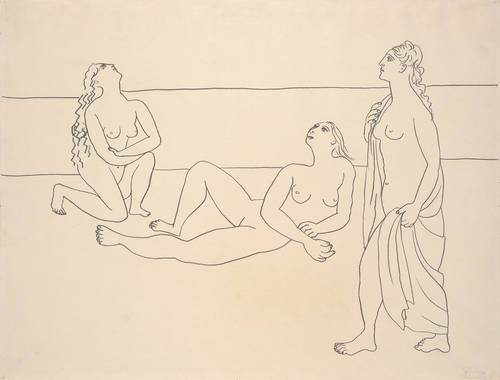
    One of my favorite drawings on display was Three Bathers by the Shore (above) which has an exact dating of August 20, 1920. Of course you can find images of many of Picasso’s works on the Internet, but nothing compares to standing before these masterworks live and imagining the artist’s hands at work in their creation, and to ponder the thousands of other eyes that have beheld them over the span of the century of their existence. 

    Self6

    Above: self-portrait of the artist as a young man. I’ve always loved reading about the period of time when Pablo Picasso was part of Gerald and Sara Murphy’s circle on the French Riviera…the long afternoons on the plage where everyone was a bit in love with Sara. Ah, to have been alive then.

    1033741

    The Picasso exhibit is only at The Frick til January 8th; it is very much worth seeing. If you go – and you should – be sure to watch a showing of two brief films, one about the Frick Collection and the second about the Picasso exhibit, in the museum’s music room. Very informative.

    Sometime between the day Debbie and I were at The Frick and today, a new space has been opened in the museum: the Portico Gallery. This long, narrow hallway is lined with glass-fronted display cabinets full of delicate porcelains. The far end of the passageway opens onto a small windowed temple-like chamber…

    Diana-the-Huntress

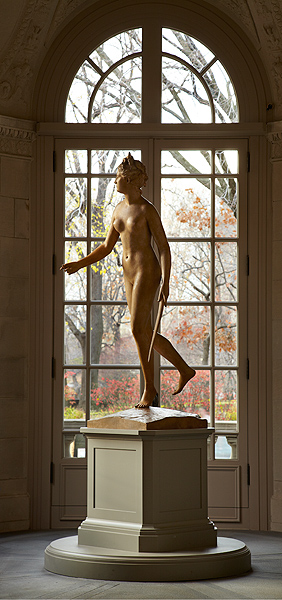
    …where Jean-Antoine Houdon’s Diana the Huntress (above) presides magnificently. I will return to this small shrine, immediately a favorite Gotham place for reverie, often.

    A perfect day with my perfect companion.