Tag: Friday February

  • A Huw Watkins Premiere @ CMS

    Huw-Watkins-3-image-B-Ealovega

    Above: composer Huw Watkins; photo by B Ealovega

    ~ Author: Oberon

    Friday February 22nd, 2019 – The US premiere of Huw WatkinsQuintet for Piano, Two Violins, Viola, and Cello was the centerpiece of this evening’s Chamber Music Society of Lincoln Center concert at Alice Tully Hall. The evening further afforded an all-too-rare chance to hear some Khachaturian. As always, the Society drew together a formidable ensemble of musicians, including some particular favorites of mine.

    Unfortunately, my enjoyment of the performance was seriously compromised by the thoughtless behavior of some audience members who were seated (late) in my immediate area. The opening Debussy sonata – excellently played – was thoroughly to my liking: I felt relaxed amid a crowd of eagerly attentive music lovers. Then the intruders arrived: after having my foot stepped on and being hit in the face by a large pocketbook, I tried to re-connect to the music – the much-anticipated Khachaturian – but these new arrivals took time settling in. Soon we had eating, drinking, texting, and picture-taking going on…to say nothing of someone with a noisy runny nose. It took all my powers of concentration to make it thru the fascinating Watkins, after which I headed home rather than trying to focus – against the odds – on the Brahms sextet that closed the evening.

    Opening a program entitled ‘International Collection‘, France was represented by Claude Debussy’s Sonata for Cello and Piano (1915), a brief work in three movements. Cellist Paul Watkins and pianist Gilles Vonsattel brought us this music in a polished performance that evoked ardent applause, calling the two men back to the stage for a bow.

    The sonata begins with Prologue, which commences with a piano solo. The music veers from animated to pensive; it builds and then becalms. Mr. Watkins’ handsome cello sound made a particularly fine impression in a descending passage where the resonance took on an inviting richness. This leads to a deep, poignant melody. Prologue fades gently away.

    Mssrs. Watkins and Vonsattel then commence the witty Serenade, which has an almost sneaky feel to it. Some rather ironic cello plucking leads to a dance, which slows as Mr. Watkins provides some beautifully sustained notes. The Serenade flows directly into the Finale, which rolls along, alternately animated and somewhat thoughtful, to a quirky finish.

    Now the latecomers were shown in; I looked around to see if there might be a seat I could move to, away from them. But there wasn’t.

    Aram Khachaturian’s Trio for Clarinet, Violin, and Piano (1932) was played by the inimitable David Shifrin, joined by violinist Paul Huang and Mr. Vonsattel. This three-part work opens with an Andante of melancholy mood. Mr. Huang is soon un-spooling his trademark silken tone, to ravishing effect in its high range, whilst Mr. Shifrin’s colourful sound brings a folkish feeling to his swirling roulades. From the Steinway, Mr. Vonsattel provides impeccable turns of phrase. The music fades into air.

    The vari-tempo range of the second movement commences with a sense of mystery and allure; sheer gorgeousness flows from Mr. Huang’s violin. Then things speed up with a peasant dance, which slows to provide a finely-blended mix from the three voices. The movement has an unusual ending.

    Mr. Shifrin opens the concluding Moderato with a marvelously-hued solo, and then Mr. Vonsattel shines in his own solo passage.  The mood turns jaunty, with the clarinet sounding sustained phrases as the violin comments; then they switch roles. Another piano solo takes us to a final dance, which slows and then begins to break down, as though the players have decided it’s time to pause for a drink.

    The Watkins work came next: his Quintet for Piano, Two Violins, Viola, and Cello is a CMS co-commission, composed in 2017 and having its US premiere tonight. The composer could not have asked for a finer collective of musicians to advocate for him: Paul Huang and Alexander Sitkovetsky (violins), Richard O’Neill (viola) and the composer’s brother, Paul Watkins (cello).

    The Quintet’s opening Allegro molto kicks off with a fun, jazzy passage; soon, though, the music turns poetic, with a sense of longing. The strings blend marvelously over rapturous piano figurations. As the music becomes more animated, Mr. Huang’s violin soars: he plays over rippling motifs from Mr. Vonsattel’s keyboard while the other strings mesh in dense, highish passages. Outstanding was a poignant ‘chorale’ for the strings as the piano held onto a simple line…so wonderful to hear. Growing in intensity, the music becomes impassioned; then Richard O’Neill’s moonlit viola sings a sad passage. Things settle into a hesitant calm as the movement draws to a close.

    By this point I am thoroughly intrigued; but there is still more to fascinate us ahead. The Lento opens with a sadly sweet violin theme radiating over teardrop notes from the piano. Paul Watkins’ cello joins, and sustained harmonies rise up from the collective. The O’Neill viola produces ‘shining music’, creating a haunting atmosphere. A sublime blending of timbres makes us want to linger, but we return to the movement’s opening violin/piano duo, so expressively played by Mssrs. Huang and Vonsattel. Briefly the music turns grand, only to shade away into delicacy. Paul Watkins takes up a poignant cello theme. The piano’s ‘teardrop’ motif recurs, now with Mr. Huang carrying our spirits to the heights with his serene playing. A long, long unison note from the strings is sustained as a hush settles over the hall.

    Springlike music fills the air, with the piano shimmering, as the concluding Allegro vivace commences. Rising strings herald an increase in animation…and passion. Calming a bit, we hear Mr. Huang and his fellow violinist Alexander Sitkovetsky duetting whilst the viola and cello take a more settled stance. The music then erupts in a joyous tempest of sound to bring the Quintet to its close.

    As applause resounded, the composer walked out onto the stage, thinking the musicians were right behind him; instead, they held back, leaving Huw Watkins to have a solo curtain call. The players then joined him, to enjoy the waves of approbation filling the house. They all left, but the audience – everyone standing – insisted on a much-merited second bow.  

    In an age when so much ‘new’ music is expertly-crafted but fails to evoke an emotional response, Huw Watkins’ new Piano Quintet felt like a breath of fresh air.

    I was sorry to forego hearing tonight’s excellent group of string players in the Johannes Brahms’ Sextet No. 2, but enough is enough: it’s the triumph of indifference, yet again, as people who don’t care spoil things for people who do.

    ~ Oberon
  • Cantanti Project: Caccini’s EURIDICE

    Caccini
    ~ Author: Oberon

    Friday February 23rd, 2018 – Taking us back to the very beginnings of opera – back to where it all began – the Cantanti Project bring us a rare opportunity to experience Giulio Caccini’s EURIDICE. Last Autumn, when I first read of these performances, I knew I would want to be there.

    In 1600, Jacopo Peri had written an opera to Ottavio Rinuccini’s libretto based on the story of Orfeo and Euridice; but Peri’s opera has not yet been published when Giulio Caccini took up the same libretto, and his setting of it was performed at the Pitti Palace, Florence, on December 5, 1602. Thus Caccini’s EURIDICE is often referred to as ‘the first opera’.

    Joyce Yin, soprano and Artistic Director of the Cantanti Project, kindly arranged for me to watch a rehearsal of EURIDICE a week prior to the performances. This was a great introduction to the opera, and provided me with an opportunity to get a handle on who’s who in the cast.

    The performance took place in the ‘white box’ studio of the Alchemical Studios on West 14th Street. This long and rather narrow space was well-utilized, with seating along the walls on either side, the musicians of Dorian Baroque tucked into one corner, and the singers making the most of the central playing area.

    Director Bea Goodwin’s savvy – and often touching – stage direction told the story clearly, with elements of dance woven in and all the characters vividly drawn. Stylized gestural language was beautifully rendered, especially in the scene where Orfeo pleads with Pluto to restore Euridice to life. Alexandria Hoffman’s simple and elegant Grecian-tunic costuming – all white – and the lighting design by Michael Celentano and Emma Clarkson enhanced the performance at every turn. The audience – wonderfully silent and attentive – were clearly taken with the entire presentation.

    Let me first praise the excellent quartet of musicians whose contribution to the performance’s success was vital. Dylan Sauerwald – conducting from the harpsichord – was joined by Paul Holmes Morton (theorbo), John Mark Rozendaal (viola da gamba), and Christa Patton (harp). Their instruments are beautiful, and beautifully played, giving a timeless feeling to the music. Caccini’s EURIDICE may be four centuries old, but tonight is seemed fresh and new.

    Aside from Orfeo and Euridice, the cast all do double-duty; each singer has an assigned name-role whilst doubling as nymphs and shepherds. Where to begin with the singers? At the beginning: as La Tragedia, Fiona Gillespie Jackson’s sweet, clear soprano drew us in to the story and the musical style with her lovely rendering of the Prologue. Her words – and the assignment of this music to a melodious soprano rather than a darker contralto – foretell a happy ending, despite intervening trials and sorrows.

    Joyce Yin’s lyrical and well-projected soprano, and the youthful joy of her portrayal, were just right for Euridice. At times called upon to dance, Ms. Yin took that in stride as well. Her radiant happiness a being reunited with Orfeo was lovely to behold. As Orfeo, the tall and slender Aumna Iqbal combined authoritative acting with a distinctive voice; she was thoroughly at home in the recitativo style, shading her words and colouring the tone with impressive command. As a relaxed bridegroom-to-be, Orfeo at first carouses with friends and makes a ribald reference to his wedding night. Then, Ms. Iqbal consummately caught the character’s descent from light-heartedness to despair when news of his Euridice’s demise arrives.

    As Dafne, the bearer of those sad tidings, soprano Elyse Kakacek excelled. Her vocalism combined clarity of tone with depth of feeling, and her facial expressions told of the grief her message cost her. An intrinsic sense of hesitancy in her presentation made clear her reluctance to tell the tale of Euridice’s fate. Later, though, as his friends urged Orfeo to seek his beloved in Hades, Mr. Kakacek circled the space in authentic dance moves, exhorting everyone to optimism and the hope of a happy resolution. 

    As Venere, goddess of Love, Brittany Fowler’s striking presence and commanding singing made her the perfect advocate for Orfeo at Pluto’s court. Tall and austere, Tom Corbeil as Pluto seemed thoroughly implacable at first, his singing powerful and his stature intimidating. Lydia Dahling, as Prosperina, surprisingly takes Orfeo’s side in the debate, her singing warm of tone yet urgent. Michael Celentano and Marques Hollie, with contrasting tenor voices, are Charon and Radamanto in this key scene, wherein Ms. Iqbal was superb. These are the opera’s most powerful moments, with Orfeo supplicating himself before Pluto to beg for Euridice’s return. The characters’ varying gestures of supplication, implacability, and intercession were done with authority: engrossing staging, very well-played.

    Mr. Hollie’s power and wide-range were utilized when – as Amyntas – he sought to reassure his friends that Orfeo had indeed been successful in his bid to regain his beloved and that the couple would soon appear among them again. Mr. Celentano’s lyrical sound was pleasing to hear in his interjections as the story moved to its resolution.  

    Two singers who particularly intrigued me were Laura Mitchell (Arcetro) and Sarah Lin Yoder (Nymph). Ms. Mitchell’s attractive singing was made the more ingratiating thru her lovely use of piano and her nuanced delivery of the words. Ms. Yoder, a unique beauty, displayed a voice of natural power and expressiveness.  

    Aside from the scene in the Underworld, another vignette in the opera which made a particularly strong impression on me occurred as the assembled nymphs and shepherds knelt in a circle to mourn Euridice’s death. Handsomely lit, this passage calls for finely-harmonized ensemble singing interspersed with solo lines. The blend of voices was really enchanting, both here and at the opera’s happy end. 

    ~ Oberon

  • Cantanti Project: Caccini’s EURIDICE

    Caccini
    ~ Author: Oberon

    Friday February 23rd, 2018 – Taking us back to the very beginnings of opera – back to where it all began – the Cantanti Project bring us a rare opportunity to experience Giulio Caccini’s EURIDICE. Last Autumn, when I first read of these performances, I knew I would want to be there.

    In 1600, Jacopo Peri had written an opera to Ottavio Rinuccini’s libretto based on the story of Orfeo and Euridice; but Peri’s opera has not yet been published when Giulio Caccini took up the same libretto, and his setting of it was performed at the Pitti Palace, Florence, on December 5, 1602. Thus Caccini’s EURIDICE is often referred to as ‘the first opera’.

    Joyce Yin, soprano and Artistic Director of the Cantanti Project, kindly arranged for me to watch a rehearsal of EURIDICE a week prior to the performances. This was a great introduction to the opera, and provided me with an opportunity to get a handle on who’s who in the cast.

    The performance took place in the ‘white box’ studio of the Alchemical Studios on West 14th Street. This long and rather narrow space was well-utilized, with seating along the walls on either side, the musicians of Dorian Baroque tucked into one corner, and the singers making the most of the central playing area.

    Director Bea Goodwin’s savvy – and often touching – stage direction told the story clearly, with elements of dance woven in and all the characters vividly drawn. Stylized gestural language was beautifully rendered, especially in the scene where Orfeo pleads with Pluto to restore Euridice to life. Alexandria Hoffman’s simple and elegant Grecian-tunic costuming – all white – and the lighting design by Michael Celentano and Emma Clarkson enhanced the performance at every turn. The audience – wonderfully silent and attentive – were clearly taken with the entire presentation.

    Let me first praise the excellent quartet of musicians whose contribution to the performance’s success was vital. Dylan Sauerwald – conducting from the harpsichord – was joined by Paul Holmes Morton (theorbo), John Mark Rozendaal (viola da gamba), and Christa Patton (harp). Their instruments are beautiful, and beautifully played, giving a timeless feeling to the music. Caccini’s EURIDICE may be four centuries old, but tonight is seemed fresh and new.

    Aside from Orfeo and Euridice, the cast all do double-duty; each singer has an assigned name-role whilst doubling as nymphs and shepherds. Where to begin with the singers? At the beginning: as La Tragedia, Fiona Gillespie Jackson’s sweet, clear soprano drew us in to the story and the musical style with her lovely rendering of the Prologue. Her words – and the assignment of this music to a melodious soprano rather than a darker contralto – foretell a happy ending, despite intervening trials and sorrows.

    Joyce Yin’s lyrical and well-projected soprano, and the youthful joy of her portrayal, were just right for Euridice. At times called upon to dance, Ms. Yin took that in stride as well. Her radiant happiness a being reunited with Orfeo was lovely to behold. As Orfeo, the tall and slender Aumna Iqbal combined authoritative acting with a distinctive voice; she was thoroughly at home in the recitativo style, shading her words and colouring the tone with impressive command. As a relaxed bridegroom-to-be, Orfeo at first carouses with friends and makes a ribald reference to his wedding night. Then, Ms. Iqbal consummately caught the character’s descent from light-heartedness to despair when news of his Euridice’s demise arrives.

    As Dafne, the bearer of those sad tidings, soprano Elyse Kakacek excelled. Her vocalism combined clarity of tone with depth of feeling, and her facial expressions told of the grief her message cost her. An intrinsic sense of hesitancy in her presentation made clear her reluctance to tell the tale of Euridice’s fate. Later, though, as his friends urged Orfeo to seek his beloved in Hades, Mr. Kakacek circled the space in authentic dance moves, exhorting everyone to optimism and the hope of a happy resolution. 

    As Venere, goddess of Love, Brittany Fowler’s striking presence and commanding singing made her the perfect advocate for Orfeo at Pluto’s court. Tall and austere, Tom Corbeil as Pluto seemed thoroughly implacable at first, his singing powerful and his stature intimidating. Lydia Dahling, as Prosperina, surprisingly takes Orfeo’s side in the debate, her singing warm of tone yet urgent. Michael Celentano and Marques Hollie, with contrasting tenor voices, are Charon and Radamanto in this key scene, wherein Ms. Iqbal was superb. These are the opera’s most powerful moments, with Orfeo supplicating himself before Pluto to beg for Euridice’s return. The characters’ varying gestures of supplication, implacability, and intercession were done with authority: engrossing staging, very well-played.

    Mr. Hollie’s power and wide-range were utilized when – as Amyntas – he sought to reassure his friends that Orfeo had indeed been successful in his bid to regain his beloved and that the couple would soon appear among them again. Mr. Celentano’s lyrical sound was pleasing to hear in his interjections as the story moved to its resolution.  

    Two singers who particularly intrigued me were Laura Mitchell (Arcetro) and Sarah Lin Yoder (Nymph). Ms. Mitchell’s attractive singing was made the more ingratiating thru her lovely use of piano and her nuanced delivery of the words. Ms. Yoder, a unique beauty, displayed a voice of natural power and expressiveness.  

    Aside from the scene in the Underworld, another vignette in the opera which made a particularly strong impression on me occurred as the assembled nymphs and shepherds knelt in a circle to mourn Euridice’s death. Handsomely lit, this passage calls for finely-harmonized ensemble singing interspersed with solo lines. The blend of voices was really enchanting, both here and at the opera’s happy end. 

    ~ Oberon

  • Rehearsal: Cantanti Project’s EURIDICE

    6Q5A0845

    Above: love triumphant as Euridice (Joyce Yin) and Orfeo (Aumna Iqbal) are reunited, to the delight of the nymphs. Photo by Travis Magee from a studio rehearsal of the Cantanti Project‘s production of Caccini’s EURIDICE

    ~ Author: Oberon

    Friday February 16th, 2018 – This evening, photographer Travis Magee and I stopped in at a rehearsal for the Cantanti Project‘s upcoming performances of Giulio Caccini’s EURIDICE.

    The earliest opera for which a complete score survives, this work is being presented by the singer-driven ensemble of the Cantanti Project on Februaryical Studios,104 West 14th Street, here in New York City. For tickets, click here. Once on the order page, apply this discount code when ordering: EURIDICE5OFF. This code gives the user $5 off per ticket when two or more tickets are purchased. 

    Giulio Caccini got the upper hand on his rival composer, Jacopo Peri – who had already written his own EURIDICE in 1600, but hadn’t gotten it published – by hurriedly preparing his own setting of Ottavio Rinuccini’s libretto and getting it published six weeks before Peri’s version appeared. Caccini’s EURIDICE was first performed at the Pitti Palace, Florence, on December 5th, 1602.

    Conducted by Dylan Sauerwald, with musicians from Dorian Baroque, the production is directed by Bea (Brittány) Goodwin, with costumes by Alexandria Hoffman. The singers are Michael Celentano, Tom Corbeil, Lydia Dahling, Daniela DiPasquale, Brittany Fowler, Marques Hollie, Aumna Iqbal, Fiona Gillespie Jackson, Elyse Anne Kakacek, Laura Mitchell, Joyce Yin, and Sara Lin Yoder.

    In Caccini’s setting of the immortal myth of the singer Orfeo, the hero descends to the underworld and pleads with Pluto for the return of his beloved Euridice, who has perished after having been bitten by a snake. Pluto’s wife, Prosperina, takes Orfeo’s side and persuades her husband to restore Euridice to life. Unlike the Gluck opera, where Orfeo fails to obey the command not to look at Euridice until they have left the realm of the dead – with dire consequences – in the Caccini setting the lovers return safely to their friends for a happy ending.

    28236569_10213913655168608_1635880759_n

    The Muse of Tragedy (Fiona Gillespie Jackson) sings the Prologue

    6Q5A0447

    Euridice (Joyce Yin) receives flowers from her friends

    6Q5A0485

    Nymph and shepherd (above, Lydia Dahling and Marques Hollie)

    6Q5A0567

    Orfeo (Aumna Iqbal) on the lookout for his beloved Euridice, who has wandered off

    6Q5A0651

    Daphne (Elyse Kakacek) reveals the sad news of Euridice’s death

    6Q5A0644

    The nymphs lament the fate of Euridice

    6Q5A0641

    Sara Lin Yoder and Tom Corbeil

    6Q5A0661

    Fiona Gillespie Jackson

    6Q5A0665

    Daniela DiPasquale and Elyse Kakacek

    6Q5A0700

    Arcetro (Laura Mitchell) urges Orfeo to pursue Euridice in the underworld

    6Q5A0734

    Elyse Kakacek and Brittany Fowler encourage Orfeo (Aumma Iqbal)

    6Q5A0747

    Brittany Fowler

    6Q5A0744

    Orfeo’s resolve (Aumna Iqbal)

    6Q5A0766

    Supplication: Orfeo (Ms. Iqbal) implores Prosperina (Lydia Dahling), Pluto (Tom Corbeil), and Charon (Michael Celentano) to return Euridice to him

    6Q5A0793

    Pluto (Tom Corbeil) accedes to Orfeo’s pleas

    6Q5A0803

    Euridice (Joyce Yin) lives again

    6Q5A0834

    Amyntas (Marques Hollie) assures the nymphs and shepherds that Euridice will soon be back among them

    6Q5A0836

    Her friends await Euridice’s return: Lydia Dahling, Tom Corbeil, Brittany Fowler, Sara Lin Yoder

    6Q5A0854

    Sisterhood: Lydia Dahling, Elyse Kakacek, Brittany Fowler, Fiona Gillespie Jackson, Daniela DiPasquale, and Laura Mitchell

    6Q5A0887

    The opera’s happy end: Aumna Iqbal and Joyce Yin

    All photography by Travis Magee.

    ~ Oberon

  • Rehearsal: Cantanti Project’s EURIDICE

    6Q5A0845

    Above: love triumphant as Euridice (Joyce Yin) and Orfeo (Aumna Iqbal) are reunited, to the delight of the nymphs. Photo by Travis Magee from a studio rehearsal of the Cantanti Project‘s production of Caccini’s EURIDICE

    ~ Author: Oberon

    Friday February 16th, 2018 – This evening, photographer Travis Magee and I stopped in at a rehearsal for the Cantanti Project‘s upcoming performances of Giulio Caccini’s EURIDICE.

    The earliest opera for which a complete score survives, this work is being presented by the singer-driven ensemble of the Cantanti Project on Februaryical Studios,104 West 14th Street, here in New York City. For tickets, click here. Once on the order page, apply this discount code when ordering: EURIDICE5OFF. This code gives the user $5 off per ticket when two or more tickets are purchased. 

    Giulio Caccini got the upper hand on his rival composer, Jacopo Peri – who had already written his own EURIDICE in 1600, but hadn’t gotten it published – by hurriedly preparing his own setting of Ottavio Rinuccini’s libretto and getting it published six weeks before Peri’s version appeared. Caccini’s EURIDICE was first performed at the Pitti Palace, Florence, on December 5th, 1602.

    Conducted by Dylan Sauerwald, with musicians from Dorian Baroque, the production is directed by Bea (Brittány) Goodwin, with costumes by Alexandria Hoffman. The singers are Michael Celentano, Tom Corbeil, Lydia Dahling, Daniela DiPasquale, Brittany Fowler, Marques Hollie, Aumna Iqbal, Fiona Gillespie Jackson, Elyse Anne Kakacek, Laura Mitchell, Joyce Yin, and Sara Lin Yoder.

    In Caccini’s setting of the immortal myth of the singer Orfeo, the hero descends to the underworld and pleads with Pluto for the return of his beloved Euridice, who has perished after having been bitten by a snake. Pluto’s wife, Prosperina, takes Orfeo’s side and persuades her husband to restore Euridice to life. Unlike the Gluck opera, where Orfeo fails to obey the command not to look at Euridice until they have left the realm of the dead – with dire consequences – in the Caccini setting the lovers return safely to their friends for a happy ending.

    28236569_10213913655168608_1635880759_n

    The Muse of Tragedy (Fiona Gillespie Jackson) sings the Prologue

    6Q5A0447

    Euridice (Joyce Yin) receives flowers from her friends

    6Q5A0485

    Nymph and shepherd (above, Lydia Dahling and Marques Hollie)

    6Q5A0567

    Orfeo (Aumna Iqbal) on the lookout for his beloved Euridice, who has wandered off

    6Q5A0651

    Daphne (Elyse Kakacek) reveals the sad news of Euridice’s death

    6Q5A0644

    The nymphs lament the fate of Euridice

    6Q5A0641

    Sara Lin Yoder and Tom Corbeil

    6Q5A0661

    Fiona Gillespie Jackson

    6Q5A0665

    Daniela DiPasquale and Elyse Kakacek

    6Q5A0700

    Arcetro (Laura Mitchell) urges Orfeo to pursue Euridice in the underworld

    6Q5A0734

    Elyse Kakacek and Brittany Fowler encourage Orfeo (Aumma Iqbal)

    6Q5A0747

    Brittany Fowler

    6Q5A0744

    Orfeo’s resolve (Aumna Iqbal)

    6Q5A0766

    Supplication: Orfeo (Ms. Iqbal) implores Prosperina (Lydia Dahling), Pluto (Tom Corbeil), and Charon (Michael Celentano) to return Euridice to him

    6Q5A0793

    Pluto (Tom Corbeil) accedes to Orfeo’s pleas

    6Q5A0803

    Euridice (Joyce Yin) lives again

    6Q5A0834

    Amyntas (Marques Hollie) assures the nymphs and shepherds that Euridice will soon be back among them

    6Q5A0836

    Her friends await Euridice’s return: Lydia Dahling, Tom Corbeil, Brittany Fowler, Sara Lin Yoder

    6Q5A0854

    Sisterhood: Lydia Dahling, Elyse Kakacek, Brittany Fowler, Fiona Gillespie Jackson, Daniela DiPasquale, and Laura Mitchell

    6Q5A0887

    The opera’s happy end: Aumna Iqbal and Joyce Yin

    All photography by Travis Magee.

    ~ Oberon

  • Graham/Duato/Cherkaoui @ The Joyce

    Mosaic4

    Above: Xin Ying and Abdiel Jacobsen in Sidi Larbi Cherkaoui’s Mosaic; photo by Brigid Pierce

    Friday February 17th, 2017 – A richly rewarding evening of dance from The Martha Graham Dance Company, performing works by Graham, Nacho Duato, and Sidi Larbi Cherkaoui at The Joyce. A packed house seemed spellbound by the ballets, and went wild for the Graham dancers – and rightfully so: their power, commitment, bravery, and beauty make them seem super-human. 

    As a prelude to the evening, Peter Sparling’s gorgeous film SacredProfane was shown as audience members found their seats and settled in. You can sample Sparling’s imaginative work here.

    Mysteries 2

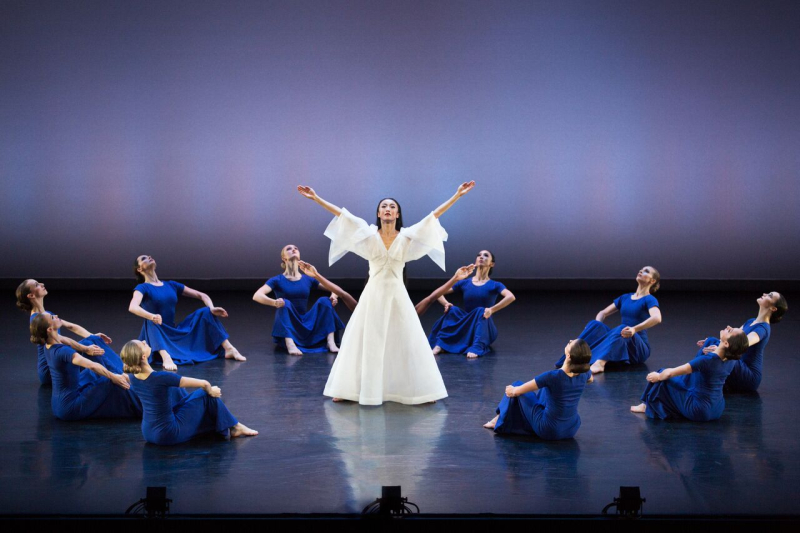
    Above: Pei-Ju Chien-Pott and the ensemble in Primitive Mysteries; photo by Brigid Pierce

    Primitive Mysteries is the Graham work I have most been wanting to see ever since I first read about it a few years ago, shortly after I had attended the rehearsal of Chronicle with photographer Brian Krontz which turned my curious interest in Graham into something of an obsession.

    Performed to music by Louis Horst for flute and piano, Primitive Mysteries is divided into three sections: “Hymn to the Virgin,” “Crucifixus,” and “Hosannah.” The work premiered on February 2, 1931, with Martha Graham in the central role. This ritualistic ballet draws inspiration from the veneration of the Virgin Mary that permeates Catholicism, but also from the rites of the Native Americans whose belief systems were obliterated by the arrival of undocumented immigrants on these hitherto unsullied shores.

    Mysteries 4

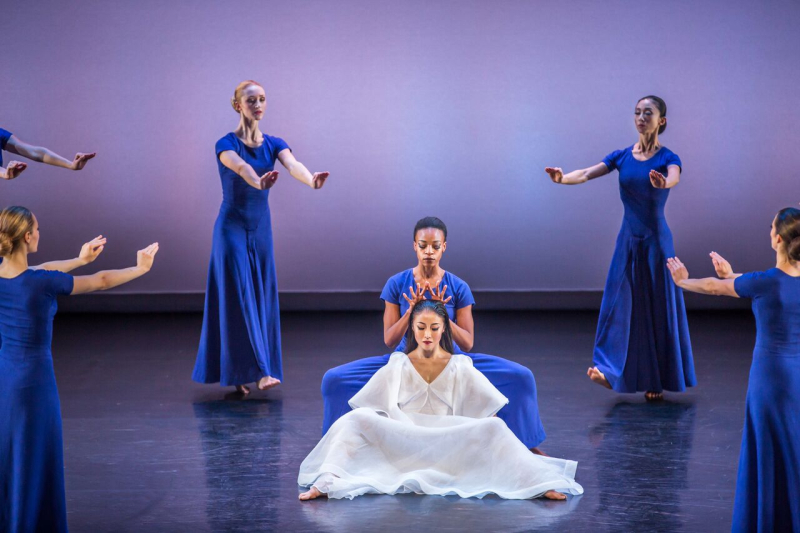
    Above: PeiJu Chien-Pott and the ensemble in Primitive Mysteries; photo by Brigid Pierce

    A corps of twelve blue-clad women frame the iconic Virgin, portrayed this evening by that fascinating Graham paragon, PeiJu Chien-Pott. Clad in pristine white, her hair flowing like black silk, Ms. Chien-Pott presides over her acolytes with benign yet unquestionable authority.

    The dancers enter in silence, with slow, unified strides: they will exit and re-enter in the same mode for each section of the ballet. Trademark Graham moves are to be seen, with high-stepping, contracted motifs, and regimented, stylized gestures unifying the sisterhood. In the second movement, Ms. Chien-Pott strikes a pose of crucifixion, arms outstretched, while the women circle her at increasing speed.

    Mysteries 3

    Above: PeiJu Chien-Pott and Leslie Andrea Williams (center) in a Brigid Pierce photo

    In the concluding “Hosannah”, Ms. Chien-Pott and Leslie Andrea Williams – a charismatic, ascending Graham dancer – strike ecstatic plastique poses, ending with Ms. Williams in a slow, backward collapse into Ms. Chein-Pott’s arms: a Pietà-like vision. Transfigured, the women slowly leave the stage as darkness falls.

    Primitive Mysteries evoked the first of the evening’s ovations, the dancers receiving vociferous screams of delight from the crowd as they took their bows.

    Rust 2

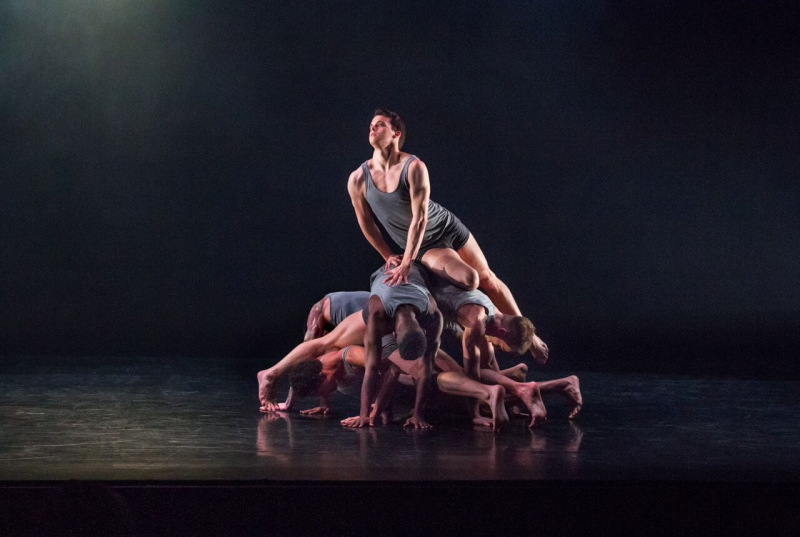
    Above: Lloyd Mayor at the top of the heap in Rust; a Brigid Pierce photo

    After a brief pause, the curtain rose on Nacho Duato’s Rust, a powerful all-male work that served as an ideal counterpoise to the feminine spirit of the preceding Graham work. Lorenzo Pagano emerges from the shadows under the relentless beam of an interrogation spotlight; upstage, the hapless Ari Mayzick is kicked, tortured, and left for dead. Ben Schultz, Lloyd Mayor, and Abdiel Jacobsen complete the quintet as Mr. Duato puts them thru demanding physical passages and down-trodden floor work.

    Rust

    Above: from Rust; photo by Brigid Pierce

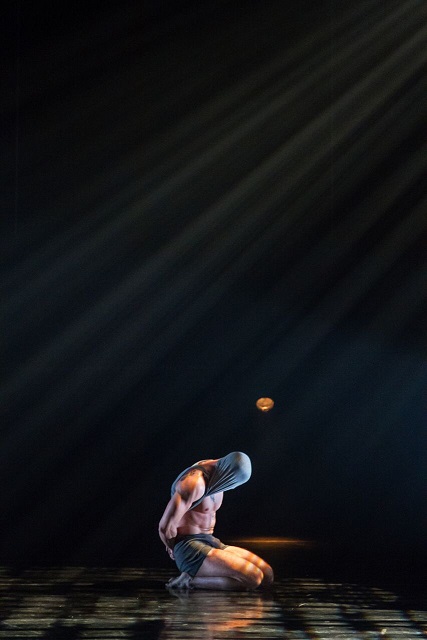
    Rust is danced to Arvo Pärt’s deep-chanting “De Profundis” (composed in 1980); voices emerge from the depths of despair, rising up to create an atmosphere of devotional reverence. The spirituality of the music and the brutality of the action remind us of the violence that permeates the history of the great religions. Rust ends with the men kneeling, hooded and with their hands tied behind their backs: all are prisoners, one way or another.

    Ben s rust

    Above: Ben Schultz in Rust; photo by Brigid Pierce

    We had had a preview of Sidi Larbi Cherkaoui’s Mosiac a few weeks ago at the Graham studios. Tonight this exotic, sensual but also shadowy ballet looked mysterious in Nick Hung’s lighting. Felix Bunton’s mid-Eastern score, spicy and alluring, is embellished by spoken commentary from the news networks.

    The dancers, costumed in soft, warm-hued garments, are seen in a cluster at curtain-rise. In a solo passage, Anne Souder’s personal beauty and physical flexibility made an alluring impression. Vocals that evoke deserts, minarets, and marketplaces set the dancers swirling; smoke drifts on the air as Lorenzo Pagano steps forward for a solo.

    Unspecified4d

    Above: Lorenzo Pagano in Mosaic; Brigid Pierce’s image from a studio showing 

    Mosaic

    Above: Xin Ying in Mosaic; photo by Brigid Pierce

    A threatening atmosphere arises; the incomprehensible talk all sounds like bad news. Stylized dancing under aqua lights brings forth the Company’s incredible Xin Ying: her feel for the sway of the music is intrinsic. A big beat and strobe lights give off contrasting impressions: are we in a nightclub or a prison yard? The dancers begin to shed their outer layers of clothing, and their vulnerability lends a new aspect to the story.

    Mosaic2

    A duet for Anne Souder and Lloyd Mayor (above, photo by Brigid Pierce) could be provocative, or manipulative. In the end, the dancers return to the clustered formation, but now they are trembling uncontrollably.

    Mosaic3

    Above: Xin Ying and Abdiel Jacobsen in Mosaic; a Brigid Pierce photo  

    To close the evening Diversion of Angels, Martha Graham’s glowing commentary on the aspects of love, was marvelously danced. To Norman Dello Joio’s lyrical, romance-tinged score, we meet three women who embody the ages of love: Charlotte Landreau (Young Love, in yellow), Xin Ying (Passionate Love, in red), and Konstantina Xintara (Deep and Lasting Love, in white); each has her beloved: Lloyd Mayor, Lorenzo Pagano, and Ben Schultz respectively. An ensemble of four women (So Young An, Marzia Memoli, Anne Souder, and Leslie Andrea Williams) and an additional man (Jacob Larsen – to complete the male quartet) fill out the stage picture with animated choreography, often heralding or echoing the principals.

    Konstantina-1

    Ms. Xintara (above) and Mr. Schultz exude calm: her elongated arabesques show romantic centeredness and confidence while his muscular physique provides a pillar of strength for his beloved. A particular gesture of Ben’s reminded me ever so much of Nijinsky’s Faune.  At times, this White Couple simply stand together, assured of their mutual affection as they watch the younger generations leap and swirl.

    Xin-ying

    Xin Ying (above), superbly beautiful in her red frock, repeatedly displays her own arabesque-motif, sustaining the pose with awesome control. Mr. Pagano is a more fleeting lover here, but when he and his love do meet up, their passion sizzles.

    Charlotte

    Charlotte Landreau (above) is a dancer to cherish. With her strong technique and engaging presence, Charlotte seems destined for many Graham roles. As the Woman in Yellow tonight, her breezy jetés – stretched long and wonderfully elevated – delighted my choreographer/friend Claudia Schreier and me. As Charlotte’s ardent young lover, Lloyd Mayor hovered over his sweetheart, looking at once smitten and protective. 

    Jacob Larsen, handsome of face and form, kept pace with the Company’s dynamic men; he looks likely to become a valuable asset in the Graham rep. 

    An excellent evening on every count, and the cheers and applause that greeted the generous Graham dancers as they took their bows were eminently deserved.

    Production photos in this article are by Brigid Pierce, sent to me at just the right moment by the Graham Company’s press agent, Janet Stapleton.

  • ASO: Max von Schillings’ MONA LISA

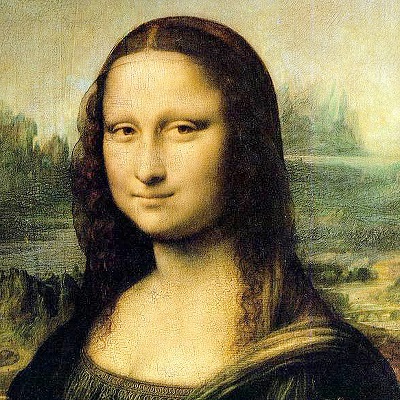
    Mona_Lisa

    Friday February 20th, 2015 – An opportunity to hear a forgotten opera, Max von Schillings’ MONA LISA, came about thanks to conductor Leon Botstein and the American Symphony Orchestra. Bringing us operatic rarities is one of Maestro Botstein’s specialties, and tonight MONA LISA proved a wonderful discovery.

    The opera was vastly popular in its day; in the fifteen years following its 1915 premiere, it was performed more than 1,200 times, including in St. Petersburg and at New York’s Metropolitan Opera. The composer’s embrace of Nazism has since cast him as an unsavory individual and, upon his death in 1933, he and his music were essentially forgotten.

    von Schillings was considered a neo-Wagnerian, but in MONA LISA we experience a link with Italian verismo; both in its Renaissance setting and its musical style, I was most often put in mind of Zandonai’s FRANCESCA DA RIMINI. The influence of Strauss and Zemlinsky may also be felt. von Schillings successfully blends a variety of stylistic elements into music that evokes the Age of da Vinci from a Germanic viewpoint. 

    The story is a Mona Lisa fantasy and revolves around her jealous husband, Francesco del Giocondo, and her former lover, Giovanni de Salviati who arrives at the del Giocondo palazzo on an errand from the pope: to purchase a rare pearl. Mona Lisa and Giovanni had once been lovers, and the flame is re-kindled.

    The pearl is kept in a small, air-tight chamber. After arranging the purchase, Giovanni covertly persuades Mona Lisa that they should run away together when he comes to collect the pearl. Her husband notices the mysterious smile on his wife’s face – a smile she has never shone on him in their years of marriage –  and suspects Giovanni as a rival. To avoid being caught, Giovanni hides in the pearl-chamber, which Francesco then locks. Mona Lisa knows that Giovanni will suffocate, but she keeps her cool and the next morning she tells her husband says she will wear the pearl. When Francesco enters the chamber to fetch the jewel for her, she slams the door shut behind him and locks it.

    The opera is set during carnival season which gives rise to some passages of courtly entertainment. And, subtly, the libretto refers to Madama Borgia as being Mona Lisa’s friend. Thus the notion of dispatching an unwanted husband would come naturally to Mona Lisa.

    The score abounds with melody and the opera is impressively orchestrated, bringing in harp, celeste, mandolin and organ…even castanets are heard at one point. The ASO‘s concertmaster Erica Kiesewetter seized several opportunities to bring forth beautiful solo violin passages.

    The opera was well-cast with singers intent on characterizing their music. In the title-role, soprano Petra Maria Schnitzer, despite a less-than-comfortable upper register, blended lyricism with passionate declamation. As Francesco, the charismatic Michael Anthony McGee, delighted in the vocal art of insinuation, his genial vocal veneer covering a soul of brooding jealousy and duplicity. In a performance of intense power and commitment, tenor Paul McNamara scored a great success as he met the Wagnerian demands of the role of Giovanni; his vocalism made a strong impact in the Hall.

    A quintet of courtiers, led by tenor Robert Chafin as Arrigo Oldofredi, provided ongoing commentary in Act I, with bursts of song woven into the tapestry. John Easterlin, Justin Hopkins, Christopher Burchett, and Michael Scarcelle kept their scenes lively with characterful singing and good dramatic interaction. An appealing trio of young women gave a vocal counter-balance to the men’s ensemble: Lucy Fitz Gibbon and Katherine Maysek sang attractively, and Ilana Davidson had a lovely vocal vignette, portraying Venus in a carnival pageant. The Bard Festival Chorale had rather less to do than one might have wished, but they did it well indeed.

    THE CAST

    Foreigner/Francesco del Giocondo: Michael Anthony McGee, bass-baritone
    Woman/Mona Fiordalisa: Petra Maria Schnitzer, soprano
    Lay Brother/Giovanni de Salviati: Paul McNamara, tenor
    Pietro Tumoni: Justin Hopkins, bass-baritone
    Arrigo Oldofredi: Robert Chafin, tenor
    Alessio Beneventi: John Easterlin, tenor
    Sandro da Luzzano: Christopher Burchett, baritone
    Masolino Pedruzzi: Michael Scarcelle, bass-baritone
    Mona Ginevra: Ilana Davidson, soprano
    Dianora: Lucy Fitz Gibbon, soprano
    Piccarda: Katherine Maysek, mezzo-soprano

    Bard Festival Chorale (James Bagwell, director)

    Conductor: Leon Botstein

  • ASO: Max von Schillings’ MONA LISA

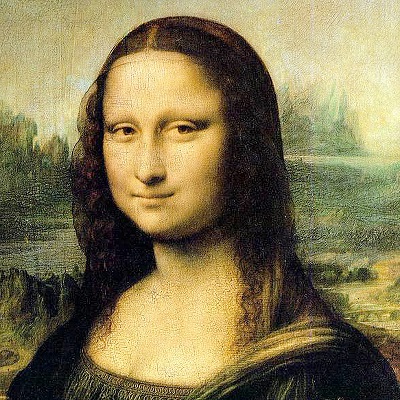
    Mona_Lisa

    Friday February 20th, 2015 – An opportunity to hear a forgotten opera, Max von Schillings’ MONA LISA, came about thanks to conductor Leon Botstein and the American Symphony Orchestra. Bringing us operatic rarities is one of Maestro Botstein’s specialties, and tonight MONA LISA proved a wonderful discovery.

    The opera was vastly popular in its day; in the fifteen years following its 1915 premiere, it was performed more than 1,200 times, including in St. Petersburg and at New York’s Metropolitan Opera. The composer’s embrace of Nazism has since cast him as an unsavory individual and, upon his death in 1933, he and his music were essentially forgotten.

    von Schillings was considered a neo-Wagnerian, but in MONA LISA we experience a link with Italian verismo; both in its Renaissance setting and its musical style, I was most often put in mind of Zandonai’s FRANCESCA DA RIMINI. The influence of Strauss and Zemlinsky may also be felt. von Schillings successfully blends a variety of stylistic elements into music that evokes the Age of da Vinci from a Germanic viewpoint. 

    The story is a Mona Lisa fantasy and revolves around her jealous husband, Francesco del Giocondo, and her former lover, Giovanni de Salviati who arrives at the del Giocondo palazzo on an errand from the pope: to purchase a rare pearl. Mona Lisa and Giovanni had once been lovers, and the flame is re-kindled.

    The pearl is kept in a small, air-tight chamber. After arranging the purchase, Giovanni covertly persuades Mona Lisa that they should run away together when he comes to collect the pearl. Her husband notices the mysterious smile on his wife’s face – a smile she has never shone on him in their years of marriage –  and suspects Giovanni as a rival. To avoid being caught, Giovanni hides in the pearl-chamber, which Francesco then locks. Mona Lisa knows that Giovanni will suffocate, but she keeps her cool and the next morning she tells her husband says she will wear the pearl. When Francesco enters the chamber to fetch the jewel for her, she slams the door shut behind him and locks it.

    The opera is set during carnival season which gives rise to some passages of courtly entertainment. And, subtly, the libretto refers to Madama Borgia as being Mona Lisa’s friend. Thus the notion of dispatching an unwanted husband would come naturally to Mona Lisa.

    The score abounds with melody and the opera is impressively orchestrated, bringing in harp, celeste, mandolin and organ…even castanets are heard at one point. The ASO‘s concertmaster Erica Kiesewetter seized several opportunities to bring forth beautiful solo violin passages.

    The opera was well-cast with singers intent on characterizing their music. In the title-role, soprano Petra Maria Schnitzer, despite a less-than-comfortable upper register, blended lyricism with passionate declamation. As Francesco, the charismatic Michael Anthony McGee, delighted in the vocal art of insinuation, his genial vocal veneer covering a soul of brooding jealousy and duplicity. In a performance of intense power and commitment, tenor Paul McNamara scored a great success as he met the Wagnerian demands of the role of Giovanni; his vocalism made a strong impact in the Hall.

    A quintet of courtiers, led by tenor Robert Chafin as Arrigo Oldofredi, provided ongoing commentary in Act I, with bursts of song woven into the tapestry. John Easterlin, Justin Hopkins, Christopher Burchett, and Michael Scarcelle kept their scenes lively with characterful singing and good dramatic interaction. An appealing trio of young women gave a vocal counter-balance to the men’s ensemble: Lucy Fitz Gibbon and Katherine Maysek sang attractively, and Ilana Davidson had a lovely vocal vignette, portraying Venus in a carnival pageant. The Bard Festival Chorale had rather less to do than one might have wished, but they did it well indeed.

    THE CAST

    Foreigner/Francesco del Giocondo: Michael Anthony McGee, bass-baritone
    Woman/Mona Fiordalisa: Petra Maria Schnitzer, soprano
    Lay Brother/Giovanni de Salviati: Paul McNamara, tenor
    Pietro Tumoni: Justin Hopkins, bass-baritone
    Arrigo Oldofredi: Robert Chafin, tenor
    Alessio Beneventi: John Easterlin, tenor
    Sandro da Luzzano: Christopher Burchett, baritone
    Masolino Pedruzzi: Michael Scarcelle, bass-baritone
    Mona Ginevra: Ilana Davidson, soprano
    Dianora: Lucy Fitz Gibbon, soprano
    Piccarda: Katherine Maysek, mezzo-soprano

    Bard Festival Chorale (James Bagwell, director)

    Conductor: Leon Botstein

  • Another SWAN @ NYC Ballet

    ArticleLarge

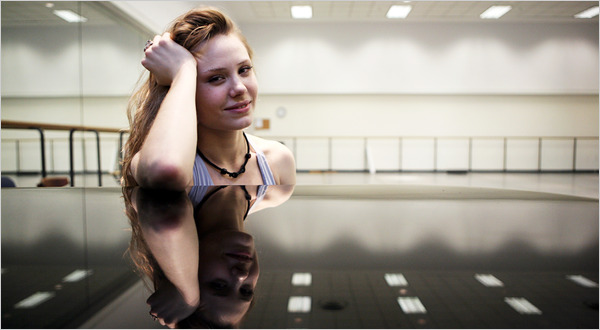
    Due to the extraordinary demand for tickets, New York City Ballet have announced an additional performance of the Peter Martins SWAN LAKE for Friday February 11th. Sara Mearns is scheduled to dance Odette/Odile that evening. Photo of Sara by Damon Winter.

    It’s amusing to hear people attribute the great interest in these SWAN performances to the recent film BLACK SWAN. But the last previous revival of Martins’ SWAN LAKE was also a sellout, and that was long before the movie was made.