Tag: Friday July

  • NYO-USA at Carnegie Hall

    Aw

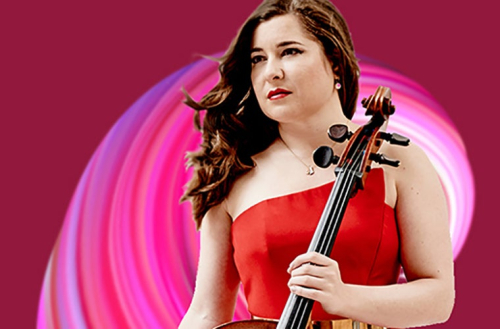
    Above: cellist Alisa Weilerstein

    Author: Ben Weaver

    Friday July 29th, 2022 – Elgar’s Cello Concerto and Mahler’ Fifth Symphony made up the very ambitious program by the National Youth Orchestra of the United States of America at Carnegie Hall. The young American musicians – aged 16 to 19 – are embarking on a world tour with these works and will perform at the Concertgebouw in Amsterdam, as well as in Berlin, Ravello, and Lucerne in the upcoming weeks. Leading the orchestra in all these concerts is the British conductor Daniel Harding, with American cellist Alisa Weilerstein the soloist in the Elgar.

    Elgar’s Cello Concerto, composed in 1919, was mildly popular before Jacqueline du Pré gave it immortality with Sir John Barbirolli in the 1960s. There are few mainstream works as identified with one performer as Elgar’s concerto is with du Pré. For any cellist to take on this work must be intimidating. Alisa Weilerstein is a cellist who needs not fear anything from comparison. A consummate artist of genuine depth, gravitas, and beauty, Ms. Weilerstein’s performance glowed with humanity and grace. From the first passionate notes of the work – no orchestral introduction here – Elgar’s  writing for the cello is intricate and deeply emotional. Even the Scherzo has little frivolity. Ms. Weilerstein’s warm and powerful playing, the rich sound of her cello effortlessly filling the hall, was a true joy. Elgar’s ability to compose for a large orchestra, yet keep the orchestration translucent so it never buries the solo instrument, is perhaps rather unique among cello concertos. And Maestro Harding also kept the young players of the orchestra at bay, letting loose when necessary, but allowing Ms. Weilerstein to always be heard. Everything in this performance was perfectly balanced. An all-around marvelous performance of a very special work.
    Harding

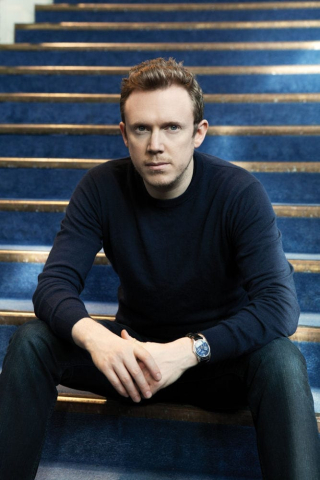
    With Mahler’s Fifth Symphony things got a bit more complicated. Maestro Harding (above) is an excellent Mahlerian, having began his career as an assistant first to Simon Rattle in Birmingham and then to Claudio Abbado in Berlin. And his decision to include such a difficult work for a young orchestra was certainly brave, but it did not pay off on this evening. There’s no need to mention any specific mistakes made by specific musicians – I’ve heard the same mistakes made by professional and very experienced musicians of the New York Philharmonic. And there were many wonderful moments too: the horns were warm and fruity, the concertmaster’s solo was lovely, the percussion section was on peak form (I especially enjoyed the grin on the face of one of the percussionists every time he played something loud – his enthusiasm and joy were wonderful, charming, and infectious.) But the totality of the work just did not come together. There were wonderful moments scattered throughout. Perhaps it was Maestro Harding who failed to bring it all together. Perhaps the orchestra’s future performances, as they face more audiences and play the work more, will come together. But, with its faults, I’m glad these young musicians played Mahler. They are the future members of our great American orchestras.

    ~ Ben Weaver

  • Steven Banks @ Mostly Mozart

    Steven-banks

    Friday July 22nd, 2022 – Saxophonist Steven Banks (above) headlined this evening’s concert by the Mostly Mozart Festival Orchestra at Alice Tully Hall. The wonderfully sprightly – and hugely talented – Xian Zhang was on the podium.

    The concert was presented as a choose-what-you-pay event, part of Lincoln Center’s Summer for the City festival. There were several small children in the audience, and for the most part they were well-behaved; I’m sure they found the very tall Mr. Banks – and the sound of his saxophone – intriguing, and most likely they were equally fascinated by Xian Zhang’s lively personality. The concert lasted about 90 minutes, without intermission.

    Composer Nokuthula Ngwenyama greeted us, speaking briefly about her work, Primal Message, which was having its New York premiere as the opening piece this evening. She talked about prime numbers and about possible ways of communicating with extra-terrestrial life, but thoughts of science, and of theories, evaporated as her appealing music filled the space. 

    Melodious, and even romantic-sounding at times, the music commences with themes for cello and viola, leading to a haunting violin solo and sweet sounding phrases from the harp. Pinging tones from the xylophone, and isolated chime notes, signify a mystical language as the work wends towards its delicate finish. If beings on other worlds were to receive Ms. Ngwenyama’s Primal Message, their response would doubtless be cordial. The audience seemed taken with the music, applauding both musicians and composer enthusiastically.

    I first heard saxophonist Steven Banks earlier this year in a noontime recital at the Morgan Library, presented by Young Concert Artists. Everything about his playing impressed me then, and he impressed me even more this evening. Mr. Banks towered over the diminutive Xian Zhang, but as artists they are of equal stature.

    Tonight, Mr. Banks took the Tully Hall stage for a rarity: Alexander Glazunov’s Concerto in E flat major for alto saxophone and string orchestra, Op. 109, written in 1934. It is music deeply rooted in Romanticism, and it has become a standard in the saxophone repertoire; this was my first time hearing it, and it’s a complete delight.

    Although invented in the early 1840s, the saxophone was still fairly new and unfamiliar in Glazunov’s day; it remained under-utilized for years as it was considered “low-brow”. Glazunov, however. was intrigued by this new timbre in the musical world; still, the composer almost certainly never heard his Saxophone Concerto publicly performed, since the Paris premiere of the work did not take place until after his death.

    The concerto commences with a big, unison string theme: this is lushly lyrical music. Mr. Banks’s warm, gorgeous tone fills out the melodies so persuasively, and there are passages of coloratura that are deftly handled. The saxophone sings over a rather hesitant accompanying rhythm, from which a long cadenza for the soloist arises. 

    The music turns animated and wryly amusing. A swirling solo melody becomes a fugue. Mr. Banks sails onward, thru various trills and furbelows, to a lovely finish, winning the audience’s vociferous approval.

    After a brief pause, Mr. Banks returned for another work: Jacques Ibert’s Concertino da Camera, written in 1935. From its flashy, almost chaotic start, Mr. Banks explores the saxophone’s jazzy side, later taking up a sad song over the orchestra’s swaying accompaniment. The strings, motivated by eloquent basses, commence a theme over which the saxophone delivers smooth fiorature. Things dance along, turning vibrant, and starting to swing. 

    In a mood-change, a soft and pensive saxophone solo sounds over the orchestra’s deep sighing: this is the sound of a broken heart, expressively sung by Mr. Banks and echoed by the horn. But you can’t keep a good man’s spirits down, and soon the sax player is reeling off rapid figurations: Mr. Banks revels in the subtleties of the score, polishing off a cadenza covering a vast range and brimming with dynamic shifts. Cries of “bravo” resounded in the Hall as this saxophone paragon took his bows. 

    Xian Zhang

    Above: tonight’s conductor Xian Zhang

    The evening concluded with the Beethoven’s Fourth Symphony, which was premiered at the Lobkowitz Palace in Vienna in March 1807; being a private concert, there are no first-hand reports of initial reaction to the work.

    Here, we can savour Xian Zhang’s mastery of both grandeur and finesse; the orchestra played superbly for her, and the wind soloists – flute, clarinet, oboe, bassoon, and horn – had a heyday, reeling off their passages with élan, whilst the Mostly Mozart strings were suitably satiny. Ironically, both my companion and I found ourselves thinking of Mendelssohn’s Midsummer Night’s Dream during the Beethoven.

    The concert ended with a joyous ovation, the conductor being hailed with special enthusiasm.

    But our complete enjoyment of the concert was dampened by the news that we may be facing the end of Mostly Mozart as we have known and loved it. Weaving a handful of Mostly Mozart concerts into a summer festival of general entertainment events at Lincoln Center won’t suffice for hardcore classical music-lovers. Or are we really witnessing the long-dreaded ‘death of classical’?

    This article sheds some light on the situation. Could another venue be found where Mostly Mozart could make their home – and flourish – in the future?

    ~ Oberon

  • Pekka Kuusisto @ Mostly Mozart

    Out_there_Kuusisto_Pekka_2018-19_03

    Above: Pekka Kuusisto, photographed by Kappo Kamu

    ~  Author: Oberon

    Friday July 26th, 2019 – An unusual and exciting program at Mostly Mozart this evening as violinist Pekka Kuusisto joined the Mostly Mozart Festival Orchestra under Andrew Manze’s baton. The program featured music of Bartók, plus Mr. Kuusisto’s setting of Vivaldi’s beloved Four Seasons into which folk music from Norway and Finland has been woven.

    Béla Bartók’s Romanian Folk Dances, arranged for string orchestra by Arthur Willner, opened the evening on an upbeat note. Mr. Kuusisto and his sidekick, bassist Knut Erik Sundquist, participated as members of the ensemble, further spicing up the already lively music. What a treat to hear these pieces played live! They have an irresistible impulse, to which the two guest soloists introduced embellishments that gave an additional flair.

    The six-dance suite commences with Jocul cu bâtă (“Stick Dance”), with an interesting ‘pulling’ rhythm. Then comes the jaunty Brâul (“Sash Dance”), followed by the Pe loc (“In One Spot”) into which Mr. Kuusisto injected a spaced-out, high violin passage. Buciumeana (“Dance from Bucsum”) was my favorite of the dances, being slowish and tinged with sadness. (Sample it is Emmanuel Pahud’s flute rendition here.)

    Then came the lively Poarga Românească (“Romanian Polka”) after which Mssrs. Kuusisto and Sundquist lit into a fast and funky duet which morphed into the Mărunțel (“Fast Dance”); here the violinist exceeded the speed limit with his amazing technical facility as well as fancy foot-work – as much fun to watch as to hear. Sweeping on with the orchestra to a grand finale, the players were awarded a vociferous ovation from the crowd for their exhilarating performance.

    Mwmzzhhrm93k6f281j4m

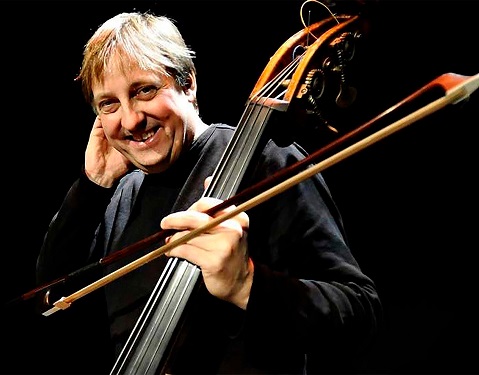
    If Mr. Kuusisto was in the limelight all evening, bassist Knut Erik Sundquist (above) made a vivid impression in his own right. I imagine that. had he not been constrained by holding onto his bass, he would have joined in the dancing. His facial expressions were priceless. 

    Without intermission, the performance continued with the ultra-familiar Vivaldi Four Seasons, rendered – as if by time-warp – as a fusion of Baroque and contemporary modes, into which Mssrs. Kuusisto and Sundquist interpolated traditional music from Finland and Norway. If you’re going to fiddle around (!) with the classics, this is the way to do it. 

    The great lilting start of “Spring” was flowing along congenially when suddenly sounds like a swarm of birds were heard. Later, the violas sounded seasick, and later still the drone of a bagpipe was evoked. In “Summer”, the strings melted and drooped, the violin and a cello engaged in an off-pitch dialog, and the music sizzled or soured before turning briskly exciting. A decrescendo brought whispers and falterings; and an en masse turn of the page was truly amusing. A storm breaks, the finale carries  on with more interruptions and some scraping motifs.

    “Summer” was perhaps the highlight of the Seasons, and a program note mentioned the fact that this concerto is “…built of exclusively unpleasant conditions, (connecting) it with the ongoing climate debate.”

    Kuusisto and Sundquist opened “Autumn” with a duet; the music sometimes took on an ‘outer space’ feeling. A snoring woman next to us rather spoilt the effect, but she woke up when Mr. Kuusisto started whistling. The tapping of bows on instruments and a ‘drunken’ passage kept us engaged. 

    Animated plucking – and a bit of humming from the orchestra members – were among the felicities of “Winter”; Mr. Kuusisto was by now in full “mad violinist” mode, his virtuosity simply mind-boggling. 

    An enormous standing ovation ensued, the audience clearly thrilled by what they had heard. Maestro Manze and the two soloists were called and re-called, to veritable tsunamis of applause. 

    Before the concert started, Maestro Manze spoke of what we were about to hear, and he asked that everyone in the audience “..stay to the end…”; I’ve never heard that kind of request at a concert. At any rate, a few people did head for the exits during The Four Seasons. But one woman, who was seated in the stage seats, attempted to leave and was sent back to her seat by an usher.

    ~ Oberon

  • BalaSole Presents SALMAGUNDI

    BalaSole_Dance_-_Salmagundi

    Above: Alexandra Jacob, a guest soloist in tonight’s performance by BalaSole Dance Company

    Friday July 17th, 2015 – The word “salmagundi” refers to a type of salad, but also to any kind of assortment, medley, or montage. Celebrating their fifth anniversary season tonight at Ailey Citigroup, Roberto Villanueva’s Balasole Dance Company offered a smorgasbord of dance, with a tasty array of solos – everything from tap to toe shoes – in a skillfully arranged and nicely lit production.

    As is the custom at BalaSole performances, the evening opened and closed with ensemble works which are prepared and danced by all the participating soloists and emerging artists in the week leading up to the show. Roberto often uses baroque music for these group dances, but this time around he chose contemporary music with a seductive throb; the dancers seemed very much at home in this milieu.

    LAURA ASSANTE was the first soloist; her piece entitled “Cancelled Stamp” was danced to the voice of the inimitable Nina Simone singing her classic “Love me or leave me”. Ms. Assante, a lively blonde with a great range of facial expressions, filled the song – which has a long piano riff midway thru – with energy and charm. 

    ANNA CUFFARI performed a pensive, searching solo entitled “Maktub“. She awakens in a pool of light to the sound of a harp. As the music expands into a passionate romantic theme, the dancer made excellent use of the space with her questing movement and expressive face and hands.

    FREDRICK DAVIS (from Dance Theatre of Harlem, making a guest appearance tonight) displayed his striking classic technique in an excerpt from  “Undisputed Love“. Set to the celestial sounds of Arvo Part’s “Fratres”, the danseur, in tights and a white shirt, seemed like a contemporary Albrecht lamenting his lost Giselle. Fredrick’s dancing had a fine sense of nobility and quiet ecstasy. 

    The comely ANDREA SAMONILOVA appeared next, reciting poetry for her solo entitled “Možná Jednou” (translation: ‘Maybe One Day’). Meshed with the spoken words is the sound of water flowing. The sad poetess seems like a lost soul as she stares into the audience, in search of someone. A winsome melody evokes memories of another time and place to which she cannot return. This solo, and Ms. Samonilova’s dancing of it, was both moving and mysterious.

    XAVIER TOWNSEND made remarkable moves in his solo “Return”, including some risky B-boy passages that had the audience gasping. Running in place and enmeshed in a struggle for self-expression, the lithe and handsome dancer was able to combine his explosive energy with more lyrical moments to make his solo a big hit with the crowd. 

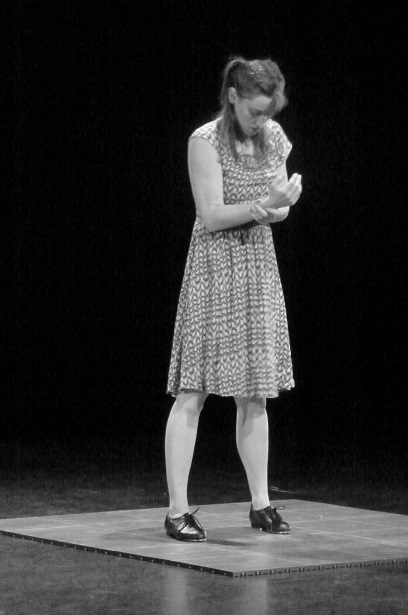
    CAMILLE SCHMOEKER performed a tap solo “Gilgal“, to an arrangement of the old gospel song “Joshua Fit The Battle of Jericho”. Using subtle shifts in the speed and volume of her tapping, the dancer, in a simple country frock, sometimes evoked line dancing in this solo which had a taste of Americana as well as a feeling of personal narrative.

    The powerful physique of ELIJAH LAURANT made a commanding impression in “Delimited Connection“; music from Kangding Ray underscored the dancing with a pounding beat, but the dancer steered clear of literalism and held our interest with his unfolding, expressive moves and the strength of his technique. 

    ALEXANDRA JACOB, a guest soloist, was for a decade a star of Dance Theatre of Harlem. Tonight, she performed “Anástasis” (translation: ‘Resurrection’), choreographed on her by Roberto Villanueva. Clad in midnight blue and with her hair flowing free, Ms. Jacob’s on-pointe dancing showed a luminous quality as she moved among pools of light. Music by Olafur Arnalds, rather ominous of mood, set the dancer on her path: a restless feeling imbued with lyricism, and a gorgeous ability to communicate directly with the audience thru the poetry of movement.

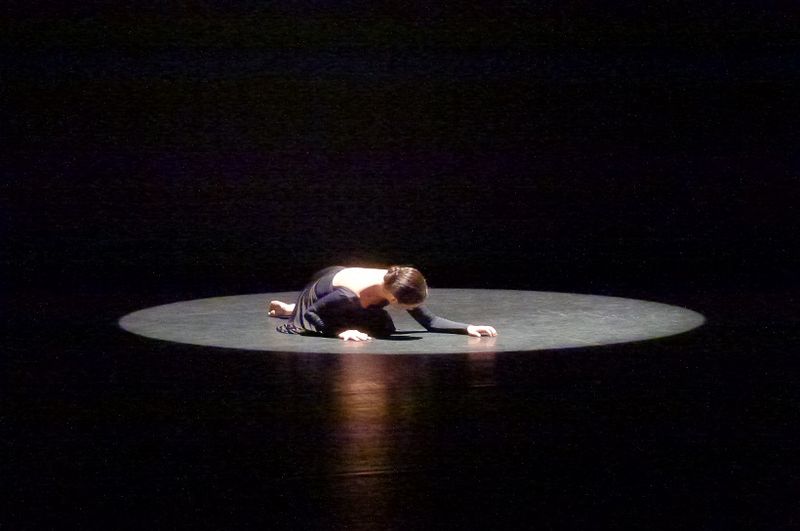
    BRIANA BUTLER enters in silence; on the ground, she pulls herself into a circle of light. Her solo,  “Unstoppable“, is danced to music that is alternately mystical and thunderous. Ms. Butler’s strength and control developed the solo with propulsive energy, and she added some impressive gymnastic elements along the way before things settled again into silence.

    ROBERTO VILLANUEVA always dances the closing solo at all BalaSole performances, and invariably his solos are highlights of the show. Today, his ‘awakening’ solo, “Air”, was danced to music by Max Richter. Roberto’s solos have an improvisational air but they are always carried off with the polished artistry and committed musicality of a born mover. 

    Prior to the show I watched the dress rehearsal, hoping to get some useful photos of all the participants; but that did not go so well for me and my camera today. I include a few here, but it’s totally random and I’m sorry to say not all the dancers are represented in their solos.

    L1580631

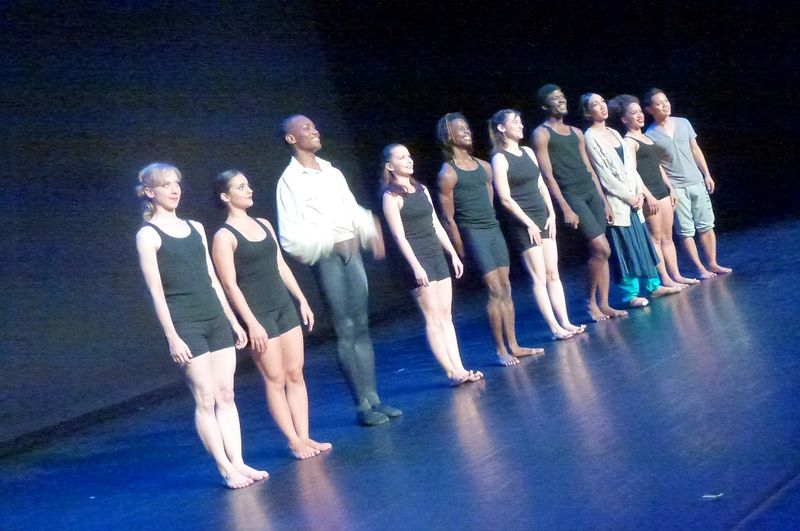
    Above: the soloists, lined up in performance order – Assante, Cuffari, Davis, Samonilova, Townsend, Schmoeker, Laurent, Jacob,  Butler, Villanueva

    L1580630

    Above: the emerging/re-emerging artists – these dancers appeared in the ensemble works at the start and end of the performance. They are (left to right) Gabriella Perez, Sasha Smith, Laurel Higa, and Ezra Goh.

    L1580683

    Above: Laura Assante

    L1580692

    Above: Anna Cuffari

    L1580778

    Above: Camille Schmoeker

    L1580801

    Above: Elijah Laurant

    L1580835

    Above: Briana Butler

    L1580888

    Above: Roberto Villanueva

    L1580901

    Above: the guest artists, Alexandra Jacob and Fredrick Davis, taking a bow

  • MÉLANGE @ BalaSole Dance Company

    L1440328

    Friday July 18th, 2014 – Roberto Villanueva’s BalaSole Dance Company presenting MÉLANGE at the Ailey Citigroup Theatre. BalaSole’s evenings of concert dance afford a rare opportunity for dancers in all genres to present solo works in a professional setting, with expert lighting and sound, before a large audience. Roberto Villanueva has made a niche for his Company in the New York City dance world: I don’t know of anyone else who organizes this kind of programme, a boon for both emerging and established dance artists who need to have their work seen. 

    This evening’s program was one of BalaSole‘s strongest to date. Roberto likes to stress variety in his presentations, and this evening there was something for everyone. The audience – a packed house – watched in attentive silence and warmly applauded all the participating dancers. I had watched the dress rehearsal (a couple hours before curtain time) and I tried to take some pictures, but I wasn’t having much luck this time around.

    BalaSole‘s programming follows a set blueprint: eight or ten artists are chosen by audition to present their solo works. They are mentored by Roberto, getting their dances stage-worthy. In the week prior to the show, ensemble pieces are created which will open and close the evening. This time around, Roberto chose wonderfully ‘danceable’ music by Franz Joseph Haydn for these group numbers, and the dancers – in vividly coloured leotards – evoked the joy of the sharing the stage with colleagues. Following a welcoming speech by Roberto, the solos began. 

    To an Al Kooper blues tune, Sara Braun strolls coolly onto the stage, wearing sunglasses. Removing her shades seems also to remove her self-confidence. The dance takes on a restless quality, though her poise is restored when she dons the glasses again. The dancework, entitled Amy W 27, clearly carries some meaning in the dancer’s life; the fact that we don’t know what inspired her to create the piece adds to the mystique of the character.

    Tall and commanding, Steven Jeudy performs a balletic solo to the Callas recording of “O mio babbino caro” from Puccini’s GIANNI SCHICCHI. Moving with supple grace, the bare-chested dancer shows off a fine line and an impressive extension. He continues to dance after the aria ends. The title of the solo is Resplendent – a title that well-describes Mr. Jeudy himself.

    In the solo Steady Tread (choreographed by Monica Hogan), Courtney Liu danced on pointe to music by the Carolina Chocolate Drops –  music which somehow has a Mid-Eastern sway to it. Pausing in balanced arabesques or bringing a jogging motif into play, the pretty dancer covered the space with lively charm.

    L1440461

    Alvaro Gonzalez danced a solo (choreographed by Tatiana Martinez) entitled En La Ausencia (In The Absence) in which the dancer, to a poignant Yann Tiersen score, is filled with loneliness. An empty embrace evokes the sense of loss; even Mr. Gonzalez’s hair seems to be expressive. The dance evolves to an agitated coda, until the dancer finally curls up on the floor in despair.

    In a daffodil-yellow frock, Kendra Ross takes the stage with a striking command of sensuous musicality for Manifest Divine, danced to an Everett Saunders song. A natural mover, Ms. Ross explores her own private world for our delectation, at the end dissolving into marvelous laughter as she rushes away.

    L1440517

    Exquisite artistry marked Misei Daimaru’s performance of her solo Stars in The Dark. Having seen Misei performing with Sunhwa Chung/KoRyo Dance Company and with Janusphere, I was very pleased to see her in a solo work. To music by Pierre and Gaspard Genard, Misei’s solo begins in a pool of light. Many dancers have used a chair in their solo works over the years, but few have made such compelling use of it as Misei; it became her virtual partner in the scheme of things. Misei’s dancing has a lovely internalized feeling, and a deeply expressive movement quality.

    Roberto Lara’s personal magnetism underscored his spell-binding performance of Via Crucis (The Way of the Cross), a poignant rendering of Camille Saint-Saens’ classic Dying Swan. Dancing in toe shoes, Roberto’s black tutu contrasted with his creamy alabaster torso. This justaposition of male and female characteristics was played out without any hint of Trockadero-style camp from the muscular dancer with his dark eyes and scruffy beard. The audience responsed to this tantalizing solo with genuine enthusiasm.

    In The First Ten, Katie Kilbourn appears in childish innocence. She evokes a nursery-like atmosphere while the music, by CoCo Rosie, makes us think of a music box. Sometimes sucking her thumb, the dancer moves with a doll-like feeling of naïveté. In the end, she slowly winds down while standing in a pool of light, her girlish white dress enveloping her in the virgnial purity of youth.

    Schubert’s Ave Maria served as the basis for Journey, a solo by Chloe Cappo. Using her flexible physique, the dancer wove elements of pure ballet technique into her solo which used the space well and responded clearly to the music in its sense of phrasing.

    L1440289

    In a slow progress along a lighted path across the stage, Roberto Villanueva displayed his physical control in the opening passage of Caught Up; the sound of clapping hands is later swept into ecstatic phrases for violin in a musical mixture of Steve Reich and Max Richter. Roberto pauses in a lighted circle to dance an animated section, seemingly wishing to escape. Then he continues on his way until the light fades to darkness.

    BalaSole have announced their next audition for August 1st, 2014 with performances in October.

  • Jessica Lang @ Joyce SoHo

    Copy of 1(6)

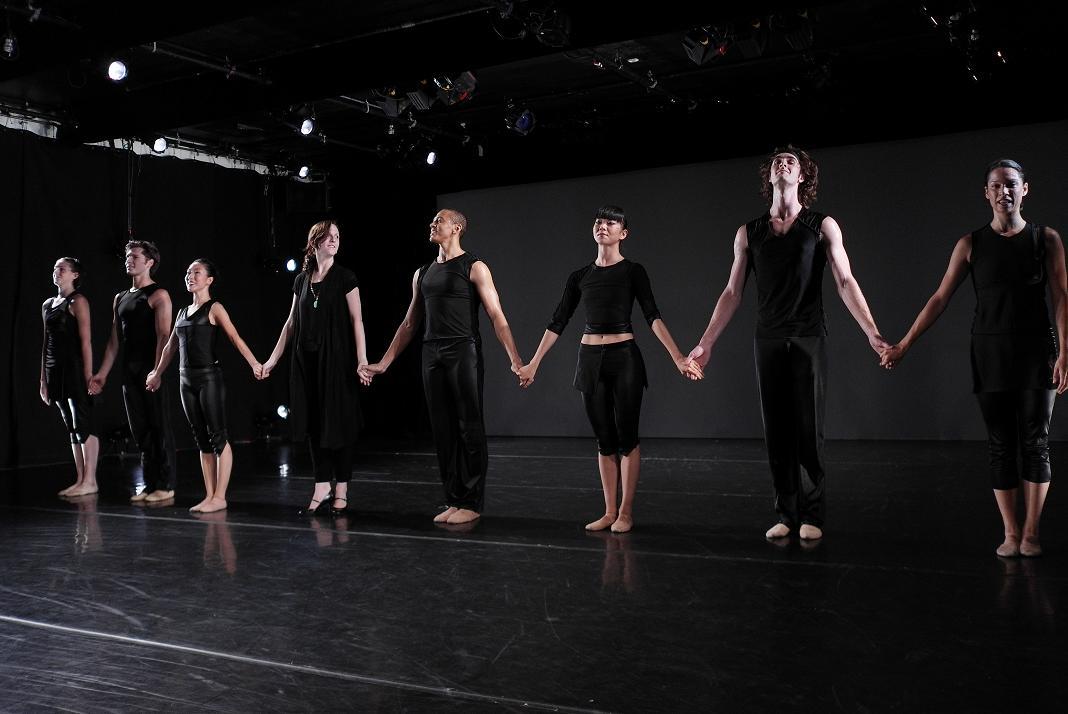
    Friday July 22, 2011 – Last week we watched a rehearsal of works being created by choreographer Jessica Lang during her Joyce Residency. Tonight we went back to Joyce SoHo where Jessica presented the new creations for an invited audience. The evening also served as the official debut of her own Company: Jessica Lang Dance. The choreographer’s eye for exciting dance personalities matches her creative spirit as a dancemaker. The result was an auspicious event which brought an already-impressive choreographic ‘voice’ into her next stage of artistic development. Above: Jessica and her dancers take a bow; photo by Kokyat.

    The evening opened with a perfect union of music and movement with an Untitled work-in-progress set to the andante of Mendelssohn’s piano trio in D-minor. Having already commended Jessica at the studio rehearsal for using this beloved score, I was particularly looking forward to seeing the piece lit and costumed. The dancers, who had all looked fine at the rehearsal, positively bloomed in performance mode: their personalities began to make strong individual impressions. Long-haired Thomas Garrett, tallest of the men, showed a combination of powerful dancing and a spirituality of expression that was quite unique. Technically polished Kirk Henning has a clear vitality of style, while Clifton Brown’s experience as an Alvin Ailey dancer shines thru in his handsome presence, total ease onstage and his accomplished partnering skills. From Korea and Japan respectively, Julie Fiorenza and Kana Kimura each have that mixture of delicacy and strength makes them so appealing to watch. Claudia MacPherson, who has a long list of Mark Morris credits, is technically secure and has the gift of drawing the viewer to her in ensemble passages.

    These dancers moved seamlessly thru Jessica’s choreographic passages all of which stemmed naturally and gracefully from the flow of this poignantly expressive music. Jessica stated again that she hopes to develop another movement from the Mendelssohn trio in future; tonight’s free-standing andante certainly served as a very impressive calling card.

    This was followed by a film, WHITE made in collaboration with Shinichi Maruyama. To music by Edward Grieg, dancers were filmed both in slow motion and in real time and then the clips were juxtaposed, creating unusual ghostly images that ebb and flow thru the dance. Flashes of humour (as when certain passages are sped up giving a ‘silent movie’ feeling) alternate with more resonant images where the dancers appear to be moving thru a dreamscape. Jessica stated that the films were still in a work-in-progress state but to me they seemed quite intriguing just as they are.

    L1000779

    Artist Shinichi Maruyama’s KUSHO series (photo above) was a source of inspiration for the final work on this evening’s programme: i.n.k. Danced before a backdrop of slow-motion projections of Maruyama’s colliding splashes or falling drops of paint and water, each section of i.n.k. had a strong individual flavour despite the unifying element of the projected images. Composer Jakub Ciupinski offers a variety of tempi and sonic colours to set the dancers in motion, creating a Diaghilevian union of music, art and dance.

    Copy of 24

    Central to i.n.k. is a radiant adagio danced by Kana Kimura and Clifton Brown (Kokyat’s rehearsal image above); this duet was originally performed under the title DROPLET by NYC Ballet’s Wendy Whelan and Craig Hall. This evening, Kana and Clifton etched the slow movement with quiet intensity, matching both the liquid beauty of Mr. Ciupinski’s score and the climactic burst of the Maruyama film where Kana executes a luxuriant backbend while poised in a lift. 

    For i.n.k. the dancers were joined by Company apprentice Jesse Dunham. Throughout the performance, the excellent lighting by Nicole Pearce and the attractive and unfussy costuming by Elena Comendador made the dancers look their best.

    In sum, this was an impressive evening with an excellent range of musical choices, the use of film to enhance but never overwhelm the choreography, and imaginatively structured works danced with clarity and personal expression. Jessica Lang Dance are off to a beautiful start.