Tag: Friday May

  • Evgeny Kissin @ Carnegie Hall ~ May 2024

    Kissin 2

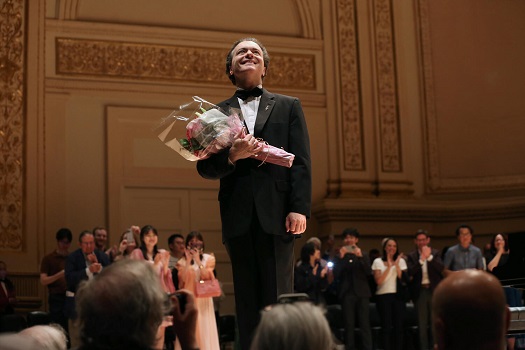
    Above, Yvgeny Kissin at Carnegie Hall; performance photo by Steve J Sherman

    ~ Author: Ben Weaver

    Friday May, 24th, 2024 – Evgeny Kissin is giving back-to-back concerts of the same program at Carnegie Hall this month. I attended the first one this evening, and it was a magnificent night of music, one of the best things I have heard in a concert hall this season. Kissin’s program is so popular, in fact, that not only were additional seats added on the stage (more about that later), but he will repeat this program on May 29th.

    Surprisingly this was my first time hearing Kissin live, though I have admired his many recordings over the years. He is a very unaffected performer, seemingly almost shy. His very sincere physical presence and unpretentious playing made an enormously positive impression throughout the night.

    Kissin began the program with Beethoven’s Piano Sonata No. 27 in E minor, Op. 90, composed in 1814. It reflects Kissin’s overall demeanor that he began with one of Beethoven’s least performed piano sonatas. Made up of only two movements – unusual for Beethoven – it open with a familiar Beethovenian bombast, but that falls away almost immediately and an achingly lovely melody takes over; it will return throughout the movement. The tonal contrasts throughout the the work can be hard to weave together. Kissin’s cleared those hurdles effortlessly. His playing was very clean and unfussy, each note etched like a diamond. Despite the Sonata’s Romanticism, Kissin seemed to be connecting it to Haydn and Mozart.

    Throughout the night one noticed Kissin’s very judicious use of the pedal, never letting the sound get murky and messy. This gave a great clarity to Chopin’s Nocturne in F-sharp minor, Op. 48, No. 2 and Fantasy in F minor, Op. 49 (both composed in 1841.) The long, melancholic melodies of the Nocturne – a particular specialty of Chopin’s – was played gently and without undue sentimentality. At each carefully built climax, Kissin pulled back just in time before falling into schmaltz. He launched into the Fantasy’s opening march right away. It felt like another example of Kissin not milking the crowd for affection.

    With Brahms’ Four Ballades, Op. 10 (composed in 1854) Kissin again reigned in much bombast, reminding us that Brahms, though composing at the height of Romanticism, was more of a classicist in temper. Which is not to suggest that his playing was lacking in brimstone. But Kissin’s very carefully chosen moments of when to let things blow up were fascinating to hear. The focus was always on the music and not the individual at the keyboard.

    Prokofiev’s Piano Sonata No. 2 in D-minor, Op. 14 (composed in 1912) is an early composition for the young composer (he was still a student at the St. Petersburg Conservatory), and it shows him trying out new ideas that would become trademarks in his future works. The Scherzo in particular sounds like echt Prokofiev: a playful melody played with demonic speed and attitude. Kissin’s hands were flying over the keyboard in a blur. With Prokofiev, Kissin ended the official program with the most outwardly virtuosic  piece played as dazzlingly as one can imagine.
    Kissin i

    Photo by Steve J Sherman

    The audience response was predictably wild. Kissin quickly offered 3 encores, all played superbly and all connected to the main program. A Mazurka by Chopin, March from Prokofiev’s opera “The Love for Three Oranges,” and Brahms’ gentle Waltz, Op. 39, No. 15. 

    During the opening Beethoven piece, the audience had been remarkably quiet. Perhaps making a note of this in my head jinxed the situation because what followed during the rest of the program was people repeatedly dropping things (probably their cell phones) and ringing cell phones. There is also always a risk in placing members of the audience onstage: one young girl in a white dress, sitting near the edge of the stage, was very bored and was swinging her legs the entire 1st half of the program. Thankfully her father probably took her home during intermission because they did not return. And just as Kissin launched into Prokofiev’s sonata, an elderly couple decided to exit the stage, down the steps, and out the door. Audience etiquette remains an untamable beast.

    ~ Ben Weaver

    Performance photos by Steve J Sherman courtesy of Carnegie Hall

  • Gražinytė-Tyla|Rachvelishvili|MET Orchestra

    AR

    Above: Anita Rachvelishvili, the stellar soloist at Carnegie Hall tonight

    ~ Author: Oberon

    Friday May 18th, 2018 – Mirga Gražinytė-Tyla conducting The MET Orchestra with mezzo-soprano soloist Anita Rachvelishvili at Carnegie Hall. Works by Debussy, Mussorgsky, and Tchaikovsky were on the bill.

    Claude Debussy’s Prélude à l’après-midi d’un faune opened the evening; this score, now beloved of ballet fans worldwide, was the setting for the controversial ballet by Vaslav Nijinsky who – at its 1912 premiere in Paris – caused a scandal with his portrayal of the exotic faun. It has since been performed in various choreographic versions, most notably that of Jerome Robbins for New York City Ballet (1953) where it remains a mainstay of the repertoire.
     
    Tonight, The MET Orchestra brought just the right glow of mystery and languid sensuality to this music.  Beautifully atmospheric playing from flautist Seth Morris was an outstanding feature of the performance; his solo bow rightfully drew bravos. Throughout, the numerous wind and harp solo passages were poetically played. At times, the pacing seemed just a shade too fast; but the overall effect was sublime. So nice to see the Met’s peerless concertmaster, David Chan, getting out of the pit and out onto the stage where his musicianship could shine the brighter.  
     
    CH1384284
     
    Ms. Rachvelishvili (above, in a Chris Lee photo from the performance) then appeared for Modest Mussorgsky’s Songs and Dances of Death (performed in the Shostakovich orchestration). The Georgian mezzo, who is making quite a name for herself these days, looked and sounded splendid, with her softer singing carrying superbly in the Hall, and producing a thrilling effect when she unleashed her full power.  

    Songs and Dances of Death, composed in the mid-1870s, is a set of four songs. In Lullabye, a mother cradles her sick child, who grows increasingly feverish. Death appears, disguised as a babysitter, and rocks the infant to eternal sleep. Here Ms. Rachvelishvili displayed a haunting use of almost straight-tone, employed as a means of lyrical expression. Her timbre is darkish, wine-coloured, with a haunting quality.

    Serenade depicts the figure of Death waiting outside the window of a dying woman, serenading her like a wooing lover. Ms. Rachvelishvili was simply magnificent here, the lushness and house-filling strength of her voice making a vivid impression. The music rises to a passionate conclusion. 

    In Trepak, a drunken peasant stumbles outside into the snow and becomes caught in a blizzard. The figure of Death invites him to dance the Trepak with him. The drunken man freezes to death, dreaming of summer fields and doves. The song starts softly, then a rhythmic figuration springs up; the bass-clarinet is prominent. Ms. Rachvelishvili’s vocal power, unleashed, was something to hear; and she brought forth some simply massive chest tones. For all the thrill of her voluminous, rich sound, she can also be extraordinarily subtle. 

    The Field Marshal is the final song, wherein the figure of Death is depicted as an officer summoning the dead troops of opposing armies after a horrific battle. As the ghostly soldiers parade before him, the Field Marshall speaks of them in remembrance. A bit of tension on some of the singer’s upper notes was swept aside by the visceral impact of her singing; in a calmer interlude, the straight-tone was again brought forth to extraordinary effect.

    Ms. Rachvelishvili received rapturous applause and was called back twice for additional bows. Someone handed flowers up to her, always nice to see. The crowd clearly wanted an encore, but perhaps the singer knew best; she left us with the echoes of the powerful Mussorgsky songs.   

    Following the interval, Ms. Gražinytė-Tyla led Tchaikovsky’s Symphony No. 4 in which the orchestra shone. Written in 1877-1878, the symphony is dedicated to the composer’s patroness and ‘dear friend,’ Nadezhda von Meck.

    Following his catastrophic marriage to his former student, Antonina Miliukova, which lasted all of two months, Tchaikovsky began writing his fourth symphony. Struggling with his sexuality and battling depression, he produced a symphony which, he is quoted as saying, is about Fate: “the fatal power which prevents one from attaining the goal of happiness”.

    The 4th is vastly pleasing in so many respects, with its titanic fanfares, its plaintive oboe solo in the Andantino, its originality in a Scherzo full of plucking strings, and the rush and plush of the final Allegro con fuoco. What is doesn’t do – for me, at any rate – is reach the depths of feeling that the composer so often evoked in other works.

    Mirga Gražinytė-Tyla’s extremely animated podium style became wearying to watch after a while. This orchestra plays so well on their own; the musicians hardly need a conductor at all. Constantly in motion, Ms.  Gražinytė-Tyla rose on her toes, hopped up and down, waved her baton overhead, and energetically gave cues. I ended up closing my eyes, to avoid this visual distraction.

    Though the 4th does not seem to me to be peak Tchaikovsky – though the composer himself thought highly of it, apparently – it did make me long to see EUGENE ONEGIN, SWAN LAKE, SLEEPING BEAUTY, and Balanchine’s SERENADE.

    There were empty seats around me, and the couple behind me remarked that the MET Orchestra series no longer seems to be the sell-out it has always been in seasons past. I wonder if the absence of James Levine has anything to do with it?

    ~ Oberon

  • Ballet Academy East ~ Spring Performance 2016

    Facebook_logo1

    Friday May 20th, 2016 – Students from Ballet Academy East’s Pre-Professional Division took the stage at the Gerald W. Lynch Theater tonight to dance a mixed program marking the end of term.

    Alan Hineline’s ravvishing ballet Sans Nuages opened the evening, and as soon as it ended my companion Claudia Schreier and I agreed that we wanted to see it again…right away. It’s that wonderful. The ballet is set to the Serenade for Strings in E, Opus 22 by Antonín Dvořák and is danced by an ensemble of fifteen, including a principal couple and female soloist; we had seen a preview of it in March.

    With the girls in sumptuous creamy tutus, the ballet has a romantic swirl to it. The structure and musicality of Mr. Hineline’s choreography – and the way it showed the dancers always to best advantage – make it a ballet that companies everywhere should want to acquire. Excellent dancing from Petra Love in the soloist role and Yuki Takahashi and Alejandro Andrade in the central pas de deux; the entire cast in fact danced beautifully, clearly inspired by the lovely Dvořák score.

    Darla Hoover created two brief ballets for the youngest dancers from BAE; in setting the works to Salieri (Une Petite Introduction) and Bach (Un Petit Menuet), Darla wisely sets a standard of musical choices that will hopefully inspire these youngsters both in their dancing and in their lives. (The Bach melody, incidentally, was borrowed for a 1960s pop hit, Lover’s Concerto, by The Toys; it was later taken up by The Supremes.)

    Slightly older dancers took the stage for Jenna Lavin’s Gossec’s Gavotte, to music composed by François-Joseph Gossec. Central to this piece was a a solo turn for the petit danseur Tristan Massa; his charming performance won the hearts of the audience. 

    Following an intermission, TO BE CONTINUED…, Jenna Lavin’s second work on the program, found five of the advanced dancers backed by a younger corps de ballet. Ms. Lavin gets an extra  bouquet of roses for choosing music of Henry Purcell, a composer whose work simply cries: “Dance!”

    In this “blue” ballet, Alejandro Andrade gave a truly impressive display of male bravura dancing; he also partnered each of the four main girls in well-constructed duet passages. Mr. Andrade’s performance brought down the house.

    Alan Hineline’s de l’innocence brought forth pianist Steven Mitchell to perform Franz Schubert’s 16 German Dances. This very pretty ballet featured spacious dancing from Tallison Costa, four soloists, and a corps de ballet of ten. Mr. Hineline’s choreography flows nicely on the music here, as dancers in varying combinations sweep on and rush away in a succession of finely-shaped vignettes. Once again, the choice of music contributed greatly to the overall enjoyment of the program.

    To close this evening, the third act of Coppélia, choreographed ‘after Petipa’ by Roger Van Fleteren (Alabama Ballet’s Associate Artistic Director) was performed by the BAE dancers with handsome sets and costumes on loan from Alabama Ballet.

    Every time I hear music from Coppélia, I recall my own very brief ballet career. Watching this evening’s re-creation was actually quite a nostalgic experience for me: I found myself wondering where my dancing mates from so long ago are now, especially TJ.

    The large cast, skillfully deployed by Mr. Van Feteren in the limited stage space, all entered into the spirit of this naive, musically brilliant ballet. Mary Watters built a real character as Swanhilda, her bridal bouquet trembling in her hands until Franz said “I do.” The ballerina showed lovely musicality in her solo, with its musical hesitations mirrored by subtle pauses in her dancing. Mr. Andrade, in addition to his commanding virtuosity, showed himself to be a real stage creature with his easy, affable stage demeanor. Petra Love’s lyrical dancing as Dawn and the poetic reverie of Yuki Takahashi’s Prayer both reflected lovingly on the music, and Joseph Marlborough was the authoritative Burgermeister.

    As the unstoppable joy of the Delibes finale propelled the dancers on to the finish line, Ms. Watters reeled off an attractive set of fouettés whilst Mr. Andrade leapt and swirled about the stage with unabashed vitality.

  • In Performance: GRAHAM 2

    11015477_10153139682186131_3644922198939538584_n

    Friday May 29th, 2015 – The young dancers of Graham 2 in performance at the Martha Graham Dance Company’s home space at Westbeth on Bethune Street in the West Village. It was rather stuffy in the theatre, and there were distractions of latecomers wandering in during the dancing. But it was a very impressive performance overall, and several of the participating dancers seemed poised to emerge as successful Graham artists in the seasons ahead.

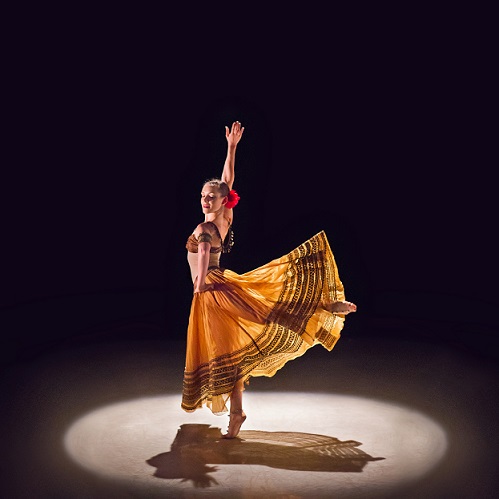
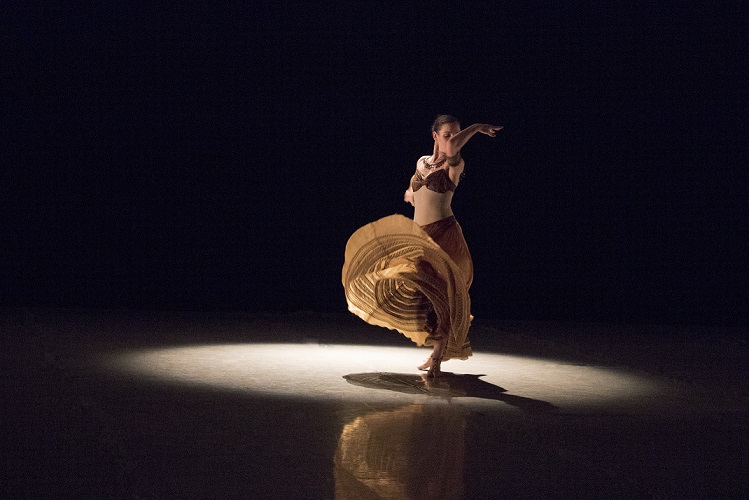
    Beginning in a circle of light, Dani Stringer performed the elegant solo à l’espagnole, SERENATA MORISCA. In a billowy skirt, wearing ankle bells and with a peony in her hair, Dani seemed eminently at home in this liltingly lovely dance, to atmospheric music by Mario Tarenghi. Premiered in 1916 (!) the solo looks absolutely fresh and au courante today. Two photos of Dani dancing the Serenata were offered to me – each captures her so well that I decided to include both:

    001 - _MG_1804

    Above, photo by Brigid Pierce

    002 - G215_SM1

    Above, photo by Antonia K Miranda

    HERETIC dates from 1929 and is one of Graham’s most powerful works. It alludes to the outcasts that are found in every culture, race, and religious affiliation. I’ve now seen it a few times and it’s a resonant work, with a stop-and-start score arranged by Charles de Sivy from an old Breton chanson

    002 - G215_H2

    Above: from HERETIC, with Jessica Sgambelluri and the Graham 2 ensemble; photo by Antonia K Miranda

    Jessica Sgambelluri gave a powerful performance as the scorned woman, constantly subjugated by the implacable sisterhood who move almost mechanically into positions of closing ranks around the hapless victim. At times they seem to be praying for the woman’s redemption, but they remain sternly rejecting, even threatening.

    001 - G215_H1

    Above: Ms. Sgambelluri and the ensemble in HERETIC; photo by Antonia K Miranda

    001 - G215_L1

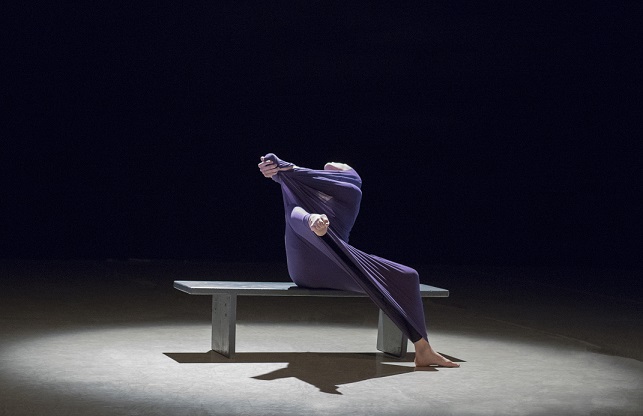
    Anja Zwetti (above, in Antonia K Miranda’s photo) took on the iconic Graham solo LAMENTATION and made a strong impression as she performed this ‘dance of sorrows’ seated on a bench and wrapped in a shroud of purple jersey. The Kodaly piano score gives the dancer her movement cues, and the lighting provides a shadow-dance that gives the work an added ghostliness. Ms. Zwetti held the audience in a state of keen focus throughout the solo. I had the feeling that several in the crowd were seeing LAMENTATION for the first time, and were deeply moved by the experience.

    002 - G215_L2

    Above: Anja Zwetti in LAMENTATION, photo by Antonia K Miranda.

    A selection from NIGHT CHANT followed, re-staged by the inimitable Virginie Mécène. This late Graham work (1988) is set to an exotic score by R Carlos Nikai and features a large ensemble of both male and female dancers who move in signature Graham motifs; it is an homage to the culture of the Native Americans, depicting the rituals of their community.

    001 - _MG_0258

    The women (above, photo by Brigid Pierce) appear variously in large or small movement units while the men, sexy in sleek tights, are given dynamic leaps and cartwheels. NIGHT CHANT features a central pas de deux couple: tonight we had the charismatic Dani Stinger and Alex Clayton giving a fluent performance. 

    003 - G2150178

    Above: the ensemble in TURNING POINT, photo by Antonia K Miranda

    In its world premiere performances, TURNING POINT by Blanca Li was a striking addition to the Graham 2 repertory. Thirteen dancers, clad in black trousers, first appear standing in place; they remain on their marks as individual solos, disconnected duets, and mini ensembles spring up almost randomly. They fall and rise in various combinations, and then there’s a walkabout before they re-group. They disappear and re-enter in a diagonal, with more floor time and passages of gestural language. Suddenly the dancers rush about the space; a female duet ensues, and then a female trio takes up a counter-dance. Silence falls, and the full ensemble appear in a cluster swaying gently as the light fades.

    Tao Guttierez’s wonderful score shows us a contemporary composer unafraid of melodic appeal; the dancers did a great job with this piece, which afforded many individual opportunities. I hope to have a chance to see TURNING POINT again.

    001_MG_0497

    Above: Jessica Sgambelluri in TURNING POINT; photo by Brigid Pierce.

    002_MG_0599

    Above: Stylianos Kefalas in TURNING POINT; photo by Brigid Pierce

    Following the interval, more Graham classics to be savoured, beginning with the 1936 all-female ensemble work STEPS IN THE STREET, the central section of Graham’s visionary anti-war trilogy CHRONICLE.

    002_MG_1790

    Dani Stinger (above, photo by Brigid Pierce) led the ensemble with an impressive sense of mission…

    001_MG_1757

    …while the ensemble (above, Brigid Pierce photo) moved compellingly thru the stylized demands the choreography places on them. My hope for these young dancers – both the women and the men – is that they will be instilled not only with Graham’s dance technique but also with her work ethic and philosophy of life.

    Anne Souder appeared next in the signature green-black-white-yellow dress that says: SATYRIC FESTIVAL SONG. This is Graham at her most witty, and Ms. Souder did an excellent job of it, with her quirky leaps, wiggles, and sudden posed stops; her hair also became part of her performance. I unfortunately don’t have a photo of Anne Souder in this solo but moments later she was back onstage for DIVERSION OF ANGELS and here she shone ever-brighter.

    001_MG_1248

    Above: Anne Souder in DIVERSION OF ANGELS; photo by Brigid Pierce

    In the concluding DIVERSION OF ANGELS (1948, to a Norman Dello Joio score), Ms. Souder displayed a soaring extension and rock-steady balances, along with a stage-hungry aspect that gave each moment of her performance an inspiring glow. The dancing by everyone, in fact, was really impressive. The men gave their passages a high-energy verve – will they make the leap to the top Graham echelon? Let’s hope so, because the courage and conviction are there: in addition to Alex Clayton, we had Alessio Crognale, Antonio Cangiano, and Stylianos Kefalas all doing handsome work. Sharing the spotlight with Ms. Souder in the ballet’s principal female roles were Anja Zwetti (lyrical in White) and Vera Paganin (lively in Yellow). Sarita Apel and Linda Bombelli joined Jessica Sgambelluri and Dani Stinger for some fine dancing in the supporting female quartet.

    Lovely to see Graham luminaries Natasha Diamond-Walker and Lorenzo Pagano among the crowd, and my special thanks to Janet Stapleton for arranging things and for sending me the production photos with perfect timing.

  • Gotham Chamber Opera: THE RAVEN

    64f8384177b1bc6ce6103c6e19507a29d202a740

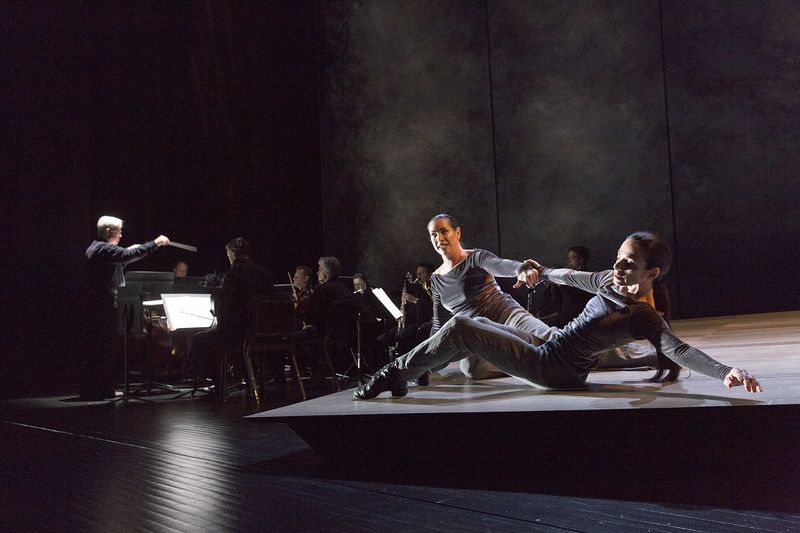
    Friday May 30th, 2014 – Gotham Chamber Opera presenting the U.S. premiere performances of The Raven, a monodrama by Toshio Hosokawa, based on Edgar Allen Poe’s immortal narrative poem. Mezzo-soprano Fredrika Brillembourg and prima ballerina Alessandra Ferri take the leading roles with the chamber ensemble under Neal Goren’s baton; Luca Veggetti staged and choreographed the opera.  As a prelude, André Caplet’s rarely heard Conte fantastique: Le Masque de la Mort rouge, inspired by another Poe work – The Mask of the Red Death – was performed by a quintet featuring harpist Sivan Magen.

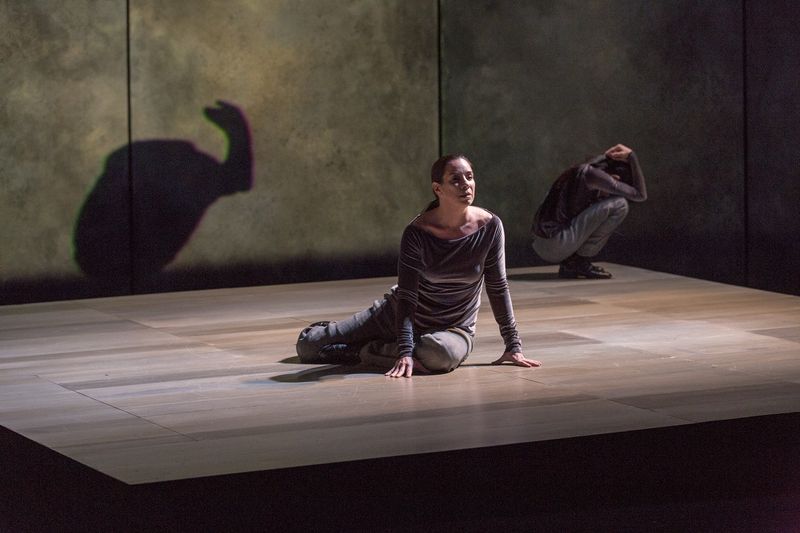
    The evening was engrossing both musically and visually; from the moment we entered the theater we were drawn to the stage by the shadow cast by Mr. Magen’s harp. The players made ravishing sounds in the eerily colourful Caplet score, the harpist’s pianissimo melismas delicately pricking the ear. The composer, in this conte fantastique, limns the tale of Prince Prospero who – with several guests – walls himself up in his castle to escape the plague. But Death finds him anyway. At one point Mr. Magen knocked on the wooden frame of his harp, a sinister effect.

    Luca Veggetti had the excellent notion of creating a musical bridge between the Caplet and the Hosokawa by having the clarinetist play a sustained tone soon after the opening work ended. Other players took up the sound, an improvised entr’acte that prevented the audience lapsing into idle chatter as the stage was set for the opera.

    The Raven takes place on a raked platform, imaginatively lit by Clifton Taylor. The mezzo-soprano sings/speaks the entire Poe narrative poem whilst the dancer moves about the space – is she is the Raven or the lost Lenore? – sometimes physically entwining herself with the singer. 

    Toshio Hosokawa’s score creates a sonic tapestry which sets the singer’s incantation in high relief. Winds and strings mingle voices with piano and percussion, evoking the eerie nocturnal visitation of the raven. The chill of an evening breeze sweeping thru a graveyard, the darkling shimmer of moonlight on a marble tomb, the icy shudder of tree roots shifting in the frost-covered ground: these illusions are musically expressed, deepening the mystery of the theatrical experience. 

    Fredrika Brillembourg offered a triple tour de force in her performance: she has mastered both lengthy and repetitive the texts of the poet and the sung-speech called for by the composer, and also the physicality of the director’s staging in which the singer becomes an active counterpoise to the dancer. In the beginning, Ms. Brillembourg’s speech had an exaggerated, measured slowness of expression; her narration later became more urgent. Her clarity of diction almost made the super-titles superfluous. In bursts of song, the mezzo revealed a vast range and a fine dynamic mastery: her vocal performance was engrossing at every moment. Ms. Brillembourg entered fully into the physical demands of the production, singing powerfully from improbable positions…

    RTRH4C1132 copy

    …and even at one point balancing Ms. Ferri on her up-turned feet, as in the childhood game of Flying Angels. [above photo by Richard Termine]

    At the end of this marvelous portrayal, Ms. Brillembourg was rightfully cheered by the large audience who had experienced her riveting performance in a state of pin-drop silence.

    Ms. Ferri was equally compelling, her slightest gesture or tilt of the head having a poetic quality that the greatest artists instinctively possess. I found my eyes constantly lured by her, even when she was merely standing still. Her silent presence spoke with the same authority as her singing colleague’s, and together they made the strongest possible statement on behalf of the composer and the poet.

    RTRH4C0374 copy

    In an uncanny moment, while Ms. Ferri is kneeling at the far corner of the platform (above) her shadow suddenly rises and moves across the backdrop as if drawn by the sound of the music being played stage right. This theatrical trompe l’oeil literally gave me the chills, especially as it was so subtly done.

    More images from The Raven, thanks to photographer Richard Termine:

    RTRH4C0287 copy

    RTRH4C0867 copy

    Nothing but praise then for everyone involved in this excellent production: another feather in Gotham Chamber Opera’s cap as they continue to play a vital role in the City’s cultural realm.

  • Bountiful Balanchine @ New York City Ballet

    6a00e3982574bd8833013487f8adad970c-800wi

    Above: New York City Ballet principal ballerina Ashley Bouder in a Matt Murphy portrait

    Friday May 24th, 2013 – A panoramic vision of George Balanchine’s choreographic artistry was on display this evening at New York City Ballet: an iconic classic, a quirky and mysterious series of danced vignettes, a spirited showpiece pas de deux, and a masterwork set in a luminous Chagall decor.

    It must be a memorable landmark in a NYCB ballerina’s career to be cast in one of the principal roles in SERENADE. Sterling Hyltin, who recently took on the Russian Girl, was tonight making her debut as the Waltz Girl. Sterling has her own brand of youthful elegance and sophistication as well as the mature depth of artistry to bring something very personal to this role. As the inherent drama of the ballet evolved, Sterling’s sure sense of the music and her nuanced conveyance of its romantic beauty made a poetic impression, enhanced by the angelic fall of her hair. 

    Jared Angle was a perfect cavalier for Sterling in their Waltz, and his airy solo passage was beautifully crafted. Megan LeCrone’s unique persona and wonderfully fluid movement continually found inspiration in the Tchaikovsky score, and Adrian Danchig-Waring was again a marvel of physique and presence.

    I’ve seen Megan Fairchild as the Russian Girl many times and I felt that tonight she surpassed her own high standards in the role; every phrase had a serene quality and in matters of expressiveness she found the exact hues in her dancing to enhance the lyrical glow of the music. It was a very pleasing interpretation in terms of both technique and artistry.    

    C35663-8_Ivesiana_Laraceyrr

    Above: newly-promoted to soloist, Ashley Laracey – one of the Company’s most distinctive dancers – in IVESIANA; photo by Paul Kolnik. The opening section of this ballet, entitled In Central Park, commences with a convergence of almost zombie-like women wandering the park at night. Ms. Laracey, in virginal white, moves among them – a blind girl feeling her way in the darkness. She encounters the broodingly handsome Zachary Catazaro and falls prey to his sexual desire, but it’s all very subtly manifested.

    6a00d8341c4e3853ef017eeafd0416970d-800wi

    Above: Anthony Huxley and Janie Taylor in The Unanswered Question from IVESIANA; photo by Paul Kolnik. In this duet, the barefoot ballerina is borne aloft by unseen carriers while the desperate young man pursues her in vain. I’m reminded of a similar Balanchine duet, PORTE ET SOUPIR, in which the female character appears ever beyond reach. The two ballets end differently, but the mystery and allure evoked are provocative in both works. Anthony Huxley, beautifully vulnerable, gives a charismatic youthfulness to the questing boy and his thwarted desires, while the divine Janie Taylor, wrapped in an enigma, entrances with her pale skin and iconic hair. 

    In a sudden snap-out-of-it burst of reality, Teresa Reichlen and Amar Ramasar appear in a vaudeville-like duet. Playful and unromantic, they trade solo passages before shaking hands and going their separate ways. Confident and super-attractive, Tess and Amar give IVESIANA its only bright spot, for the ballet ends in deep twilight with the corps now walking about on their knees, downcast and anonymous.

    The programme then did a volte face and gave us Balanchine at his most witty and entertaining with TARANTELLA, a virtuoso courting duet with a Neopolitan flair. Daniel Ulbricht gave a dynamic and high-flying performance, the crowd with him every step of the way as he leapt and swirled about the stage in uncanny combinations. Not to be outdone, the charming Erica Pereira brought a delicate but spicy air to her performance: her fancy footwork matched Daniel’s, and she showed off some very pretty attitude turns. As the pas de deux sails forward, the zils started to fly off from Daniel’s tambourine causing much mirth in the audience. The two dancers swept offstage after Daniel’s victorious kiss, then returned to an avalanche of applause. They were called out four times by the delighted crowd.

    It’s not often we see a fourth curtain call after a ballet at NYCB, but it happened a second time tonight as Ashley Bouder delivered a brilliant Firebird to end the evening. Ashley’s boundless technique is matched by her insightful dramatic interpretation, filled with subtle detail and highly personal musicality. She created a vibrant and magical atmosphere, topped off by a striking manege of full-stretched jetes. But then she also summoned up the gentle rapture needed in the whispering bourees of the Berceuse. Fortunate ballet-goers to have experienced two superb Firebirds – Ashley’s and Maria Kowroski’s – in a single week. They are as different as two birds of a feather could be, yet each seems perfect.

    Justin Peck was the wide-eyed and courtly Prince and Gwyneth Muller the willowy, enchanting Princess. Blessings on my lovely girls in the Dance of the Captive Maidens. Conductor Leif Bjaland and the NYCB players gave a jewel-like rendering of this fascinating Stravinsky score.  

    SERENADE: Hyltin, M. Fairchild, LeCrone, J. Angle, Danchig-Waring  [Guest Conductor: Bjaland]
    IVESIANA: Laracey, Catazaro, Taylor, Huxley, Reichlen, Ramasar  [Conductor: Sill]
    TARANTELLA: Pereira, Ulbricht  [Conductor: Sill, Solo Piano: Chelton]
    FIREBIRD: Bouder, J. Peck, Muller, Scordato  [Guest Conductor: Bjaland]

  • 2280 Pints!

    Buckets lift

    Friday May 27, 2011 – From the many invitations that I receive each week to dance events, this one from The Neta Dance Company caught my eye because of the title of the work they are presenting: 2280 Pints! Described as a dancework for seventeen dancers and 57 5-gallon plastic buckets, it just sounded so quirky that I had to give it a go.

    P1230913

    On entering the space at Dance Theater Workshop, we find the dancers posed like living statues as the music of Chopin’s second piano concerto fills the air. Each dancer has a white plactic bucket. Coins are distributed to the incoming audience members who then wander among the dancers, pressing pennies into the dancers’ open palms or dropping them into the buckets. A bell rings; suddenly the dancers break their poses and rush into the audience, grabbing people at random. Each dancer takes a guest onto the stage and arranges him/her in a statuesque pose. Thus did my friend Kokyat make his New York stage debut.

    From there, a roller-coaster ride of movement and music commences. Neta Pulvermacher deploys her squad of dancers and their fifty-seven buckets in a richly imaginative series of danced and mimed tableaux, set to a musical smorgasbord that runs the gamut from Mozart to Sonny & Cher. 

    The buckets are arranged, stacked, knocked over, sent skidding across the floor; they become hats, shoes, podiums, spotlights, drums, sinks, stepping-stones; they are hoisted and lowered over the playing area.  The dancers come and go as each musical number unfolds; sometimes there are big ensembles with everyone moving in unison and playing the buckets like percussionists kits. Other moments are more intimate: a girl sings the old Charlie Chaplin tune “Smile” (sings it really well, too) while four dancers simply raise and lower buckets over their faces, revealing their features as droll masks.

    Does it sound like a mish-mash? To an extent, it is. What saves it and makes it brilliant is the musicality of Neta’s choreographic style and the sheer energy and commitment of her dancers. One or two segments seem to stretch out a bit long but at those times one can focus on the individual personalities of the very attractive young performers. A giant plus to the production comes from the lighting by B. Lussier.

    I loved running into Taylor Gordon (either I go for months without seeing Taylor or I see her every day for a week) and to see Deborah Wingert and Matthew Westerby again. Many thanks to Alessandra Larson for inviting us to this really enjoyable evening.

    2280 Pints! continues at Dance Theater Workshop (on West 19th off 8th Avenue) thru Saturday evening. Kids over 5 will get a kick out of it at a Saturday matinee. Details here, with a video trailer.