~Author: Scoresby
Friday October 26 2018 – As the first concert in her six-part Perspectives residency at Carnegie Hall, Yuja Wang decided to do a thought-provoking collaboration with percussionists. It is great that instead of playing standard repertoire, Ms. Wang is using her platform to push her audience into more unfamiliar repertoire, such as her recital in Carnegie last season and this performance. Here, she was working with some of the all-stars of the percussion world: Martin Grubinger, his father Martin Grubinger Sr, Alexander Georgiev, and Leonhard Schmidinger for an incredibly fun evening. Unfortunately, the performance was billed as “Yuja Wang, piano and Martin Grubinger, percussion” with the other percussionists relegated to small lettering. The program didn’t even mention which percussionists played on which of the works. Oddly, no instrumentation was given for each work, instead just “piano and percussion”, despite a litany of different percussion instruments used. Nonetheless, Ms. Wang and Mr. Grubinger did give credit to their colleagues and this truly was a collaborative performance between all five musicians.
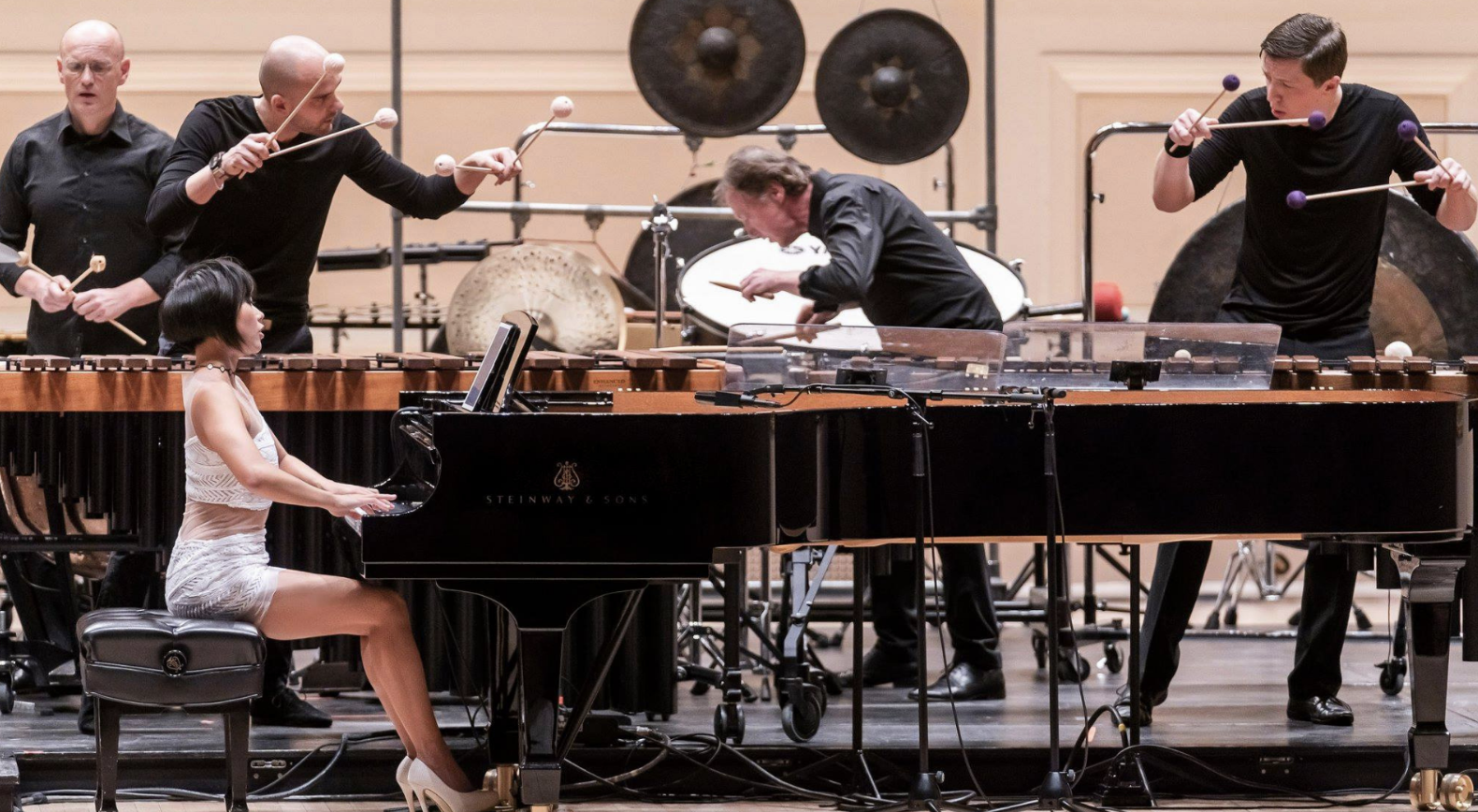
Above: In the throes of the Bartók (from left to right): Leonhard Schmidinger, Alexander Georgiev, Yuja Wang, Martin Grubinger Sr, and Martin Grubinger; Photo Credit: Chris Lee
The program began with Bartók’s Sonata for Two Piano and Percussion arranged for one piano and percussion by Martin Grubinger Sr. This was the most successful of the arrangements of the evening. Along with the Music for Strings, Percussion, and Celesta, this is Bartók at his most avant-garde with many references to jazz, interesting instrumentation, and spiky melodies. The biggest change to the score in this arrangement was splitting one of the piano parts into two marimbas played by exceptionally like one instrument by Mr. Grubinger and Mr. Georgiev – their coordination was almost surreal. The traditional percussion was played by Mr. Schmidinger and Mr. Grubinger Sr. The impact that this changed the entire timbre of the piece, becoming less incisive in a way but far more colorful. In a way it made the music sound even more avantgarde. In the mysterious opening chords after the rumbling timpani played by Martin Grubinger Sr, the aggressive playing of Ms. Wang was contrasted with the light tremolos on the marimba.
With two pianos this texture sounds more like an attack, but the woodiness of the marimbas added a lighter atmosphere and made Ms. Wang’s piano seem more percussive. It was a brilliant play to highlight the piano playing while improving the music making. Ms. Wang for her part seemed to naturally get the score switching from whacking chords for emphasize to lyrical furtive blending into the ensemble. In the second movement, Bartók employs his night music in a classic tenary form. Ms. Wang’s evocative playing here with the military-esque sound of the percussion and softness of the Marimbas worked well in tandem to produce an unusual Messiaen-like ethereal sound.
Mr. Grubinger and Mr. Georgiev exchanged more and more agitated lines with Ms. Wang leading into the virtuosic agitato with ripples of arpeggios punctuated by chords. Ms. Wang silvery sound moved through the dead hits of percussion, a dialogue less apparent in the original score. The group whipped its way through the Stravinsky-esque finale capturing a raw energy.
The sold-out crowd seemed somewhat confused by the music, perhaps a little too avant-garde for their taste – but to me it was thrilling. Luckily for most of the crowd the group came back onstage to play Martin Grubinger Sr.’s arrangement of John Psathas’s Etude from One Study for three percussionists and piano. This work is a virtuosic piece that riffs through a bunch different sequences and Mr. Grubinger Sr. made sure that each instrument got its own fun solo to show off. It was the perfect piece for some levity after the serious Bartók and genuinely sounded more in the idiom of a rock concert by the end of the etude, causing the crowd to roar with applause.
The second half of the program began with another Martin Grubinger Sr. Arrangement: this time of The Rite of Spring for one piano and three percussionists. Mr. Grubinger Sr.’s arrangement of this was magical, using elements of the two piano and one piano versions of the piece combined with marimba, vibraphone, chimes along with Stravinsky’s percussion of timpani, woodblock, washboard etc… to produce a completely unique sound that still paid homage to the original. It is incredibly unfortunate that the Stravinsky Estate decided a few weeks before this tour to ban this group from performing the work anywhere in which the copyright of the piece is still in effect (US being the only place where it is lifted), so this ended up being the second and last performance of the tour.

The group after the final applause (left to right): Martin Grubinger, Leonhard Schmidinger, Alexander Georgiev, Yuja Wang, and Martin Grubinger Sr.
The opening was flush with color using the vibraphone as the bassoon mixed with humming tremolos from the piano and marimba to slowly build into the percussive attacks of the Augurs of Spring. The explosive last few movements such as the Ritual of the Rival Tribes and the Dance of the Earth of the first part were where this arrangement really shined, sounding at once razor-sharp and still managing to capture Stravinsky’s innovative instrumentation. In the introduction to Part II, the primordial timbres were still achieved by Mr. Georgiev bowing the vibraphone (and perhaps bowed glass too?) producing an eerie metallic sound mixed with the light woody marimba of Mr. Grubinger and a base structure of Ms. Wang’s piano playing the string part of the score.
After those first two movements of Part II, the balance seemed quite off with the percussion absorbing all of Ms. Wang’s sound. Nonetheless, all four performances gave a virtuosic and energized performance. Interestingly, the percussion seemed less precise than Ms. Wang’s piano, particularly in the final section of the piece during the complicated rhythmic playing. The percussion chosen wasn’t able to stop its vibration quick enough, so some of the crisp beats sounded muddier from the bleeding sound. Still, the group seemed in perfect sync with one another, this was true ensemble playing.
To end the performance (personally it seemed odd to me to have anything after The Rite, given how climactic it is already), the group played Mr. Grubinger Sr.’s arrangement of Leticia Gómez-Tagle’s solo piano arrangement the popular orchestral work by Arturo Márquez Danzon No. 2. This poppy but fun piece was thoroughly enjoyable if a little light after The Rite. Ms. Wang seemed to really dig into the opening tango and enjoy the many different Latin American rhythms that come as the piece develops. The group did a good job keeping this fun and energized. After a thunderous applause Ms. Wang and Mr. Grubinger gave an encore of the two of them playing Jesse Sieff’s Chopstankovich, which essentially a virtuosic snare drum part added to Shostakovich String Quartet’s No. 8’s intense second movement (in this case, the string part performed by Ms. Wang on piano). It was a fun little encore to cap the evening’s eccentric program. It was a wonderful collaborative program that broke the more staid conservative environment with some of the best musicians around.
— Scoresby










 Oberon's Glade