Tag: Greer Grimsley

  • Ticho Parly

    Parly

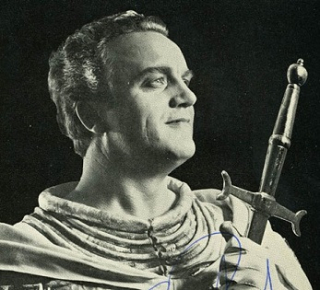
    Ticho Parly (above, as Lohengrin) would have been my first-ever Tristan if I’d been able to secure a ticket for one of his 1966 Met performances of the role, opposite Ludmila Dvořáková. But every performance at the Met in that opening season was sold out well in advance, and so it was not until 1982 that I had the unexpected pleasure of hearing this estimable helden-tenor.

    Born in Denmark, Ticho Parly went from being a treble to being a bass-baritone. It was while studying with Charles Paddock (the teacher of Anthony Laciura and Greer Grimsley) in New Orleans that Parly settled in as a tenor. He made his operatic debut with New Orleans Opera as Pong in Turandot.

    Returning to Europe, the tenor sang at Aachen, Brussels, Wuppertal, Lisbon, Kassel, Amsterdam, and Vienna. He made his Bayreuth debut in 1963 as Walther von Stoltzing in Meistersinger, and returned to the Festival to sing Siegmund and Siegfried in 1966.

    1966 was also the year of his Met debut, in the afore-mentioned Tristan und Isolde. Parly’s other Met roles were Erik in Fliegende Hollander and Aegisth in Elektra.

    Ticho Parly’s career kept him shuttling between Europe and the Americas: he sang at Covent Garden, La Scala, Paris, Covent Garden, San Francisco, Mexico City, and at the Teatro Colón. His roles included Tannhauser, Parsifal, Loge, the Drum Major in Wozzeck, Herod in Salome, the Emperor in Frau ohne Schatten, Florestan, Bacchus, and Peter Grimes. He was active thru 1988, when he sang Otello in Denmark, and passed away in 1998 in Seattle where he had been teaching.

    Here’s the story of my one opportunity to hear Ticho Parly live:

    An enterprising organization called The Wagner International Institution offered the complete Ring Cycle in concert form at Northeastern University on Boston. The operas were given on four consecutive Sunday afternoons. My friend Paul and I decided to give the Walkure a try, prompted mainly by the fact that Roger Roloff was singing Wotan. We enjoyed it thoroughly, and immediately obtained tickets for the Götterdämmerung, scheduled for two weeks later.

    Scanned Section 7-1

    Ticho Parly was not the announced Siegfried in the pre-publicity for this Ring, but on performance day, there he was onstage. He’d had a long career and I was unsure of what to expect from him, but here’s what I wrote the day after:

    “Ticho Parly was a surprise Siegfried. He sang commandingly and sustained the long, often cruelly demanding part impressively. He had ample vocal heft, and the tone is still quite pleasant; his diction so clear, and his feeling for the music so sure. His third act was especially fine: a huge and sustained high-C on “Hoi-ho!” (greeting the hunting party) and a firm rendition of his long narrative. His final apostrophe to Brünnhilde was tenderly sung, and moving. In sum: an excellent performance!”

    Mr. Parly recorded Siegfried’s farewell to Brünnhilde: here.

    Mr. Parly and Gladys Kuchta sing the final duet from Siegfried from a 1966 NY Philharmonic concert conducted by Lukas Foss. Ms. Kuchta never quite makes it up the the concluding high-C but otherwise it’s a very interesting performance. Listen here.

    ~ Oberon
  • SALOME @ The Met

    Salome1

    “You know, there are three kinds of Salomes: those who can sing it, those who can dance it, and those who should be shot!” ~ Leonie Rysanek

    Wednesday December 28th, 2016 – My friend Dmitry and I had really been looking forward to seeing SALOME at The Met this season; it’s among our favorite scores. I bought tickets in advance for two performances, since I wanted to hear both Željko Lučić and Greer Grimsley as Jochanaan.

    Then came the news that the scheduled Salome, Catherine Naglestad, had withdrawn from the title-role, and was to be replaced by Patricia Racette. Racette used to be a particular favorite of mine, going back to her performances as Emmeline in Tobias Picker’s opera at NYCO. She was a marvelous Met Mimi, Violetta, and Ellen Orford, and I very much enjoyed her Elisabetta in DON CARLO. But as the seasons have passed, the wear-and-tear has really begun to show in Racette’s singing. Still, as recently as 2013, she gave a striking performance in Dallapiccola’s IL PRIGIONIERO with The New York Philharmonic.

    Since then, anything I have heard from her has sounded sadly worn and unpleasant. I suppose there’s something honorable about “the sword wearing out the sheath” in the service of art, but after a while the artistry and dedication no longer compensate for the sound being produced.

    I don’t want to dwell on the negative, but much of Racette’s singing was really off-putting. In the lower-to-middle-range passages, she was often covered by the orchestra. The heavy usage the soprano has subjected her voice to really shows in this music: the vibrato has spread so that in the upper range there’s no core to a sustained note; the louder the note, the wider the fluctuation.

    Salome is supposedly a teenager, but Strauss wrote the part in a way that only a mature and experienced soprano can cope with it. Thus the Dance of the Seven Veils must be handled with kid gloves; soprano and choreographer have to find ways for a woman of a certain age who is capable of singing the role to be reasonably credible in the dance-moves. For this famous scene, Racette chose an unflattering get-up: a sort of tuxedo affair with hot pants and a top hat. The choreography was duly carried out by the soprano and two men, but it was about as provocative as an after-dinner mint (to quote from the film CABARET). As the dance ended, Dmitry and I quietly left the theater.

    To briefly note the evening’s positive elements: Greer Grimsley was a powerful Jochanaan – though the amplification of his voice from the cistern was unflattering – and Gerhard Siegel was pretty much perfect as Herod. Excellent singing and portrayals from Nancy Fabiola Herrera as Herodias (great high notes!) and Kang Wang, who was vocally clear and thrilling as Narraboth. I loved seeing John Hancock onstage again, and there was fine work from Carolyn Sproule, Kathryn Day, Nicholas Brownlee, Richard Bernstein (ever the impressive stage figure, as when he kept the prophet on a long leash), Mikhail Petrenko, and Paul Corona. Allan Glassman led a strong quintet of Jews who were well-differentiated as personalities and just as annoying as one imagines Strauss intended them to be.

    The orchestra played superbly, and conductor Johannes Debus did well to highlight the myriad hues of the opera’s marvelous orchestration. Debus did not, however, always maintain an ideal union between pit and stage, sometimes drowning out the singers.

    Neither Dmitry nor I could recall the fanciful fore-curtain of angels, but perhaps we’ve suppressed the memory of it. The audience seemed pretty much captivated by the whole performance, though the woman seated in the adjoining box giggled and commented aloud during the dance. 

    Over the years and through repeated hearing, I’ve found that my favorite passage of SALOME is Jochanaan’s admonition to Salome to seek Christ at the Sea of Galilee. Tonight, Mr. Grimsley and concertmaster David Chan rendered this moment so beautifully; I suppose it’s odd that an atheist should be moved by this affirmation of faith, but to be honest, I often find expressions of deep and simple belief to be truly touching.

    Metropolitan Opera House
    December 28th, 2016

    SALOME
    Richard Strauss
    Salome..................Patricia Racette
    Herod...................Gerhard Siegel
    Herodias................Nancy Fabiola Herrera
    Jochanaan...............Greer Grimsley
    Narraboth...............Kang Wang
    Page....................Carolyn Sproule
    Jew.....................Allan Glassman
    Jew.....................Mark Schowalter
    Jew.....................Noah Baetge
    Jew.....................Alex Richardson
    Jew.....................David Crawford
    Nazarene................Mikhail Petrenko
    Nazarene................Paul Corona
    Soldier.................Nicholas Brownlee
    Soldier.................Richard Bernstein
    Cappadocian.............John Hancock
    Slave...................Kathryn Day
    Executioner.............Reginald Braithwaite

    Conductor...............Johannes Debus