Tag: Isaac Stern Auditorium

  • The ASO: Sounds of the American Century

    DSC09652

    Above: Maestro Leon Botstein, in a Matt Dine portrait

    ~ Author: Brad S. Ross

    Friday, January 25th, 2019 – It was another fine program Friday night at Carnegie Hall’s Isaac Stern Auditorium as the music director Leon Botstein led The American Symphony Orchestra in an all-American program of under-performed greats aptly titled “Sounds of the American Century.”  And that it most certainly was.

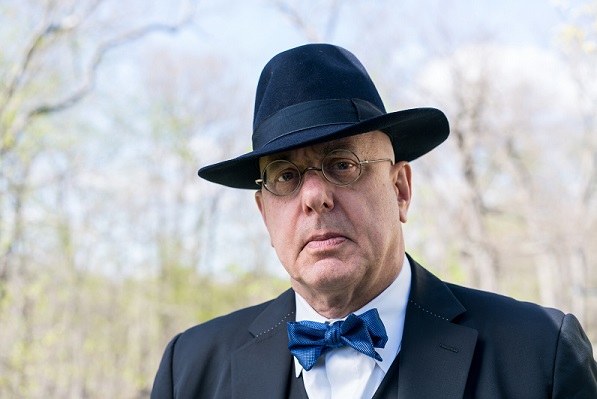
    Mann

    The evening began with Fantasy for Orchestra, a tone poem by the late violinist and educator Robert Mann (above).  Mann, who died last year at the ripe old age of 97, was a long-time staple of the New York classical music scene, in front of and behind the scenes, and was first violinist of the Juilliard String Quartet for over fifty years.  In addition to performance and education, Mann also dabbled in composition to pleasantly effective results.  His Fantasy for Orchestra was originally commissioned by the New York Philharmonic and first performed by that ensemble under the direction of Dimitri Mitropoulos at Carnegie Hall itself in 1957.

    The piece opened on the violas sustaining a single note.  Other members of the orchestra soon joined and a collage of atonal sonorities began to emerge.  This menace continued to build until a percussive roll launched the work into more energized and frenzied territory.  Mann’s Fantasy played almost programmatically, as if scoring the unseeing drama of some unsettling film or ballet.  A haunting violin solo emerged, performed by the concertmaster Cyrus Beroukhim, as harp ostinati and melancholic low brass chords created an almost dream-like atmosphere.  After a near-silent decrescendo, the drama then built up to a sequence of full-orchestra blasts that rang the piece to a volatile conclusion.  This was a decidedly above-average mid-century tone poem, played with force by the American Symphony Orchestra, and one that should warrant more-frequent airings.

    Vivian-Fine

    Next, receiving its long-overdue New York premiere, was Concertante for Piano and Orchestra by Vivian Fine (above).  Fine, who was one of a handful pioneering female composers in the early 20th century, is perhaps best known for her many chamber works, including the atonally adventurous Capriccio for Oboe and String Trio.  The Concertante for Piano and Orchestra, composed in 1944, was the first of her orchestral repertoire.

    After Mann’s Fantasy for Orchestra, Fine’s Concertante was almost strikingly tonal, as if ripped from the pages of some lost Romantic-era score composed sixty years prior.  Comprising two movements, it opened on a stately and delicate Andante con moto and closed on a convivial and spirited Allegro risoluto.
    Charliealbright

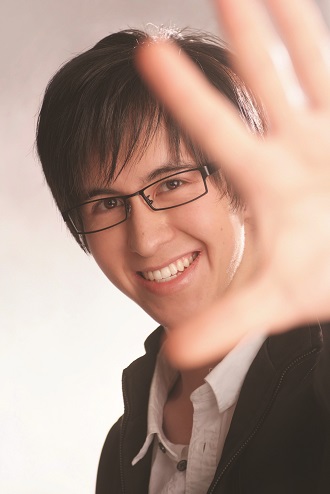
    Pianist Charlie Albright (above) made solid sport of the piece’s numerous solo passages and improvised an impressively intricate and lively cadenza that charged the work to its end.  His admirable commitment to the piece brought much life to what otherwise struck me as a very dainty and anachronistic work, one I don’t expect to hear programmed again anytime soon.

    A minor ovation brought Albright back to the piano bench for an encore of a work that, as a friend of his apparently put it, “takes balls to perform.”  He then ripped into a breezy rendition of 1957’s “Great Balls of Fire” that cheekily concluded the first half of the concert.

    J Druckman

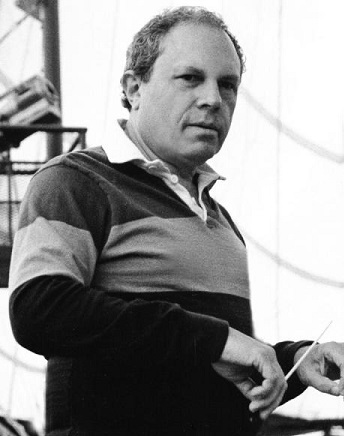
    After intermission came a performance of Prism, a three-movement orchestral set by written in 1980 the great and often unsung composer Jacob Druckman (above).  Inspired in part by Luciano Berio’s 1968 Sinfonia, Druckman crafted Prism by blending the musical styles of historic composers with his own decidedly modern voice.  Fittingly, each movement references the music of a Baroque or Classical-era composer for which it is titled.

    The first movement “After Marc-Antoine Charpentier” began on otherworldly textures consisting of percussion, woodwind clusters, pizzicato hits, and haunting tremolo in the strings.  Quotations of Charpentier soon emerged, complete with a synthesized harpsichord, but carrying with it the wild distortions and eerie timbres of the 20th century.  The second movement, “After Francesco Cavalli”, carried on in similar fashion, blending the sonorities of these disjointed eras.  A clarinet solo accompanied by atonal statements throughout the orchestra brought some much-appreciated color and allowed the piece to stand more fully on its own legs, rather than succumb to pastiche.  Violent punctuations opened the third movement, “After Luigi Cherubini,” which was occasionally discursive to a fault.  Nevertheless, this built to an impressively bombastic finale that rekindled any waning interest.

    Compositions that blend the styles of different musical eras like Prism or Berio’s Sinfonia (or Steven Stucky’s Dreamwaltzes or John C. Adams’s Absolute Jest, for that matter) tend to walk a fine line between tasteful reference and cheeky gimmickry.  While the merits of such genre-bending continue to be up for debate, I must confess enjoying Prism best when lived in its own era.

    P01l7krp

    The final piece of the evening was the Third Symphony by one of America’s greatest composers, William Schuman (above).  A contemporary of Robert Mann, Schuman was also a staple of New York’s classical music scene, albeit with a much wider influence.  Throughout the course of his life, he served as the president of the Juilliard School, president of Lincoln Center, and in 1943 became the first-ever recipient of the Pulitzer Prize for Music.  Among his impressive catalog of compositions are numerous ballets and concertante, two operas, dozens of chamber and orchestral works, and a whopping ten symphonies.  The Third Symphony, composed in 1941, is perhaps his most famous.

    Clocking in at about thirty minutes, the symphony is cast in two parts played with short pause—Part I comprising a Passacaglia and Fugue and Part II concluding on a Chorale and Toccata.  It begins on a slow and somber viola line that is gradually joined by the remainder of the strings and, finally, the rest of orchestra.  This tragic crescendo continues until a great fortissimo brass statement launches the work into new, dramatic frontiers.  Its form relaxed, but never rambling, the rest of the work is colored with mysterious string runs, noble brass statements, haunting solo passages, and occasionally violent musical statements.  Its final Toccata, opening on droning bass and military snare, eventually leads to vigorous string runs and bombastic low brass that slowly build it to a brilliant full-orchestral finale.

    Alternately lively and melancholic, stately and haunting, beautiful and ferocious, the symphony marks a high point of American orchestral writing.  It is one our nation’s finest symphonies and should be played as often as any of the best works of Aaron Copland or Leonard Bernstein.  Alas, it tends to languish, as do so many other great American orchestral works, on the dusty shelves of music libraries as the works of Beethoven, Brahms, and Mozart are performed ad infinitum.  It’s a scandal that American orchestras don’t find more time in their seasons to honor the music of their native soil, one that I’m happy to see Leon Botstein and company attempting to combat.

    While I wasn’t always thrilled with this interpretation of the piece, which occasionally leaned on the sluggish side, this still ultimately made for triumphant conclusion to a grand evening of American classical music at Carnegie Hall.  The mission of the American Symphony Orchestra, now in its 57th season, is one of the most admirable kind.  New Yorkers could do far worse than to hear this orchestra unearth great works of art from our nation’s past.

    ~ Brad S Ross

  • Oberlin College Choir and Orchestra @ Carnegie Hall

    Oberlin-in-nyc-v3

    ~ Author: Brad S Ross

    Saturday January 19th, 2019 – The Oberlin Conservatory of Music, visiting from Ohio, began 2019 on the proverbial high-note Saturday night at Carnegie Hall’s Isaac Stern Auditorium.  The talents of students and educators alike were well-showcased in a concert bifurcated between the Oberlin College Choir and the Oberlin Orchestra.  Following brief opening remarks by Oberlin College President Twillie Ambar, things were swiftly under way in what would turn out to be a tremendously satisfying program.

    Thumbnail_RS80080_LK2_9234 copy copy

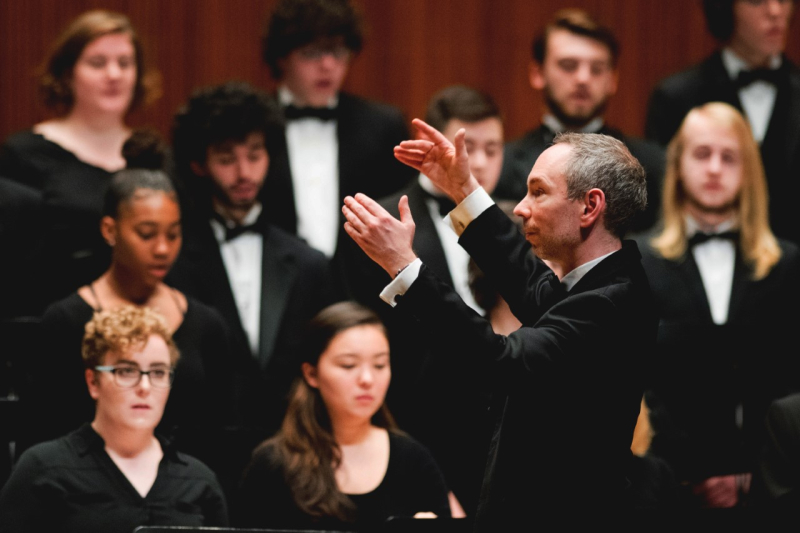
    For the first half of the concert, the Ronald O. Perelman Stage belonged to the Oberlin College Choir under the baton of Gregory Ristow (photo, above).  They began with Triptych, a mostly tonal choral composition written in 2005 by the British-American composer Tarik O’Regan.  Though originally cast for chorus and orchestra (and what a sight to behold that would’ve been!), it was presented here in a more manageable arrangement for percussion and chorus by the percussionist and composer Dave Alcorn.  It featured an eclectic text culled from such myriad sources as William Blake, John Milton, William Wordsworth, Muhammad Rajab al-Bayoumi, and the Book of Psalms, among others.

    The first movement, “Threnody,” opened on a gripping a cappella statement set to an epigram by William Penn, “When death takes off the mask, we will know one another.”  A driving percussion line soon entered and pushed the work forward as languid, otherworldly phrases meandered in call and answer throughout the chorus.  The effect was almost primal.

    Following a short percussion interlude, the second movement “As We Remember Them” opened on a haunting soprano solo set to the words of the rabbi Roland B. Gittelsohn, “In the rising of the sun and at its going down, we remember them.”  This was performed with remarkable precision by Risa Beddie, whose voice would be featured occasionally throughout the remainder of the piece.  This elegy seemed in many ways the heart and soul of O’Regan’s Triptych, however, as the combined, yet subdued forces of Beddie, chorus, and percussion achieved a hypnotic beauty.

    Another short interlude followed and the work was propelled energetically forward into the third and final movement, “From Heaven Distilled a Clemency.” O’Regan’s choral writing here was its most exuberant as the choir toned the words of the great Persian poet Rumi, “So why then should I be afraid?  I shall die once again to rise an angel blest.”  Beddie’s haunting soprano then returned for one last quiet utterance before the work rose to its climactic finale.  Every force was well-utilized in Triptych and it made for excellent way to put the evening into motion.

    Next up was Igor Stravinsky’s ballet Les noces (“The Wedding”) for four pianists, percussion, vocal soloists, and chorus from 1923.  Like O’Regan’s Triptych, Les noces was also originally conceived for a much larger ensemble, but Stravinsky himself made the decision to scale back its herculean forces to a mere four solo vocalists, chorus, percussion, and four pianos.  Indeed, even with this “reduced” compliment, the sight of so many musicians, instruments, and four Steinway pianos gave the stage impressively cluttered look.  Its libretto, penned by the composer himself from traditional Russian wedding songs, describes the marriage rite of a young bride and groom.

    Les noces begins frighteningly on a solo soprano line accompanied by piano, cymbals, and xylophone effecting somber bell tones.  Other unholy voices soon joined the proceedings as the mother and bridesmaids console the young bride-to-be.  While the libretto features a deceptively melodramatic narrative, musically Stravinsky seemed to be describing a wedding straight from the gates of hell.  There was no hint of saccharine or sentiment to be found amongst the composer’s numerous parallel lines, violent dynamic shifts, and strikingly dissonant harmonies—so much the better.

    Les noces followed the marriage of its protagonists right up to the wedding night and showcased exhilarating performances by the soprano Katherine Lerner Lee, mezzo-soprano Perri Di Christina, tenor Nicholas Music, baritone Kyle Miller, and bass Evan Tiapula as various members of the ceremony.  Its final eerie bell tone—open octaves throughout the instrumental accompaniments—reverberated for what seemed an eternity before Ristow finally lowered his baton.  This was an electrifying way to conclude the first half of the program.

    Thumbnail_RS16976_IMG_7691 copy copy

    After intermission came a high-point in what had already proved to be an exhilarating evening.  The conductor Raphael Jiménez (photo, above) and the Oberlin Orchestra next took the stage for the New York premiere of Elizabeth Ogonek’s All These Lighted Things—a set, as the work’s subtitle notes, of “three little dances for orchestra.”  It was originally commissioned and premiered by the Chicago Symphony Orchestra in 2017 while Ogonek served as the ensemble’s composer-in-residence.  Ogonek, who teaches composition at Oberlin, has quickly earned a reputation as one of the finest young composers in the United States.  Based on All These Lighted Things, I would be hard-pressed to disagree.

    The first movement began with quiet textures emanating from the percussion and high strings.  A broad sonic spectrum swiftly unfolded from Ogonek’s musical prism, with such varied colors as muted brass, dissonant woodwind runs, and violent strikes in the strings, among many other extended techniques I couldn’t quite decipher from a single hearing.  The etherial sound of a rainstick opened and continued to be featured throughout the second movement, soon joined by a full high-voice descending glissandi and a stirring violin solo by concertmaster Jerry Zheyang Xiong.

    Animated pizzicato runs in the bass and celli signaled the start of the third movement.  Aided with light percussion, swift woodwind runs allude to a growing musical menace.  A sumptuous flute line emerged with building woodwind accomplices.  Finally, a great, full-ensemble crescendo swelled to a tremendous crash and a few fleeting quiet percussion voices sang the piece to its silent conclusion.

    Like many contemporary pieces, All These Lighted Things seemed to be more about shifting sonic textures than any strict adherence to musical form.  This will no doubt exhaust some listeners who long for structure, but they should at least take comfort that none of Ogonek’s sonorities ever outstay their welcome, as modern compositions so often do.  I, for one, found it a lively and vibrant piece—one that will surely warrant many further hearings.

    The evening concluded with a performance of Claude Debussy’s La Mer.  Its performance was solid, if not quite on par with what New York audiences have been spoiled to expect of late (the New York Philharmonic programmed it twice last year alone, both times to tremendous effect).  Apart from the occasionally muddy entrance and one conspicuously fracked trumpet note, the Oberlin Orchestra played with delicate grace, offering a decidedly above-average rendition of Debussy’s great orchestral tome.  For his part, Jiménez’s interpretation was lingering and dynamic, never rushing its dramatic moments.  This worked well in its first and second movements where Debussy’s colors should be allowed to frolic and breathe freely.  By the third movement, however, this approach seemed a touch overwrought and unfortunately robbed some essential energy from the grand brass chords that announce the work’s finale.

    But I quibble.  A critic knows he’s heard something truly good when there are only minor details he would change.  All in all, this was a successful finale to an indisputably successful concert program—one that will surely signal a prosperous new year for the Oberlin Conservatory’s faculty and students.  If the sustained standing ovation that night was any indication, New York audiences will welcome them back as often as they’ll come.

    ~ Brad S Ross