Tag: Isadora Duncan Dance Company

  • Isadora: Lament, Hope, and Renewal

    Duncan_2

    Wednesday September 17th, 2014 – Lori Belilove and the Isadora Duncan Dance Company presented an evening of film, live performance and discussion in an intimate salon setting at the Company’s home space on West 26th Street. A few days after marking the anniversary of Isadora’s untimely death (on September 14th, 1927), Lori and her Company keep the spirit of ‘the mother of modern dance’ vividly alive.

    For me, this week brought the unusual happenstance of back-to-back evenings of Martha Graham and Isadora Duncan. These two pioneering forces on the frontiers of modern dance seem to me to be twin goddesses: from them, so many blessings flow – even onto the present day.

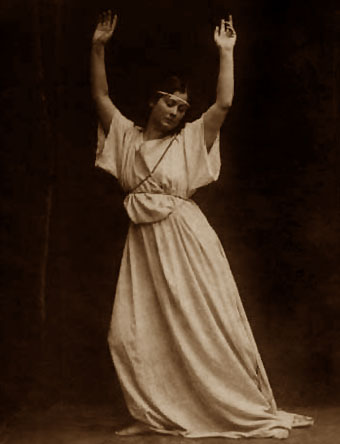
    Central to this Isadora evening was the showing of a silent film clip of brief fragments from Dance of the Priestesses, a ‘lost’ Duncan work. This film, made in 1963, features extremely rare footage of Anna Duncan, one of the original Isadorables. In the film,  Anna dances with Julia Levien and Hortense Kooluris, two women who were the teachers of Lori Belilove: thus the direct line of passing the torch from generation to generation is maintained. 

    The film was entrusted to Lori Belilove and it inspired her to embark on a restoration of Dance of the Priestesses which, until now, had been little more than a legend. The dance is set to music by Christoph Willibald von Gluck from his opera IPHIGENIE EN TAURIDE. In the film, Anna, Julia and Hortense show a wonderful weighted quality. Lori was able to impart this to the dancers of her current Company and, after viewing the film, we were treated to a beautiful live rendering of the piece. Lori has set it for five women (Isadora’s ensemble works can be danced by small or large contingents of dancers). The girls looked stately in their midnight-blue gowns, with Morgana Rose Mellett in a prominent role and Kim D’Agnese, Emily D’Angelo, Faith Kimberling, and Nicole Poulos as her sister/priestesses. Their performance evoked the ancient gods and the mythic rituals of times long vanished.
    686

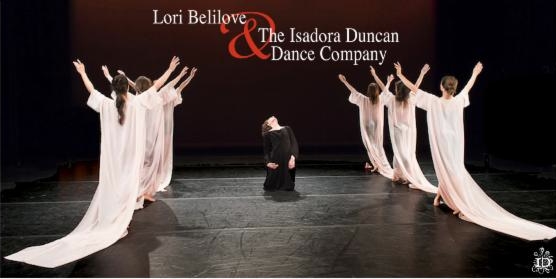
    Also on film, we saw a full performance of Slow March (photo above) as performed by the Company last May.

    Isadora created danceworks in several moods, stemming from her mental state at the time of creation. Joyous, celebratory dances gave way to dark, lamenting themes following the death of her two children. Lori Belilove performed two of these despairing solos tonight: Death and The Maiden (set to Chopin) and Mother (set to Scriabin). The mood was brightened by two Chopin mazurkas danced by Mlles. D’Agnese, Mellett, Kimberling and D’Angelo in signature pink-and-white Grecian tunics. Lori and the four girls joined in an extended finale: Dance of the Blessed Spirits and Orpheus’ Lament, both drawn from themes from Gluck’s opera ORFEO ED EURIDICE

    Pianist Melody Fader played all the selections for the evening, an enhancement to the atmosphere of the performance. 

    Watching the dances this evening, I couldn’t help but think that today’s young choreographers could benefit greatly in studying Isadora’s work. In terms of musicality, structure and creation of mood, Isadora’s instincts always seem spot-on. As dancer Miki Orihara wrote in her notes for her recent solo concert, we may look into the future of dance by investigating the past.
  • Finding Isadora’s ‘DANCE OF THE PRIESTESSES’

    L1460609

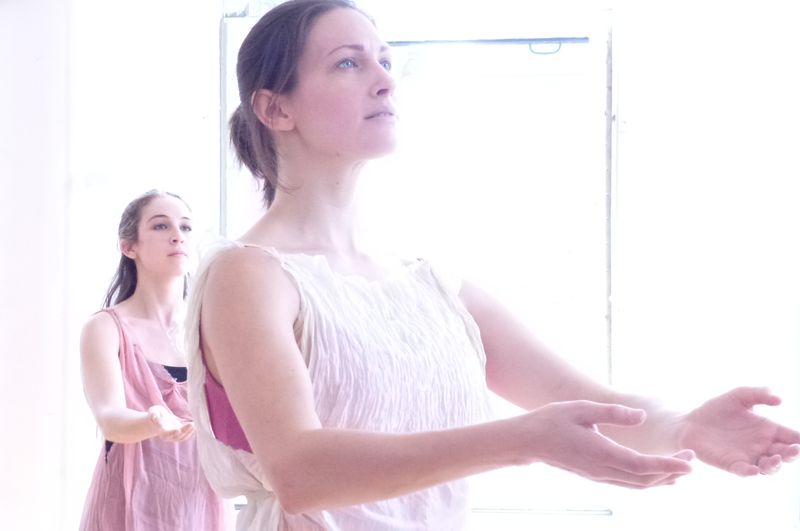
    Above: dancers Morgana Rose Mellett and Emily D’Angelo of the Isadora Duncan Dance Company

    Friday August 29th, 2014 – Today I went down to the Gibney Dance Center where friends of the Isadora Duncan Dance Company had been invited to an intimate studio session in anticipation of the upcoming renewal of a ‘lost’ Duncan work, DANCE OF THE PRIESTESSES.

    Lori Belilove, artistic director of the Company, welcomed us and then told the story of how DANCE OF THE PRIESTESSES has miraculously re-surfaced after several decades of being nothing more than a bit of legend.

    There had been talk of a film of the work having been made in 1963 and featuring one of the original Isadorables, Anna (Denzler) Duncan. Incredibly the film surfaced and was presented to Lori by some benevolent angel.  Lori set to work with her dancers to re-construct the piece, and we will be able to see it danced both on the film and live at a presentation at the Gibney Dance Center on September 17th, 2014, at 6:30 PM.  Further details of this event will be forthcoming.

    The dancework is drawn from the story of Iphigenia, daughter of Agamemnon, who was rescued from her fate as a human sacrifice by the goddess Artemis. Iphigenia becomes a priestess at the temple of Artemis in Tauris, a position in which she has the gruesome task of ritually sacrificing any foreigners who land on that kingdom’s shores.  Iphigenia is eventually confronted with the necessity of sacrificing her long-lost brother Orestes but that horrific duty is averted by the intercession of the goddess Athena.

    The story was immortalized in Christoph Willibald von Gluck’s gorgeous opera, IPHIGENIE EN TAURIDE. And it is to Gluck’s music that DANCE OF THE PRIESTESSES is performed.

    After providing us with this background, Lori asked each of us to cross our hands over our sternum and to breathe deeply; we can immediately sense our own center and the connectedness of the entire body. Her dancers then demonstrate some of the exercises with which they warm up: similar to a ballet barre, and yet the movement emanates from the torso rather than being guided by the limbs.

    The dancers looked so beautiful doing these deceptively ‘simple’ exercises which actually call for great concentration and control. The movement has a slow and ecstatic quality as the wheel-like flow of the arms, radiating from the sternum, reach down to the Earth and then soars skyward.

    Having shown us these stylistic elements, the dancers then performed a brief passage from DANCE OF THE PRIESTESSES. The ritualistic pouring of the libation oil and the stately pacing of the celebrants, arms opening in eloquent gestures of offering and supplication, create a timeless atmosphere of feminine power and beauty.

    The dancers – Kim D’Agnese, Faith Kimberling, Emily D’Angelo, and Morgana Rose Mellett – each have distinguishing physical characteristics which maintain their individuality even when dancing in unison. Watching them was a truly savorable experience.

    I’m hoping to see a rehearsal of the full work prior to the Gibney showing on September 17th.

    Watch a brief film clip of Anna Duncan performing at Jacob’s Pillow in 1942 here.