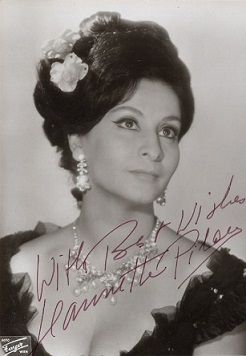
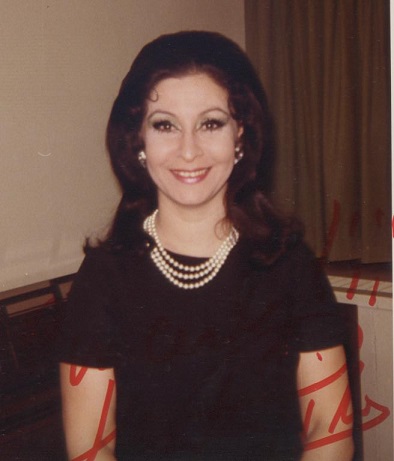
(I have imported this story from Oberon’s Grove…it used to include lots of photos, but I just wanted to save what I’d written back in 2007. Here is a photo I took of her that she loved…she was so sweet as signed it for me.)

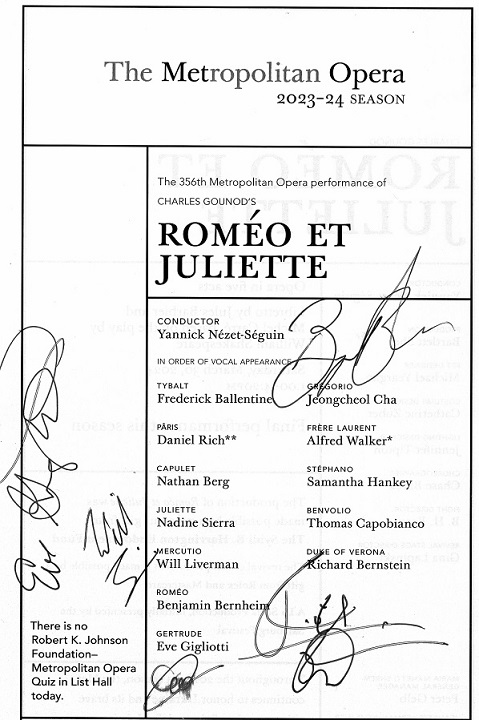
Around noon on October 7, 1967, I bought a big bunch of yellow chrysanthemums from a street vendor and rushed over to the stage door of the Metropolitan Opera House; the flowers were for one of my idols at the time, the Italian soprano Mirella Freni who was singing Juliette in Gounod’s ROMEO & JULIETTE that afternoon. I bounded up the steps to the Met’s stage door reception area and approached the desk. An indifferent woman was there, talking on the phone. When she finally hung up, she ignored me. “I want to leave these flowers for Miss Freni!” I said. She looked up at me wearily and said, “Miss Freni is ill and is not singing this afternoon.” Walking out, I held the door for a chorister who was coming in; “Want some flowers?” I said to her, handing her the mums. A few hours later I had fallen in love.
Gay men fall in love with women all the time; of course, it isn’t ‘that kind’ of love. It’s usually an attraction to their beauty and their talent, tinged with a bit of regret that it couldn’t ever be the ‘other kind’ of love. That is exactly how I always felt about Jeannette Pilou. She made her Met debut that afternoon as Juliette and for the next few years she was a singer who intrigued me so often with the delicacy and charm of her singing, her unfailingly fresh dramatic interpretations of some of opera’s most beloved characters, and her modest sincerity and great kindness. The stages at Lincoln Center have been home to so many beauties, from Carol Neblett to Helene Alexopoulos, and Pilou was one of the most memorable of them all.
Jeannette Pilou was born in Egypt and could trace her heritage to the Greeks, but for me she was always a French soprano. Her voice was lyrical with a metallic thread that gave it an easy projection. It was not in itself one of those beautiful instruments that immediately melt the listener; she never had a long breath line and her top register could get an edgy quality. Her appeal vocally was in the way she phrased and used a delicate pastel palette to make music you’d heard a hundred times seem new and alive. Aside from her incredible physical appeal, Pilou’s interpretations invariably brought those little gestures and expressions that you always remember. In the final act of TRAVIATA when the dying Violetta rises from her sickbed to be reunited with her beloved Alfredo, Pilou hastily looked at herself in the mirror before turning to present her ravaged face to her lover. I’ve never forgotten that moment of desperation which spoke so clearly of Violetta’s helpless regret over her fate.
But I’ve gotten ahead of myself, because I must start with that debut Juliette which is where my love affair began. Pilou looked so fetching on her first entry at the Capulet ball, spiraling into her little introductory “Ecoutez, ecoutez!” with a voice that wafted clearly into the big house. Not long after, she won her first big applause at the Met singing Juliette’s waltz, “Je veux vivre” with easy scale-work, pointed diction and youthful vivacity; she even touched on the high-D in the cadenza which Freni had been omitting. Moments later Pilou encountered her handsome Romeo, Franco Corelli, and the chemistry was apparent from the start. Corelli was having quite a success as Romeo at the Met with his passionate vocalism, thrilling the house with a stunning diminuendo on the final B-flat of “Ah, leve-toi soleil!”. He was one of the few tenors at that time who looked good in tights, too. In their love duets, Corelli really seemed smitten with Jeannette and they sounded wonderful together. Corelli drew a thunderous ovation when he took a full-throttle top C upon Romeo’s banishment from Verona. The afternoon ended with a mammoth ovation; the curtain calls had been designed so that the title characters always bowed together and they came out several times until finally Jeannette made the beautiful gesture of withdrawing to let Franco have a solo call. The house exploded and Franco was so gracious when he brought Jeannette out again. In addition to the lovely impression her Juliette had made, Jeannette had endeared herself to the legion of Corelli fans in no uncertain terms. I met her after the performance and she was so lively and sweet, and even more beautiful up close than she had seemed to be onstage. Her speaking voice was so intimate and enchanting; I immediately added her to the list of singers whose performances would be a priority.
Violetta in the Cecil Beaton production of TRAVIATA was my next Pilou role; she looked every bit as striking as Moffo in these costumes. She was paired with the light-voiced tenor Luigi Alva and they made a beautiful blend in the duets. Jeannette was so moving in the great Act II duet with Germont (Robert Merrill) where she struggled valiantly to maintain her composure as her fragile world crumbled around her. Phrase after phrase of wonderfully modulated vocalism wove a spell. A few years later, Pilou stepped in to a broadcast of TRAVIATA replacing Montserrat Caballe; I was in the house enjoying Jeanette’s portrayal and her colleagues Carlo Bergonzi & Sherrill Milnes so much. A downward transposition in “Sempre libera” caused something of a scandal among the fans; I thought it was a rather minor transgression in view of what she was able to convey in the role.
Micaela in CARMEN followed with Jeannette making a particularly lovely impression in the Act I duet with Nicolai Gedda. This was the infamous Jean-Louis Barrault production set inside the bullring. The cast, led by Grace Bumbry, almost managed to overcome the awkward staging; Jeannette’s big aria was lovingly phrased. Next came Zerlina in DON GIOVANNI in which she presented a very youthful, zesty portrayal of the peasant girl; singing opposite the Don of the young Puerto Rican heartthrob Justino Diaz, Jeannette reveled in the seductive expressiveness of “La ci darem la mano”.
Jeannette & Franco Corelli created an atmosphere of extraordinary romance when they appeared together in BOHEME. This was one of Jeannette’s most moving portrayals, using her mastery of parlando in the Act I narrative and spinning out some fragile piani in her ‘Addio senza rancor’. Franco was in prodigious voice, his singing so passionate and virile but also very tender; he was obviously smitten with his beautiful Mimi and changed the words in the love duet from “Dammi il braccio, mia piccina” to “Dammi il braccio, mia bambina.” In the moving trio where Rodolfo tells Marcello of Mimi’s hopeless ill-health, not knowing that Mimi is listening, Franco tore his heart out and the audience burst into a volley of bravos mid-act. Jeannette & Franco carried the romance of their characters into the curtain calls.
At the dress rehearsal of NOZZE DI FIGARO in February 1972, Jeannette had one of her most attractive roles in Susanna. She gave a portrayal free of soubrette cuteness, utterly natural. Vocally she was in the captivating company of Cesare Siepi, the reigning Figaro of the day, the radiant Pilar Lorengar (Contessa) and the beloved and versatile Evelyn Lear (Cherubino). On the podium the great Karl Bohm served up perfect tempi and ideally supported his singers. The ensembles and gentle comic by-play were a joy. FIGARO soared. The photo shows Jeannette with one of New York’s best-known opera fans, Lois Kirschenbaum.
It was amusing to walk Jeannette out from her dressing room after the rehearsal; when we came to the main reception area it was jammed with singers coming and going from coachings and I very much enjoyed observing the effect Jeannette had on all the men, including some very well-known tenors and baritones. If she was aware of the waves she was causing, it didn’t show; she greeted everyone with easy, modest charm and left them all panting in her wake.
Later in the month, Jeannette took part in a memorable evening when FALSTAFF was revived. Sir Geraint Evans and Regina Resnik trod the boards with grand portrayals of Sir John and Dame Quickly. Renata Tebaldi was singing Alice Ford for the first time at the Met. The orchestra launched the scampering introduction to the second scene and when the curtain rose and the audience caught sight of the great Italian diva, the place erupted. The applause obliterated the music and when it died down the singers had lost their way; “Start over!” someone yelled and that is exactly what Christoph von Dohnanyi (debut) did. Jeannette was a cuddly Nannetta. In a magical moment she arrived at Herne’s Oak dressed as the Queen of the Fairies on a white Shetland pony. Her aria, “Sul fin d’un soffio” was spun out of moonlight. At the end of the romping ensemble which concludes the opera, Jeannette tackled a bright top-C. The curtain calls were so much fun and the audience truly reluctant to let the singers go. I had an aisle seat in the orchestra and sitting two rows ahead of me was Franco Corelli. I thought it was pretty nice of him to come out and support his long-time colleague Tebaldi. After the performance I spent a long time backstage with Jeannette who was in a particularly sociable mood. Everyone else had gone home, but she seemed in no hurry to leave. I said goodnight and came out to find Corelli pacing back-and-forth near the stage door with a limo waiting. Did they have a date? If so, she may have been standing him up.
Jeannette and Nicolai Gedda were reunited in a wonderful performance of Gounod’s FAUST; the Met’s production was rather ugly (though later replaced by an even uglier one) but along with Cesare Siepi’s famed Mephistopheles, the singers carried the day. The role really suited Jeannette to perfection: her clarity of enunciation of the French text added to the sweetness and dexterity of her singing made the long ‘Roi du Thule’ and Jewel Song sequence delightful. Later she and Gedda harmonized rapturously in the ‘Laissez-moi’ duet (the highlight of the score, in my opinion) and Jeannette sang the concluding lines of the Garden Scene (‘Il m’aime!’) with slowly mounting ecstasy. As the tides turned against Marguerite, Jeannette relied on the metallic thread in her voice to project over the orchestra in the Church Scene and in the ascending phrases of the final trio.
It was a long time before I saw her onstage again; I spent some time in Houston and she was busy at other opera houses. In fact four years elapsed before I next saw her, again as Marguerite in FAUST, this time opposite the less-than-romantic looking but mellifluous Stuart Burrows in the title role. Jeannette’s interpretation had deepened although the production had deteriorated further with an especially awful ballet now being interpolated. She and Burrows rescued the evening.
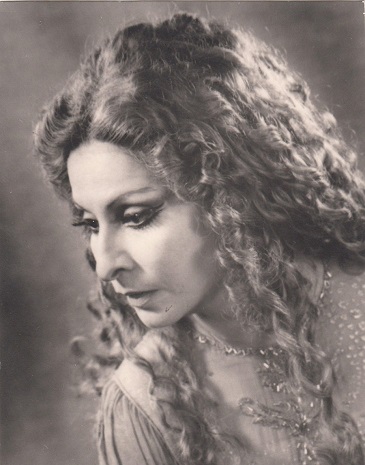
There was another very long hiatus before her next – and for me her most memorable – Met role as Melisande in Debussy’s masterpiece in 1983. The production was murky and grim (it has since been replaced by a far more atmospheric one) but musically it was so rewarding both in James Levine’s brooding traversal of the dense score and in the ideal interpretations of the three principal roles: Pilou as Melisande, Dale Duesing as Pelleas and the unforgettable Jose van Dam as Golaud. As the gentle and mysterious Melisande, Jeannette ‘spoke’ her lines with a refined sense of lyricism and she was so moving in her simplicity and deeply feminine vulnerability. The overwhelming sadness of watching Melisande’s life fade away following the birth of her daughter left me feeling bereft.
Two years later I saw Jeannette onstage for the last time, singing Nedda in PAGLIACCI. The tension in her upper register had taken its toll but she had some wonderful lyric passages, most notably in the duet with Silvio, and she mounted a fiery defense in the final moments before Nedda is brutally murdered.
I had long since stopped visiting singers backstage but I did run into her in the Met lobby during her final season of Neddas and Micaelas and she was as lovely and gracious as ever. In the years since I first met Jeannette Pilou, the memories of her portrayals and of her easy kindness to a young and eager fan have stayed with me vividly.
Here is Jeannette singing Juliette’s entrance and Waltz @ The Met.

 Oberon's Glade