Tag: Jennifer Taylor

  • Roomful of Teeth/Tambuco Percussion Ensemble

    CH11514760

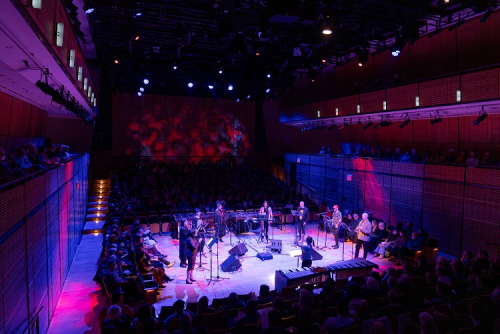
    Above: performance photo by Jennifer Taylor

    ~ Author: Lili Tobias

    Saturday January 25th, 2025 – Tonight, I had the joy of hearing Roomful of Teeth and Tambuco Percussion Ensemble perform at Carnegie Hall’s Zankel Hall. Between the two ensembles, I got to hear music by six different composers, from familiar favorites of mine like Caroline Shaw, to names that were completely new to me (but who I will certainly listen to again)

    Both Caroline Shaw’s and William Brittelle’s pieces were exceptionally chaotic—which is completely on brand for Roomful of Teeth! The eight singers performed a vast variety of vocal techniques and styles, including but not limited to guttural croaking sounds, throat singing, really really high notes, muttering repeated syllables, low glissandos, and speaking normally. Shaw’s piece, The Isle, in which she set text from Shakespeare’s The Tempest, also contrasted the chaos at times with more homophonous singing—hearty choral triads and flowing solo melodies—which provided a good balance so we could still hear the words.

    The text of Brittelle’s piece, Psychedelics, was very different. He explains in the program notes that the surreal collection of words in this music are “meant to form a swarm of images, not a literal, linear narrative.” And they certainly did just this! As I listened, I caught snippets of the words, such as “I watch for dogs,” and these fragments created a very joyful experience in their meaninglessness. Throughout this piece, I never knew what to expect in the best possible way!


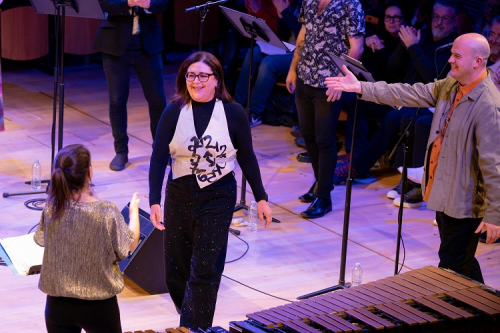
    The bridge between the vocal portion of the concert and the percussive potion was the composer Gabriela Ortiz. Ortiz is Carnegie Hall’s composer in residence this year, and both Roomful of Teeth and Tambuco Percussion Ensemble performed a piece of hers in this concert.


    In Canta la Piedra-Tetluikan (of which this would have been a world premiere performance if not for the group of elementary school kids who got to sit in on a rehearsal), Ortiz set the words of poet Mardonio Carballo. And these words were in Nahuatl! Nahuatl is a language (sometimes considered a group of languages) spoken in Central Mexico, and I was very excited to hear it in a musical context. Ortiz’s setting of Carballo’s poem was joyously animated. The mesmerizing repetitions—“atl, atl, atl” (water, water, water), “tlitl, tlitl, tlitl” (fire, fire, fire), and more—and energetic (and very difficult!) rhythms grounded the music in the natural world. 


    I had been especially looking forward to hearing the voiceless alveolar lateral affricate (tɬ), since that sound is common in many variants of Nahuatl (and doesn’t appear whatsoever in English), but if the singers were singing it, the distinctly fricative sound didn’t come across prominently. Perhaps they were singing in a variety of this language that doesn’t include this consonant though, and no matter what, it was very exciting to hear music in Nahuatl!
     

    CH11514773


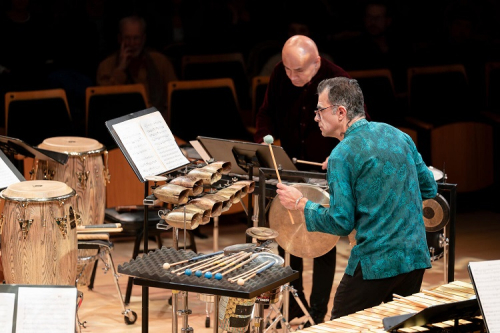
    Photo by Jennifer Taylor


    After intermission, Tambuco Percussion Ensemble performed the movement “Liquid City,” from Ortiz’s 2014 piece, Liquid Borders. The four members of the ensemble played facing each other in a circle (the perfect set-up for the central stage!) and the blooms of sound radiated outwards into the hall. The diverse timbres of the instruments certainly reflected the diverse borders of urban and rural Mexico which Ortiz aimed to reflect in this music, the sounds mixing and shifting into unique and beautiful shapes.


    CH11514777


    Photo by Jennifer Taylor


    The other three pieces on the program were very different in that they were far more homogenous in terms of the instrumental inventory: Jorge Camiruaga’s Cuarteto en chico for four drums, Leopoldo Novoa’s Sábe cómo e’? for four guacharacas (and briefly one marímbula), and Steve Reich’s Mallet Quartet for two vibraphones and two marimbas. While these pieces were certainly reigned in the chaos compared to the first half of the program, they also proved that you could still create a wide variety of sounds and musical textures even among more similar instruments. 
     

    CH11514766


    Above: Gabriela Ortiz, photo by Jennifer Taylor


    It was especially fun to see how many of the composers on the program were in the concert hall enjoying the music alongside me and the rest of the audience! I enjoyed this concert so much, and I have a feeling they did too.

    ~ Lili Tobias

  • Anne-Sophie Mutter ~ Beethoven Evening

    CH1766263_Medium_res_comp

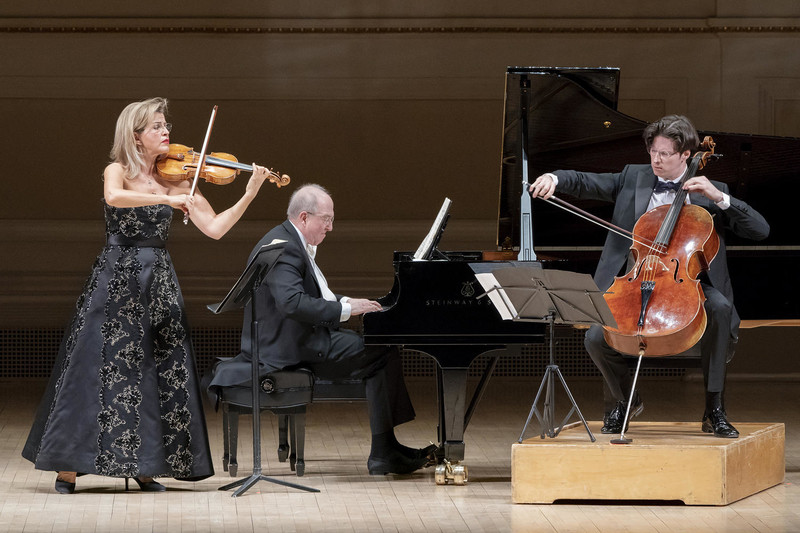
    Above: Anne-Sophie Mutter, photographed during the performance by © Jennifer Taylor.

    ~ Author: Oberon

    Thursday January 30th, 2020 – As the Beethoven Celebration year kicks off, only a handful of the announced “all-Beethoven” programs that are scheduled here in Gotham are of interest to me. But I would not have missed Anne-Sophie Mutter’s performance at Carnegie Hall tonight for anything. The esteemed violinist offered a pair of sonatas book-ending the “Ghost” trio. Ms. Mutter’s longtime collaborator, Lambert Orkis, was at the Steinway, and cellist Daniel Müller-Schott joined them for the trio.

    The comely violinist, now in the 40th year of her professional career, was warmly welcomed by a packed house as she walked onto the Carnegie Hall stage in a black gown bedecked with silver appliqué. She and Mr. Orkis immediately commenced the violin sonata No. 5 in F-Major, Op. 24, fondly known as “Spring”: the blithe opening passages were played softly, at once settling the audience and drawing them in.

    This opening Allegro continues thru a series of lyrical themes in which the two players alternate roles: melodist and accompanist. Minor key intrusions sometimes imply that clouds are passing overhead, but the sunshine always returns. A unison section shows the advantages of a longtime musical partnership: simply perfect.

    In the ensuing Adagio molto espressivo, Ms. Mutter and Mr. Orkis sustained a heavenly, pensive atmosphere with playing of exquisite delicacy and spun-out legato: they seemed to cast a spell over the venerable Hall. With a charming light touch, the Scherzo is over before it starts, and we are plunged into the Rondo – Allegro ma non troppo, in which almost Mozartean pleasantries are sometimes interrupted by jolts of fast and furious playing. But all’s well as ends well, and the Springtime sun illuminates the sonata’s optimistic ending.

    CH1766260_Medium_res_comp

    Above: Ms. Mutter and Mssrs. Orkis and Müller-Schott, photo © Jennifer Taylor.

    The Piano Trio in D Major, Op. 70, No. 1, “Ghost” brought cellist Daniel Müller-Schott to the stage, joining Ms. Mutter and Mr. Orkis. 

    The energetic start of this popular trio, in which the cello quickly establishes a prominent place, leads on to a flowing lyricism with deftly rolling piano motifs which Mr. Orkis delivered with gracious sweep.

    The eerie start of the Largo heralds the movement which gives this trio its sobriquet: “Ghost.” A mournful theme from Mr. Müller-Schott’s cello is soon mingling with Ms. Muller’s bittersweet violin colorations. Again Mr. Orkis’s mastery of the piano’s softest dynamics is mesmerizing. Passion waxes and wanes as the movement approaches its finish, and Mr. Orkis plays a long and spell-binding downward scale in which every note has a quiet luminescence.

    Melancholy is swiftly dispelled by the opening of the concluding Presto. Mr. Orkis interjects flourishes of filigree as the music wends its way forward with alternating currents of vitality and delicacy. There were fleeting moments in the Trio this evening that made me feel that intonation was slightly off, but only by a hair’s breadth.

    CH1766262_Medium_res_comp

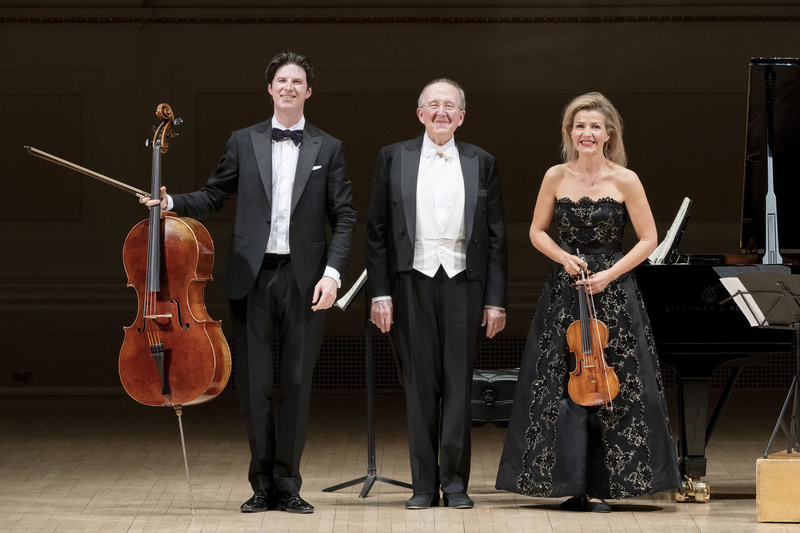
    Above: taking a bow after the “Ghost” trio, photo © Jennifer Taylor.

    During the interval, DK and I were anticipating our second “live” encounter with the Kreutzer sonata, Beethoven’s Op. 47, in the span of a month’s time. This epic work, which places so many demands on the two musicians, found the Mutter/Orkis partnership at its inimitable best.

    An intrusion at the very start almost destroyed the performance: just as the first notes were sounding, a very loud cellphone with a chiming ring tone-blared from one of the boxes. The culprit hastily fled, and for a moment I thought the musicians might pause and start over. But they moved on, leaving me to re-connect with the music as best I could. The playing was simply magnificent, with both players reveling in the bravura demands of the first movement’s Presto section. Together they brought a great sense of structure and musical coherence to the entire work.

    The “theme” of the ensuing Andante is a descending phrase which Arrigo Boito may have subconsciously lifted for the aria “Dai campi, dai prati” in his opera MEFISTOFELE. A ‘theme and variations’ setting develops, in which Ms. Mutter’s high-flying coloratura and enchanting trills ravished the ear. 

    The sonata’s Finale is exhilarating, with the irresistible impetus of a tarantella. A feeling of joy seemed to fill the house as the music sped on its way, Ms. Mutter and Mr. Orkis musically to urginge us to cast off our woes and – at least for the moment – savour the genius of Beethoven as played by two incredible artists.

    A massively enthusiastic full-house standing ovation commenced the moment the music ended. Ms. Mutter announced an encore: Beethoven’s Allegro in G-major, for mechanical clock, as arranged by Willy Hess. This little gem was delivered with tongue-in-cheek charm.

    Re-called by further waves of applause and cheers, Ms. Mutter charmingly introduced her second encore: an arrangement of ‘Nice To Be Around’ from the film Cinderella Liberty, part of her recent collaboration with composer John Williams. This beautiful tune was beautifully shaped by violinist and pianist.

    CH1766261_Medium_res_comp

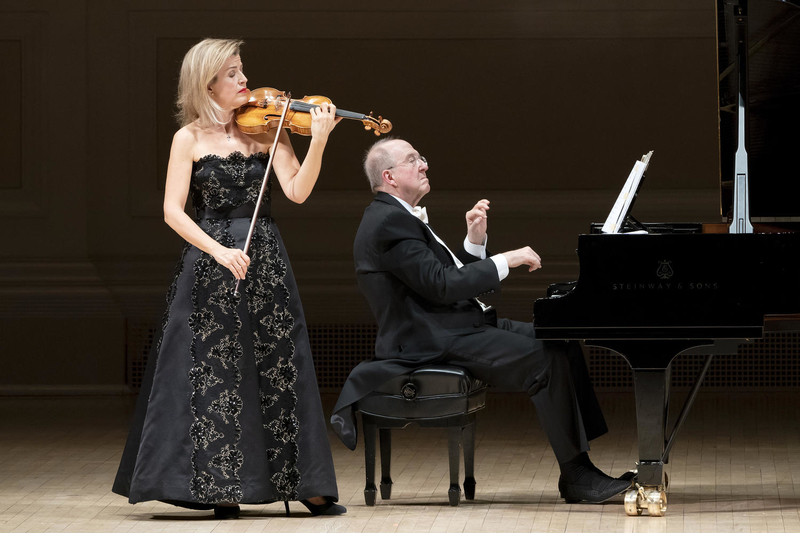
    Above: Ms. Mutter and Mr. Orkis, photo © Jennifer Taylor.

    All performance photos are © Jennifer Taylor, courtesy of Carnegie Hall.

    ~ Oberon

  • The Illuminated Heart @ Mostly Mozart

    1980x1012_MMFO-11802_copyright Jennifer Taylor

    Above: Maestro Louis Langrée, surrounded by members of the Mostly Mozart Festival Orchestra; photo © Jennifer Taylor

    Tuesday July 26th, 2016 – Opera director and video artist Netia Jones has created The Illuminated Heart, a program of arias and ensembles from Mozart’s operas performed live in a multi-media installation with video projections: this was the opening offering of the 2016 Mostly Mozart Festival. The Festival’s well-loved music director, Louis Langrée, presided over the 90-minute evening (presented without intermission) marking the 50th anniversary of Mostly Mozart.

    The Mostly Mozart musicians were in the pit and the Geffen Hall stage was taken up by a large, white, simple room. Imaginative projections – including fanciful flights of birds during Papageno’s aria – filled the space, and English translations of the pieces being sung moved unobtrusively across the rear wall. As Maestro Langrée led a lively NOZZE DI FIGARO overture, “Susanna” appeared, removing dust-covers from stage furnishings and polishing up. Fortuntely, no attempt was made to turn the random operatic selections into a narrative, as the Met did so tediously with THE ENCHANTED ISLAND. Each solo, duet, or ensemble was done as a free-standing set piece, the singers costumed in a ‘timeless’ style.

    Following the overture, things got off to a rather raw start: the voices seemed very harsh (I almost thought they were being miked) and there was a feeling of relentlessness to the singing, with little elegance or refinement to be heard. Nadine Sierra, singing Susanna to Peter Mattei’s Almaviva in the Act I NOZZE duet, wore a dress that made her look pregnant. Christopher Maltman, in Papageno’s Act I aria, seemed to be auditioning for Wotan: more than ample sound, to be sure, but lacking in charm. The Act I finale of COSI FAN TUTTE doesn’t play well out of context. 

    Ms. Sierra sang the ‘rarest’ work of the evening: “Ruhe sanft, mein holdes Leben” from ZAIDE. She has the right feeling for the music, and did some attractive soft singing, but to me she often seems to hover just a bit sharp of the pitch.

    Ana Maria Martinez’s performance of “Mi tradi” from DON GIOVANNI signaled the start of a progression of four arias that formed the vocal centerpiece of the evening. Ms. Martinez’s voice has a nice weight for this music, and she was able to carry off the more florid passages with assurance whilst bringing dramatic urgency to her singing.

    Une-pleiade-de-concerts-gratuits-pour-tous_282178_510x255

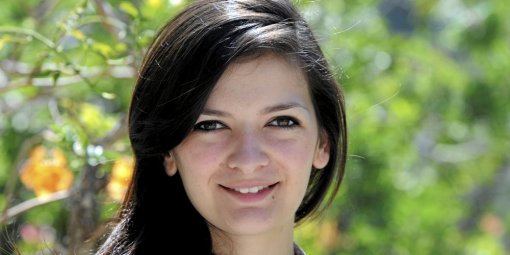
    New to me was the distinctive voice of Marianne Crebassa (above); this comely French-born mezzo-soprano gave a performance of “Parto, parto” from LA CLEMENZA DI TITO that could stand comfortably beside such wonderful versions of this aria as those of Teresa Berganza, Tatiana Troyanos, Anne Sofie von Otter, and Elina Garanca. Ms. Crebassa’s timbre is unique, with a nice duskiness in the lower range, and she sailed thru the coloratura passages with deft surety. Matching the mezzo in expression and poised musical embroidery was the excellent clarinetist Jon Manasse.

    2a4fcf0f033be538df20736eca38e9c6

    Simply superb: Peter Mattei (above) sang Count Almaviva’s “Hai gia vinto la causa…” from NOZZE with plush, commanding sound and vivid dramatic inflections, handling the speedy passage-work as the aria rushes to its close with aplomb. A masterful performance!

    MatthewPolenzani

    Matthew Polenzani (above) gave the evening’s most moving singing with his heartfelt “Dalla sua pace” from DON GIOVANNI. Kneeling at the back of the performing space, Polenzani sang with great tenderness and refinement; his touching command of piano nuances, and his wonderfully sincere rendering of the words made for a spell-binding performance. His Idomeneo at The Met cannot get here soon enough. Bravo, bravo, bravo…

    Ms. Martinez and mezzo-soprano Daniela Mack sounded fine in the COSI trio, “Soave sia il vento”, but it was Mr. Mattei’s singing as Don Alfonso that dominated: so rich, firm, and lovingly phrased. An ensemble from CLEMENZA – nicely sung by Christine Goerke, Mlles. Sierra and Crebassa, and Mr. Polenzani – seemed a bit aimless out of context. Moving immediately into Elettra’s aria might have made things seem more cohesive, but instead Ms. Goerke remained onstage, pondering, whilst Mr. Maltman popped out – wine bottle in hand – to sing Don Giovanni’s vigorous “Finch’an del vino”. 

    Ms. Goerke then came forward for Elettra’s “O smania, O furie!” Her vivid declamation was spot on, and   she brilliantly conveyed the character’s dementia in “‘Oreste, D’Ajace”. But the voice tightens as she goes higher up, and so the effect of this mad scene’s climax was somewhat compromised.

    Everyone joined in for the NOZZE DI FIGARO finale,including soprano Kiera Duffy, who had had no real opportunity to shine vocally in the course of the evening.

    Overall, The Illuminated Heart worked quite well. I would have chosen some slightly different pieces, and maybe slightly different singers, and would have included a basso to sing one of Sarastro’s arias. The 90-minute time-span, without intermission, was ideal. Mr. Maestro Langrée’s propulsive pacing and the swift staging transformations from one number to the next made the concert fly by.