Tag: Jerome Robbins

  • Joshua Bell & The NY Philharmonic

    Joshua-bell_s345x230

    Thursday November 13, 2014 – Violinist Joshua Bell (above) plays the Glazunov violin concerto in a series of five concerts with The New York Philharmonic. Case Scaglione takes the podium for these performances, which also features Debussy’s Afternnoon of a Faun and Prokofiev’s symphony #5.

    My friend Monica and I attended the second evening of the programme; since we are both passionate ballet enthusiasts, we very much enjoyed experiencing the Debussy in a concert setting; we have often seen the Jerome Robbins setting of the work at New York City Ballet, and recently Boston Ballet brought their ‘original’ version to Lincoln Center.

    One of the composer’s most famous works, Claude Debussy’s Prélude à l’après-midi d’un faune referred to in this evening’s Playbill by its English title – premiered in 1894. The work is considered a turning point in the history of music: Pierre Boulez once said he considers the score to be ‘the beginning of modern music’. Tonight the Philharmonic gave a beautifully shaped rendering of this sensuous piece, which commences with the languid flute theme. Individual voices emerged dreamily from the overall soundscape and Debussy’s alluring colour scheme was indeed seductive. Neither Monica nor I could recall having previously heard the gentle chime of a triangle near the end of the piece; it seemed very prominent tonight. Case Scaglione rightly summoned the Philharmonic’s principal flautist, Robert Langevin, for a solo bow during the warm applause that greeted this opening work.

    Composer Alexander Glazunov (1865-1936) managed to endure ten years in Russia following the Bolshevik Revolution; he fled to Paris in 1928. His compositions from that point on are considered less impressive than his earlier works which include the richly melodic score for the ballet RAYMONDA, a suite from which was recently featured in ABT’s Autumn season at Lincoln Center.

    The violin concerto, Glazunov’s most frequently-performed work, was composed it in 1904. It is dedicated to, and was premiered by, the great Hungarian violinist Leopold Auer, the teacher of Heifetz, Milstein, and Elman, among others. Glazunov casts this concerto in an unbroken arc, with the three vari-paced movements subtly linked. A virtuosic cadenza carries us to the exuberant finale in which the soloist dazzles against a tapestry of orchestrated fireworks.

    Joshua Bell, taller than I had imagined and retaining a youthful energy of demeanor in his mid-40s, displayed the warmth of tone and the clear shimmer of upper-range diminuendo that are hallmarks of his playing. I was a bit surprised to note that he was using a score, but he handled it with casual assurance. Creating a fine rapport with conductor and musicians, Joshua drew the succession of themes in the opening movement into long, impeccably turned phrases; in the almost frantic pacing of the final allegro, he seized upon the sparkling coloratura passagework with thrilling dexterity. The crowd called him out for a well-deserved solo bow.

    After the interval, the Prokofiev: he wrote his fifth symphony during the summer of 1944, while staying at a dacha in the countryside outside Moscow. Having stored up his musical ideas over time, he wrote with speed and surety. The symphony was first performed in Moscow in January 1945 with the composer conducting.

    The first movement is dense of texture and thick with themes: there are five distinct tunes to be discerned, and the composer integrates them with skill. The movement closes on a grandiose note; I must say I wasn’t totally enamoured of this opening andante; it seemed a bit turgid and over-extended. But thereafter, the Prokofiev I have come to love was very much in evidence. The second movement in particular is a great delight with its relentless forward motion decorated by interjections of wit and melodic irony. The tempo gradually accelerates, almost to the point of veering out of control.

    The adagio conjures up the blend of unhappy romance and wistful tenderness we associate with the composer’s ROMEO AND JULIET, with a turbulent central passage. Then on to the final Allegro giocoso, where we again find Prokofiev at his most inventive, opening with an echo of the first theme of the first movement, and then a passage for the clarinet – Prokofiev at his most magical – superbly voiced by principal Anthony McGill. The symphony plunges forward to its conclusion, re-affirming the composer’s fixed positon in my constellation of favorite composers.

  • All-Robbins @ New York City Ballet

    Wendy-Henry-Leutwyler-©-2010

    Above: Wendy Whelan, photo by Henry Leutwyler

    Saturday May 17th, 2014 (evening) – My first opportunity to see Wendy Whelan dancing since her return to the stage following surgery. She danced tonight in Jerome Robbins’ GLASS PIECES. I can’t begin to tell you how much I’ve missed her; at least I had the pleasure of running into her a few times in the interim.

    From the moment she appeared tonight, seemingly floating into view in Adrian Danchig-Waring’s big, beautiful hands, everything suddenly seemed right with the world again: the rift in the time-space continuum was sewn up, clocks started ticking again, the lights came back on. This is what’s been missing these past few months, why everything has seemed ever-so-slightly awry. Wendy’s been such a symbol for me of my whole New York Experience, of my dream that came true; seeing her dancing again was like an affirmation of faith.

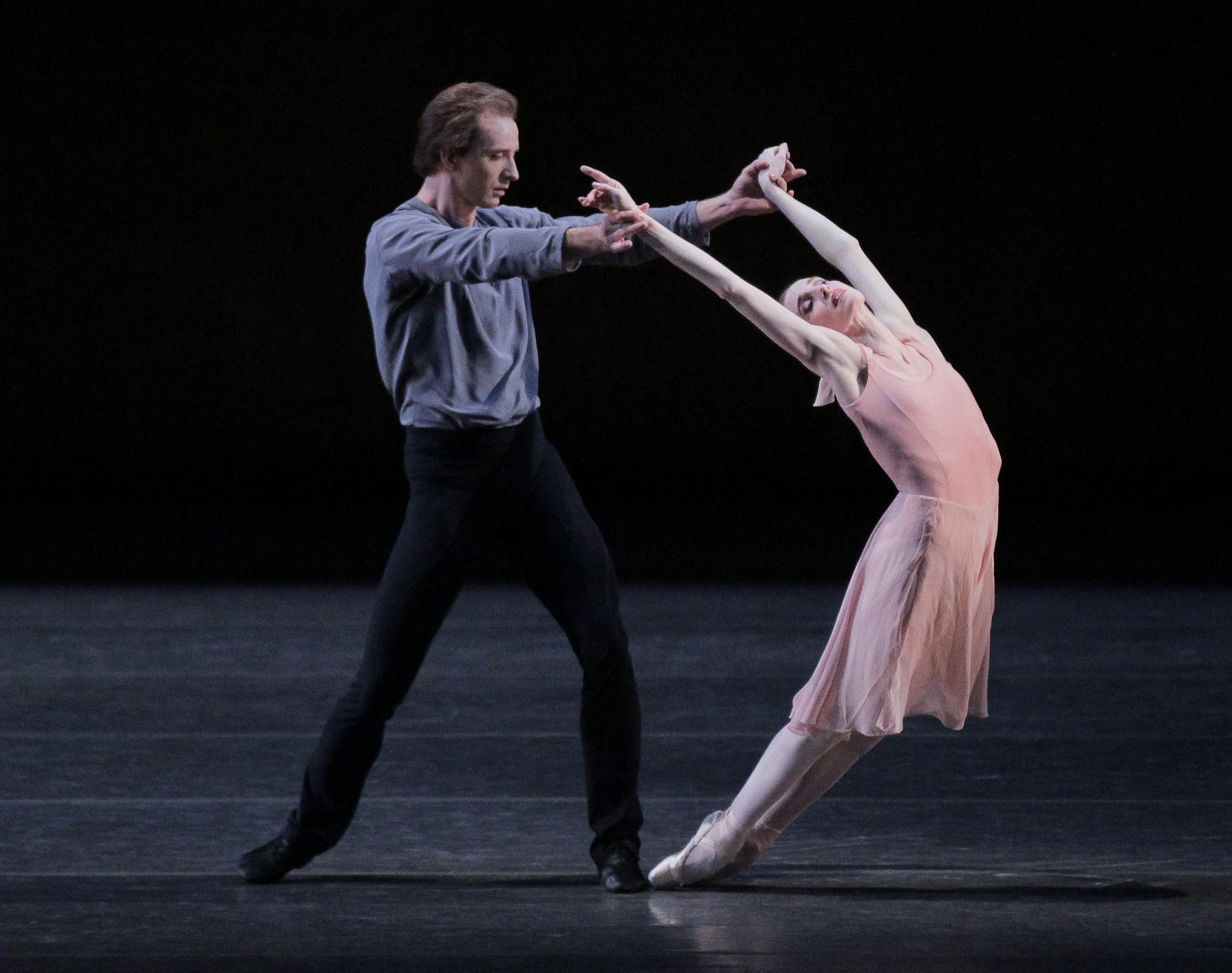
    She and Adrian cast a spell over the crowd in their mesmerizing, other-worldly duet. With their stylized gestures, they speak to us over the trance-like repetitive musical motif. We are drawn into their parallel universe, and it’s breath-taking to behold. Beautiful creatures. 

    If their pas de deux could have gone on and on I would have been content, but as Wendy is gently borne away the jungle drums begin to beat. And who is this tall, handsome demi-god who comes wheeling into view? It’s Russell Janzen, and he’s coming into his own at NYC Ballet now: Barber Violin Concerto this past February, and now he’s been cast in the lead role of Davidsbundlertanze, which I hope to see in the coming week. He looked fantastic tonight, leading off the third movement of the Glass. 

    Earlier, in the ballet’s opening segment, the three ‘angels-among-us’ couples were Ashley Laracey with Daniel Applebaum, Meagan Mann with Joseph Gordon, and Emilie Gerrity with Andrew Scordato. They all look wonderful, and Mr. Gordon is stepping up nicely in each assignment.

    Clothilde Otranto was on the podium tonight, and for the Prokofiev score of OPUS 19/THE DREAMER, she had City Ballet’s excellent concert-master Kurt Nikkanen spinning out the music, by turns tranquil and restless. Speaking of gods, Gonzalo Garcia certainly looked divine and his dancing was powerfully expressive. Sterling Hyltin has just debuted in this ballet and she makes a vibrant impression; the ballerina here is not always dreamy – she has some jagged, almost harsh moments mixed in – and Sterling handled these transitions with compelling musicality.  She and Gonzalo looked superb throughout; the ballet ends in its iconic pose with the dancers resting their heads gently in one another’s open palms. Quiet murmurs from the crowd as the music faded indicated that OPUS 19 had again bewitched us.

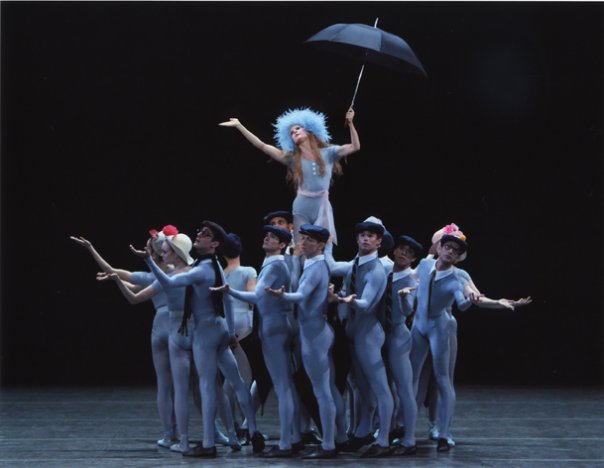
    Several newcomers to the cast of THE CONCERT were enough to keep me in the theatre for this ballet, one that I often skip out on. Good thing I stayed, because it was a genuinely great performance. Pianist Elaine Chelton not only played the Chopin selections very well indeed, but entered into the drama with gusto. Sterling Hyltin was back in a role as different from OPUS 19 as one could imagine; she is as fine a comic muse as she is a lyrical one. Joaquin de Luz was perfect as the hen-pecked husband who finally rebels, and Lydia Wellington debuted in the role of the wife – which has been so memorably undertaken by Delia Peters and Gwyneth Muller – and made it her own: Lydia’s timing was spot on, and her facial expressions were a characterful delight. I hardly recognized Troy Schumacher, even though I had bumped into him before the show: he had transformed himself into a total nerd. Marika Anderson’s be-spectacled ballerina was another gem; she is so versatile, and – joined by five other off-beat sylphs – drew a prolonged round of applause and laughs as they presented an epically un-coordinated pas de six.

    GLASS PIECES: Laracey, *Mann, *Gerrity, Whelan, Applebaum, *Gordon, Scordato, Danchig-Waring

    OPUS 19/THE DREAMER: Hyltin, Garcia [Solo Violinist: Nikkanen]

    THE CONCERT: Hyltin, *Scordato, *Adams, *Segin, Anderson, De Luz, *Wellington, Schumacher, Peiffer, Nelson

  • Violin Concertos @ NYC Ballet

    318356_2232197878477_977158597_n

    Above: Russell Janzen of New York City Ballet

    Wednesday February 19th, 2014 – Ballets by Jerome Robbins, Peter Martins, and George Balanchine – each set to a great 20th century violin concerto – were on the bill at New York City Ballet this evening. To an already-great line-up of dancers there was a late addition: Russell Janzen made his debut in BARBER VIOLIN CONCERTO; Tiler Peck and Amar Ramasar were also making role debuts tonight.

    Three conductors passed the baton one to another as the evening progressed; the Company’s two concertmasters – Kurt Nikkanen and Arturo Delmoni – shared the soloist spotlight, Kurt playing the Prokofiev and Arturo playing Barber and Stravinsky. It was a programme during which really missed my beautiful seat in Fourth Ring AA where I used to watch the orchestra from on high.

    The evening opened on a high note: the curtain rose on Robert Fairchild, all in white, as the restless dreamer of Jerome Robbins’ OPUS 19/THE DREAMER – my favorite Robbins ballet. Robert danced the ballet’s opening solo with deep musicality and supple fluidity of movement. Out of the blue, his muse materializes: Tiler Peck, in this role for the first time, found a perfect balance between the classical vocabulary and the sometimes jagged expressionism the ballet requires. In the more lyrical passages, her lush pirouettes had remarkable clarity; to a role that has been gorgeously danced in recent seasons by Wendy Whelan, Jenifer Ringer, and Janie Taylor, Tiler brought her own distinctive touches. Robbins gives the corps some dreamy moves – and also some athletic ones – in OPUS 19; I very much enjoyed tonight’s collective which was made up of some of my favorite dancers.

    It took me a few hearings to figure out exactly what it is about the opening measures of the Barber violin concerto that sings to me so clearly: it’s the use of the piano, especially the opening chord. It gave me a little frisson again tonight; while I love so many violin concertos I think sometimes the Barber is my actual favorite. I remember one summer driving very fast out Route 6 with Kenny to the end of the world – Provincetown – with the Barber blasting on the car stereo. Music and memory are so often indelibly linked.

    In tonight’s performance of the Barber, Teresa Reichlen and Russell Janzen looked great together – not just because they are long-limbed and attractive, but because they share a sense of elegance that manifests itself in their bearing and the grace of their line. A chill passed thru me as Amar Ramasar entered, a fallen angel with a dangerous ‘loner’ appeal who will eventually draw Tess to the dark side. Megan Fairchild excels in the barefooted role created by Kate Johnson: it’s a far cry from the charming, pristine pointe-work that is Megan’s specialty, but she jumps right in and makes it happen.

    After their classical parterning passages in the first movement, Tess and Russell will each experience a transformation. At first seeming to console Amar, Tess falls under his spell and is borne away to an unknown fate; their duet is a psychological conflict which reaches its turning point when the subjugated woman lets her hair down. Amar’s character is not so much seductive as simply a force that cannot be withstood; Tess in her vulnerability looks ravshingly ravished. Random thought: I’d love to see Amar in the Martha Graham rep.

    In the final allegro, Russell strives to withstand the endless torment of Megan’s advances: she’s playing one of the most annoying characters in all dance. She ends up writhing on the floor as Russell backs away, covering his eyes to blot out the vision of her over-sexed frenzy. In a final attempt to get what she wants, Megan literally climbs up Russell’s back to perch on shoulder; in a last defense, he flips her over and sends her crashing to the floor. The two dancers handled this tricky finale with aplomb and in fact danced the whole third movement to perfection.

    6a00d8341c4e3853ef014e887730ac970d-800wi

    Above: Janie Taylor, in a Henry Leutwyler portrait

    Tonight’s Stravinsky had a special energy; it was in fact one of the finest performances of this ballet I’ve seen. Part of the singular excitement in the atmosphere tonight may have stemmed from the presence of Janie Taylor, the Company’s enigmatic/charismatic principal ballerina who is soon to retire. I’ve been crazy about Janie since she first stepped out, a mere slip of a girl just over from SAB, to dance the lead in LA VALSE. After building a reputation as a dancer at once fragile and fearless, a long hiatus due to a complicated injury took her away from the stage for months…years, even. Her ‘second career’ has been a real source of joy for me and so tonight it was bittersweet to think that in a few days she will be vanishing from this stage, leaving only perfumed memories. But what memories they are!

    Tonight’s performance showed off of Janie’s balletic split personality: a palpable vulnerability alinged to a steely technical resiliance: she’s simply extraordinary…and irreplacable. Ask LaCour’s partnering of this blonde enigma developed a wonderful simpatico, a sense of tenderness in what is after all an abstract and ’emotionless’ ballet. In that marvelous moment where the ballerina stands against her partner as he shows her a view of the world with a sweeping gesture of the arm, I thought I’d never seen anything so beautiful.

    Janie and Ask seemed poised to walk off with the gold tonight, but the other Stravinsky couple – Rebecca Krohn and Adrian Danchig-Waring – were so potent technically and so vivid in their presentation that the entire ballet took on a grand dynamic, abetted by the excellent corps (the quartet of leaping boys won a ‘bravo’ all their own). Rebecca Krohn has really done wonders in the leotard ballets; she looks phenomenally confident and polished, and for me she’s the equal of any ballerina I’ve seen in this rep, going way back to Suzanne and Karin. Her generous dancing found a fine match in Adrian Danchig-Waring’s vibrant physicality; together these two dancers crafted amazing shapes as they moved thru the ballet’s demanding partnering motifs, ending their pas de deux with Adrian in a finely-timed fall to the floor and Rebecca in a sweeping back-bend.

    Extra delight: Faye Arthurs in a brief partnered segment with Adrian; she danced in both the Prokofiev and the Stravinsky tonight. So nice to run into Erica Pereira and Caitlin Dieck…and Tess, after the show.

    OPUS 19/THE DREAMER: *T. Peck, R. Fairchild [Conductor: Sill, Solo Violin: Nikkanen]

    BARBER VIOLIN CONCERTO: Reichlen, *Ramasar, M. Fairchild, *Janzen [Conductor: Otranto, Solo Violin: Delmoni]

    STRAVINSKY VIOLIN CONCERTO: Taylor, la Cour, Krohn, Danchig-Waring [Conductor: Capps, Solo Violin: Delmoni]

  • Three Robbins Ballets @ NYCB

    C33283-11_InMemory_WhelJAngCour

    Tuesday January 24, 2012 – Three works by Jerome Robbins, each featuring an ideal ballerina in its central role, were performed tonight at New York City Ballet. The music? Ravel, Berg, Chopin. What a great way to spend a cold Winter’s evening! In the Paul Kolnik photo at the top, Wendy Whelan borne aloft by Jared Angle and Ask LaCour at the end of IN MEMORY OF…

    Robbins600

    The evening opened on a beach where the dancers, in pastel 1920s beachwear, cavorted to the Ravel piano concerto IN G MAJOR. Maria Kowroski (above in a Paul Kolnik) gave a radiant performance and Tyler Angle was a frisky young god in his solo. In the ballet’s central adagio, the two dancers found a fine rapport and a sense of freshness that kept the audience spellbound as they shaped their long limbs into a series of beautiful snapshots. The final lift, as Maria’s leg sweeps heavenward and her pointed foot seems to brush the sky, was thrilling. Excellent corps dancing: a neat moment when Maria is partnered by the tall and slender Austin Laurent made me wish that principals and corpsmen could dance together more extensively. IN G MAJOR has a striking backdrop by Erté, a designer perhaps forgotten nowadays but whose work resonates with Art Deco elegance. His set features a fanciful sunburst and dark outlines suggesting clouds and waves: a remarkably classy beachscape.

    With George Manahan (of New York City Opera) as a guest conductor bringing out some lovely nuances in the score and pianist Susan Walters giving a polished performance at the keyboard, the musicians and dancers conspired to make this a wonderfully gratifying performance in every regard.

    Mr. Manahan also took up the baton for IN MEMORY OF…, the poignantly dramatic work that Robbins set to the violin concerto of Alban Berg. The composer crafted this, his only concerto for solo instrument, in reaction to the death from polio of Manon Gropius (daughter of Alma Mahler and Walter Gropius) at the age of 22. Berg was deeply shaken by the girl’s demise and wrote “To the Memory of an Angel” on the score’s title-page. Tonight the City Ballet‘s concertmaster Kurt Nikkanen gave the work a lustrous performance.

    Robbins sets the ballet in a three-part narrative where we first see the young woman dancing with her beau, later joined by friends. Signs of the girl’s illness begin to manifest and as the corps stride in unison across the stage, the figure of Death appears.

    C33281-14_InMemory_WhelCour

    In a long and intense pas de deux, Death stalks the girl (Ask LaCour and Wendy Whelan, above). She puts up a mighty struggle but in the end she is bested by his implacable strength. Her crumpled body is borne away as the stage fills with the corps, now white-clad angels, who eventually welcome the young woman to the celestial realm.

    Of the many and varied roles in Wendy Whelan’s repertory, the central character in Robbins’ dramatic IN MEMORY OF… suits her most particularly well. Here she is able to convey the girl’s passionate love of life, her confused state as Death begins to attack her, her frantic attempts to stave off the inevitable, and her luminous vulnerability as she succumbs. In the ballet’s final moments, Wendy re-appears, now in virginal white with her hair down, moving among the spirits. Every element of technique, dramatic instinct and expression that Wendy embodies are filtered into this character and her performance is a complete marvel in every sense.

    Ask LaCour, towering over the ballerina, brings an interesting sense of nobility to the Death figure. As he gains control over the girl’s soul, Ask uses his long arms and expressive hands to keep her in his thrall even as she tries to escape. An excellent portrait. Jared Angle was handsome and gently ardent as Wendy’s mortal lover, and I was especially happy to see Faye Arthurs back onstage – after a long hiatus – dancing with the very attractive corps ensemble.   

    20432_636712076840_10906551_36867859_7700456_n

    Sterling Hyltin talks about her role in THE CONCERT here.

    No performance at the ballet or opera these days can ever be free of audience distractions. I had such a nice seat for the evening but on returning from the intermission two idiot girls sitting a couple of seats away had brought in snacks and a bottle of water which they decided to enjoy during IN MEMORY OF… they were just far enough away so that shushing them was to no avail.

    I therefore decided to move for the closing ballet; but having heard that the ushers now don’t allow people to move to another part of the house (even if you’ve paid $100 and want to sit in an unused $29 seat), I decided to try watching THE CONCERT on the screen on the Promende. This did not work out too well, but at least got to watch Sterling and Joaquin de Luz for a while. 

    The saddest aspect of the evening was seeing the vast emptiness of the 4th Ring which was open but occupied by only 2 or 3 spectators. I’m simply at a loss to comprehend what the administration is doing to my favorite dance company. It’s disheartening and alienating. They can spin it however they want, but empty seats are empty seats. It’s especially depressing because the Company are dancing so well. 

  • Millepied/Balanchine/Robbins @ NYCB

    64328_10150289075680529_112319735528_15072609_7664235_n

    Wednesday February 23, 2011 – A really nice evening at New York City Ballet tonight with two beautiful Balanchine masterworks as the centerpiece, opening with a recent work by Benjamin Millipied and ending with a Jerome Robbins classic that still feels quite contemporary even though it’s a quarter-century old. Top photo: Sterling Hyltin & Tyler Angle in Benjamin Millepied’s PLAINSPOKEN, photographed by Paul Kolnik. 

    PLAINSPOKEN: Hyltin, Taylor, Reichlen, Somogyi, T. Angle, Marcovici, Ramasar, J. Peck
        
    VALSE-FANTAISIE: T. Peck, De Luz
        
    SQUARE DANCE: M. Fairchild, *Huxley
         
    GLASS PIECES: Laracey, Hankes, Lowery, Whelan, Finlay, Thew, Tworzyanski, Hall

    The curtain rose on the Millepied and I felt certain I was going to like it much better than I did the last time I saw it. The music is very good (especially the ‘Sterling Hyltin’ section), and the eight dancers looked great. But as the work progressed I found my interest fading, despite the high level of dancing and the individual personalities of some of the Company’s best and brightest stars. The audience applauded dutifully at the end but failed to muster a call for the dancers before the curtain. My feeling is that we won’t see PLAINSPOKEN again; as well-danced as it is, there is nothing in the ballet that really grabs the viewer either musically, emotionally or technically.

    Thereafter the performance soared steadily upward with superb dancing from Tiler Peck and Joaquin de Luz in VALSE-FANTAISIE. Backed by a lovely quartet of ballerinas – Amanda Hankes, Ashley Laracey, Gretchen Smith and Lydia Wellington – Tiler gave a stellar performance where her musicality, technical wizardry, personal beauty and her elegant joy in dancing Balanchine’s steps combined in perfect measure to delight the audience. Joaquin tossed off the virtuoso passages with his accustomed brilliance. Watching Tiler and Joaquin is one of the great pleasures of ballet-going these days and they were at their finest tonight.

    In SQUARE DANCE, Megan Fairchild has one of her most appealing roles. Whether wafting into balances or embroidering the stage with her fancy footwork, she gave a wonderful performance. Her partner was Anthony Huxley, debuting in his role with impressively precise technique. His quiet lyricism in the expressive slow solo kept the audience engaged, and he and Megan swept thru the allegro passages with easy charm. The audience responded enthusiastically to their dancing, calling them out three times before the curtain: a well-deserved success. The ensemble of twelve was comprised of excellent dancers from the NYCB corps and they all deserve mention: the ladies – Likolani Brown, Alina Dronova, Lauren King, Meagan Mann, Kristen Segin, Mary Elizabeth Sell – and the gentlemen: Devin Alberda, Cameron Dieck, Ralph Ippolito, Austin Laurent, Troy Schumacher and Giovanni Villalobos. They added so much to the pleasure of watching this beautiful Balanchine creation.

    Wendy Whelan and Craig Hall danced the adagio of the concluding GLASS PIECES with cool intensity; the audience scarcely breathed as these two gorgeous dancers cast their spell, abetted by the mystery of the Philip Glass score. An excellent sextet of demi-solistes – Ashley Laracey with Chase Finlay, Amanda Hankes with Joshua Thew, and Savannah Lowery with Christian Tworzyanski – made a vivid impression in the first movement, and of course the finale of this ballet is a treat for corps watchers.

    It was nice to see the house packed to the rafters tonight. Perhaps the sold-out SWAN LAKES this season have generated a desire among newcomers to the ballet to see more of the Company’s rep and more of this great troupe of dancers. I hope the management are planning a couple weeks of SWAN LAKE in the Autumn: strike while the iron is hot! In addition to generating good box office and buzz, there are some potential Swan Queens and Siegfrieds in the Company who I’d like to see have an opportunity.