
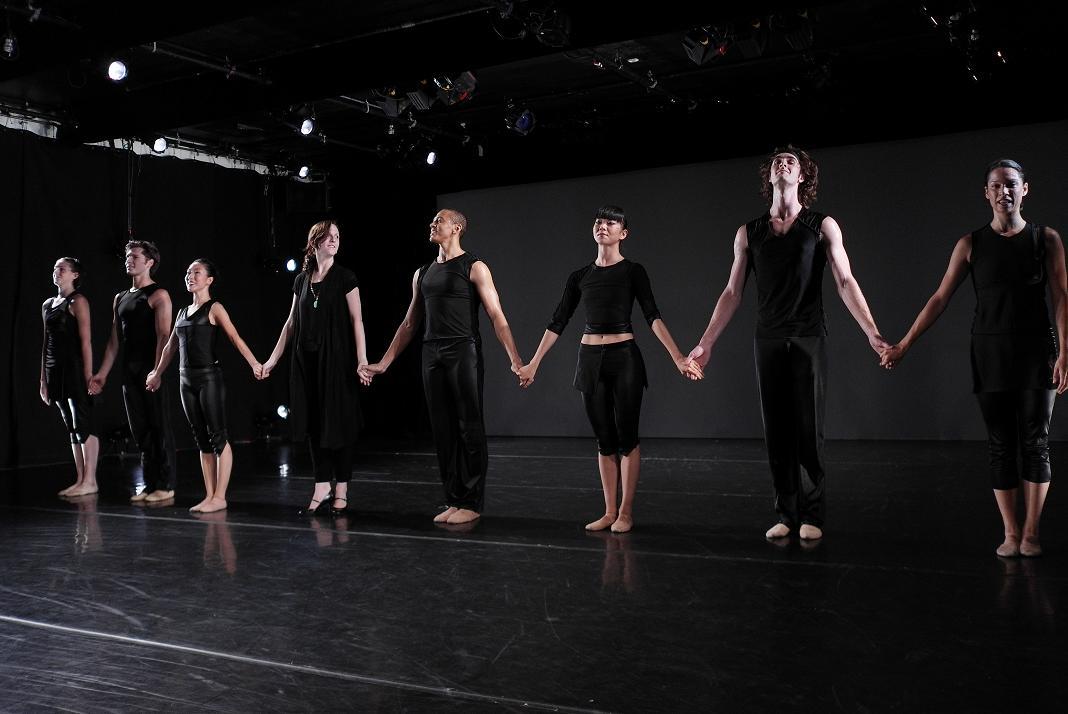
Above: from Jessica Lang’s The Calling, photo by Takao Kamaru
Thursday February 20, 2014 – Jessica Lang Dance are at The Joyce this week, presenting an exciting programme of danceworks in varied musical styles, all of it choreographed with Lang’s innate sense of sophistication and grace. And it’s all beautifully danced as well.
Lines Cubed is a Lang work new to me and I loved every moment of it. Set to a score by composers John Metcalfe and Thomas Metcalf, the ballet takes on the aspects of a danced symphony: there’s a prelude, an andante, a scherzo, an adagio, and a finale – and each movement is colour-coded for the costuming and set decor. Throbbing mechanical rhythms and passages of lyricism allow the choreographer to explore various movement motifs: much of the ballet has a stylized, ritualistic quality with questing port de bras. The lighting (Nicole Pearce) and the use of accordian-like set pieces which the dancers open and close in passing create a shifting visual framework.
Following a ritualistic opening movement, Black, the space glows in ruby-rich light for Red with an evocative solo danced by Kana Kimura backed by four men. Bright sun and infectious joy are expressed by a trio of women – Julie Fiorenza, Sarah Haarmann and Laura Mead – in Yellow. This gives way to a rather sombre Blue adagio, danced by Claudia MacPherson and Milan Misko. The colours are mixed and matched for the full-cast finale. Such was the cumulative effect of the setting, music and dancing that I could have immediately watched this ballet again.
For Mendelssohn/Incomplete, Jessica Lang has turned to my favorite chamber work – the Mendelssohn piano trio #1 – and created an ensemble work of longing and gentle melancholy in a dusk-like setting. The women in purple dresses and the men in soft shades of grey cross the stage in a clustered formation, a community seeking something in the impending darkness. They pause to dance: here the choreographer shows us tenderness and consolation in choreography that quietly illuminates the music. In the end, the group seem to be moving on – one woman lingers in the space, but she is not left behind. This poignant ballet, so touching in its sincerity and humanity, made a fine impression and was superbly danced by Mlles. Fiorenza, MacPherson and Haarman with Clifton Brown, Milan Misko and Kirk Henning.
In Aria, a quartet set to Zenobia’s restless-fury aria “Son contenta di morire” from Handel’s RADAMISTO, three boys (Todd Burnsed, Kirk Henning and Milan Misko) in grey tights and bright red shirts sail thru strongly musical combinations while Laura Mead – in a flame-red frock and dancing on pointe – comes and goes in a breathlessly-paced virtuoso performance. Mr. Burnsed is her primary partner; there are lifts, escapes, and swirling entrances and exits in this portrait of a woman on the brink.
The Calling, a mind-bendingly gorgeous solo, is culled from a Lang signature work Splendid Isolation II. It was performed tonight by the radiant Kana Kimura. The dancer – in a long white gown – basically remains stationary, using port de bras and gentle shiftings of the upper body, neck and head to enthrall the viewer while music by Trio Mediaeval lends a timeless sense of rapture. This work, and Ms. Kimura’s sheer expressive elegance, enthralled the packed house tonight.
White, a dance-on-film made in 2011 and having its New York premiere at these performances, shows six white-clad dancers against a jet-black background. The perspective makes them appear large or small as they dance across the screen, sometimes with witty inflection. Their comings and goings have a silent-movie flair, and the music of Edward Grieg makes White an especially pleasing interlude.
i.n.k. is a Jessica Lang work that I have experienced from its earliest formative stages. Visually engrossing, the ballet features black-clad dancers moving before a snow-white back-panel, sometimes dancing with their shadows. Meanwhile drops or waves of dark ink splash across the screen. The other-worldly score by Jakub Ciupinski, the costuming of Elena Comendador, Nicole Pearce’s lighting, and the intriguing film elements (KUSHO by Shinichi Maruyama) all combine to draw the viewer into this dream-like world.
Clifton Brown – truly one of the great dancers of our time – and the celestial Kana Kimura have a remarkable adagio in i.n.k. which ends with a mesmerizing slow backbend from Kana, supported on high in Clifton’s arms. This passage is so compelling and I felt this evening that i.n.k. should actually end here; and my companion felt the same way.
On my dance wish-list is Jessica Lang’s production of Pergolesi’s STABAT MATER which premiered at Glimmerglass in the Summer of 2013; I’m hoping it could be brought to New York City.



 Oberon's Glade