
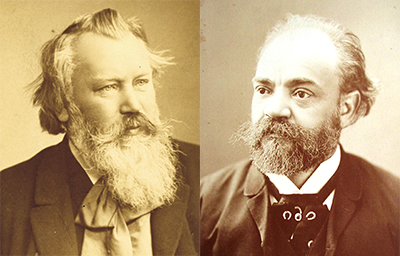
Above: Johannes Brahms
~ Author: Oberon
Tuesday June 19th, 2018 – The last concert the St Luke’s Chamber Ensemble‘s series, Facets of Brahms, at Merkin Hall brought us Andy Stein’s octet-arrangement of the Beethoven Symphony No. 2 in D Major, Op. 36, and Alan Boustead’s nonet-reconstruction of Johannes Brahms’s Serenade No. 1 in D Major, Op. 11, which – in its orchestrated form – might have been designated as the composer’s first symphony.
Brahms seems to have been hesitant to attempt composing a symphony in large part because he could hear “the footsteps of a giant” – Beethoven – walking behind him. Brahms’s anxiety meant that it wasn’t until 1876 that his 1st symphony premiered, some 14 years after he’d made preliminary sketches.
This evening, the St. Luke’s Chamber Ensemble opened with Beethoven 2nd Symphony in an octet realization conceived by Andy Stein. Two violins, one viola, a cello, a bass, and clarinet, bassoon, and horn made up the ensemble. Their full, rich playing did not give a feeling of a ‘reduction’ in any sense of the word. Instead, it was a very pleasing, absorbing experience; and Mr. Klein was called to the stage for a bow, warmly greeted by the crowd.
The 2nd opens with a slow introduction which in a flash turns into a lively Allegro; this is ‘glad music’, rich in melodies. In the Larghetto, Beethoven churns out cordial, lyrical themes. The music summons up thoughts of Springtime, flowering meadows, and blue skies. The Scherzo shows the composer’s sense of humour, which to me seems even more evident in the witty opening of the final Allegro molto, which seems to have a touch of sarcasm.

Above: Jon Manasse
In tonight’s ensemble, Jon Manasse’s clarinet playing made a superb impression: I have heard him play often in recent seasons and he makes the music so alive, with his fragrant tone and attention to dynamic detail. His subtle playing in the final movement gave me a smile. Of equal note was the sound of Marc Goldberg’s mellow bassoon. Violinist Krista Bennion Feeney, so fine in last week’s concert, impressed again, as did bassist John Feeney.
The Brahms 1st Serenade is in six movements. The composer noted it as a ‘Sinfonie-Serenade‘, later enlarging it for full orchestra at the urging of Clara Schumann. Alan Boustead gives the music back to its chamber roots in his excellent rendering.
Jesse Mills was the principal violinist in this work tonight, with Ms. Bennion Feeney, violist David Cerutti, cellist Daire FitzGerald along with Mr. Feeney’s bass filling out the string contingent. Joseph Anderer provided warm-toned horn-playing, and clarinetist Dean LeBlanc joined Mr. Manasse. Elizabeth Mann’s flute sang forth with serene, appealing tone.
The first three movements of this Serenade each felt a bit long tonight, as if the composer wanted to keep presenting his admittedly lovely themes to us again and again. By the fourth movement, a double Menuetto featuring the winds, Brahms was showing more economy. Ms. Fitzgerald and Mr. Anderer made the most of the ‘hunting call’ motif of the Scherzo, whilst Ms. Mann’s playing in the Rondo~Allegro was very pretty indeed. And throughout, Mr. Manasse continued to display the artistry that makes him such a valuable player on the Gotham scene.
~ Oberon



 Oberon's Glade