Tag: Jon Vickers

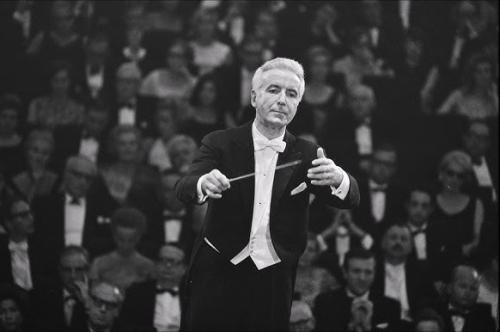
  • Jean Fournet conducts SAMSON ET DALILA

    Fournet copy

    Jean Fournet (above) conducts a performance of Camille Saint-Saëns’ SAMSON ET DALILA performed by the Netherlands Radio Orchestra in 1964. Audio only.

    Listen here

    The principal artists are Samson: Jon Vickers; Dalila: Oralia Dominguez; Le Grand-Prêtre de Dagon: Ernest Blanc;  Abimélech: Henk Driessen; Old Hebrew: Peter van der Bilt 

  • Gilda Cruz-Romo

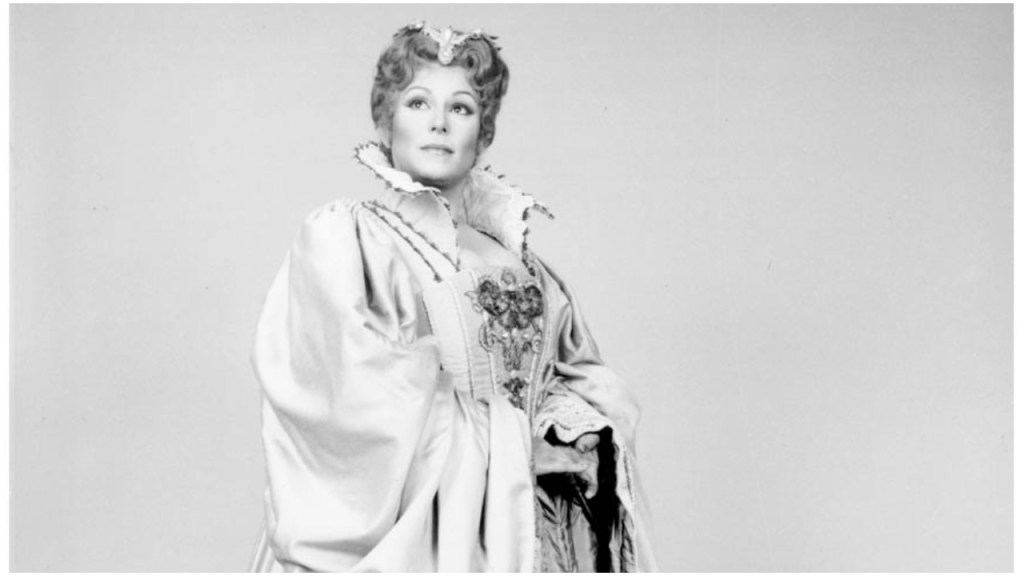
    c-r desdemona

    The wonderful Mexican soprano Gilda Cruz-Romo (above, as Desdemona) has passed away at the age of 85.

    Read a long article about her that I wrote many years ago:

    https://oberonsglade.blog/oberons_grove/2008/07/singers-gilda-cruz-romo.html

    Listen to Gilda and the great Jon Vickers in the OTELLO love duet as performed at Houston in 1979:

  • TRISTAN UND ISOLDE ~ Chicago 1979

    Knie vickers

    Above: Roberta Knie as Isolde & Jon Vickers as Tristan; photo by Tony Romano

    A performance of Wagner’s TRISTAN UND ISOLDE given by Lyric Opera of Chicago in 1979. Franz-Paul Decker conducts, with the following cast:

    Tristan – Jon Vickers
    Isolde – Roberta Knie
    Brangaene – Mignon Dunn
    Marke – Hans Sotin
    Kurwenal – Siegmund Nimsgern
    Melot – Richard Versalle
    Shepherd – Gregory Kunde
    Steersman – Daniel McConnell
    Voice of a Young Sailor – William Mitchell

    Listen here.

  • Crespin & Meliciani ~ AIDA Scene

    Meliciani

    Soprano Régine Crespin and baritone Carlo Meliciani (above) sing the father/daughter duet from Act III of Verdi’s AIDA; the performance is from Mexico City, 1962, with Nicola Rescigno conducting. Jon Vickers is heard as Radames.

    Listen here.

    Mr. Meliciani recently passed away at the age of 92. He was a popular star at La Scala, debuting there In 1959 as Ping in TURANDOT and continuing to sing there thru the 1970s, taking on the Verdi baritone roles. He performed at the major opera houses of Italy, where such roles as Scarpia, Tonio in PAGLIACCI, and Carlo Gerard in ANDREA CHENIER supplemented his Verdi list. Mr. Meliciani also appeared at Wiesbaden, Lausanne, in Greece, Mexico, and in the USA (Philadelphia and Hartford). 

  • My First WALKURE

    T16406_jon-vickers-canadian-tenor

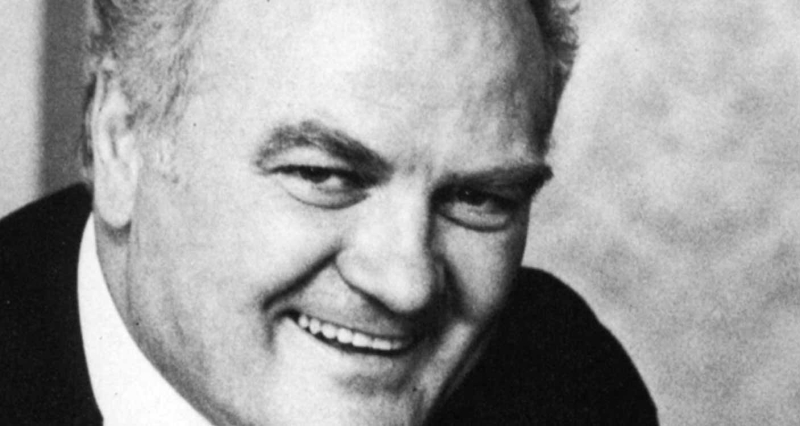
    Above: Jon Vickers, my first Siegmund

    ~ Author: Oberon

    With Wagner’s RING Cycle currently playing at The Met, I’ve been thinking back to when I saw these operas for the first time. My first RHEINGOLD was conducted by Herbert von Karajan; it was part of a thrilling weekend I spent at The Met in 1969.

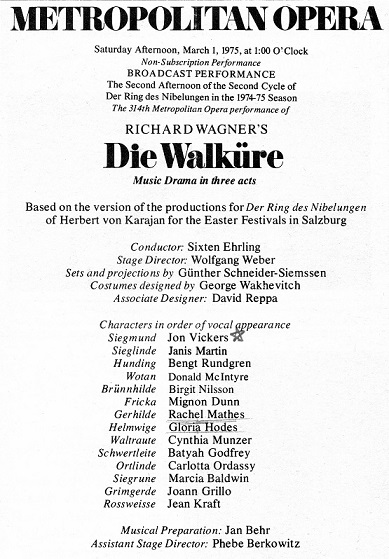
    It wasn’t until 1975 that I saw WALKURE, in a production based on Karajan’s Salzburg Festival production. Karajan of course had been due to stage and conduct the entire Cycle at The Met, but he never got beyond the first two operas before withdrawing from the project.
    My first WALKURE

    Of my first WALKURE, I wrote in my diary:

    “First time – an uneven performance: the good moments were very good, but much of the performance was a letdown.
    Sixten-ehrling

    Sixten Ehrling (above) did a really great job; he kept things moving, allowed the singers to be heard at all times, and his reading had warmth and clarity. The Valkyries were a mixed lot [I am not sure why I underlined two of the singers’ names on my cast page, especially as people like Marcia Baldwin, Batyah Godfrey, and Jean Kraft were favorites of mine at the time]. Bengt Rundgren was an impressive Hunding.

    Dunn Fricka

    Mignon Dunn as Fricka (above) got off to a rough start, but quickly got things in gear and was very fine. [She was another top favorite of mine, and in 1977 established herself as a star with her portrayal of Ortrud in LOHENGRIN].

    Wotanalone

    Donald McIntyre (above) as Wotan was truly effective: well-sung, very involved, a first-class actor. His long Act II monologue was a high point of the performance.

    Birgit Nilsson was not good as Brunnhilde. She looks really old, was uninvolved as an actress, and she behaved stupidly during the curtain calls. Her “Ho-Jo-To-Ho!” was full of swoops and off-pitch notes. Most of Act II was very ambiguous pitch-wise, and her voice seems to have diminished in size and scope. In Act III, she sounded somewhat better, but pitch was really a problem, and spoiled much of her performance.

    Janis Martin as Sieglinde was very good in Act I, but after that she slid downhill. She does not have the ringing upper range for this music, and seemed always to be singing at full-force. Stage-wise she was not exciting at all. Considering all this, I was surprised that she received a rapturous ovation during the curtain calls.

    Only one word is needed for Jon Vickers’ Siegmund: perfect! Bravo!!


  • A Memorable Concert From Tanglewood

    Vickers

    Above: tenor Jon Vickers

    It seems everything is on YouTube these days; I was especially glad to come upon this concert which I was fortunate enough to have attended. The performance of Act I of Wagner’s DIE WALKURE took place at Tanglewood in 1979; Jessye Norman was Sieglinde, Jon Vickers sang Siegmund and Gwynne Howell was Hunding. Seiji Ozawa conducted the Boston Symphony Orchestra. It seems to have been the only time that Norman and Vickers sang this music together.

    The concert has held its prominent place in my memory mainly because of Jon Vickers’ singing as Siegmund. While listening to the YouTube recording, I decided to dig out my opera diary write-up of the concert and see if the impressions I registered in the diary the morning after the concert held true upon listening to it again, almost 35 years later.

    Of course any broadcast in going to create a very different sonic impression from when you are sitting in the concert space, and that’s especially true in a vast setting such as Tanglewood.

    My diary entry reflects my admiration for Ozawa’s conducting and for Gwynne Howell’s singing as Hunding, and that holds true on listening to the recording. Jon Vickers is as sensational as I remember him being.

    At the time of the concert, my Sieglinde was Leonie Rysanek. I thought she was the only one and so I had compared the impact of Jessye Norman’s performance to Leonie’s and found it wanting. This was my first time experiencing Jessye live and depite so many admirable aspects in her singing, I did not think she was as thrilling in the role as Leonie was. Of course, they are totally different types of singers and listening to Jessye on the recording there is just so much to enjoy. At the time, I praised her lower register especially, and her dynamics and her persuasive way with the text; but I found her a bit too restrained and lady-like overall, and also noted that her top register did not really bloom (the top was Leonie’s glory at the time). And to me it seems on the recording a couple of Jessye’s highest notes are just a hair’s breadth below pitch.

    Norman went on to become a great favorite of mine, though I always thought she was really a mezzo-soprano. (By far the grandest singing I ever heard from her came in a concert performance of Act II of SAMSON ET DALILA at Carnegie Hall in 1983 where I thought to myself… ‘this is Jessye!’)

    Listening now to the Tanglewood recording makes me think more highly of Norman’s performance; of course over the ensuing years I have enjoyed many types of Sieglindes since those incredible Rysanek-evenings. My perspective has broadened and Norman’s interpretation seems pretty grand to me now.

    Vickers bowled me over at Tanglewood and he does so again on the recording. In his white sport coat  he reminded me of “…a wrestler dressed for the prom.” Siegmund’s music was “…offered with unstinting vocal generosity (as well as unbelievable subtlety!). Vickers, with that rough-beautiful timbre, gave his all. His command and artistry were dazzling. The great moments – the whole Sword monolog with its unearthly cries of ‘Wälse! Wälse!’;…his gorgeous ‘Winterstürme’; the enthralling build-up to pulling out the sword; his impassioned presentation of Notung to Sieglinde, and his stentorian final lines – were just the pinnacles of a truly magnificent performance.”

    “As Ozawa and the orchestra crashed thru the heart-stopping pages and drove the act to its glorious conclusion, the whole audience leapt up with a massive shout. The soloists and conductor were called out many times, to frantic ovations…”

    So nice to have this souvenir of a wonderful memory.