Tag: Joshua Bell

  • Joshua Bell|NY String Orchestra

    JoshuaBell-696x329

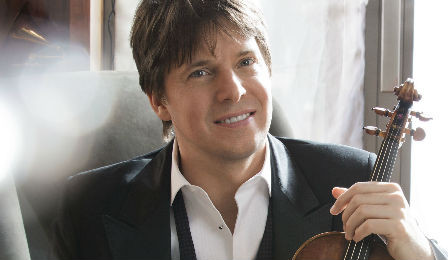
    Above: Joshua Bell

    ~ Author: Oberon

    Friday December 28th, 2018 – Holding forth at Carnegie Hall over the holidays, the New York String Orchestra presented a Christmas Eve concert (which Ben Weaver wrote about here) and then followed up with this evening’s program which brought us Joshua Bell as soloist for the Brahms Violin Concerto, book-ended by George Walker’s Lyric and Tchaikovsky’s Pathétique Symphony.

    George Walker‘s Lyric for Strings opened the program. From its very soft opening, this music was drawing us in and clearing our minds of the worries and woes that abound in these troubled times. Guest conductor Karina Canellakis and the young musicians savoured the rich themes, the Romantic Era yet still contemporary-sounding harmonies, the beautiful layering of arching violins and darkish basses. The music quietens, then a new melodic journey commences. After some thoughtful hesitations, the work finds a gentle ending: we are in a tranquil place. 

    Joshua Bell gave a knockout performance of the Brahms Violin Concerto in D-Major, Op. 77. The concerto’s first movement (Allegro non troppo) is especially rich in themes; following a unison opening passage, the music becomes quite grand. An excellent contingent of wind players joined the ensemble. Joshua Bell’s intense playing – and his feel for the dramatic – found a counterpoise in the ravishing sheen of his highest range, his pinpoint dynamic control, and his pliantly persuasive phrasing.
     
    A recurring theme, which make us think of springtime, found the violinist at his most lyrical, while in the demanding cadenza, Mr. Bell’s masterful dispatching of flurries of notes covering a vast range reached its end with a shimmering trill. The movement’s final measures were sublime.
     
    The winds set the mood of the Adagio. A marvelous oboe solo and – later – an impressive passage of bassoon playing – fell sweetly on the ear. Mr. Bell’s silken sounds in the upper register cast a spell over the hall, his exquisite control giving me chills of delight. In his mixture of passion and refinement, the music seemed so alive. Without pause, Maestro Jaime Laredo took us directly into the final movement; here, in the familiar theme, the rhythmic vitality of the orchestra and Mr. Bell’s bravura playing combined to winning effect.
     
    A full-house standing ovation greeted Joshua Bell’s stunning performance; hopes for an encore had the audience calling him back for repeated bows. But perhaps he felt that nothing really could follow the Brahms, especially after such a thrilling rendition.
     
    Following the interval, several alumni of the New York String Orchestra joined the current ensemble for a tonally lush rendering of Tchaikovsky’s Symphony No. 6, Pathétique. Among these alumni were several of today’s finest artists – people like violinist Pamela Frank, violist Steven Tennenbom, cellists Peter Wiley and Nicholas Canellakis, bass player Timothy Cobb, and clarinetist Anthony McGill. These musicians did not take over the principal chairs from the current players, but simply joined the ranks of the orchestra, seated interspersed among their young colleagues. I can only imagine how inspiring it must be for these emerging musicians to be playing alongside David Kim or Kurt Muroki.

    Maestro Laredo crafted a rich-hued, passionate performance, and the musicians played their hearts out. As the symphony unfolded – really impressively played – I found the first two movements to be magnificent in every regard. The Allegro molto vivace – which Tchaikovsky seems to have referred to as a ‘scherzo‘ and which one writer described as “a waltz with a limp” – seemed to go on too long. And as affecting as the final Adagio lamentoso is, there are themes in SWAN LAKE, SLEEPING BEAUTY and the Serenade for Strings that I find far more moving.

    Over time, people have sometimes felt that the Adagio lamentoso, with its faltering heartbeat at the end, presages the composer’s death. Within nine days after conducting the first performance of his the epic Sixth, Tchaikovsky would in fact be dead. There are various theories about the cause of the composer’s sudden demise: cholera from drinking tainted water, suicide induced by depression, or a sentence of death imposed on him by a ‘Court of Honor’ when his affair/infatuation with a young nobleman, Prince Vladimir Argutinsky (whose father was a high-placed official in the tsar’s court) came to light. In this third scenario, Tchaikovsky took poison after the Court’s verdict was handed down.

    Tchaikovsky & argutinsky
     
    Above: Tchaikovsky with Prince Vladimir Argutinsky
     
    Applause between movements somewhat spoiled the atmosphere tonight, even though after the Allegro non troppo of the Brahms it was understandable that the full house wanted to to applaud Mr. Bell. But premature applause at the end of the Tchaikovsky was a more serious mood breaker.
     
    ~ Oberon

  • Joshua Bell @ Mostly Mozart

    Joshua-Bell

    Above: violinist Joshua Bell

    Wednesday August 17th, 2016 – Geffen Hall was packed to the rafters for Mostly Mozart tonight: all the stage seats were taken, and there was a line for ticket returns: could it have had something to do with Joshua Bell being the scheduled soloist?  Mr. Bell certainly impressed in his performance of Mozart’s 4th violin concerto, and the program overall was highly enjoyable.

    Any hearing of Felix Mendelssohn’s overture to A Midsummer Night’s Dream is bound to summon up visions of Balanchine’s enchanted forest – it’s quite amazing, in fact, when you think of the amount of narrative and dancing Mr. B was able to fit into this 12-minute overture, without ever for a moment seeming over-busy. The Mostly Mozart Orchestra coped well with the brisk tempi set by the youthful-looking conductor, Matthew Halls, and it was so much sheer fun to hear these familiar themes played live again. I must mention Jon Manasse’s lovingly-phrased clarinet solo.

    Joshua Bell then appeared to a warm greeting from the crowd. In this rendering of the Mozart violin concerto #4 in D-major, the violinist and the conductor formed a steady rapport. Unobtrusively using a score, Mr. Bell launched the solo line in the stratosphere and went on to play the Allegro vivace‘s capricious music with easy aplomb. There’s a lot of high-velocity coloratura in play here, and it culminates with a florid, witty cadenza of Mr. Bell’s own design.

    On a high, sweetly sustained note, Mr. Bell lures us into the Andante cantabile; the melody eventually dips into a lower range where his playing a balm to the ear. An elegant ‘interlude’ has a different sort of appeal; then the main theme recurs, before the violinist ascends to another high-lying cadenza. 

    After an elegant start, the Rondeau turns sprightly – a delicate mini-cadenza teases us and then there’s another more extended cadenza. The soloist joins the massed violins in a sort of chorale, and Mr. Bell continues to seize opportunities for yet two more cadenzas, the first having an ironic buzzing quality.

    As ever, Mr. Bell’s physically engaged playing is as enjoyable to watch as to hear. The random smudged note here or there was nothing to deter from the ongoing sweep of his music-making, and though I agreed with my companion that the cadenzas sometimes seemed rather too ‘modern’, they gave the performance an individuality that was refreshing in its own right.

    Beethoven’s overture to Coriolan, Op. 62, was the composer’s first opportunity to write for the stage, and his success has kept the overture in the repertory. Originally conceived as a prelude to the play of the same title by the composer’s friend Heinrich Joseph von Collin – a theatrical success in Vienna in 1802 – the overture didn’t appear until 1807, when the play’s popularity had waned. It seems that only one performance of the play with Beethoven’s overture took place: on April 17th, 1807. After that, the eight-minute overture went on to thrive as a concert number.

    This evening’s performance was finely-wrought by Maestro Halls, and most attractively played. The contrasting themes of anger and tenderness express the theme of the play: the betrayal of his duty as a Roman general by Coriolanus, and his mother’s entreaties to abandon his plan to lead the enemy forces in an attack on Rome. Her pleading is effective: Coriolanus abandons his scheme and faces his punishment.

    A warm and appealing performance of Beethoven’s “little” symphony – the 8th – concluded the evening on an optimistic note. The last time I heard this symphony performed live was in December 2013 when the Spanish conductor Rafael Frühbeck de Burgos, then in his 80th year, led the New York Philharmonic in the work and left my friend Dmitry and I with wonderful memories of the highly-respected Maestro, who passed away in June 2014. We still speak of that Philharmonic concert with special affection. 

    Timed at around twenty-five minutes, this four-movement symphony flies by: there’s no adagio to make us stop and ponder, but rather a charming and often witty flow of themes with the congeniality of dance rhythms ever-ready to buoy the spirit.

    A lively podium presence, Maestro Halls was well in his element here, and the musicians seemed fully engaged in this music which successfully blends elegance with folkish gaiety. The horns sounded plush, and again Mr. Manasse made his mark: an outstanding musician.

  • Joshua Bell’s Mendelssohn @ The NY Phil

    Josh-bell-violin

    Wednesday December 30th, 2015 – Joshua Bell (above) played Mendelssohn’s violin concerto with The New York Philharmonic tonight on a program that was otherwise an all-Sibelius affair, in celebration of the Finnish composer’s 150th birthday.

    Sibelius’s The Swan of Tuonela, which opened the evening, was originally to have been included in an opera the composer was working on. It later became one of the Four Legendsthe best-known of the four and often played as a stand-alone work.  Tuonela, the realm of the dead in Finnish mythology, is surrounded by a dark-water moat on which the swan of Tuonela floats majestically, singing.

    This is music of somber gorgeousness. Sibelius structures the work on a cushioning of strings; Carter Brey’s mournful cello theme sets the tone. An evocative English horn passage (played, I believe, by Robert Botti – though we didn’t catch sight of him) leads to a brief brightening of mood. But the swan glides back into the gloom and her voice fades away to a mysterious heartbeat. At the composer’s wish, The Swan of Tuonela was performed at his own funeral.

    Alan Gilbert spoke to us before commencing the Sibelius Symphony No. 4. He seemed to veer from personal enthusiasm for the piece to apologizing for its depressing qualities. The symphony was written while the composer was dealing with problems stemming from alcoholism. This probably accounts for the work’s disjointed qualities.

    Forward-looking harmonically, the 4th does not sound like most of the other music that has given Sibelius lasting popularity over the years. Carter Brey again had a leading theme – played with striking lyricism – in the first movement. Later, as the ensuing movements unfold, the oboe, clarinet, and flute will all have their moments to shine forth. Maestro Gilbert referred to the second movement as a Scherzo, but if it’s a joke it stems from a very dark sense of humour; oddly, it includes a brief gavotte motif for flute duo…charming, but it goes un-developed. The big, deep theme of the Adagio comes closest to what we could think of as Sibelian. The agitated opening of the final Allegro – which includes the unexpected introduction of the glockenspiel – does not resolve in a positive way.

    Overall, the Sibelius 4th seemed an odd inclusion on a holiday-season program. Interestingly, it had not been played by the Philharmonic for nearly 30 years. Tonight’s audience reacted with a mixture of admiration for the playing and uncertainty as to whether they really liked the piece or not.

    Following the interval, Joshua Bell appeared for the Mendelssohn violin concerto. This was the composer’s last completed orchestral work: within three years of its premiere in 1845, he had died at the age of 38 following a series of strokes.

    Mendelssohn’s violin concerto is innovative in that its three movements are played without pause, preventing mood-breaking applause. Eschewing gratuitous technical flourishes, the composer instead goes in for heartfelt melody. There are brilliant and demanding passages to be sure, but they are more conscientiously woven into the musical fabric than tacked on to display the violinist’s deftness. 

    The concerto in fact seemed like a conversation between soloist and orchestra and, in the course of playing it, Mr. Bell often turned towards the musicians to keep the dialogue flowing in both directions. It goes without saying that the orchestra played superbly, and that Maestro Gilbert was in his particular element here – especially in the Adagio, where he and Mr. Bell communed in an almost balletic pas de deux.

    Throughout, in fact, the black-clad violinist wove, bent, and swayed in a dance that had just a trace of the satanic about it as he drew the music from his 1713 Stradivarius. Right from the start – in that lovely and rather restless opening theme – Mr. Bell assured us we were in the presence of a musician of matchless technique, inspired artistry, and deep commitment. His capacity for subtle nuance was spine-tingling, and the satiny lustre of his sustained playing in the Adagio was – in a word – magical.

    Among the many felicities in this performance, I particularly liked Maestro Gilbert’s up-sweep of tempo as the first movement neared its conclusion, and some dashing attacks from Mr. Bell in the finale. It was a performance to treasure, and the audience could not suppress their enthusiasm: the applause erupted a split second before the final note could fade away. Mr. Bell was called out three times, and could easily have served up an encore or two: I liked instead that he let the concerto stand as his year-end gift to us. Bravo! 

    Returning to Sibelius to end the evening, Maestro Gilbert and the Philharmonic gave us a soul-stirring rendering of the composer’s Finlandia: a sure-fire crowd-pleaser, performed with resonant grandeur.