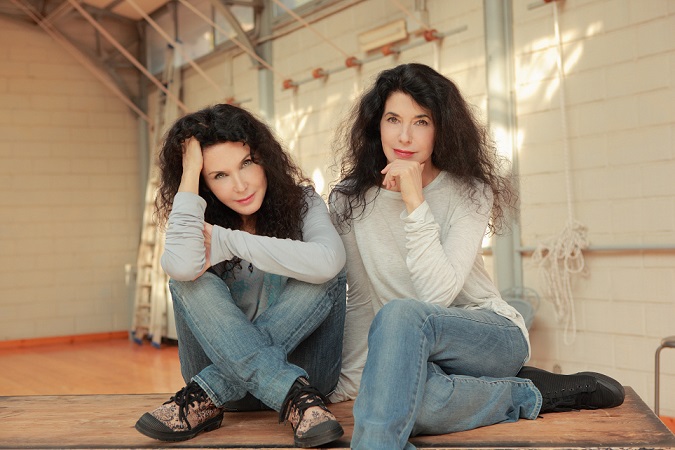
Above: Katia and Marielle Labèque
Author: Oberon
Saturday September 23rd, 2017 – The first thing we noticed upon taking our seats at The New York Philharmonic this evening was that the seating arrangement for the orchestra had changed: risers are now in use. Hopefully this is a permanent enhancement, as it is so pleasing to be able to actually see people like Judith LeClair, Robert Langevin, Anthony McGill, and Liang Wang while they are playing.
This week has marked the start of the Jaap van Zweden era at the Philharmonic, even though it’s not until next season that the appendage “Designate” will be dropped from the title “Music Director”. The orchestra played superbly for the Maestro, and if the vociferous standing ovation that erupted the moment the Mahler 5th ended is any indication, the audience is embracing Mr. van Zweden in no uncertain terms.
The New York premiere of Philip Glass’s Concerto for Two Pianos and Orchestra opened the program. The Labèque sisters, in fitted black trousers and be-spangled sweaters, were warmly greeted by the crowd; they have been top-rank musicians for a long time and they still look sensationally slender and attractive…and their playing retains its accustomed verve and grace.
Glass calls for a huge orchestra for this most recent of his creations; no fewer than seven percussionists take part, along with vast troupes of string, wind, and brass players. The concerto is in three movements and sets out from a jazzy opening that develops into a feeling of a giant hurdy-gurdy playing as a kozmic merry-go-round swirls madly. Pulsing waves of sound, in dense textures, wash over us. From this turbulence, a lovely misterioso motif for the pianos emerges, with a gong struck softly as an undertone.
The pianists playing in their lower ranges open the second movement, with wooden clappers beating time. The trumpets and flutes join voices; at this point a cellphone went off in the audience but it merged into the musical texture. Rhythmic and textural variety sustain this central movement. The concerto concludes with a sort of adagio of somewhat darkish hues.
The new concerto is appealing in its way, but I can’t say it’s particularly distinctive or memorable. The pianos do not take the prominence one might expect in a concerto setting, but rather they are simply one constant voice in the overall chorus of instruments, given a few solo/duo passages along the way. I was hoping for an encore from the Labèque sisters, or possibly an appearance by Philip Glass, but after a couple of bows, the intermission commenced.

Above: Jaap van Zweden
Mahler’s Fifth Symphony was composed during the summers of 1901 and 1902, during his annual holiday from his job as director of the Vienna Court Opera. It was in Vienna the winter prior to beginning his fifth symphony that Mahler had met Alma Schindler, the beautiful daughter of a famous landscape painter. Mahler proposed to her in the Autumn of 1901, and the symphony, with its journey from mourning thru the dreamworld of the Adagietto to happy triumph seems to mirror the composer’s state of mind with his new-found love.
The symphony’s brilliant opening trumpet fanfare was excitingly introduced by Christopher Martin. As the first three movements of this very long symphony progressed, the Philharmonic players responded thrillingly to Maestro van Zweden’s intense, almost daemonic vision of the score. In the beloved Adagietto, for strings and harp, the conductor’s gentle pace and his summoning of luminous textures from the musicians created a depth of beauty in which we could – for a few minutes – forget the dark dangers of living in today’s uncertain world. In the grandeur of the symphony’s dazzling Rondo-Finale, the maestro and his musicians swept the celebratory feeling forward, pausing only for a couple of momentary roundabouts, and on to its epic conclusion. The audience went wild.
~ Oberon
 Oberon's Glade