Tag: Juho Pohjonen

  • CMS Summer Evenings 2023 ~ Concert 4

    Juho_Lisa-Marie Mazzucco jpg

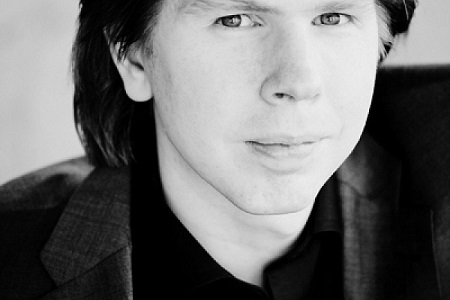
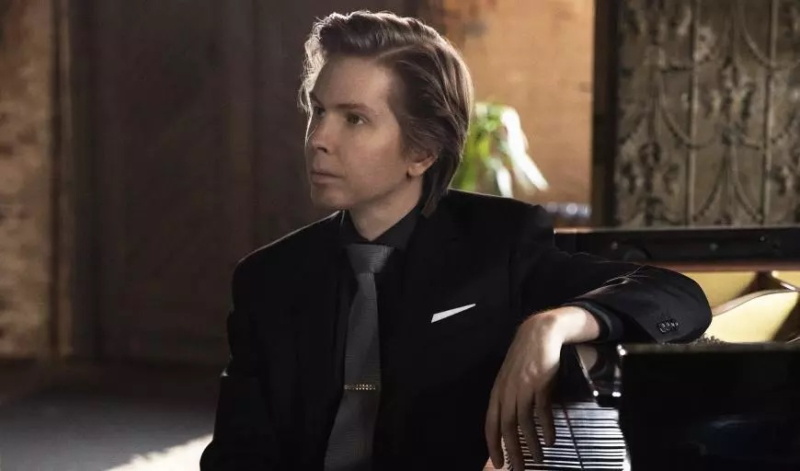
    Above: pianist Juho Pohjonen, photo by Lisa-Marie Mazzucco

    Author: Oberon

    Tuesday July 18th, 2023 – The final concert in Chamber Music Society of Lincoln Center‘s 2023 Summer Evenings series presented a quintet of distinctive artists in music of Haydn, Mozart, and Fauré. The remarkable Finnish pianist Juhi Pohjonen was at the center of this engrossing program, playing in all three works with the combination of passion and subtlety that is his trademark.

    Haydn’s Trio in E-flat major for Violin, Cello and Piano, Hob. XV:29, dating from 1797, made for an elegant start to the evening. The opening Poco allegretto commences with a sustained note from the three artists: violinist Stella Chen, cellist Sihao He, and Mr. Pohjonen. The music then progresses in a ‘theme and variations’ setting, briefly entering the minor mode. The pianist’s rippling florid passages delighted the ear, whilst violin and cello duetted lyrically.

    The pianist opens the Andante with the most delicate of pianissimi, taking up a simple melody in which the three voices blend sweetly. The ebb and flow of passion and restraint leads to a mini-cadenza from the pianist before the Allemande finale kicks off with a burst of energy.  Mr. Pohjonen spins off immaculate fiorature laced with trills, whilst Sihao He offers rapid cello scalework. After pausing for a playful piano passage, the music dances on: winding down, only to re-boot to a zesty finish.

    Mozart’s Concerto No. 12 in A -major for Piano and String Quintet, K. 414, was written in 1782 for the composer himself to perform, with a small ensemble; the string quartet setting was created later. This piece offers a perfect showcase for Mr. Pohjonen’s artistry.

    The opening Allegro features genial strings: violist Beth Guterman Chu has joined violinists Stella Chen and Danbi Um, with Sihao He’s mellow sound enriching the harmonies. Mr. Pohjonen’s marvelous tone and sparkling agility are pure magic. Ms. Guterman Chu, with a gleam in her eye, is a wonderful addition to the ensemble, whilst Sihao He’s rich-toned descending motifs are truly appealing. At last comes a fabulous Pohjonen piano cadenza, so gracefully played.

    The Andante suffered from the intrusion of two dropped objects and a jangling cellphone, but the artists kept their focus, opening with a string quartet. Mr. Pohjonen’s nuanced playing was just sublime, and I must again praise Sihao He’s plush sound. A minor-key piano passage underlined by sighing strings achieves a marvelous blend, and Mr. Pohjonen’s cadenza was offered in a hushed pianissimo, with trills etched in.

    The final Rondeau: Allegretto is lively indeed, with nimble, utterly clear piano phrases and unison string passages, which eventually develop into a fugue. Full stop…and then the pianist’s virtuosity was in full   flourish, pausing only for some enticing delicate measures along the way. Bravo Juho!

    Following a rather longish the interval, Gabriel Fauré’s Quartet in C-minor for Piano, Violin, Viola, and Cello No. 1, Op. 15, was given a luminous performance by Mr. Pohjonen, Danbi Um, Beth Guterman Chu, and Sihao He.

    The opening Allegro molto moderato momentarily has an à la Russe feeling, later becoming quietly rapturous. A piano theme is soon taken up by Danbi Um’s silken violin, then passed on to Ms. Chen and Ms. Guterman Chu. The music becomes overwhelmingly beautiful and passionate, before turning more lyrical. Mr. Pohjonen’s sorcery is again evidenced in the movement’s sustained conclusion.

    Delicate plucking opens the Scherzo, with sprightly motifs from the Steinway: all is lightness and air. Rhythms compete, the music covering a broad dynamic range with shifts of energy. After a false finish, the piano gently resumes. The unison strings then part company, taking up slithering scales. The music dances on, full of fun.

    Sihao He introduces the Adagio with an achingly gorgeous theme; the strings unite, and the pianist is at his most pensive. Danbi Um’s violin sounds radiantly, whilst the violist and cellist, playing in unison, introduce darker hues. These lower voices join Danbi in poignant harmonies. The music is lush and passionate until a sudden mood swing comes from the piano, playing pianissimo.  The the opening cello solo returns, and a feeling of time standing still gave me the chills…so haunting. Then Mr. Pohjonen offers a final benediction.

    In the final Allegro molto, we can simply sit there and savour the vibrant playing that’s on offer. Juho is beyond splendid, and bits of melody are passed about among the string players. After a brief interlude, the music seems to be summoning energy for a big finish, but instead there’s a full stop. From the silence, Danbi Um’s exquisite sound emerges, opening a pathway to a grand and sweeping finish.

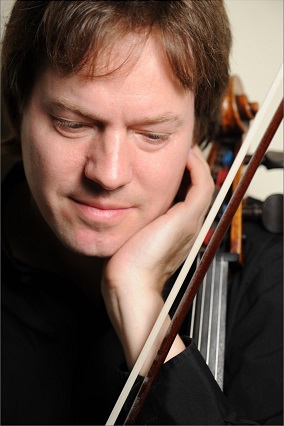
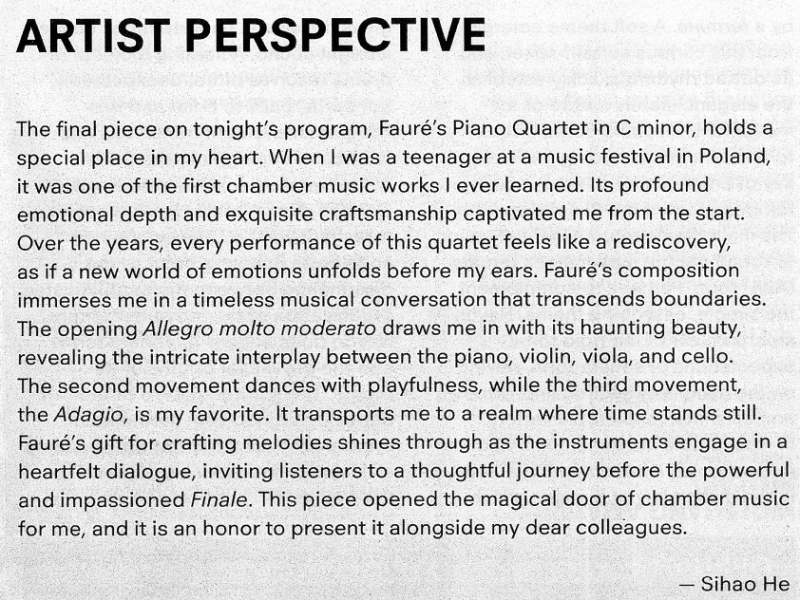
    Cellist Sihao He wrote of his experience learning the Fauré C-minor quartet as a teenager; I wanted to include his thoughts about the work here, as they align perfectly with my own:
    Faure-1 jpg

    ~ Oberon

  • 2nd Summer Evening @ CMS ~ 2019

    Artist_2237

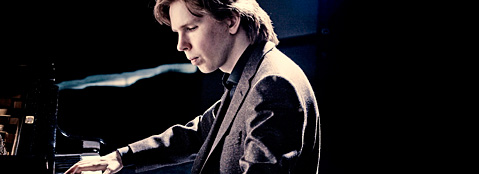
    Above: pianist Juho Pohjonen

    ~ Author: Oberon

    Sunday July 14th, 2019 – The second of three concerts in Chamber Music Society of Lincoln Center‘s annual Summer Evenings series brought together a trio of esteemed CMS artists joined by The New York Philharmonic’s beloved principal clarinetist Anthony McGill. No French music on this Bastille Day program; Austria, Germany, and Russia were represented. The playing was superb.

    Bella-Hristova-FI

    Above: violinist Bella Hristova, photo by Lisa-Marie Mazzucco

    With Mr. Pohjonen at the Steinway, Ms. Hristova opened the concert with Mozart’s Sonata in B-flat major for Violin and Piano, K. 454, which dates from 1784. Fittingly enough, this sonata was composed for a female violinist: Mozart wrote it for the Viennese debut of Regina Strinasacchi, and he himself was the pianist on that occasion. Female violinists were quite rare in those days. Signorina Strinasacchi had studied at the famous Ospedale della Pietà in Venice where Antonio Vivaldi had once served as music director. She was 21 years old at the time of her Vienna debut, and was said to be a dazzling violin virtuoso who had also trained as an opera singer.

    Ms. Hristova, who in March of this year gave a dazzling recital at Merkin Hall, looked fetching in a dusty rose à la Grecque frock. After a courtly – almost regal – introduction, Ms. Hristova’s playing of the affecting first melody set the mood. She and Mr. Pohjonen traded melodic statements, making it clear from the start that they are ideal colleagues. The music gets lively, with little hesitations and subtleties woven in; abundant charm and sweet lyricism prevail.

    A tender theme commences the Andante; the musicians take turns playing melody and rhythmic figurations. Ms. Hristova’s phrasing is so appealing here. The music turns a bit melancholy, with a sense of passion restrained. A sustained note from the violinist leads on to a sort of coda and a gentle finish.

    The sonata’s concluding Allegretto is a lot of fun; violinist and pianist sometimes play in unison and sometimes harmonize. The pacing and dynamics offer pleasing contrasts along the way to a virtuosic finale.

    IMG_7629-e1350511246980-1024x748

    Anthony McGill (above) then joined Nicholas Canellakis and Mr. Pohjonen for Johannes Brahms Trio in A-minor for Clarinet, Cello, and Piano, Op. 114. This was composed in 1891, after Brahms had heard the great clarinetist Richard Mühlfeld and was much taken with the sound of the instrument.

    Mr. Canellakis has the trio’s opening statement – a rich melodic passage – and soon Mr. McGill’s clarinet makes its sublime entrance. From the Steinway, Mr. Pohjonen pulses up and the music takes off, calming for a cello solo in which Mr. Canellakis’s depth of tone makes a marvelous impression. Cello and clarinet bring incredible subtlety to a scale passage, and there’s a trace of gypsy lilt in the music. Following more scalework, the Allegro fades away.

    At the start of the Andante, Mr McGill’s lambent tone is beautifully matched to Mr. Canellakis’s, producing a spellbinding blend: ‘phrasing is all’ here as the voices entwine. To their mix, Mr. Pohjonen adds his poetic playing. The Andantino grazioso begins like a serenade: the clarinet sings while the cello provides a plucked accompaniment. This lighthearted movement transforms itself into a waltz, which proceeds lyrically.

    Mr. Canellakis’s cello digs into the final Allegro, with the piano urgent and the clarinet vibrant. The music is broad, with a folkish feel. Descending phrases are heard, and the trio finds a brisk ending.   

    N C

    Following the interval, Nick Canellakis (above) along with Ms. Hristova and Mr. Pohjonen, offered Anton Arensky’s Trio No. 1 in D-minor for Piano, Violin, and Cello, Op. 32. Whenever I hear Mr. Canellakis playing, I find myself thinking back to his magnificent performance of Leon Kirchner’s Music for Cello and Orchestra at Carnegie Hall in 2015.

    Images

    Arensky (above) is something of a forgotten composer – unfairly, in my view. You can read about him, and hear some of his music, here. Listening to his music, you can see where Scriabin and Rachmaninoff profited from having been Arensky’s students.

    Bella Hristova’s gorgeous violin solo plays over restless patterns from the Steinway; the cello then takes up the melody. Mr. Pohjonen relishes the con moto sweep of the virtuoso writing for piano.  “This is fabulous music!”, I scrawled across my notes.  The string players exchange bits of melody, the pianist deftly dispatches phrase after lovely phrase. A soft, sustained violin note ends the Allegro moderato.

    The second movement is a sprightly Scherzo, with plucked strings and high trills from the piano: at times the instruments sound almost like toys. Mr. Pohjonen’s tone shimmers throughout. An engaging waltz gets quite grand, and, after some wry hesitations, the Scherzo‘s end is lighthearted.

    A tender, reflective cello solo opens the Elegia; the music seems to recall happier times that have been left behind. Ms. Hristova’s violin climbs poignantly higher and higher, whilst Mr. Canellakis’s cello again sounds from the depths. 

    From a turbulent start, the cello and then the violin carry the melody of the concluding Allegro non troppo: this music is very much à la Russe. As passion ebbs and flows thru the melodies, the shining piano and soft strings lend an ethereal air. The composer then crafts a lively finale for his trio.

    Ms. Hristova and Mssrs. Canellakis and Pohjonen were greeted with great enthusiasm at the program’s end, and insistent applause brought them out for a second bow.

    ~ Oberon

  • Schubert & Schnittke @ CMS

    JuhoPohjonen

    Above: Juho Pohjonen

    Friday March 20th, 2015 – Three outstanding artists joined forces this evening at Alice Tully Hall as Chamber Music Society of Lincoln Center presented yet another outstanding programme in their Intimate Expressions series.  Pianist Juho Pohjonen joined violinist Benjamin Beilman for Schubert and cellist Jan Vogler for Schnittke; then all three musicians concluded the performance with Schubert’s trio #1 in B-flat major.

    Despite a late-Winter snowfall and chilling winds, a large audience filled Tully Hall, and it was in a marvelous state of silent anticipation that the listeners opened their hearts and minds to the extraordinary music coming from the stage. This state of mutual communication, where the players can’t help but be aware of the spell they are casting over the Hall, is one of the great pleasures of Chamber Music Society‘s presentations.

    The level of artistry today was extraordinarily high. When Benjamin Beilman and Juho Pojhonen walked onstage we were struck by their youthful appearance and a trace of shyness as they acknowledged the welcoming applause. But as soon as they began to play, their surety of technique and depth of musicality drew us in to their compelling delivery of the opening Schubert. 

    Benjamin_beilman_artistpage

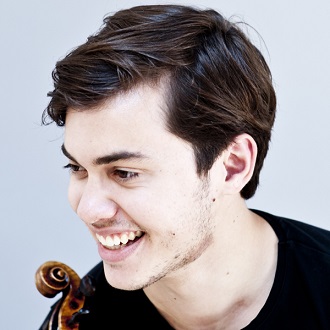
    Above: Benjamin Beilman

    The Schubert Fantasy in C-major (1827) is a long work in seven inter-connected movements and it places extraordinary demands on the violinist while also requiring a pianist who is far more than an accompanist, but rather a partner in expressiveness.

    The extraordinary delicacy of Mr. Pohjonen’s opening measures showed us at once that we were in the presence of a master of dynamic control; the silken seamlessness of his playing was ideally taken up by Mr. Beilman in his opening lyrical flight. As the sonata progresses, the violin’s poignant theme of longing shifts to a dynamic dancelike passage. In a set of variations, Mr. Beilman showed his skill in alternate plucking and bowing, as well as in flourishes of fast fiorature and rolling cascades of melody. A rapturous theme for violin and piano has a heart-rending quality, and soon we return to the still calm of the work’s opening statements. The gallantly graceful pace of the finale lulls into a last evocative slow passage before a dash to the finish. The audience embraced the two young paragons with warm enthusiasm for their savorable performance.

    29782

    Above: Jan Vogler

    Jan Vogler was making his CMS debut today, and a welcome event it was: he took on the the daunting combination of angularity and soulfulness that make the Schnittke sonata so remarkable, and again Mr. Pojhonen at the Steinway was an ideal accomplice.

    Commencing with a rather ominous cello theme, this sonata often has a dreamlike (even nightmarish) sense of mystery. The cellist at one point slithers up and down a snakelike scale passage with a creepiness that evokes thoughts of the eerie prelude to Klytemnestra’s murder in Strauss’s ELEKTRA. In fact, the Schnittke might be said to echo the Strauss opera in its mixture of violence and unexpected flashes of  lyricism. 

    I scrawled several brief notes, not wanting to take my eyes off our intrepid players: “march-like piano”, “rambunctious cello”, “bizarre waltz”, “restless quest”…and then suddenly Mr. Pohjonen lays into the lowest notes of the keyboard to produce a violent sonic boom. He then immediately swirls upward to the highest range, whilst Mr. Vogler takes up a desolate theme. The cello goes to the depths – and such resonant depths – interrupted by an aching/annoying 2-note motif before ending up on a very sustained tone. A brief, mysterious plucked passage before settling back into the deep while the piano creates a soft cloud of starshine in the highest range.

    Let’s have Mr. Vogler back for the second Schnittke sonata, at the earliest opportunity.

    After the interval, the three gentlemen set to a performance of Schubert’s Trio in B flat major, immediately establishing the kind of congenial rapport that makes a great piece of music even greater.

    The trio was probably written in 1827; the original autograph score is lost. It is in four movements, and I can’t imagine a more pleasing rendition than tonight’s with its fusion of the three voices constantly sending those delightful little chills up the spine. The nostalgic theme that opens the Andante expanded into a vivid emotional experience with playing that was subtle and full of nuance. The three gentlemen were in a playful mood for the witty and sparkling Scherzo – with its lovely surprise of a slower interlude – and then moved on to the sprightly dance of the final Rondo, which includes an unusual ‘fluttery’ motif.

    In this trio, the three players showed both graceful dexterity and a mutual desire to draw forth each thread of melody for our delight. Both in programming and in the choice of artists, Chamber Music Society sets the highest standard. I entered Alice Tully Hall tonight with great expectations, only to find they were not simply met, but surpassed. Incredibly, that seems to be the norm here at CMS.

    The Repertory:

    The Participating Artists: Juho Pohjonen (piano); Benjamin Beilman (violin); Jan Vogler (cello)