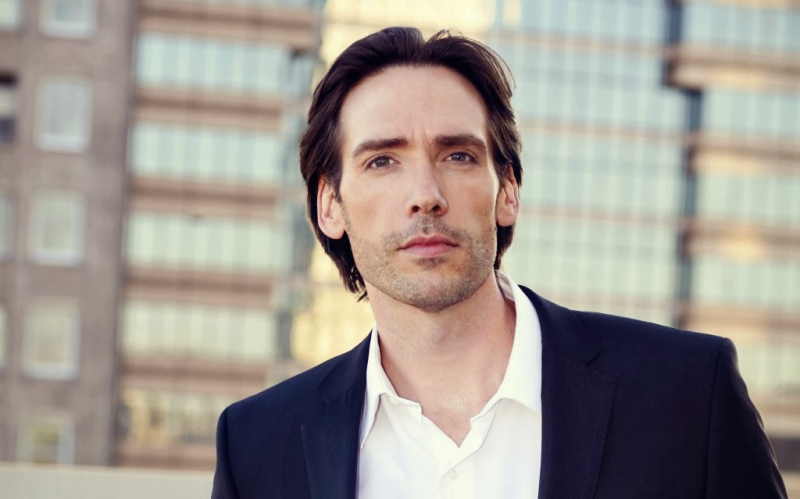
Saturday December 24th, 2016 matinee – This afternoon we had the unalloyed pleasure of experiencing baritone Michael Todd Simpson’s performance as Jaufré Rudel in Kaija Saariaho’s breathtakingly beautiful opera L’Amour de Loin at The Met. Mr. Simpson was replacing the scheduled Eric Owens in the role, and to say that he gave an impressive interpretation would be putting it mildly: in terms of both voice and physical presence, Mr. Simpson was simply ideal.
We settled in at our balcony box this afternoon, observing the many empty seats for this matinee; neither the Saariaho nor Strauss’s Salome – to be shown in the evening – is really holiday fare, but that’s what The Met programmed on this day before Christmas. The Amour production has its striking moments, but overall it was the musical experience that thrilled us.
My friend Dmitry and I had been looking forward to seeing the Saariaho opera ever since the plan for the opera’s Met premiere was whispered to me by my choreographer-friend Luca Veggetti. Luca is good friends with Ms. Saariaho, and they have collaborated here in New York: Luca staged the composer’s ballet MAA at The Miller Theatre in 2010, and in 2013 he invited me to a rehearsal of the same work when he was preparing it for a Paris production. Luca turned to Ms. Saariaho’s music for his 2012 all-female dancework From the Grammar of Dreams, created for The Martha Graham Dance Company. In 2014, a fascinating collaboration between Gotham Chamber Opera and The Martha Graham Dance Company resulted in a memorable presentation of Saariaho’s The Tempest Songbook at The Metropolitan Museum of Art: I saw an early rehearsal, and the stunning opening night performance. Ms. Saariaho was also featured in a composer’s evening at The Miller Theatre in February 2014.
L’Amour de Loin premiered at the Salzburg Festival in 2000. The Robert Lepage production – which The Met is presenting – is the tenth production of this striking work to date; that fact alone attests to the opera’s viability, which springs – in my opinion – both from the magical sound-world Kaija Saariaho has created and from the ineffable sadness and mystery of the story.
Jaufré Rudel was a 12th century troubadour from Blaye, near Bordeaux in south-west France. He fell in love – sight-unseen – with the Countess of Tripoli after hearing her praised by pilgrims returning from Antioch. He wrote poems about her and sang of her nobility and virtue. From this idealized love sprang Jaufré’s desire to meet her. He joined the Crusade and set sail for the Holy Land, but he fell gravely ill on the Mediterranean voyage and arrived at Tripoli only to die in the Countess’s arms. She had him buried in the temple of her city, and thereafter, undone by her grief, she became a nun.
Kaija Saariaho’s score, as with Debussy’s for Pelléas et Mélisande, creates a unique atmosphere with its timeless and treasurable tale of a love that is both exalted and doomed, rendered in music of intoxicating tenderness and – eventually – despair. In shimmering orchestral textures, the composer summons up visions of the sea which divides the lovers and upon which the mysterious Pilgrim sails in his fragile boat, carrying messages between Jaufré and his beloved Countess.
From the very first measures, this music drew me in and held me, as if in a dream from which one doesn’t want to awaken. Countless passages from the opera were so hauntingly expressive that I regretted not having booked more than one performance. The music darkened considerably in the second half of the evening: there’s a vivid sea-faring prelude to Act IV, some dance-like rhythms spring up; and Jaufré’s lamenting phrases that he may not live long enough to meet his beloved are deeply moving.
The Met orchestra played superbly under the baton of Susanna Mälkki: I loved watching her from my perch high above the pit, and she was given a warm reception when she appeared onstage at the end of the opera.
This afternoon was actually my second encounter with Michael Todd Simpson at The Met; in 2012 he caught my attention in the brief role of the Tsar’s herald in Khovanschchina. It is Mr. Simpson, as Jaufré Rudel, who opens the Saariaho opera. But even before he began to sing, the baritone established himself as a charismatic presence: tall, fair of complexion, with expressive eyes and handsome cheekbones, Mr. Simpson put me in mind of the Royal Ballet’s Edward Watson – and believe me, I can’t pay a higher compliment than that.
Yet all that would have been for nought had Mr. Simpson not had the vocal goods to back up his physical appeal. But …he does! This is a warm, clear, easily-produced voice – a voice wonderfully present in the big House. Mr. Simpson seemed utterly at home, both in the persona and in the music; one would have thought he’d sung this piece dozens of times since every word and note in his nuanced performance radiated assurance and grace. All afternoon, the Simpson voice was a veritable font of baritonal beauty, and while comparisons are not always meaningful, I can only say that listening to Mr. Simpson gave me the same deep pleasure I have often drawn from the singing of Sanford Sylvan and Thomas Hampson.
Deservedly hailed with bravos at his solo bow, Mr. Simpson proved so much more than a stand-in: he’s a distinctive artist, and one I hope to hear again – soon and often.
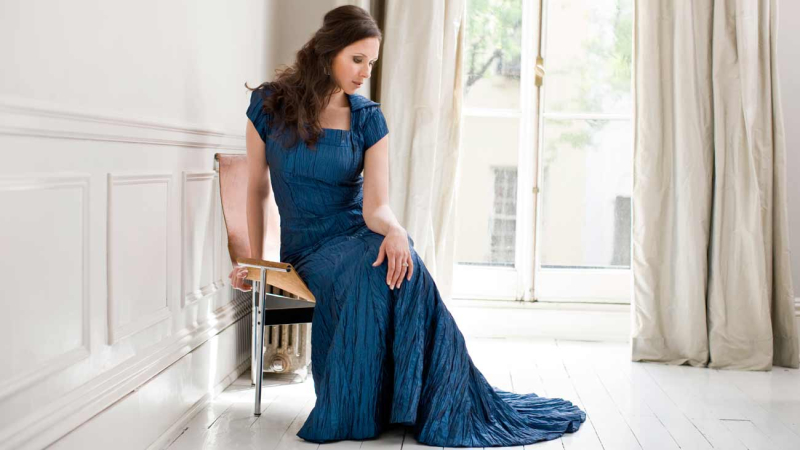
More sublime singing this afternoon came from mezzo-soprano Tamara Mumford (above, in a Dario Acosta portrait) in the role of The Pilgrim. Patiently plying her small boat across the stage, Tamara looked out at us with far-questing eyes. She’s clad in neutral garb, a messenger with a masculine aura; but there’s no question that the voice is anything but intrinsically female. And what a voice it is! As with every note I have heard from this superb singer since she first came onto the scene, Ms. Mumford’s house-filling and lustrous tone, evenness of range, and pliantly expressive phrasing combined to imbue her performance with a marvelous glow.
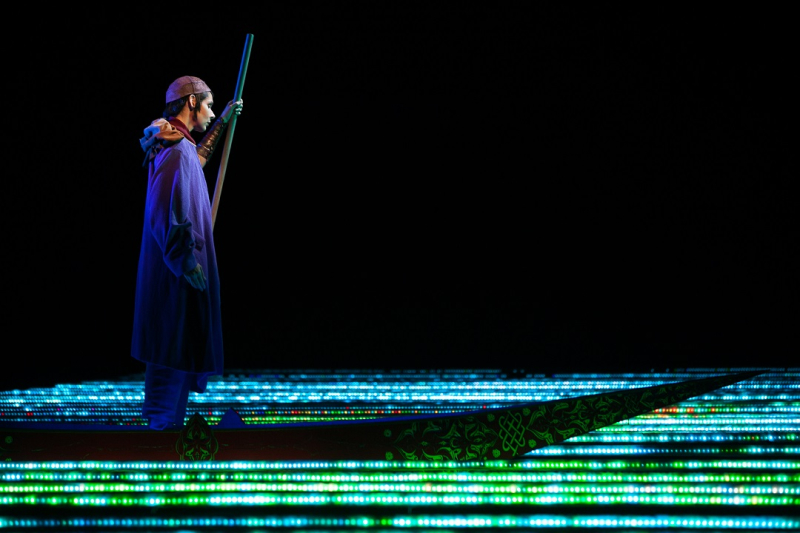
Above: Tamara Mumford as The Pilgrim
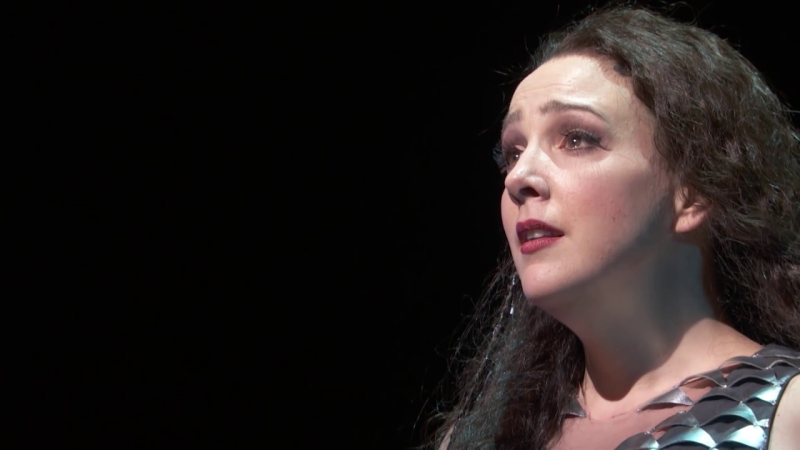
Above: Susanna Phillips as Clémence, Countess of Tripoli. In this role, Ms. Phillips had her finest Met success to date. A beautiful young woman, she well-captured the initial reserve and ultimate passion of the poet’s muse. Traces of stridency marked some of her uppermost notes, but overall the soprano coped impressively with the demands of the role, creating a lyrical atmosphere with her clear phrasing and sense of dynamics. And she looked so lovely, gazing out across the sea to her lover from afar.
Robert Lepage’s infatuation with machinery – which gave us the clunky, cumbersome $20 million RING Cycle set that languishes in storage somewhere – was evident in a huge metal see-saw apparatus that swung slowly around the stage thru much of the evening. The waves of the sea were evoked by row upon row of tiny LED lights which flickered in changing colours and patterns, eventually tiring the eye. The chorus are seated beneath the waves and pop up when they are called on to sing. As the afternoon progressed, I increasingly wished The Met had imported the imaginative ENO/Cirque de Soleil production rather than this earthbound contraption. Still, I was extremely grateful to experience the opera live in any setting.
Some people complained of the opera’s longueurs; I never felt this at all, but I must say that the end of the opera was something of a disappointment. After Jaufré’s death, one wants a silence and then an evaporating orchestral postlude. Instead, Clémence has a sort of mad scene that becomes too verismo in its intensity. She expresses the same feelings, over and over, while one is always hoping each utterance is her last. There’s even some screaming. For me, this shattered the mood of all that had gone before. How much more poetic it would have been to end with Jaufré’s tender phrase: “In this moment, I have all that I desire.”
Most people seem to believe that a love for someone you’ve never met is unrealistic, and that a mutual bond is unattainable. Speaking from personal experience, I strongly disagree.









 Oberon's Glade