
Above: Katherine Crockett, photo by Matthew Murphy
Friday March 21st, 2014 – Gods and goddesses never leave us, but they do sometimes move from one sphere to another, the better to bring light to the entire universe. Tonight at City Center I watched two of the great Graham dancers of our day – Katherine Crockett and Maurizio Nardi – in their final performances as members of the Martha Graham Dance Company. (Maurizio actually bids farewell on Saturday evening, but I am unable to be there). Both of them – I hope – will come back as guests in future Graham seasons; or perhaps we will see them in different contexts in the months ahead.
This evening’s performance was brilliant in every regard: the Company danced to perfection and the two contrasting Graham works framed an Andonis Foniadakis creation to which the word ‘gorgeous’ can be most aptly applied.
Ms. Crockett, as Clytemnestra in a one-act distillation of the 1958 Graham classic, was beyond the beyond. To be tall, shapely of limb, and fair of face is all well and good, and to put these gifts at the service of art and music with such total conviction is Katherine Crockett’s great achievement. Her performance was so clear of focus and so striking in every step and gesture and expression that it seemed impossible that we might be seeing her in this role for the last time. Katherine has always seemed to me to be the incarnation of an ancient goddess, alive and speaking to us today of the luminous vitality of the feminine spirit. As the audience and her fellow dancers hailed her with flowers and waves of applause at her curtain calls, she seemed to have attained iconic status. And yet, we were to see her again in a subtle encore, wafting across the stage in an angelic white gown in MAPLE LEAF RAG, the evening’s closing work.
CLYTEMNESTRA, to a musical score by Halim El Dahm with sets by Isamu Noguchi and costumes by Ms. Graham and Helen McGehee, affords many solo-character opportunities for the Graham dancers and so we are able to bask in the power and poetry of the individual personalities in this fascinating Company. Starting at curtain-rise, Lloyd Knight as the Messenger of Death set the tone for the whole work with his natural armor of musculature set off in a flowing royal-purple skirt. Martha Graham unabashedly admired the male form, and a veritable parade of masculine marvels strode before us: Ben Schultz as the towering King Hades – armed and epically dangerous – and Abdiel Jacobsen with a handsome mixture of vulnerability and resolve as Orestes (Abdiel is having quite a season!); Maurizio Nardi’s drunken lout of an Agisthes was personified by his slender strength and Hollywood cheekbones, and Lorenzo Pagano – already a valuable asset to the Company – gave a powerful rendering of the Night Watchman’s solo. As the hapless Agamemnon, Tadej Brdnik was perfect – and, after his character’s death, Tadej reappears in high platform shoes and the ballet becomes a ghost story.
The women are equally superb, with the calculating urgency of Electra brought vividly to life by that impeccable Graham priestess, Blakeley White-McGuire. Natasha Diamond Walker (Helen of Troy), Mariya Dashkina Maddux (Iphigenia), PeiJu Chien-Pott (Cassandra) and Xiaochuan Xie (Athena) were distinctive as these mythic females, and the blessed assurance of their dancing and of their commitment augur well for the future of the Company.

Above: rehearsal image from Andonis Foniadakis’ ECHO, photo by Christopher Jones
In their quest to bring new choreography into the Graham repertoire, the Company have struck gold with Andonis Foniadakis’ ECHO. Drawing inspiration from the ancient tale of Narcissus and Echo, this work fits like a glove into the Company’s scheme of things, where myth, magic and mystery are their daily bread.
Andonis, who in 2008 brought his mind-blowing solo version of RITE OF SPRING – danced by the divine Joanna Toumpakari – to Joyce SoHo, is now becoming more widely known here in Gotham (his ballet GLORY will be seen the The Joyce this coming week, performed by Ballet du Grand Theatre Geneve…details here).
ECHO opens in silence in a foggy landscape with a shallow circular pool. It is here that the beautiful Narcissus is held captive by his own reflection. Andonis uses two of the Graham company’s handsomest men to personify the self-obsessed youth: Lloyd Mayor and Lorenzo Pagano. They are clad in long sheer skirts and the theme of self-infatuation is embodied in their constant embracing and intimate partnering. They are all but inseparable.
As the rapture of Julien Tarride’s musical score takes wing, we meet the lovely and lonely Echo, danced with flowing grace by PeiJu Chien-Pott – a dancer who this season has emerged at a stellar level. The dance swirls forward on waves of lyricism, with a time-evoking gamelan theme of particular appeal. Angelic voices from another cosmos permeate the atmosphere as the ensemble of dancers, hair down and skirts drifting as they fly swiftly about the space, come and go from the dark recesses of the stage. Tadej Brdnik, Mariya Dashkina Maddux, Lloyd Knight, Xiaochuan Xie and Ying Xin are all to be savored, and a duet passage for Natasha Diamond Walker and Ben Schultz suggested a partnership to be cultivated.
ECHO rightfully received a sustained ovation, both for the dancers and the choreographer.
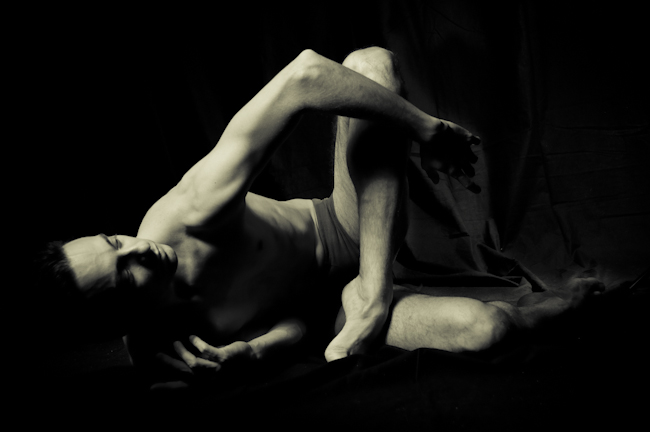
Above: Maurizio Nardi
Having my last look – for now – at Maurizio Nardi in the evening’s closing work, MAPLE LEAF RAG; Maurizio was one of the first Graham male dancers to seize my imagination when I began following the Company a few years ago. One of my regrets is never having seen him in the Graham solo LUCIFER which he has danced at galas. Perhaps an opportunity may still come. His immediate future I believe is wrapped up with Key West Modern Dance. I like to imagine him under a palm tree, sipping a cool drink after teaching class. Bon voyage, Maurizio!!
I’d never seen MAPLE LEAF RAG and it is, in a word, adorable. Adorable in two ways really: first for its wit and sparkle and second for its gentle pandering to admirers of the male physique: all the Graham hunks spend the whole ballet shirtless, in tights.
The stage is dominated by what appears to be a fusion between a ballet barre and a balance beam. The dancers will use this in myriad ways during the ballet. All wearing pastels, the eighteen dancers romp about the space to Scott Joplin tunes. Ying Xin and Lloyd Knight, in canary-yellow, are birds of a feather in their quirky, animated pas de deux. Periodically Katherine Crockett wafts across the stage, a tongue-in-cheek representation of Graham spoofing herself. Stylized Graham movement takes on a charming vibrancy here and the piece, just long enough to dazzle us without wearing out its welcome, is a great way to end the evening.
During the curtain calls, Tadej Brdnik came striding out in his Agamemnon platforms and stopped the applause to ask that we donate to Dancers Responding to AIDS on our way out. I would do anything Tadej asked of me, and so I gave them – literally – my last dollar.
So, a vastly pleasing evening in every regard with my lovely companion Roberto Villanueva, and so nice to run into Ian Spencer Bell. My thanks to Janet Eilber, Denise Vale, Andonis Foniadakis, Janet Stapleton, and all of the Graham dancers, and a champagne toast to Katherine and Maurizio. And a million roses for Martha.


 Oberon's Glade