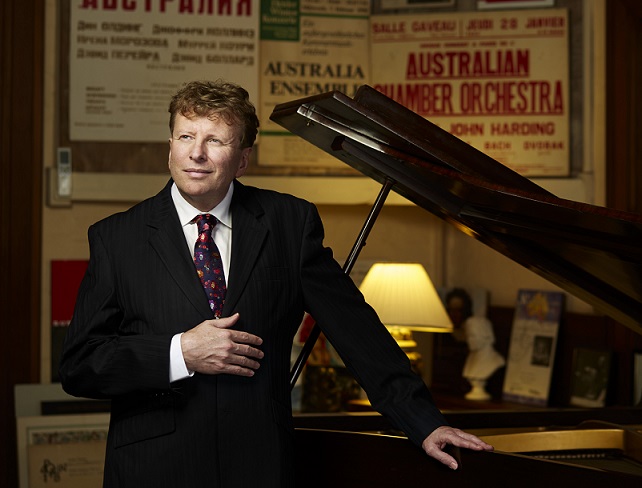
Above: pianist Piers Lane, in a Keith Saunders photo; Mr. Lane was the guest soloist in this evening’s concert at Carnegie Hall
Friday January 29th, 2016 – The Orchestra Now (TŌN) in their Carnegie Hall debut, playing works by Beethoven and his contemporaries, under the baton of Leon Botstein. Piers Lane was the soloist in Ferdinand Ries’ piano concerto #8, having its New York premiere tonight – some 190 years after it was written.
The Orchestra Now is a new orchestra, comprised of young musicians who are transitioning from conservatory to career. With the women of the orchestra all wearing dresses in shades of blue, yet each one unique, the ensemble is as appealing to the eye as to the ear.
The program was perhaps more interesting as a concept than as a musical experience: the Cherubini overture was a good choice, and the Ries piano concerto was a pleasant surprise. But the longish Reicha symphony, having its US premiere tonight, meandered forward amiably enough but seemed something of a waste of preparation time for the young musicians since it’s unlikely they’ll ever be called on to play it again.

Luigi Cherubini (above), best known for his opera Medea, was a composer greatly admired by Beethoven. Thus tonight’s program, subtitled Beethoven’s “Likes”, opened with the overture to another Cherubini opera, Les Deux Journées. This dramatic piece takes a while to gain traction, but it was well-played by the young musicians.
Anton Reicha (above), an exact contemporary and good friend of Beethoven, left us a large catalog of chamber music as well as eight symphonies, eight operas, and some large-scale choral works. As professor of counterpoint and fugue at the Paris Conservatory, Reicha numbered among his pupils Berlioz, Liszt, Gounod, and Franck.
Reicha’s 3rd symphony in F-major dates from the same year as Beethoven’s famous 5th, but that’s about the only thing they have in common. Aside from a rather nice clarinet solo in the Adagio, nothing in the Reicha really grabbed my attention. It’s an elegant work, and perfectly pleasant, but lacking in the peaks and valleys that make for a memorable symphonic experience. As Maestro Botstein remarked before he took up the baton for this work: “You’ll never hear it again!”
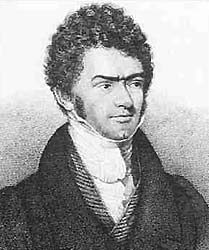
Ferdinand Ries’ piano concerto No. 8 on the other hand was a lovely discovery. In his brief remarks prior to playing the concerto, pianist Piers Lane said the music would remind us of works by several other composers but that Ries (above) has crafted it in a way very much his own. He was right!
The concerto’s manuscript bears the inscription ‘Gruss an den Rhein‘ (‘Greetings From The Rhine’) – a tribute to the river Ries he grew up near – and indeed the first movement does evoke the gentle flow of the river along its broad banks. In the Larghetto that follows, there seems to be a heralding of the Romantic age in some of Ries’ very appealing melodic and harmonic writing. The concluding Allegro molto, its mega-abundance of rapid notes brilliantly tossed off by Mr. Lane, had the infectious and vivacious charm of an opera buffa cabaletta. Throughout, the genial pianist made the strongest possible case for the concerto, winning the audience’s joyous appreciation at the end.
Sad to say, our enjoyment in experiencing this “new/old” concerto was compromised by a trio of young people who took seats in front of us as the houselights went down following intermission. They obviously had friends onstage – or perhaps they were members of the orchestra who were off-duty for the second half of the program – and they spent the entire time-span of the concerto whispering and nudging one another while the girls shared a bottle of water. We decided to leave after the concerto, our evening having been spoilt by their thoughtlessness.

 Oberon's Glade