
Above: Kirill Petrenko on the Carnegie Hall podium; photo by Chris Lee
~ Author: Ben Weaver
Wednesday March 28th, 2018 – Kirill Petrenko is finishing his term as the Generalmusikdirector of the Bavarian State Opera and in the 2019-20 season will take over as the chief conductor of the world’s most prestigious orchestra, Berlin Philharmonic. It is with the Bavarian State Opera forces (in the concert hall dubbed Bayerisches Staatsorchester) that Petrenko is making his Carnegie Hall debut this season. His only previous NYC appearances were at the Metropolitan Opera where he led a very memorable revival of Ariadne auf Naxos in 2005 and Khovanschina in 2012. For this Carnegie debut concert, Petrenko programmed two oft-forgotten works by two very famous composers: Johannes Brahms’ Double Concerto and Pyotr Tchaikovsky’s Manfred Symphony.
Brahms composed the Concerto for Violin, Cello and Orchestra, Op. 102, in 1887. It was his last orchestral composition and it was greeted coolly even by ardent supporters like Eduard Hanslick. Soon Brahms himself was dismissing it as “folly” in letters to Clara Schumann. Neglected for many years, it certainly deserves to be heard more often; it surrenders nothing to his famed violin concerto in inspiration, melody and excitement. The writing may not seem as virtuosic as the violin concerto perhaps because Brahms composed a truly double concerto. The two instruments don’t have the kind of virtuosic writing that concertos often do. The music is more of a dialogue for violin and cello – and orchestra, too. It takes a great deal of camaraderie between the two soloists and conductor to bring the pieces together. Maybe it’s the lack of true star turns for the soloists that keeps some musicians away. But when played as superbly as it was by Julia Fischer and Daniel Müller-Schott, with Maestro Petrenko on the podium, the results are breathtaking.

Above: Julia Fischer and Daniel Müller-Schott playing the Brahms Double Concerto, with Maestro Petrenko; a Chris Lee photo
The work begins with a dramatic and brief orchestral opening and immediately the cello launches into an extended solo. One of the few passages of this kind in the work, Müller-Schott immediately established himself as an artist. Rich and velvety notes poured from the instrument. Julia Fischer, a former child prodigy who has grown into a true artist of the violin, soon joined in for one of the concerto’s many extended conversations between the two instruments. Ms. Fischer’s sound is delicate and sweet, the notes rolling effortlessly from her bow. Fischer and Müller-Schott have collaborated many times over the years. Their discography together includes a lot of chamber music, as well as the Brahms concerto. Their musical partnership came across beautifully in the performance, whether playing in unison or handing off music back and forth, it’s the sort of relationship that takes time to develop. The hushed, pastoral-ish second movement was wondrous and the Bohemian inspired dances of the Finale were perfect. Maestro Petrenko and the superb Bayerisches Staatsorchester forces were excellent partners.
Ms. Fischer and Mr. Müller-Schott gave an encore: an extended virtuoso piece: Passacaglia by Johann Halvorsen. It was really great!
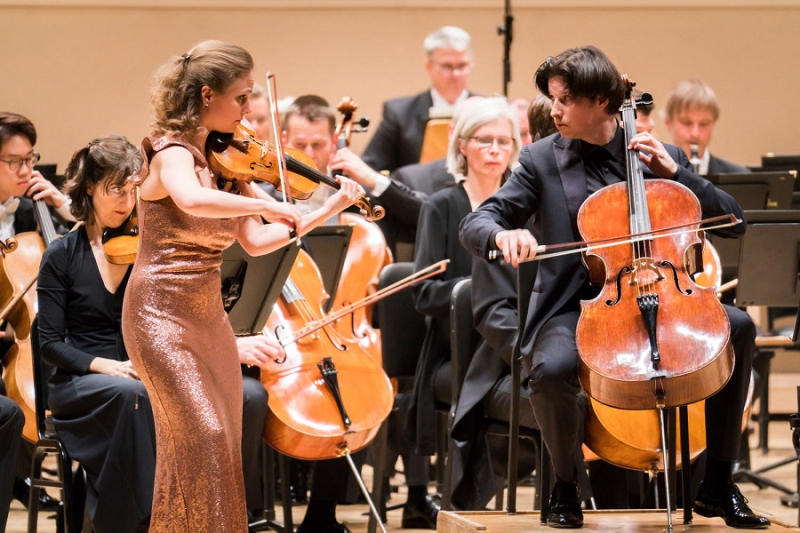
Above: Julia Fischer and Daniel Müller-Schott, photo by Chris Lee
Tchaikovsky’s largest orchestral work, the Manfred Symphony was composed in 1885, between his more famous 4th and 5th Symphonies. Inspired by Byron’s poem (Schumann composed a famous overture based on it as well), Tchaikovsky – already master of the large orchestral forces – outdid himself with sheer size of forces needed, including a harmonium (typically replaced by an organ in performances and recordings.) Initially Tchaikovsky considered it to be his finest composition, but after a mixed reception from critics and the public, in what was a common refrain of his life, turned on it and declared it awful; even considered destroying everything but the first movement. Fortunately his instinct to burn it did not come to pass because it is certainly one of his greatest works. And I often think it may be his greatest symphony.
What I find astonishing about the Manfred Symphony is the sheer amount of invention – melodic and orchestration. In some ways it reminds me of Verdi’s Falstaff. Some complain that Verdi’s last opera is lacking in melody, but it might actually contain more melodies than all of his other works combined. They simply fly by and disappear so quickly that one can fail to notice. That’s my view of Tchaikovsky’s Manfred. The melodies and brilliant orchestration can be so sudden, so novel and so brief that it’s all gone and moved on to something else entirely before you realize what you just heard. It is truly a work that demands repeated hearings.
The dark first movement depicts Manfred’s anguished wanderings in the Alps; “His life shattered…”, as the program note (by Mily Balakirev) describes. With halting phrases, Tchaikovsky depicts a peaceful pastoral one moment, Manfred’s pain the next. The explosive climax – one of Tchaikovsky’s most beautiful melodies – is hair-raising. I often hear it as a perfect musical accompaniment to the moment in Wuthering Heights where Heathcliff is found dead in Catherine’s room, thunder and lightning blaring outside. The two middle movements are, by contrast, blasts of light. The light fairy music of the Scherzo (in the program a fairy of the Alps appears to Manfred splashing in a waterfall) would have pleased Mendelssohn, I think. The slow third movement presents a portrait of a peaceful nature, something Beethoven would have recognized perhaps. And in the final movement, again a darkness descends. The music swirls and growls as Manfred visits the caves of Arimanes. And the anguished love theme from the first movement returns to signal Manfred’s death – greeted with an organ playing a hymn.
The forces of the Bayerisches Staatsorchester played the work superbly. Kirill Petrenko led an all-around thrilling performance, goading the players to play bigger and louder (I was reminded of the famous story of Richard Strauss rehearsing Elektra and yelling to the players: “Louder, louder! I can still hear Madam Schumann-Heink!”) But effortlessly bringing volume and emotion down to a whisper when needed as well. Though Manfred has long been neglected (many complete recorded cycles of Tchaikovsky’s symphonies do not include it), over the past few years it has been heard in NYC several times. New York Philharmonic played it with Semyon Bychkov (one of Petrenko’s mentors) and Vienna Philharmonic played it at Carnegie with Valery Gergiev. Perhaps Maestro Bychkov’s performance was bigger. The NY Philharmonic’s heavier sound might account for the bigger bombast. Bayerisches Staatsorchester has a leaner, more pointed sound overall. It provided greater transparency in the more heavily orchestrated parts (and there are many.) Personal tastes will vary on the preferred sound. But no doubt Kirill Petrenko led a superb night of music-making. His future with the Berlin Philharmonic is very exciting.

Above: Kirill Petrenko and the musicians of the Bayerisches Staatsorchester acknowledge the applause at the close of this evening’s concert; photo by Chris Lee
~ Ben Weaver
 Oberon's Glade